From "National Shrimp Farming" to the Intelligent Economy: The 2026 Hong Kong Web3 Carnival AI x Web3 Summit Agenda Unveiled!

marsbitPubblicato 2026-04-08Pubblicato ultima volta 2026-04-08

Introduzione

The 2026 Hong Kong Web3 Carnival will host a pivotal forum titled "Web3×AI: Value Reconstruction in the Intelligent Era" on the afternoon of April 20. This event brings together global pioneers in AI and Web3 to explore the deep integration of these transformative technologies. Discussions will cover topics ranging from Silicon Valley’s innovative uses of AI lobsters to practical implementation of AI and Web3 beyond the lab. Industry leaders from TON Foundation, Qtum, Cobo, MaxQuant, and Anoma will share insights on security, financial applications, and decentralized AI ecosystems. Key roundtables will address critical questions: Does AI truly need Web3? Experts will debate issues like data privacy, decentralized computing, and value attribution. Another session will focus on AI Agents and the future of human-computer interaction, examining how agentic AI could reshape industries by moving beyond traditional interfaces. This forum aims to cut through the hype and provide actionable insights into how AI and Web3 can move from technological overlap to symbiotic value creation.

The explosive popularity of OpenClaw has ignited a "national shrimp farming" trend. When the "intelligent emergence" of artificial intelligence meets the "trust machine" of Web3 head-on, what we are ushering in is far more than just a technological overlay—it is a profound revolution in value creation, distribution, and revaluation. When AI Agents make interfaces "disappear," what is the ultimate form of human-computer interaction? Does AI really need Web3?

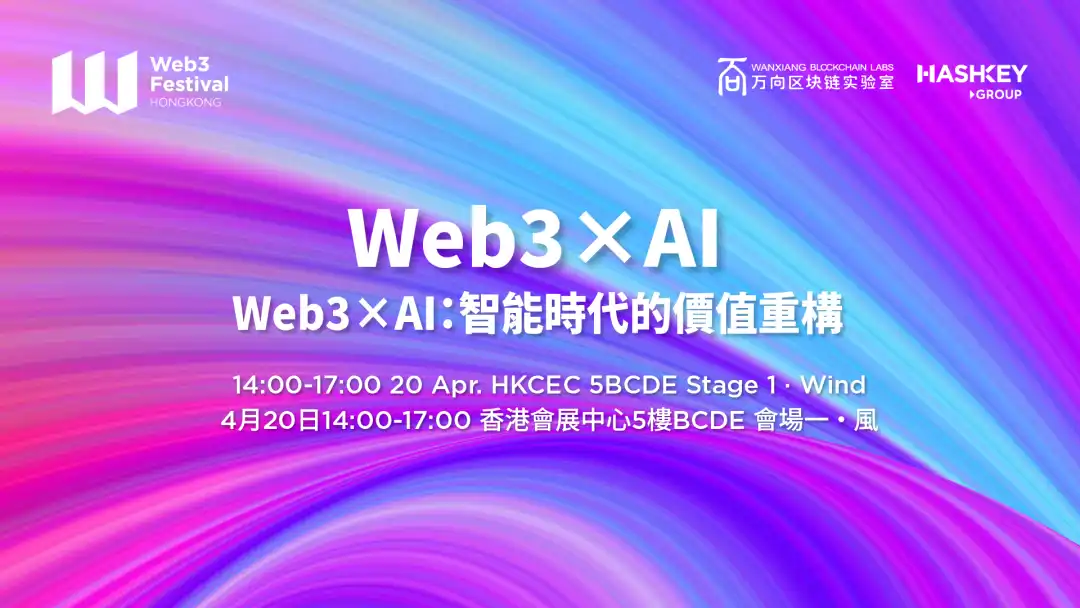
On the afternoon of April 20th, Venue 1·Feng at the 2026 Hong Kong Web3 Carnival will host the "Web3 x AI: Value Reconstruction in the Intelligent Era" thematic forum. It will bring together pioneering forces from the global AI and Web3 fields, from the "lobster secrets" at the Silicon Valley frontier to the underlying logic of enterprise practice, from practical experience in security collaboration to future previews of human-machine symbiosis. It will provide in-depth analysis and forward-looking insights, exploring the new possibilities of Web3 and AI integration in the intelligent era.

Silicon Valley AI tech blogger Lang Hanwei will reveal what Silicon Valley is using lobsters for, decoding the wildest cutting-edge trends overseas from a unique tech blogger's perspective. John, Head of Asia-Pacific at TON Foundation, will share innovative explorations of TON ecosystem and AI collaboration. Qtum Co-founder Miguel Palencia will break down how to drive AI and Web3 from the "lab" to the "application field," building efficient and collaborative technical bridges for developers and enterprises.

Cobo Co-founder and CTO Changhao Jiang, based on practical experience, will thoroughly explain the collaboration between Web3 security and AI, safeguarding the steady progress of the integrated ecosystem. MaxQuant CEO Jeffery Zeng will focus on the innovative application of AI technology in asset analysis and risk control, showcasing the new value of finance and technology integration. Anoma Co-founder Adrian Brink will also explore the future blueprint of AI and Web3 symbiosis, leading the decentralized ecosystem to new intelligent heights.

In addition to keynote speeches that address core issues, high-quality roundtable discussions will bring together industry elites to discuss the central topics of current AI and Web3 integration.

On one side is AI's centralized reliance on data, computing power, and models; on the other is Web3's pursuit of decentralization, privacy, and rights confirmation. Are the two naturally complementary, or is it a "forced match"? Hosted by Gen Labs Limited CEO He Xiaoyang, alongside guests including Keywolf, Partner and Product Head of SlowMist, and Michael Yung, Strategic Advisor at Google Cloud, the roundtable discussion "Does AI Really Need Web3?" will take place. From data privacy and decentralized computing power to value rights, it will dissect the complementary space between AI and Web3, explore possible paths from "technological overlay" to "value symbiosis," and interpret the new changes in Web3 security in the AI era.

As AI Agents rapidly penetrate various industries, human-computer interaction is undergoing a revolution of "disappearing interfaces." From the "you-click, I-search" GUI, to the "you-say, I-do" conversational interface, and further to the "you-think, I-act" autonomous Agent, what exactly does the ultimate form of human-computer interaction look like? Guests including Zolo Xiong, Co-founder of Deep Chao TechFlow, KK, COO of Virtuals Protocol, Cindy Shi, CMO of Kite AI, and Bob, CEO of Questflow, will discuss topics such as the autonomy of AI Agents, user incentives, and experience. They will break down how AI Agents are breaking the boundaries of traditional human-computer interaction and reconstructing new paradigms for production, life, and industrial operations.

Value reconstruction in the intelligent era does not wait for bystanders; the best opportunities are always reserved for those who are present. This time, stand shoulder-to-shoulder with top global tech guests, penetrate the fog of technology, decode the core secrets of Web3 and AI integration, and jointly discover new possibilities for value in the intelligent era.


Domande pertinenti

QWhat is the main theme of the 'Web3×AI: Value Reconstruction in the Intelligent Era' forum at the 2026 Hong Kong Web3 Festival?

AThe forum focuses on the convergence of AI and Web3 technologies, exploring how their integration can revolutionize value creation, distribution, and re-evaluation, featuring discussions on AI agents, decentralized ecosystems, security, and practical applications.

QWhich speakers will discuss the practical implementation of AI and Web3 technologies moving from 'laboratory to application field'?

AMiguel Palencia, Co-founder of Qtum, will address how to drive AI and Web3 from the 'laboratory' to the 'application field,' building efficient technical bridges for developers and enterprises.

QWhat specific topic will Changhao Jiang, CTO of Cobo, cover regarding AI and Web3 integration?

AChanghao Jiang will share practical experiences on the synergy between Web3 security and AI, focusing on safeguarding the robust development of the integrated ecosystem.

QWhat is the central debate question in the roundtable discussion 'Does AI Really Need Web3?'

AThe roundtable debates whether AI's centralized reliance on data, computing power, and models is naturally complementary or fundamentally incompatible with Web3's pursuit of decentralization, privacy, and value attribution.

QHow will the panel on AI Agents address the evolution of human-computer interaction?

AThe panel, featuring experts like Zolo Xiong and KK, will discuss how AI Agents are transforming interaction from GUI to conversational interfaces and autonomous agents, breaking traditional boundaries and reshaping paradigms in production and daily life.

Letture associate

Winter for Crypto IPOs: Consensys and Ledger Withdraw Applications

The crypto IPO window is tightening significantly in 2026, marked by prominent companies delaying or pausing their public listing plans. Following a successful 2025 "harvest year" that saw Circle, Bullish, and Gemini go public amidst a bull market, the tide has turned. Consensys, developer of MetaMask, recently postponed its IPO until at least fall 2026. Hardware wallet leader Ledger also suspended its planned US listing due to unfavorable market conditions, with Kraken having previously delayed its own plans. This shift is driven by a cooling market in 2026, characterized by a significant Bitcoin price correction, declining trading volumes, and reduced investor risk appetite for crypto stocks. The poor post-IPO performance of 2025 listings like Circle and Bullish, which saw major share price declines, has heightened investor caution. This contrasts sharply with the current AI sector, where companies like SpaceX, OpenAI, and Anthropic are commanding massive valuations and investor enthusiasm based on narratives of stable, exponential growth. Crypto companies now face pressure to transition from hype-driven models to demonstrating reliable cash flows and robust compliance. While the paused IPO plans may lead to valuation resets and affect ecosystem liquidity, they also accelerate industry consolidation toward stronger, more compliant infrastructure players. A potential recovery in Bitcoin's price and clearer regulations could reopen the IPO window in the latter half of 2026.

marsbit2 h fa

Winter for Crypto IPOs: Consensys and Ledger Withdraw Applications

marsbit2 h fa

ChatGPT Can Manage Your Money for You. Would You Trust It with Your Bank Account?

OpenAI has launched a personal finance tool for ChatGPT, currently in preview for US-based ChatGPT Pro users. This feature allows users to connect their bank and investment accounts (via Plaid, supporting over 12,000 institutions) directly to ChatGPT. It analyzes transactions, generates visual dashboards, and offers conversational financial advice—such as budgeting or planning for major purchases—based on the user's actual data. This move follows OpenAI's acquisitions of fintech startups Roi and Hiro Finance, signaling a strategic push into vertical "super assistant" applications, similar to its earlier health-focused feature. However, the launch has sparked significant privacy concerns. Critics question the safety of granting such sensitive financial access to an AI, especially amid ongoing lawsuits alleging OpenAI shared user chat data with third parties like Meta and Google. OpenAI emphasizes that ChatGPT only reads data (no transaction capabilities), deletes it within 30 days if disconnected, and offers opt-out options for model training. Yet, trust remains a major hurdle. The trend reflects a broader industry shift: AI companies like Anthropic and Perplexity are also targeting high-value, data-rich domains like finance and health. While technically promising, the tool operates in a regulatory gray area—it provides personalized guidance but disclaims formal financial advice or liability. Ultimately, OpenAI's challenge is convincing users to trust an AI with their most private financial information.

marsbit2 h fa

ChatGPT Can Manage Your Money for You. Would You Trust It with Your Bank Account?

marsbit2 h fa

Trading

Spot
Futures
活动图片