From Identity Protocol to AI Gateway: How Ambitious Is World?

marsbitPubblicato 2026-06-16Pubblicato ultima volta 2026-06-16

Introduzione

The article discusses Worldcoin's (WLD) evolution from a "proof of personhood" network to a potential identity infrastructure for the AI era. Initially focused on unique digital identities via iris scans, Worldcoin faced skepticism over real-world use cases. However, entering "The Simple Plan" Phase 3, it's shifting from token incentives to utility-driven growth. Key applications are emerging: enterprise solutions (e.g., deepfake verification with Zoom, Okta), consumer use cases (e.g., reducing bots on Tinder or in ticket sales), and notably, the AI Agent sector via AgentKit, which aims to establish trusted authorization between humans and AI agents. The author argues AI's proliferation makes authentic human identity a scarce and valuable resource. Worldcoin's strategy is now focused on key markets for network effects and developing self-service Orb hardware to scale sustainably. The launch of World ID 4.0 introduces a fee model for issuers/protocols, creating a potential revenue stream. In conclusion, WLD's rise reflects a market reassessment. Worldcoin's ambition is to become the foundational identity layer and crucial entry point for the coming AI Agent economy, moving crypto narratives beyond finance into verifiable human identity.

Author:Flora,CryptoPulse Labs

Recently, in the cryptocurrency market, WLD has become one of the focal points of market attention. Market data shows that WLD has continued to rise, breaking through $0.6, with a total market capitalization exceeding $3 billion.

The main driver behind the warming market sentiment is World's announcement that it has officially entered the third stage of "The Simple Plan," shifting its growth logic from early-stage token incentives to utility-driven mechanisms. Therefore, the question worth considering now is: is World truly evolving into a critical piece of infrastructure for the AI era?

一、From Iris Scanning to Real-World Application: World Enters a New Phase

From its inception, World's core objective has been unequivocally clear: to build a global "proof-of-personhood" network.

Simply put, it aims to address an increasingly critical problem in the internet world: how to prove you are a real human being, not a bot, script, or AI-generated identity.
In the past few years, this problem seemed distant. However, with the explosion of generative AI, it is rapidly becoming a real-world necessity. Today, AI can generate highly realistic images, videos, and audio, even operate social media accounts in bulk and execute complex tasks autonomously.

In the future, a significant portion of active users on the internet may not be real people but rather AI Agents. Against this backdrop, verifying that the entity on the other end is human is becoming a fundamental issue for the internet.

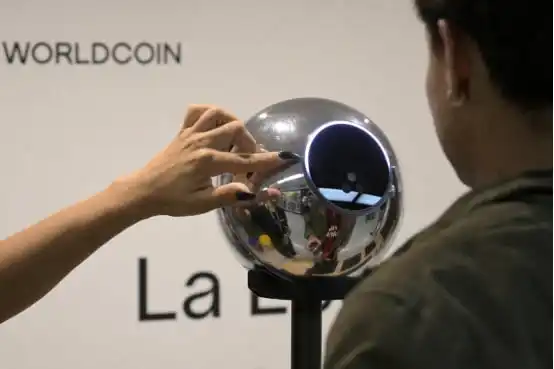
This is precisely the market World aims to capture. Its core product, World ID, uses the Orb device to scan a user's iris, generating a unique digital identity credential for each individual. This system attempts to achieve a "one person, one ID" principle, verifying authenticity while protecting user privacy as much as possible, and supporting on-chain calls.

Previously, the biggest market skepticism towards World was that, while the identity system held great imaginative potential, it consistently lacked real-world use cases. However, as it enters the third stage, this is changing. World has explicitly stated it will promote adoption across three main directions: enterprise, individual users, and AI Agents.

On the enterprise front, World is collaborating with companies like Zoom, Okta, and DocuSign to launch identity verification products targeting deepfake issues. As AI scams and deepfake attacks become more common, the demand for real-person verification is rising rapidly. Whether for video conferencing, remote work, or electronic signing, verifying identity authenticity is becoming crucial.

On the individual user front, World is targeting higher-frequency pain points on the internet. For example, Tinder could use World ID to verify if a user is a real person, and the Concert Kit for ticket purchases could reduce bot scalping and ticket touting.

This means World is attempting to solve the long-standing internet industry problems of fake accounts and bot traffic.

The most noteworthy aspect is the AI Agent front. World has launched AgentKit, aiming to establish a trusted authorization relationship between humans and AI. In the future, if everyone has their own AI assistant, these Agents might help users manage assets, execute transactions, sign agreements, or even participate in on-chain governance.

But before that, the system must be able to verify whom an AI represents and whether it has obtained authorization from a real human. The value of AgentKit lies in establishing a foundational trust framework for the future AI economy.

二、The AI Era: "Real Human Identity" is Becoming Scarce

The core reason for WLD's price increase isn't merely news-driven hype but the market beginning to reprice the scarcity value of "real human identity."

Over the past few years, numerous identity-focused projects have emerged in the crypto market, but most struggled to sustain themselves, fundamentally due to insufficient demand. While traditional internet had identity verification needs, it wasn't enough to support a massive, independent sector. However, the arrival of the AI era has completely changed this logic.

When the cost of generating AI content approaches zero, the truly scarce resource becomes human beings themselves. In the past, the internet's most important resources were traffic, content, and attention. In the future, scarcer resources might be real human identity, real human behavior, and real human authorization.

The reason is simple. AI can infinitely replicate text, images, audio, and even video, but it cannot naturally possess an independent human identity. This means that in the future internet, real humans could become an increasingly scarce resource. Whoever can verify a "real person" holds the key gateway.

This is also why the market is beginning to reassess World's long-term value. It is no longer betting on just a crypto narrative but on a crucial infrastructure need for the AI era.

Simultaneously, World's operational strategy has undergone a significant shift. The team announced it will concentrate resources on a few high-density, high-value cities, including San Francisco, New York, as well as regions like the UK, Germany, Japan, and South Korea, while scaling back operations in non-priority areas. This indicates the team is no longer pursuing widespread expansion but prioritizing establishing network effects in high-value markets first.

The business logic behind this strategy is clear. The value of an identity system inherently comes from network effects. Only when a region has enough users, enterprises, and application scenarios can the true value of World ID be realized. Otherwise, even with user growth, it's difficult to form a stable value loop.

Another key change is hardware upgrades. The next-generation Orb will move towards self-service, aiming to achieve 95% autonomous operation by the end of 2026. This is crucial.

Previously, the bottleneck in Orb expansion was the high labor cost, requiring offline operational support for each additional user. Once the device can achieve large-scale self-service operation, customer acquisition and expansion costs will significantly decrease, making the business model healthier.

三、The AI Agent Era: World Could Become a Key Gateway

From a broader perspective, World's advancement could have profound implications for the crypto industry.

First, it could drive the crypto narrative further from finance into identity. In the past, market discussions about Crypto primarily revolved around DeFi, stablecoins, ETFs, and RWA, essentially financial logic. But World represents another path: identity infrastructure.
In the future, identity itself could become a composable asset. Users with a trusted identity might gain access to airdrops, credit scores, governance rights, and even AI usage permissions.

Around the identity layer, new market sectors could emerge, such as identity protocols, human credit protocols, and AI authorization protocols.

Second, World could become important infrastructure for the AI Agent economy. If AI Agents truly become the next generation of productivity tools, the entire industry must solve three problems: who does the Agent belong to, is the Agent trustworthy, and is the Agent verifiable. World is addressing these three core needs.

From this angle, World's ambition isn't merely to be a crypto project but to become the identity gateway for the AI era. Just as Google became the gateway for information and Meta for social interaction, World aims to become the gateway for identity. If this positioning holds, the valuation logic for WLD would be fundamentally reconstructed.

Finally, the market's most pressing concern remains: how does WLD capture value? This is also a significant change brought by World ID 4.0. The new protocol introduces a fee mechanism, allowing credential issuers and the protocol to charge users (the service consumers), while end-users can still use it for free.

The significance of this model is that it gives World a real source of revenue. Users use the protocol for free, while ecosystem participants pay, which is highly similar to the business model of internet platforms.

As the number of identity verifications increases, enterprise adoption scales up, and protocol call frequency rises, the entire network has the potential to generate sustainable cash flow.

For the market, this might be the most crucial change, as it means World is no longer just telling a future story but beginning to establish a verifiable business model and value capture path.

Conclusion

WLD's price rise appears, on the surface, to be a recovery in market sentiment. At a deeper level, it reflects a shift in market perception. World's true bet isn't on short-term token price, but on the most fundamental question of the AI era: how to prove you are human.

As AI becomes more human-like, the value of a real human's identity will likely continue to appreciate. And whoever masters the proof-of-personhood network might control a key gateway to the next-generation internet. For World, this might just be the beginning.

Crypto di tendenza

Domande pertinenti

QWhat is the core goal of World, according to the article?

AAccording to the article, World's core goal is to build a global 'proof of personhood' network, aimed at solving the critical internet problem of verifying that a user is a real human and not a bot, script, or AI-generated identity.

QWhat are the three key directions World is pushing for adoption in its third stage 'The Simple Plan'?

AIn the third stage of 'The Simple Plan,' World is pushing for adoption in three key directions: the enterprise side (e.g., partnerships with Zoom, Okta for deepfake verification), the individual user side (e.g., verifying real users on Tinder, preventing bots in ticket sales), and the AI Agent side (providing a trusted authorization framework between humans and AI via AgentKit).

QWhy does the article suggest that 'real human identity' is becoming a scarce resource in the AI era?

AThe article suggests that as the cost of AI-generated content approaches zero, what becomes truly scarce are genuine human identity, human behavior, and human authorization. AI can replicate content infinitely but cannot inherently possess an independent human identity, making verified human presence a critical and increasingly scarce resource on the future internet.

QWhat significant change does the introduction of World ID 4.0 protocol bring regarding value capture?

AThe introduction of the World ID 4.0 protocol brings a fee mechanism that allows credential issuers and the protocol to charge usage fees from parties utilizing the service, while end-users can still use it for free. This change provides World with a potential real revenue stream, moving towards a verifiable business model similar to internet platforms.

QWhat broader impact might World's development have on the cryptocurrency industry, as mentioned in the article?

AThe article mentions that World's development could expand the crypto narrative from primarily finance to include identity infrastructure. It could make identity a composable asset and establish itself as crucial infrastructure for the AI Agent economy. Furthermore, by aiming to become the 'identity gateway' for the AI era, it could fundamentally reshape valuation logic for projects like WLD.

Letture associate

Conversation with Co-founder of Hyperdash: Why is Hyperliquid Still Severely Undervalued?

Interview Summary with Hanson Birringer, Co-founder of Hyperdash: Why Hyperliquid Remains Undervalued In an interview on *The Rollup*, Hanson Birringer, Co-founder and Chief Revenue Officer of Hyperdash—a trading data analytics platform for Hyperliquid—shared his investment thesis on the Hyperliquid ecosystem. He described Hyperliquid as a pure play on three key crypto super-trends: perpetual contracts, real-world assets (RWAs), and stablecoins. The platform is an open-source, decentralized, and high-performance financial system uniquely positioned to bridge traditional institutional capital with decentralized finance. Birringer highlighted Hyperliquid's leadership in perpetual DEX trading and its recent innovation of RWA perpetual contracts. He emphasized the significance of USDC becoming a core quoting asset, which, by allocating 90% of its backend yield from assets like US treasuries to a protocol buyback fund, creates substantial, programmatic buy pressure for the Hype token. He addressed regulatory challenges, noting that Hyperliquid's policy team is actively engaging with US regulators like the CFTC to establish clear rules for decentralized venues. Once achieved, regulated brokers could route orders directly to Hyperliquid's backend, tapping into its low-cost liquidity layer. Regarding revenue, Birringer was optimistic, citing the immense size of traditional financial markets. Even capturing a small fraction of global trading volume in products like RWA perpetuals could lead to exponential growth for the protocol. The recently launched Grayscale Hyperliquid ETF, seeded by their SPV (Hyper Holdings Global), provides a compliant on-ramp for institutional investors drawn to the clear "cash flow + token buyback" model. Finally, he discussed Hyperdash's acquisition of Imperator, enhancing its data and node infrastructure to serve both retail traders and traditional asset managers. His bullish case rests on Hyperliquid's potential to provide unprecedented global access to dollar-based capital markets. He struggled to articulate a bear case, seeing the long-term trends of internet adoption and financial inclusion as powerful tailwinds.

marsbit47 min fa

Conversation with Co-founder of Hyperdash: Why is Hyperliquid Still Severely Undervalued?

marsbit47 min fa

DeepSeek V4 'Full-Blooded Edition' Leaked, Could Be Released As Early As Tomorrow

The highly anticipated full release of DeepSeek V4 is imminent, expected to launch as early as tomorrow after nearly three months of waiting. A select group has already received access to the GA (General Availability) beta, which includes two versions: DeepSeek V4 Flash and DeepSeek V4 Pro. Early testers report that V4's overall performance is close to the level of Opus 4.8, with coding capabilities rivaling GPT-5.6 Sol. Its agent abilities are significantly enhanced, and 3D/SVG generation has improved notably. While it may not surpass the recently released Kimi K3 in performance, its expected price point is significantly lower. The official release will introduce a new "peak/off-peak" pricing model for its API. For example, deepseek-v4-pro will cost $0.87 per million output tokens during standard times and $1.74 during peak hours. The flash version is even more aggressive at $0.28/$0.56 per million tokens, with cached input tokens priced extremely low at $0.0028. This makes V4 a strong contender in terms of cost-effectiveness, potentially offering Opus-level capabilities at a fraction of the cost, continuing DeepSeek's reputation as a "price disruptor" in the AI market. Initial demos showcasing V4's capabilities have begun circulating, including generated 3D simulation games, HTML games blending elements of Minecraft and No Man's Sky, and classic games like a "Cut the Rope" clone. The final GA version is set to replace the older deepseek-chat and deepseek-reasoner models, which will be retired on July 24th.

marsbit56 min fa

DeepSeek V4 'Full-Blooded Edition' Leaked, Could Be Released As Early As Tomorrow

marsbit56 min fa

WEEX Labs Weekly Observation: The 'Power Restructuring' of AI Infrastructure and the 'Deep Dive Movement' into the Real Economy

WEEX Labs Weekly Review: AI Infrastructure's "Power Restructuring" and the "Deep Dive" into the Real Economy Mid-July 2026 marks a pivotal shift in the global AI industry. The allocation of computing power is transferring from cloud giants to compute resource owners, while the core value of AI is solidifying around its penetration into physical industry, moving beyond the race for model parameters. The era of fragmented model development is over, replaced by a capital-intensive, integrated chain driven by hard tech. Key developments this week include Meta's planned entry into the cloud computing market with "MetaCompute." This move by social media giants with massive GPU clusters challenges traditional cloud providers like AWS, integrating compute, models, and data into one-stop services, which will squeeze smaller rental providers and shift enterprise focus towards underlying model ecosystems. Chinese foundational models like DeepSeek-V4 and Tencent's Hy-3 are pushing towards "utility" status through open-source releases and extreme cost reductions via MoE architectures. This lowers entry barriers for enterprises, allowing them to focus resources on private deployment and deep business integration. Embodied intelligence, particularly humanoid robots, is transitioning from lab demos to real-world factory applications, driven by policies promoting large-scale, practical deployment in logistics and manufacturing. The value focus is shifting from spectacle to stable industrial data and real operational efficiency. Global governance, through forums like WAIC, is evolving from theoretical ethics to practical operational frameworks for "Sovereign AI," raising geopolitical compliance barriers and making auditability and data sovereignty core design requirements from the outset. WEEX Labs Insights: The current transformation shows AI's prosperity is deeply embedding into the fabric of global manufacturing. Strategic recommendations include: 1) leveraging open-source models for private, proprietary knowledge bases; 2) maintaining cloud provider diversity to avoid vendor lock-in from integrated model ecosystems; and 3) seeking opportunities in the "embodied infrastructure" supporting robots, such as data collection, industrial simulation, and factory AI adaptation services.

marsbit1 h fa

WEEX Labs Weekly Observation: The 'Power Restructuring' of AI Infrastructure and the 'Deep Dive Movement' into the Real Economy

marsbit1 h fa

Is WEEX TradFi Reliable? What You Should Know Before Your First Trade of U.S. Stock Tokens

In recent years, cryptocurrency users have expanded their focus beyond Bitcoin and Ethereum to include popular traditional financial (TradFi) assets like Nvidia, Apple, and Tesla stocks. This shift raises key questions: What do these TradFi assets represent on crypto trading platforms? How do they differ from traditional stock ownership? And how can users assess the reliability of platforms offering such products? TradFi products, such as those offered by WEEX TradFi (including NVDA, MSFT, AAPL, TSLA, and QQQ tokens), are blurring the lines between crypto and traditional markets. They allow users to trade based on the price movements of traditional assets within a familiar digital asset trading environment. However, it's crucial to understand that trading a "stock token" is not equivalent to owning the actual stock. Users are participating in price speculation, not gaining shareholder rights like dividends or voting. A key feature of these products is 7x24 trading, offering flexibility beyond traditional market hours. While convenient, this also introduces unique risks, such as potential liquidity gaps and volatility when underlying markets are closed. For users evaluating TradFi products, reliability hinges on transparency and risk management. Critical factors include understanding the product mechanism, how prices track the underlying assets, and the associated risks—especially when using leverage. Popular stocks and indices are still subject to company performance, macroeconomic shifts, and sector trends. Ultimately, TradFi represents a new gateway connecting crypto users to global markets. The future points toward integrated trading environments where the distinction between "crypto investor" and "traditional investor" fades. For newcomers, a platform's reliability stems not from promises, but from a clear understanding of the product, a comprehensive view of risks, and informed judgment of the platform's capabilities.

marsbit1 h fa

Is WEEX TradFi Reliable? What You Should Know Before Your First Trade of U.S. Stock Tokens

marsbit1 h fa

Trading

Spot

Articoli Popolari

Come comprare WLD

Benvenuto in HTX.com! Abbiamo reso l'acquisto di Worldcoin (WLD) semplice e conveniente. Segui la nostra guida passo passo per intraprendere il tuo viaggio nel mondo delle criptovalute.Step 1: Crea il tuo Account HTXUsa la tua email o numero di telefono per registrarti il tuo account gratuito su HTX. Vivi un'esperienza facile e sblocca tutte le funzionalità,Crea il mio accountStep 2: Vai in Acquista crypto e seleziona il tuo metodo di pagamentoCarta di credito/debito: utilizza la tua Visa o Mastercard per acquistare immediatamente WorldcoinWLD.Bilancio: Usa i fondi dal bilancio del tuo account HTX per fare trading senza problemi.Terze parti: abbiamo aggiunto metodi di pagamento molto utilizzati come Google Pay e Apple Pay per maggiore comodità.P2P: Fai trading direttamente con altri utenti HTX.Over-the-Counter (OTC): Offriamo servizi su misura e tassi di cambio competitivi per i trader.Step 3: Conserva Worldcoin (WLD)Dopo aver acquistato Worldcoin (WLD), conserva nel tuo account HTX. In alternativa, puoi inviare tramite trasferimento blockchain o scambiare per altre criptovalute.Step 4: Scambia Worldcoin (WLD)Scambia facilmente Worldcoin (WLD) nel mercato spot di HTX. Accedi al tuo account, seleziona la tua coppia di trading, esegui le tue operazioni e monitora in tempo reale. Offriamo un'esperienza user-friendly sia per chi ha appena iniziato che per i trader più esperti.

191 Totale visualizzazioniPubblicato il 2024.12.11Aggiornato il 2026.06.02

Come comprare WLD

Discussioni

Benvenuto nella Community HTX. Qui puoi rimanere informato sugli ultimi sviluppi della piattaforma e accedere ad approfondimenti esperti sul mercato. Le opinioni degli utenti sul prezzo di WLD WLD sono presentate come di seguito.

活动图片