From Hunyuan to WeChat AI: Tencent's Slow Paced Journey Reaches the Delivery Juncture

marsbitPubblicato 2026-06-08Pubblicato ultima volta 2026-06-08

Introduzione

On June 8, 2026, WeChat's developer platform announced the internal testing of "WeChat AI," an AI assistant integrated into the WeChat ecosystem. It allows users to invoke, access, and operate Mini Programs through natural language conversation. The platform offers two access modes: an "Automatic Mode" where developers authorize platform access to their source code for zero-configuration AI operation, and a "Developer Mode" for building custom skills. While the name "WeChat AI" is provisional, this marks WeChat's first step in opening its vast Mini Program ecosystem—comprising over 400,000 developers and hundreds of millions of daily active users—to AI-driven conversational interaction. This move represents the latest step in Tencent's deliberate AI strategy, moving from technical R&D and standalone product validation to integration within its super-app. The underlying foundation is Tencent's self-developed Hunyuan large language model. Ranked first domestically in application-oriented capabilities like Agent task execution in 2025, Hunyuan's focus on stability and precision over raw parameter count aligns with WeChat AI's need for reliable, low-latency operations involving sensitive tasks like payments and bookings. Prior C-side validation came from "Yuanbao," a standalone AI app whose Monthly Active Users (MAU) surpassed 114 million during the 2026 Chinese New Year红包 campaign, though daily activity later subsided. This "pulse growth" highlighted the challenge of user rete...

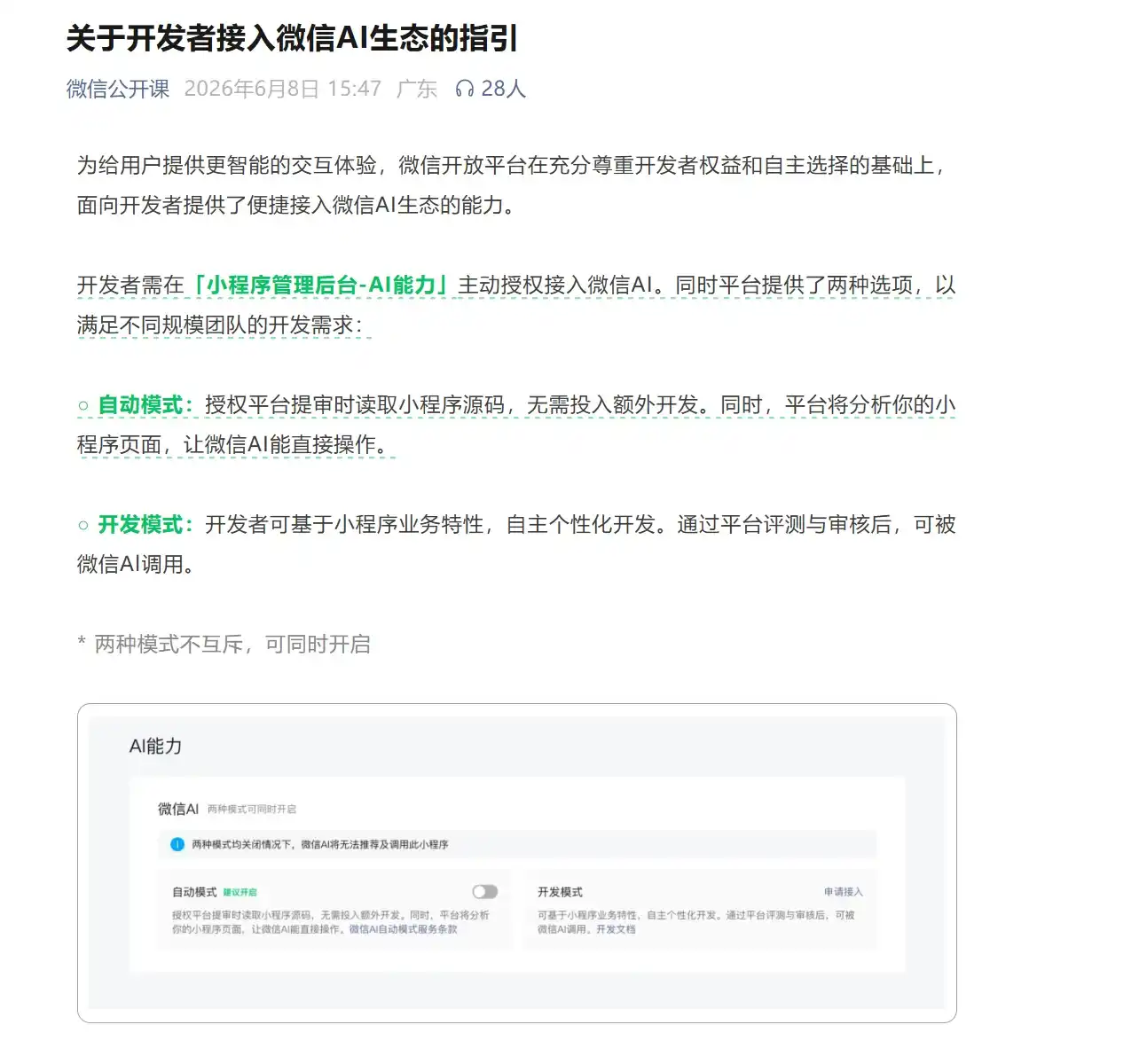
On June 8, 2026, the WeChat Developer Platform announced that WeChat AI entered its internal testing phase. This AI assistant, integrated within the WeChat ecosystem, supports users in directly invoking, accessing, and operating Mini Programs through natural language dialogues. The Open Platform offers two access modes: Automatic Mode, which allows authorized platform access to read Mini Program source code, enabling AI to directly operate pages without additional development; and Developer Mode, where developers independently build skills for AI invocation after platform review. The Terms of Service also note that 'WeChat AI' may be a temporary name, the final naming is yet to be determined, and access is optional, not affecting the normal operation of existing Mini Programs.
This marks the first time WeChat has opened its Mini Program ecosystem to AI at the conversational entry layer. The context at this time: Tencent's self-developed Hunyuan large model has joined the top tier in China in public benchmark tests; the Yuanbao App, following its explosive growth during the 2026 Spring Festival red envelope campaign, surpassed 100 million monthly active users (MAU). The WeChat AI internal test represents the latest step in Tencent's AI journey—from technology reserve and independent product validation towards delivery within a super app. The requirement for developers to hand over source code in Automatic Mode raises questions: how many developers will this low-threshold path attract, and what ecosystem interest conflicts will it encounter? These are questions to be answered during the internal testing phase.

An Opening at the Conversation Layer for the Mini Program Ecosystem

The two access modes for WeChat AI target entirely different developer groups.

The design logic of Automatic Mode is straightforward: authorize the platform to read the Mini Program source code during the review submission. The platform automatically analyzes the page structure, allowing AI to directly operate the pages without requiring additional development. A small game team with only two or three people, without needing an AI engineer or understanding Agent protocols, can simply check the authorization box. Their ordering Mini Program or tool application can then be invoked by WeChat AI.

According to data disclosed by WeChat Open Class in January 2026, the WeChat Mini Game ecosystem has gathered over 400,000 developers, 80% of whom are small teams of 30 people or fewer. The overall daily active users (DAU) exceeded 100 million in 2025, with MAU surpassing 500 million. This scale on the supply side is a unique moat for WeChat AI. ByteDance's Doubao or Alibaba's Tongyi Qianwen can create a standalone app or open APIs, but they lack a Mini Program ecosystem with over 100 million DAU to integrate directly. In essence, WeChat AI's Automatic Mode trades technical convenience for large-scale access, allowing the vast majority of the 400,000 developers to board this train at zero cost.

Developer Mode preserves customization space for service providers with complex business logic. Developers can autonomously build skills based on their business characteristics, which, after platform evaluation and review, become available for WeChat AI to call. The two modes can be enabled simultaneously and are not mutually exclusive.

The phrasing 'name undetermined' and 'optional behavior' indicates that the WeChat team still holds reservations regarding the product's positioning. The main tasks during the internal testing phase are to verify the technical pipeline and observe developer reactions. However, Automatic Mode has already touched upon a sensitive point: source code authorization. Some developers have expressed concerns in the WeChat Open Community, with core questions focusing on several aspects—how the platform guarantees code asset security after reading the source code; whether AI's direct page operation will invalidate existing tracking points and advertising display logic; and how responsibility is allocated if AI misoperations cause user losses. There are currently no public detailed rules explaining these issues.

After Achieving Second Place in Foundational Capabilities, Hunyuan Chooses to Go Deeper

What WeChat AI needs is not just a model that can chat; it needs an Agent foundation capable of understanding page structures and accurately executing operational instructions. This foundation is Tencent's Hunyuan large model.

In March 2025, the Chinese large model evaluation benchmark SuperCLUE released a report. Tencent's Hunyuan flagship version ranked second domestically in foundational model rankings, behind ByteDance's Doubao. However, it ranked first domestically in application capability dimensions, leading in sub-items such as text understanding & creation, instruction following, and Agent capability. Science Net, when summarizing the report, noted that Hunyuan performed better in the 'practical application' dimension than its foundational capability ranking suggested. Around the same time, Hunyuan Turbo S was included in the global Top 15 of the international evaluation Chatbot Arena for the first time.

Hunyuan's version iterations maintain a quarterly rhythm. An update to hunyuan-turbo was released in April 2025, followed by the flagship version TurboS in July, which enhanced reasoning capabilities. In April 2026, the Hy3 preview version was released, with official claims of a 40% improvement in inference efficiency. According to Tencent Cloud product documentation, older versions like HY 2.0 are scheduled to be discontinued starting June 26, 2026.

This pace is significantly slower than that of ByteDance and Alibaba. Over the past year, ByteDance's Doubao and Alibaba's Tongyi Qianwen have maintained a model release frequency approaching 'weekly updates,' while Hunyuan has remained stable with one major version update per quarter. Tencent management has previously made public statements about 'slow work yielding fine results.' The technical explanation is: the Agent era demands far higher stability and lower latency than the conversational era. Frequent switching of underlying models would prevent developers from engineering effective adaptations. The scenarios WeChat AI needs to invoke include placing orders, making payments, booking appointments—operations involving funds and sensitive information. Deterministic model output is much more critical than creativity.

Regarding resource investment, Tencent President Martin Lau disclosed during the 2025 annual report communication meeting that R&D investment for new AI products in 2025 was 18 billion RMB, and this investment would at least double in 2026. Content from the meeting, as relayed by The Paper, also showed that Lau stated the next core plan is to build dedicated AI agents within WeChat, integrating the full chain of Mini Programs, social features, and payments. The doubling of investment without accelerating the version release pace suggests funds are flowing more towards infrastructure reconstruction and data quality improvement, rather than competing for release windows.

Hunyuan's lead in application capabilities resonates with the scenario demands of WeChat AI. A model with a higher foundational ranking but weaker Agent capabilities might actually be less useful in WeChat AI's scenarios than Hunyuan. Tencent has chosen a path that does not chase parameter competition but focuses on practical application dimensions. This path is beginning to show its logical coherence with the launch of the WeChat AI internal test.

Daily Active Users Surpassed 50 Million During Spring Festival, Then What?

Prior to the WeChat AI internal test, the task of C-end validation for Tencent AI was undertaken by the Yuanbao App.

Yuanbao's growth curve exhibits a distinct pulse-like characteristic. According to QuestMobile monitoring data relayed by China National Radio, in January 2025, Yuanbao's MAU ranked 12th in the industry. By December 2025, it had climbed to 3rd place, behind only Doubao (MAU 226 million) and DeepSeek (MAU 135 million), with a full-year compound growth rate of 27.8%.

During the 2026 Spring Festival, Yuanbao experienced explosive growth. Data disclosed by Tencent officially shows Yuanbao's DAU peak exceeded 50 million, reaching 40.54 million on New Year's Eve, with MAU hitting 114 million. The Shanghai Securities News reported that this growth primarily came from social chain-driven user acquisition through red envelope activities.

However, post-Spring Festival, the data quickly declined. QuestMobile monitoring indicated that in April 2026, Yuanbao's normalized DAU was around 9 million. In the same period, Doubao's DAU was approximately 140 million, and Qianwen's was around 30 million. The peak-to-trough difference approached 5 times, highlighting the pulse-like growth characteristic. No public data is available for the DAU/MAU ratio, making it impossible to definitively judge user stickiness.

Yuanbao's role in Tencent's AI path is that of 'C-end validation for an independent product.' It has proven two things: First, Tencent has the ability to leverage WeChat's social chain to push an AI product in front of hundreds of millions of users. Second, users acquired via red envelopes are not retained. Martin Lau stated in the earnings call that Yuanbao's Spring Festival promotion effect exceeded expectations, and the next focus is optimizing core capabilities like voice dialogue. This statement itself indicates the team understands retention is the core proposition for the next stage.

The experience of Yuanbao's pulse growth, in turn, explains why WeChat AI chose to natively integrate directly within the super app rather than continue pushing a standalone app. A standalone app requires users to actively open it, relying on push notifications and activities for retention. Native integration relies on scenarios to bind users—when users need to order food, pay bills, or check courier status, WeChat AI is right there in the conversation flow. These are two completely different retention logics.

Every Mini Program Can Become 'Lobsterized,' But Service Providers Fear Being Bypassed

The product direction for WeChat AI was already clearly outlined in Pony Ma's public remarks in March 2026.

During the 2025 annual report communication meeting, Ma Huateng first discussed the concept of 'raising shrimp.' The 'lobster' type applications he referred to are AI Agents that possess a 'sense of a living person,' capable of autonomously executing tasks rather than merely answering questions. Ma stated that such applications provided inspiration for the WeChat AI under planning: in the future, every Mini Program could potentially undergo intelligent, 'lobsterized' transformation.

The core of this metaphor is pushing AI from a dialogue tool to a task executor. If WeChat AI were merely a chatbot, it wouldn't need to read source code or operate pages. The existence of Automatic Mode indicates its positioning is to complete cross-Mini Program tasks for users: ordering a cup of coffee, paying a utility bill, booking a hospital appointment, launching a mini-game. Users wouldn't need to know which Mini Program provides which service; they would just need to say one sentence to WeChat AI.

However, in the same meeting, Ma proactively addressed ecosystem interest conflicts. He pointed out that ecosystem service providers are concerned about being 'bypassed' or 'channelized' by AI agents. If a user says to WeChat AI, 'Help me order a latte,' and the AI directly invokes an atomic service from a coffee Mini Program to complete the transaction without the user ever entering the merchant's page, then the merchant's ad placements, brand exposure, and user retention efforts all go to zero. Service providers would not accept this outcome.

This is the core contradiction in WeChat AI's product design. The more efficient the centralized scheduling, the weaker the decentralized traffic sovereignty of merchants. The two access modes themselves do not solve this contradiction; they are merely an entry design. The real balancing mechanisms—such as traffic distribution rules, the relationship between atomic services and merchant pages, and data visibility in service provider backends—have not been publicly disclosed at all. Ma's exact words were that 'a balance must be struck between centralized scheduling and protection of decentralized traffic,' but specifically how this balance will be achieved has not been answered during the internal testing phase.

Three Lines Are in Position, But the Third Step Has Just Begun

With the parallel advancement of the three lines—Hunyuan, Yuanbao, and WeChat AI—Tencent's gradual AI path is logically coherent.

The bottom layer doesn't pursue the fastest model but builds the most stable Agent foundation. Hunyuan's domestic #1 ranking in SuperCLUE's application capability dimension supports WeChat AI's demand for precise operations. The middle layer uses a standalone app to validate social chain-driven user acquisition and basic user experience; Yuanbao's Spring Festival MAU surpassing 100 million verifies the leveraging effect of WeChat's traffic pool for AI products. The top layer pursues native integration within the super app, using scenarios to reduce retention pressure; the WeChat AI internal test directly faces 400,000 developers and a Mini Program ecosystem with over 100 million DAU.

However, whether C-end perception has been reversed can currently only be judged as 'partially complete.' Yuanbao's hundred-million-level MAU primarily came from the red envelope pulse; its normalized DAU of around 9 million remains a significant gap from Doubao's 140 million. WeChat AI has just entered internal testing; ordinary users cannot yet perceive it. There remains a noticeable gap between Tencent AI's share of public mindshare and its technical level.

Whether WeChat AI can bridge this gap depends on three variables. First, whether the source code trust issue in Automatic Mode can be resolved on the developer side, which determines the scale of access from the supply side. Second, whether the traffic distribution rules between centralization and decentralization can gain acceptance from service providers, which determines whether ecosystem interests can be balanced. Third, whether the accuracy of AI operations and the clarity of responsibility allocation can give users confidence to place orders, which determines the depth of C-end usage.

The positioning of the three lines is a prerequisite, but whether they can form a chain where 'Hunyuan ensures reliability, Yuanbao validates user habits, and WeChat AI delivers the final experience' requires at least two more quarters of public data to verify. Ma Huateng said in the earnings call that 'AI is a marathon, not a sprint.' The WeChat AI internal test is merely a marker point as this marathon reaches its mid-course; the finish line is still a long way off.


Domande pertinenti

QWhat are the two access modes provided by WeChat AI for developers to integrate their Mini Programs, and what are their key differences?

AWeChat AI offers two access modes: Automatic Mode and Development Mode. In Automatic Mode, developers authorize the platform to read their Mini Program's source code. The platform automatically analyzes the page structure, allowing the AI to operate pages without requiring additional development from the team. Development Mode allows developers to build custom skills based on their business logic, which are then reviewed and made available for the AI to call. The former is designed for low-effort, large-scale adoption, while the latter offers customization for complex services.

QAccording to the article, what are the three core variables that will determine whether WeChat AI can successfully bridge the gap between Tencent's AI technical capability and public perception?

AThe success of WeChat AI in bridging this gap depends on three core variables: 1) Whether the source code trust issue in Automatic Mode can be resolved with developers, determining the scale of supply-side adoption. 2) Whether the traffic distribution rules balancing centralization and decentralization can be accepted by service providers, determining if ecosystem interests can be balanced. 3) Whether the accuracy of AI operations and clarity of liability can make users confident enough to place orders, determining the depth of consumer usage.

QHow did the performance of Tencent's Hunyuan large model differ in the SuperCLUE benchmark rankings, and why is this relevant for WeChat AI?

AIn the SuperCLUE benchmark report, Tencent's Hunyuan flagship model ranked second domestically in basic model capability but first domestically in application ability. It led in sub-dimensions like text understanding/creation, instruction following, and Agent capability. This is highly relevant for WeChat AI because it requires a stable Agent base capable of understanding page structures and executing operational commands precisely, rather than just conversational prowess. Hunyuan's strength in practical application directly supports WeChat AI's scenario needs.

QWhat role did the Yuanbao App play in Tencent's AI strategy, and what key lessons did its growth trajectory demonstrate?

AThe Yuanbao App served the role of 'C-end validation for an independent AI product' within Tencent's strategy. Its growth, particularly a surge to over 50 million DAU during the 2026 Spring Festival红包 campaign, demonstrated Tencent's ability to leverage WeChat's social chain to push an AI product to a massive user base (reaching 114 million MAU). However, the post-festival rapid decline to a常态 DAU of around 9 million revealed the 'pulse growth' characteristic and poor user retention from promotional拉新. This experience highlighted the challenge of sustaining an independent app and informed the strategic shift towards natively integrating AI within the super-app WeChat for better user retention through场景 binding.

QWhat is the core ecosystem contradiction identified by Ma Huateng regarding the 'lobsterization' (intelligent Agent transformation) of Mini Programs via WeChat AI?

AThe core ecosystem contradiction is the tension between centralization and decentralization. Ma Huateng noted that service providers fear being 'short-circuited' or 'channelized' by the AI Agent. If WeChat AI directly completes a transaction (e.g., ordering coffee) by调用 an atomic service from a Mini Program without the user ever entering the merchant's page, the merchant loses all benefits of广告位 exposure, brand building, and user沉淀. Efficient centralized scheduling by the AI potentially weakens the流量 sovereignty of decentralized merchants. The challenge is designing mechanisms to balance this centralization with protection for decentralized traffic.

Letture associate

Is AI Creating a New Class of 'Information Poor'?

AI is generating a new kind of "information poverty." The core issue isn't that AI denies answers to the poor; it's that it provides abundant, cheap, and plausible-sounding answers to everyone. This availability shifts the true scarcity from obtaining answers to possessing the **judgment to evaluate them** and the access to turn them into real-world opportunities. New information poverty thus describes those who have AI tools and outputs, but lack the complementary skills, authorization, and contextual experience to critically assess and act on them. Research reveals a multi-layered divide: access to AI is stratified by income and platform design (e.g., premium vs. free, embedded tools). In workplaces, usage heavily favors higher-paid, more experienced, or formally trained employees, with AI often automating entry-level tasks that were traditional stepping stones. Crucially, the heaviest users are often mid-career professionals whose existing expertise allows them to effectively judge and leverage AI outputs, while novices risk over-relying on them without building judgment. While controlled experiments show AI can significantly boost low-skilled workers' performance, real-world adoption and benefit are constrained by unequal social and organizational structures. Historically, general-purpose technologies first reward those with existing complementary capital. AI, by affecting judgment-based work, may accelerate and deepen this initial inequality gap, even if it narrows over decades. The danger lies in the illusion of competence it creates, potentially stunting the very critical thinking needed in an era where judgment is paramount.

marsbit1 min fa

Is AI Creating a New Class of 'Information Poor'?

marsbit1 min fa

Jensen Huang 'Saves' South Korean Stock Market: Locks In SK Hynix Memory, Chip Shortage to Continue

On June 5th, South Korea's stock market experienced a sharp decline, with major chipmakers like Samsung and SK Hynix dropping nearly 10%. Amidst the turmoil, NVIDIA CEO Jensen Huang's visit to Seoul played a dramatic role in boosting market sentiment. Following a dinner meeting with SK Group Chairman Chey Tae-won and SK Hynix CEO Kwak Noh-Jung, Huang confirmed that NVIDIA's new Vera CPU will utilize SK Hynix DRAM. The companies announced a multi-year technical partnership to co-develop next-generation memory for NVIDIA's AI infrastructure, covering products from data centers to personal AI and robotics. This collaboration extends beyond memory supply. SK Hynix is integrating NVIDIA's AI and Omniverse platform into its own semiconductor design and manufacturing processes, including computational lithography and creating digital twins of its fabrication plants for autonomous operation. While strengthening ties with SK Hynix, NVIDIA is diversifying its supply chain for the upcoming HBM4 memory, with Samsung, SK Hynix, and Micron all certified as suppliers for its Vera Rubin platform. Despite this, Huang warned that the global chip shortage, driven by relentless demand from AI factory construction, is expected to persist for several years across the entire supply chain. His visit underscores NVIDIA's systematic effort to deepen integration with South Korea's broader tech industry.

marsbit54 min fa

Jensen Huang 'Saves' South Korean Stock Market: Locks In SK Hynix Memory, Chip Shortage to Continue

marsbit54 min fa

Nasdaq Plunges 4.2% in a Single Day: Does "Black Friday" Burst the U.S. Stock Market Bubble?

The Nasdaq plunged 4.18% on June 5, 2026, its worst single-day drop in over a year, as a much stronger-than-expected US jobs report triggered fears of economic overheating and delayed Federal Reserve interest rate cuts. The selloff, centered on high-valuation tech and AI stocks like Nvidia and Broadcom, spread across major indices. The article examines whether this signals a market top. The strong May non-farm payrolls data, nearly double expectations, pushed bond yields higher, directly hurting rate-sensitive tech stocks. This exposed vulnerabilities in the crowded AI trade, where valuations had soared on narratives of infinite growth, despite emerging signs of slowing order momentum and corporate AI monetization challenges. Prior to the drop, market indicators flashed warning signs: historically high valuations (e.g., Shiller CAPE ratio near 39.5), extreme bullish sentiment, and high levels of leverage. Technical charts showed key support levels being breached. Wall Street is divided on the outlook. Bears, citing risks of "stagflation" and AI bubble comparisons to the dot-com era, warn of a potential significant correction. Bulls view the drop as a healthy correction within a bull market, underpinned by a strong economy and expected corporate earnings growth of around 7% in 2026. The immediate future hinges on upcoming key events: the May CPI inflation data and the mid-June FOMC meeting. Their outcomes will critically shape market expectations for the Fed's rate path. The article concludes that conditions for a major market top are aligning, marking a fragile transition from narrative-driven gains to a phase demanding validation from macroeconomic data and corporate fundamentals. Caution is advised.

marsbit58 min fa

Nasdaq Plunges 4.2% in a Single Day: Does "Black Friday" Burst the U.S. Stock Market Bubble?

marsbit58 min fa

Nasdaq Plunges 4.2% in a Single Day, Did 'Black Friday' Pop the U.S. Stock Bubble?

The Nasdaq Composite plummeted 4.18% on June 5, its biggest single-day drop since April 2025, triggering widespread debate over whether the U.S. stock market has peaked. The sell-off was sparked by a stronger-than-expected U.S. non-farm payrolls report, which fueled fears of economic overheating and pushed back market expectations for Federal Reserve rate cuts, leading to a sharp rise in Treasury yields. The AI sector, the primary driver of the recent bull market, suffered severe losses, with the Philadelphia Semiconductor Index crashing over 10%. Stocks like Nvidia, Broadcom, and Micron led the decline. Concerns are mounting about the sustainability of AI capital expenditures and high valuations, with signs of order cuts for next-generation chips emerging. Analyses point to several warning signs: historically high market valuations (e.g., elevated Shiller CAPE ratio, Buffett Indicator), extreme bullish sentiment indicators, and significant insider selling. The sell-off also caused a key technical breakdown, with the S&P 500 breaking below its short-term moving average and testing its 200-day moving average. Wall Street is divided on the outlook. Bears warn this could be the start of a bubble deflation or a "stagflation" scenario, while bulls view it as a healthy, overdue correction within a bull market driven by solid corporate earnings growth. A more moderate view suggests the easy liquidity-driven rally is over, and markets are entering a phase of fundamental stock-picking with potential for consolidation. The immediate future hinges on key upcoming events: the May CPI report and the mid-June FOMC meeting. Their outcomes will be critical in determining whether this is a temporary pullback or the beginning of a more significant trend reversal. The consensus is that the era of one-directional market gains may be ending, requiring increased investor caution.

Odaily星球日报1 h fa

Nasdaq Plunges 4.2% in a Single Day, Did 'Black Friday' Pop the U.S. Stock Bubble?

Odaily星球日报1 h fa

The First Case on AI Agents: What Was Adjudicated?

"The First 'Agent' Ruling: What Was Decided?" On April 30, the Guangzhou Internet Court issued a ruling—China's first behavior preservation order in the intelligent agent (AI agent) field. The defendant, an open-source AI agent software, was ordered to stop downloads, cease actions that bypassed a platform's technical protection measures, and delete related tutorials and data. The core issue: the software used the operating system's "accessibility service" permissions to automate user interactions within other apps without those platforms' authorization. This mirrors a recent US case where Amazon sued Perplexity for similar reasons—bypassing Amazon's API to directly scrape and interact with its pages—and won a preliminary injunction. Both rulings establish a crucial legal boundary for the AI agent era: agents cannot operate unchecked. The article argues the fundamental legal principle emerging is one of **dual authorization**. An AI agent requires both **user consent** AND **platform consent** to operate legitimately within that platform's ecosystem. Bypassing platform rules through system-level permissions, even with user permission, undermines platform responsibilities for content moderation, data security, and user privacy, creating liability issues. The piece uses the evolution of "Doubao Phone" (an AI-integrated smartphone) as a case study. Its initial, aggressive version that bypassed platform controls faced roadblocks. Its upcoming 2.0 version is reportedly pivoting to negotiate API access and authorization deals with major platforms (like Alibaba's ecosystem), seen as a strategic adaptation to the new regulatory reality. A global trend is identified: the era of unregulated, "wild west" growth for AI agents is ending, replaced by a **compliance race**. This raises barriers to entry, as securing platform authorizations becomes a new cost. Open-source status is also not a legal shield if the code facilitates bypassing technical protections. In conclusion, these first rulings target not the largest, but the most **aggressive and representative** cases. By setting precedent with them, regulators are efficiently steering the entire industry towards a new, more regulated operating paradigm defined by dual authorization and platform cooperation.

marsbit1 h fa

The First Case on AI Agents: What Was Adjudicated?

marsbit1 h fa

Trading

Spot
Futures

Articoli Popolari

Cosa è $S$

Comprendere SPERO: Una Panoramica Completa Introduzione a SPERO Mentre il panorama dell'innovazione continua a evolversi, l'emergere delle tecnologie web3 e dei progetti di criptovaluta gioca un ruolo fondamentale nel plasmare il futuro digitale. Un progetto che ha attirato l'attenzione in questo campo dinamico è SPERO, denotato come SPERO,$$s$. Questo articolo mira a raccogliere e presentare informazioni dettagliate su SPERO, per aiutare gli appassionati e gli investitori a comprendere le sue basi, obiettivi e innovazioni nei domini web3 e crypto. Che cos'è SPERO,$$s$? SPERO,$$s$ è un progetto unico all'interno dello spazio crypto che cerca di sfruttare i principi della decentralizzazione e della tecnologia blockchain per creare un ecosistema che promuove l'impegno, l'utilità e l'inclusione finanziaria. Il progetto è progettato per facilitare interazioni peer-to-peer in modi nuovi, fornendo agli utenti soluzioni e servizi finanziari innovativi. Al suo interno, SPERO,$$s$ mira a responsabilizzare gli individui fornendo strumenti e piattaforme che migliorano l'esperienza dell'utente nello spazio delle criptovalute. Questo include la possibilità di metodi di transazione più flessibili, la promozione di iniziative guidate dalla comunità e la creazione di percorsi per opportunità finanziarie attraverso applicazioni decentralizzate (dApps). La visione sottostante di SPERO,$$s$ ruota attorno all'inclusività, cercando di colmare le lacune all'interno della finanza tradizionale mentre sfrutta i vantaggi della tecnologia blockchain. Chi è il Creatore di SPERO,$$s$? L'identità del creatore di SPERO,$$s$ rimane piuttosto oscura, poiché ci sono risorse pubblicamente disponibili limitate che forniscono informazioni dettagliate sul suo fondatore o fondatori. Questa mancanza di trasparenza può derivare dall'impegno del progetto per la decentralizzazione—un ethos che molti progetti web3 condividono, dando priorità ai contributi collettivi rispetto al riconoscimento individuale. Centrando le discussioni attorno alla comunità e ai suoi obiettivi collettivi, SPERO,$$s$ incarna l'essenza dell'empowerment senza mettere in evidenza individui specifici. Pertanto, comprendere l'etica e la missione di SPERO rimane più importante che identificare un creatore singolo. Chi sono gli Investitori di SPERO,$$s$? SPERO,$$s$ è supportato da una varietà di investitori che vanno dai capitalisti di rischio agli investitori angelici dedicati a promuovere l'innovazione nel settore crypto. Il focus di questi investitori generalmente si allinea con la missione di SPERO—dando priorità a progetti che promettono avanzamenti tecnologici sociali, inclusività finanziaria e governance decentralizzata. Queste fondazioni di investitori sono tipicamente interessate a progetti che non solo offrono prodotti innovativi, ma contribuiscono anche positivamente alla comunità blockchain e ai suoi ecosistemi. Il supporto di questi investitori rafforza SPERO,$$s$ come un concorrente degno di nota nel dominio in rapida evoluzione dei progetti crypto. Come Funziona SPERO,$$s$? SPERO,$$s$ impiega un framework multifunzionale che lo distingue dai progetti di criptovaluta convenzionali. Ecco alcune delle caratteristiche chiave che sottolineano la sua unicità e innovazione: Governance Decentralizzata: SPERO,$$s$ integra modelli di governance decentralizzati, responsabilizzando gli utenti a partecipare attivamente ai processi decisionali riguardanti il futuro del progetto. Questo approccio favorisce un senso di proprietà e responsabilità tra i membri della comunità. Utilità del Token: SPERO,$$s$ utilizza il proprio token di criptovaluta, progettato per servire varie funzioni all'interno dell'ecosistema. Questi token abilitano transazioni, premi e la facilitazione dei servizi offerti sulla piattaforma, migliorando l'impegno e l'utilità complessivi. Architettura Stratificata: L'architettura tecnica di SPERO,$$s$ supporta la modularità e la scalabilità, consentendo un'integrazione fluida di funzionalità e applicazioni aggiuntive man mano che il progetto evolve. Questa adattabilità è fondamentale per mantenere la rilevanza nel panorama crypto in continua evoluzione. Coinvolgimento della Comunità: Il progetto enfatizza iniziative guidate dalla comunità, impiegando meccanismi che incentivano la collaborazione e il feedback. Nutrendo una comunità forte, SPERO,$$s$ può affrontare meglio le esigenze degli utenti e adattarsi alle tendenze di mercato. Focus sull'Inclusione: Offrendo basse commissioni di transazione e interfacce user-friendly, SPERO,$$s$ mira ad attrarre una base utenti diversificata, inclusi individui che potrebbero non aver precedentemente interagito nello spazio crypto. Questo impegno per l'inclusione si allinea con la sua missione generale di empowerment attraverso l'accessibilità. Cronologia di SPERO,$$s$ Comprendere la storia di un progetto fornisce preziose intuizioni sulla sua traiettoria di sviluppo e sui traguardi. Di seguito è riportata una cronologia suggerita che mappa eventi significativi nell'evoluzione di SPERO,$$s$: Fase di Concettualizzazione e Ideazione: Le idee iniziali che formano la base di SPERO,$$s$ sono state concepite, allineandosi strettamente con i principi di decentralizzazione e focus sulla comunità all'interno dell'industria blockchain. Lancio del Whitepaper del Progetto: Dopo la fase concettuale, è stato rilasciato un whitepaper completo che dettaglia la visione, gli obiettivi e l'infrastruttura tecnologica di SPERO,$$s$ per suscitare interesse e feedback dalla comunità. Costruzione della Comunità e Prime Interazioni: Sono stati effettuati sforzi attivi di outreach per costruire una comunità di early adopters e potenziali investitori, facilitando discussioni attorno agli obiettivi del progetto e ottenendo supporto. Evento di Generazione del Token: SPERO,$$s$ ha condotto un evento di generazione del token (TGE) per distribuire i propri token nativi ai primi sostenitori e stabilire una liquidità iniziale all'interno dell'ecosistema. Lancio della Prima dApp: La prima applicazione decentralizzata (dApp) associata a SPERO,$$s$ è stata attivata, consentendo agli utenti di interagire con le funzionalità principali della piattaforma. Sviluppo Continuo e Partnership: Aggiornamenti e miglioramenti continui alle offerte del progetto, inclusi partnership strategiche con altri attori nello spazio blockchain, hanno plasmato SPERO,$$s$ in un concorrente competitivo e in evoluzione nel mercato crypto. Conclusione SPERO,$$s$ rappresenta una testimonianza del potenziale del web3 e delle criptovalute di rivoluzionare i sistemi finanziari e responsabilizzare gli individui. Con un impegno per la governance decentralizzata, il coinvolgimento della comunità e funzionalità progettate in modo innovativo, apre la strada verso un panorama finanziario più inclusivo. Come per qualsiasi investimento nello spazio crypto in rapida evoluzione, si incoraggiano potenziali investitori e utenti a ricercare approfonditamente e a impegnarsi in modo riflessivo con gli sviluppi in corso all'interno di SPERO,$$s$. Il progetto mostra lo spirito innovativo dell'industria crypto, invitando a ulteriori esplorazioni delle sue innumerevoli possibilità. Mentre il percorso di SPERO,$$s$ è ancora in fase di sviluppo, i suoi principi fondamentali potrebbero effettivamente influenzare il futuro di come interagiamo con la tecnologia, la finanza e tra di noi in ecosistemi digitali interconnessi.

75 Totale visualizzazioniPubblicato il 2024.12.17Aggiornato il 2024.12.17

Cosa è $S$

Cosa è AGENT S

Agent S: Il Futuro dell'Interazione Autonoma in Web3 Introduzione Nel panorama in continua evoluzione di Web3 e criptovalute, le innovazioni stanno costantemente ridefinendo il modo in cui gli individui interagiscono con le piattaforme digitali. Uno di questi progetti pionieristici, Agent S, promette di rivoluzionare l'interazione uomo-computer attraverso il suo framework agentico aperto. Aprendo la strada a interazioni autonome, Agent S mira a semplificare compiti complessi, offrendo applicazioni trasformative nell'intelligenza artificiale (AI). Questa esplorazione dettagliata approfondirà le complessità del progetto, le sue caratteristiche uniche e le implicazioni per il dominio delle criptovalute. Cos'è Agent S? Agent S si presenta come un innovativo framework agentico aperto, progettato specificamente per affrontare tre sfide fondamentali nell'automazione dei compiti informatici: Acquisizione di Conoscenze Specifiche del Dominio: Il framework apprende in modo intelligente da varie fonti di conoscenza esterne ed esperienze interne. Questo approccio duale gli consente di costruire un ricco repository di conoscenze specifiche del dominio, migliorando le sue prestazioni nell'esecuzione dei compiti. Pianificazione su Lungo Orizzonte di Compiti: Agent S impiega una pianificazione gerarchica potenziata dall'esperienza, un approccio strategico che facilita la suddivisione e l'esecuzione efficiente di compiti complessi. Questa caratteristica migliora significativamente la sua capacità di gestire più sottocompiti in modo efficiente ed efficace. Gestione di Interfacce Dinamiche e Non Uniformi: Il progetto introduce l'Interfaccia Agente-Computer (ACI), una soluzione innovativa che migliora l'interazione tra agenti e utenti. Utilizzando Modelli Linguistici Multimodali di Grandi Dimensioni (MLLM), Agent S può navigare e manipolare senza sforzo diverse interfacce grafiche utente. Attraverso queste caratteristiche pionieristiche, Agent S fornisce un framework robusto che affronta le complessità coinvolte nell'automazione dell'interazione umana con le macchine, preparando il terreno per innumerevoli applicazioni nell'AI e oltre. Chi è il Creatore di Agent S? Sebbene il concetto di Agent S sia fondamentalmente innovativo, informazioni specifiche sul suo creatore rimangono elusive. Il creatore è attualmente sconosciuto, il che evidenzia sia la fase embrionale del progetto sia la scelta strategica di mantenere i membri fondatori sotto anonimato. Indipendentemente dall'anonimato, l'attenzione rimane sulle capacità e sul potenziale del framework. Chi sono gli Investitori di Agent S? Poiché Agent S è relativamente nuovo nell'ecosistema crittografico, informazioni dettagliate riguardanti i suoi investitori e sostenitori finanziari non sono documentate esplicitamente. La mancanza di approfondimenti pubblicamente disponibili sulle fondazioni di investimento o sulle organizzazioni che supportano il progetto solleva interrogativi sulla sua struttura di finanziamento e sulla roadmap di sviluppo. Comprendere il supporto è cruciale per valutare la sostenibilità del progetto e il suo potenziale impatto sul mercato. Come Funziona Agent S? Al centro di Agent S si trova una tecnologia all'avanguardia che gli consente di funzionare efficacemente in contesti diversi. Il suo modello operativo è costruito attorno a diverse caratteristiche chiave: Interazione Uomo-Computer Simile a Quella Umana: Il framework offre una pianificazione AI avanzata, cercando di rendere le interazioni con i computer più intuitive. Mimando il comportamento umano nell'esecuzione dei compiti, promette di elevare le esperienze degli utenti. Memoria Narrativa: Utilizzata per sfruttare esperienze di alto livello, Agent S utilizza la memoria narrativa per tenere traccia delle storie dei compiti, migliorando così i suoi processi decisionali. Memoria Episodica: Questa caratteristica fornisce agli utenti una guida passo-passo, consentendo al framework di offrire supporto contestuale mentre i compiti si sviluppano. Supporto per OpenACI: Con la capacità di funzionare localmente, Agent S consente agli utenti di mantenere il controllo sulle proprie interazioni e flussi di lavoro, allineandosi con l'etica decentralizzata di Web3. Facile Integrazione con API Esterne: La sua versatilità e compatibilità con varie piattaforme AI garantiscono che Agent S possa adattarsi senza problemi agli ecosistemi tecnologici esistenti, rendendolo una scelta attraente per sviluppatori e organizzazioni. Queste funzionalità contribuiscono collettivamente alla posizione unica di Agent S all'interno dello spazio crittografico, poiché automatizza compiti complessi e multi-fase con un intervento umano minimo. Man mano che il progetto evolve, le sue potenziali applicazioni in Web3 potrebbero ridefinire il modo in cui si svolgono le interazioni digitali. Cronologia di Agent S Lo sviluppo e le tappe di Agent S possono essere riassunti in una cronologia che evidenzia i suoi eventi significativi: 27 Settembre 2024: Il concetto di Agent S è stato lanciato in un documento di ricerca completo intitolato “Un Framework Agentico Aperto che Usa i Computer Come un Umano”, mostrando le basi per il progetto. 10 Ottobre 2024: Il documento di ricerca è stato reso pubblicamente disponibile su arXiv, offrendo un'esplorazione approfondita del framework e della sua valutazione delle prestazioni basata sul benchmark OSWorld. 12 Ottobre 2024: È stata rilasciata una presentazione video, fornendo un'idea visiva delle capacità e delle caratteristiche di Agent S, coinvolgendo ulteriormente potenziali utenti e investitori. Questi indicatori nella cronologia non solo illustrano i progressi di Agent S, ma indicano anche il suo impegno per la trasparenza e il coinvolgimento della comunità. Punti Chiave su Agent S Man mano che il framework Agent S continua a evolversi, diversi attributi chiave si distinguono, sottolineando la sua natura innovativa e il potenziale: Framework Innovativo: Progettato per fornire un uso intuitivo dei computer simile all'interazione umana, Agent S porta un approccio nuovo all'automazione dei compiti. Interazione Autonoma: La capacità di interagire autonomamente con i computer attraverso GUI segna un passo avanti verso soluzioni informatiche più intelligenti ed efficienti. Automazione di Compiti Complessi: Con la sua metodologia robusta, può automatizzare compiti complessi e multi-fase, rendendo i processi più veloci e meno soggetti a errori. Miglioramento Continuo: I meccanismi di apprendimento consentono ad Agent S di migliorare dalle esperienze passate, migliorando continuamente le sue prestazioni e la sua efficacia. Versatilità: La sua adattabilità attraverso diversi ambienti operativi come OSWorld e WindowsAgentArena garantisce che possa servire un'ampia gamma di applicazioni. Man mano che Agent S si posiziona nel panorama di Web3 e delle criptovalute, il suo potenziale per migliorare le capacità di interazione e automatizzare i processi segna un significativo avanzamento nelle tecnologie AI. Attraverso il suo framework innovativo, Agent S esemplifica il futuro delle interazioni digitali, promettendo un'esperienza più fluida ed efficiente per gli utenti in vari settori. Conclusione Agent S rappresenta un audace passo avanti nell'unione tra AI e Web3, con la capacità di ridefinire il modo in cui interagiamo con la tecnologia. Sebbene sia ancora nelle sue fasi iniziali, le possibilità per la sua applicazione sono vaste e coinvolgenti. Attraverso il suo framework completo che affronta sfide critiche, Agent S mira a portare le interazioni autonome al centro dell'esperienza digitale. Man mano che ci addentriamo nei regni delle criptovalute e della decentralizzazione, progetti come Agent S giocheranno senza dubbio un ruolo cruciale nel plasmare il futuro della tecnologia e della collaborazione uomo-computer.

536 Totale visualizzazioniPubblicato il 2025.01.14Aggiornato il 2025.01.14

Cosa è AGENT S

Come comprare S

Benvenuto in HTX.com! Abbiamo reso l'acquisto di Sonic (S) semplice e conveniente. Segui la nostra guida passo passo per intraprendere il tuo viaggio nel mondo delle criptovalute.Step 1: Crea il tuo Account HTXUsa la tua email o numero di telefono per registrarti il tuo account gratuito su HTX. Vivi un'esperienza facile e sblocca tutte le funzionalità,Crea il mio accountStep 2: Vai in Acquista crypto e seleziona il tuo metodo di pagamentoCarta di credito/debito: utilizza la tua Visa o Mastercard per acquistare immediatamente SonicS.Bilancio: Usa i fondi dal bilancio del tuo account HTX per fare trading senza problemi.Terze parti: abbiamo aggiunto metodi di pagamento molto utilizzati come Google Pay e Apple Pay per maggiore comodità.P2P: Fai trading direttamente con altri utenti HTX.Over-the-Counter (OTC): Offriamo servizi su misura e tassi di cambio competitivi per i trader.Step 3: Conserva Sonic (S)Dopo aver acquistato Sonic (S), conserva nel tuo account HTX. In alternativa, puoi inviare tramite trasferimento blockchain o scambiare per altre criptovalute.Step 4: Scambia Sonic (S)Scambia facilmente Sonic (S) nel mercato spot di HTX. Accedi al tuo account, seleziona la tua coppia di trading, esegui le tue operazioni e monitora in tempo reale. Offriamo un'esperienza user-friendly sia per chi ha appena iniziato che per i trader più esperti.

1.1k Totale visualizzazioniPubblicato il 2025.01.15Aggiornato il 2026.06.02

Come comprare S

Discussioni

Benvenuto nella Community HTX. Qui puoi rimanere informato sugli ultimi sviluppi della piattaforma e accedere ad approfondimenti esperti sul mercato. Le opinioni degli utenti sul prezzo di S S sono presentate come di seguito.

活动图片













