From Hot Storage to Cold Memory: Decentralized Storage in the AI Era's Storage Boom

marsbitPubblicato 2026-07-27Pubblicato ultima volta 2026-07-27

Introduzione

"From Hot Storage to Cold Memory: Decentralized Storage in the Era of AI Storage Boom" This article explores the divergent market trajectories of AI-driven centralized storage and Web3's decentralized storage. It argues that while AI storage is experiencing a massive revaluation focused on "hot data efficiency" — maximizing computational throughput via technologies like HBM, enterprise SSDs, and sophisticated data pipelines — decentralized storage projects like Filecoin and Arweave are currently sidelined. Their core value proposition lies in "cold data trust," prioritizing data integrity, censorship resistance, and long-term archival over raw speed. The piece details the AI storage architecture, emphasizing its role as a "performance engine" critical for feeding GPUs, contrasted with decentralized storage's focus on serving as a permanent, verifiable ledger for humanity's collective memory. It analyzes the challenges decentralized storage faces, including product-market fit, enterprise readiness, and token economic misalignment, but concludes that its fundamental value in preserving provenance, public datasets, and civilizational archives positions it for potential long-term revaluation as issues of data sovereignty, AI auditability, and historical preservation become more acute. The current market rewards efficiency, but the pendulum may eventually swing back towards trust.

Author: Jacob Zhao @ IOSG


Today, "China's first domestic memory stock," Changxin Storage Technology (CXMT), officially debuted on the ChiNext board, igniting the market with a staggering 500% surge. Although the overall storage sector is still experiencing some residual volatility from recent corrections, AI storage continues to be frantically revalued by capital amid the current wave of tech narrative. At the same time, decentralized storage in the Web3 realm has fallen into a prolonged period of silence and despondency. Why do entities both bearing the name "storage" exhibit such a stark contrast in market performance? The fundamental answer lies in a complete divergence of their underlying value functions.

The revaluation of storage in the AI era is essentially a frenzy surrounding "hot data efficiency," serving the ultimate maximization of computing utilization and commercial realization. What decentralized storage adheres to, however, is the value proposition of "cold data trustworthiness," defending data fairness, censorship resistance, and the long-term memory of human civilization. The former is an efficiency system for hot data; the latter is a trustworthiness system for cold data. The current capital market undoubtedly stands firmly on the side of "efficiency," but human civilization ultimately still needs a tamper-proof memory foundation. The long-term value of trustworthy cold storage has never disappeared; it merely lies dormant in the dark side of the cycle, waiting to be repriced by the times.

Why Storage Has Regained Spotlight in the AI Industry Chain

In the traditional IT era, storage was a "capacity business." Enterprise CIOs focused on cost per unit capacity, hard drive reliability, disaster recovery solutions, archival strategies, and equipment refresh cycles spanning 3-5 years. Storage was seen as an accessory accompanying server procurement.

This round of storage fervor is not a traditional cyclical recovery but rather a repricing of data flow capabilities by AI. In the era of large models, the storage logic has qualitatively shifted from "capacity first" to "efficiency supreme," relentlessly pursuing extreme metrics such as GPU feeding rate, Checkpoint write speeds, and ultra-low latency for RAG. This signifies that the value of storage is leaping from "the final parking place for data" to "the high-speed channel for data entry into computation."

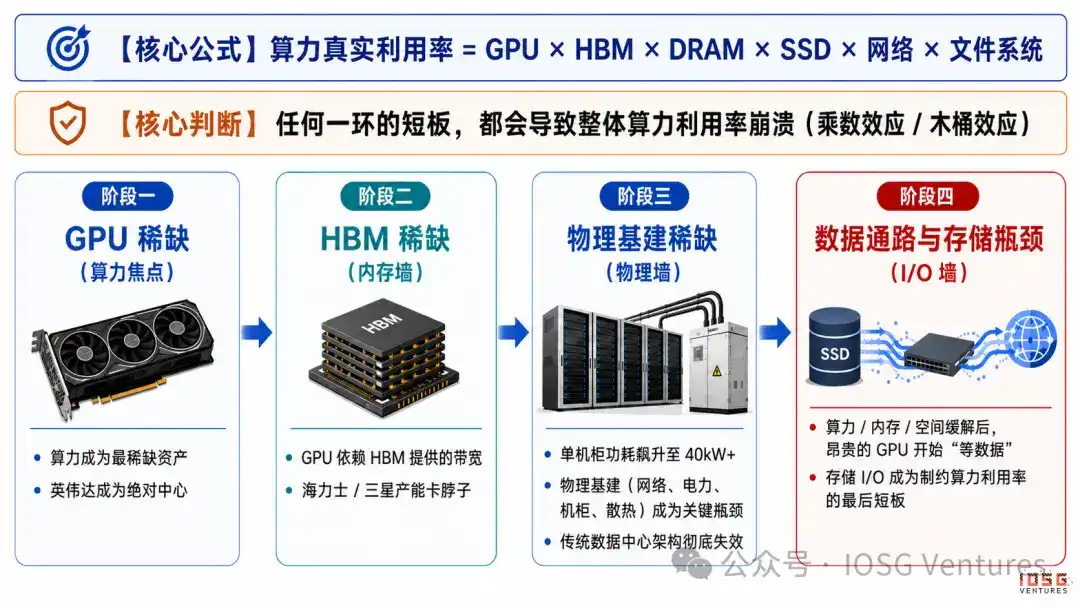
The evolution of resource bottlenecks in AI infrastructure is essentially a battle to fill the gaps in the "barrel effect." The real utilization of computing power is not a linear sum of individual assets but a stringent multiplicative effect: Real Compute Utilization = GPU × HBM × DRAM × SSD × Network × File System. A shortfall in any single link can cause overall computing efficiency to collapse. In the AI era, storage has transformed for the first time from a "cost center" to an "efficiency engine." This is the fundamental logic behind storage's repricing.
Panorama of AI Storage Architecture: From HBM Bandwidth Organ to Data Lake Foundation

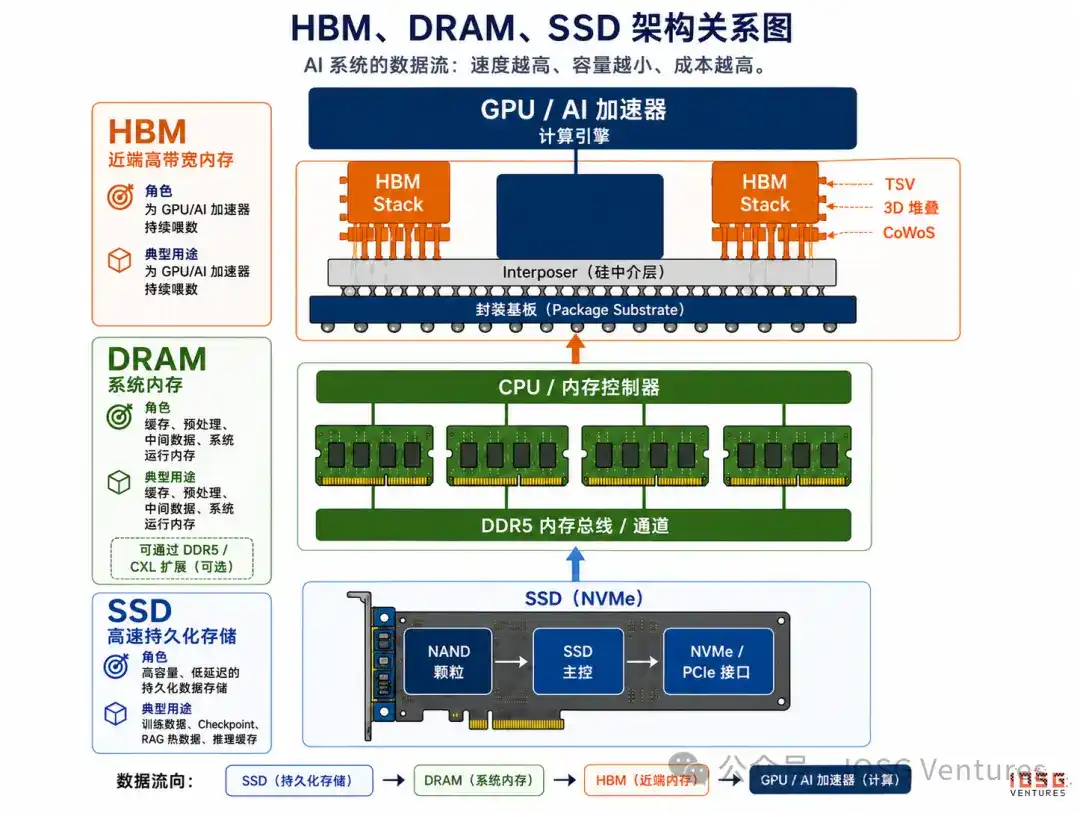
AI storage is by no means a mere pile of individual hardware components; it is a complex, tightly coupled, and hierarchically managed system. Within this system, industrial value and capital focus are highly concentrated on HBM, enterprise SSDs, SSD controllers, NVMe/CXL protocols, and high-performance storage systems. To clearly deconstruct its value flow, we divide the AI storage architecture into four core hierarchical layers:
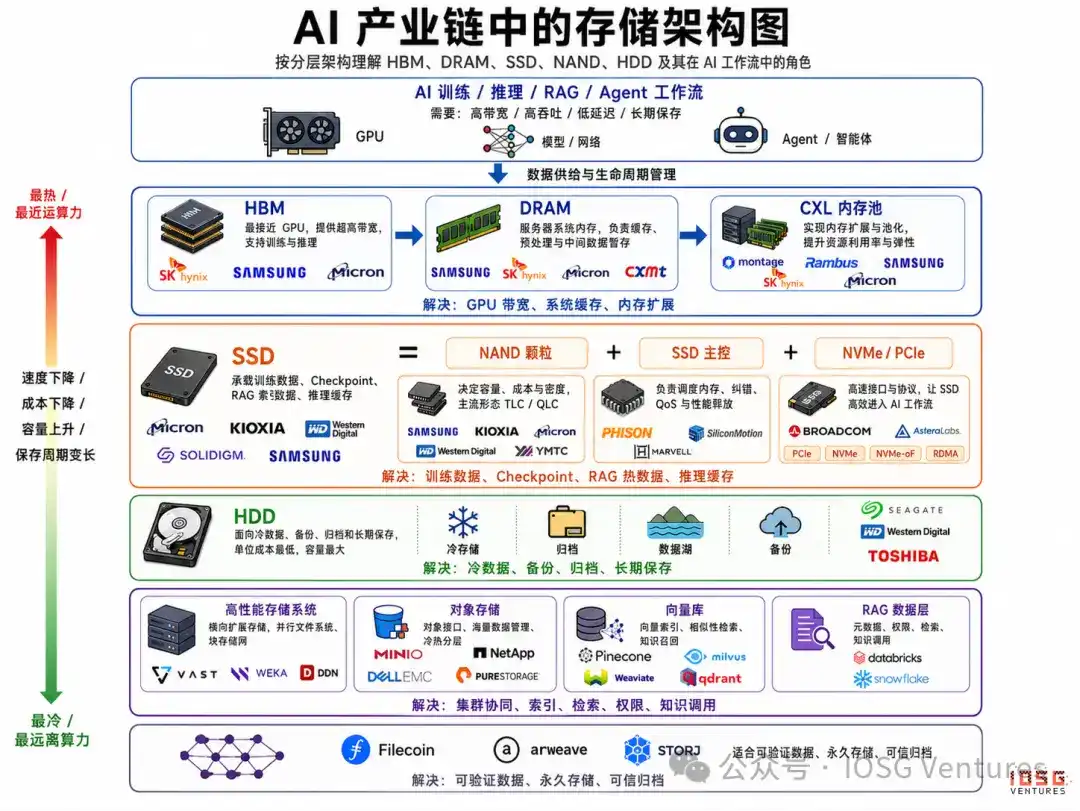
  • Compute-Near Memory Layer (Bandwidth Core): Dominated by HBM, supplemented by DRAM and CXL memory pooling technology. This layer is directly attached to GPU/CPU packaging or the bus, aiming to break the "memory wall." It is the first gate determining whether computing power can be fully unleashed.

  • High-Speed Persistent Storage Layer (I/O Hub): The core logic is Enterprise SSD = NAND Flash + SSD Controller + NVMe/PCIe Data Path. This layer handles high-frequency Checkpoint writes, massive training dataset loading, and RAG hot data caching. It represents the most definitive increment in persistent storage for AI data centers.

  • Low-Cost, High-Capacity Storage Layer (Capacity Base): Consisting of HDDs, cold storage, and data lake archival systems. Faced with the exponential growth of multimodal raw data, historical logs, and compliance backups, this layer still provides irreplaceable TCO (Total Cost of Ownership) advantages.

  • AI Storage Systems & Data Software (Scheduling Brain): Includes high-performance parallel file systems, distributed object storage, vector databases, and RAG data governance layers. What AI truly consumes is not bare hardware, but the data availability efficiently organized, indexed, and secured by the software stack.

As an ecosystem extension, decentralized storage does not directly engage in the millisecond-level race of AI hot data. Instead, it anchors positions like public dataset attestation, AI training data provenance, and long-term cold memory archival, establishing its unique niche as the "trustworthy cold layer."

HBM: The "Bandwidth Organ" Closest to Compute in the AI Storage Chain

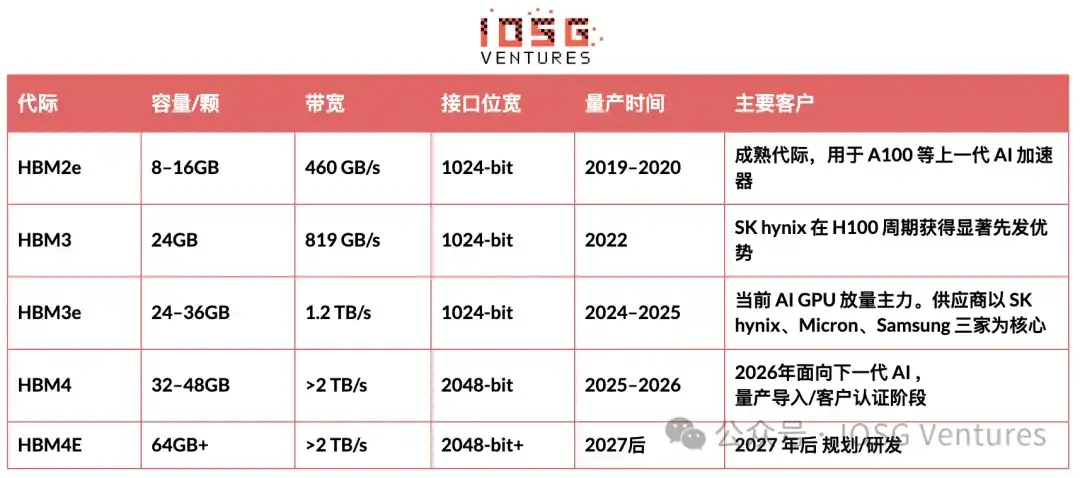
High Bandwidth Memory (HBM) is not traditional storage; it is a high-bandwidth memory layer proximate to the GPU. Its core mission is not to save data, but to continuously "feed" data to the compute units with extremely high bandwidth. HBM is the link in the AI storage chain that is closest to compute, with the highest certainty. It directly determines whether GPUs can be "fed adequately" and is the most critical supply chain bottleneck currently.

The core architecture of HBM is "3D DRAM stacking + 2.5D advanced packaging": Through TSV vertical stacking and CoWoS heterogeneous integration, the distance between memory and compute is compressed to the extreme, achieving generational leaps in bandwidth. Its industrial barriers encompass not just DRAM design, but a system engineering effort involving DRAM process technology, TSV, ultra-thin stacking, packaging, thermal management, testing, and customer certification. A defect in any single link can cause the entire HBM stack to be scrapped.

Currently, only three giants worldwide can stably mass-produce HBM: SK hynix, Samsung, and Micron, who have built a triple moat of top-tier DRAM process, packaging capabilities, and NVIDIA/AMD customer certifications.
DRAM & CXL: The System Memory Base and Memory Pooling Engine

HBM solves the extreme bandwidth problem near the GPU, DRAM solidifies the server's system memory foundation, while CXL attempts to break physical boundaries and reorganize memory resource allocation within data centers.

  • DRAM: Primarily handles CPU-side caching, data preprocessing, intermediate state storage, and system operation. It is the most fundamental system memory layer in servers. The global DRAM market is highly concentrated among three giants: SK hynix, Samsung, and Micron; Changxin Storage (CXMT) is the core variable in China's domestic DRAM substitution strategy.

  • CXL (Compute Express Link): A new-generation cache-coherent interconnect protocol for data centers, aiming to overcome the limitations of traditional DIMM slots, local memory capacity, and server memory resource silos, driving memory architecture towards expansion, pooling, and sharing. CXL is currently still in its early stages, transitioning from platform support to scaled deployment, but holds significant medium-to-long-term architectural value. Key companies include Astera Labs and Montage Technology.
Enterprise SSD: The Data Hub Built on NAND, Controllers, and NVMe

Enterprise SSDs represent the most critical high-throughput persistent storage increment in AI data centers. They continuously "feed" data to GPUs with extremely high throughput, ultra-low latency, and stable QoS, covering the entire lifecycle including training data loading, Checkpoint writes, RAG retrieval, inference caching, and log streaming.

Within the AI storage architecture, SSDs are not isolated hardware but a highly coupled system, which can be distilled into an industrial formula: Enterprise SSD = NAND Flash + SSD Controller + NVMe/PCIe Data Path. These three layers represent independent industrial chain segments:

  • NAND Flash (Raw Material Layer): Determines storage density and unit cost. Representative companies: Samsung, SK hynix (Solidigm), Micron, Kioxia, Western Digital, Yangtze Memory Technologies (YMTC).

  • SSD Controller (Performance Enablement Layer): Determines performance delivery, data error correction, QoS stability, and wear-leveling. Representative companies: Phison, Silicon Motion, Marvell, Maxio (Rayson).

  • NVMe/PCIe (Data Path Layer): Determines the efficiency of data transfer from storage to compute. Combined with technologies like GPUDirect Storage, it reduces CPU memory bounce buffers and CPU involvement, significantly alleviating I/O bottlenecks. Representative companies: Broadcom, Marvell, Astera Labs.

HDD / Cold Storage / Archival: The Low-Cost Base for AI Data Lakes

AI will not eliminate HDDs. With multimodal large models' voracious appetite for video and image data, and the exponential growth of enterprise compliance logs and historical datasets, demand for low-cost cold data storage is simultaneously exploding. In AI storage architecture, SSDs and HDDs collaborate based on a tiered business value approach: SSDs handle hot data and high throughput, while HDDs handle low cost and long-term preservation. Representative companies include Seagate, Western Digital, and Toshiba.

AI Storage Software Stack: The Scheduling Hub for Data Availability

What AI truly consumes is never bare drives, but "data services" meticulously organized by the software stack. This architecture transforms underlying hardware into knowledge assets directly callable by upper-layer AI. It can be divided into four specific layers:

  • High-Performance Storage Systems (Feeding System): Focus on concurrent throughput and low latency. Parallel file systems address the GPU cluster's "data hunger," ensuring rapid flow for training and inference. Representative companies: VAST Data, WEKA, Pure Storage.

  • Object Storage (Raw Data Lake): Core concepts are Object, Key, and Metadata management, hosting massive unstructured data. It doesn't pursue extreme low latency but builds capacity bases with low cost and cloud-native characteristics. Representative company: AWS S3.

  • Vector Databases (Semantic Indexing Layer): Vector databases store, index, and retrieve vectors generated by embedding models, enabling AI to precisely locate relevant content from vast knowledge bases. Representative companies: Pinecone, Milvus.

  • RAG Data Layer (Knowledge Invocation Layer): Goes beyond simple retrieval, encompassing data chunking, cleaning, access control, and citation provenance, ensuring enterprise data can be safely, accurately, and traceably invoked by large models. Representative company: Databricks.

From AI Hot Storage to Decentralized Cold Memory: Efficiency Maximization vs. Trust Maximization

AI Storage is an extreme efficiency-driven system whose value function focuses on maximizing computational output. HBM bandwidth determines whether GPUs can be fed adequately, SSD throughput determines dataset and Checkpoint read/write efficiency, and low latency is critical for RAG and real-time inference experiences. These metrics ultimately converge into GPU utilization and per-Token cost, directly deciding the commercial profitability of AI applications. The ultimate goal of AI storage is not preservation but acceleration, serving productivity.

Conversely, the value function of decentralized storage is fundamentally different. It questions whether data will still exist in ten years, whether it has been tampered with, and whether it can resist single-point censorship. Through cryptographic proofs and distributed networks, it builds an openly accessible, permanently preserved public data foundation. Its ultimate goal is to defend the absolute truth and sovereign independence of data, serving fairness, censorship resistance, and civilizational memory.
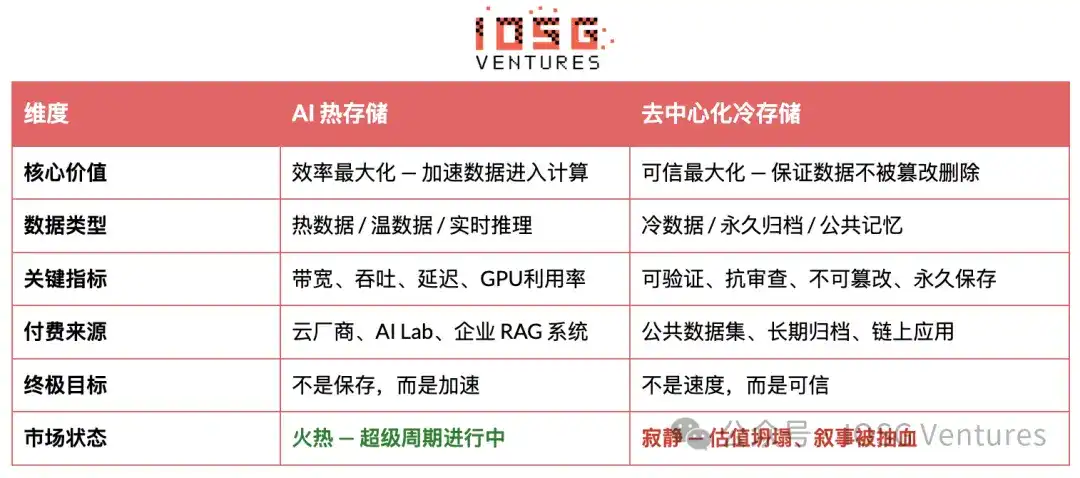
AI storage is "hot storage" providing fuel for future productivity; decentralized storage is "cold memory" preserving undeletable historical records for human civilization. The former serves efficiency, pursuing extreme speed; the latter serves trustworthiness, defending silent memory. The former determines how fast models run; the latter determines whether memories might be deleted. Currently, market mechanisms reward productive efficiency. AI storage is at the forefront of the wave, while decentralized storage seems to be experiencing a silence of valuation collapse and narrative bloodletting.

The Vision and Reality of Decentralized Storage

There are numerous decentralized storage projects, but in terms of industry mindshare and ecosystem depth, the core representatives remain Filecoin and Arweave. Although both fall under "decentralized storage," their underlying architectural philosophies are almost entirely divergent paths—the former approximates AWS-like elasticity through market-based contracts, while the latter approximates the permanence of a library through a one-time social contract.

  • Filecoin: Has built the most complete verifiable economic system through PoRep and PoSt. It should not continue to compete directly with AWS on consumer-grade cloud storage. Instead, it should pivot towards AI data provenance, public dataset hosting, and compliance archiving, providing verifiable chains for model auditing and copyright proof. The necessary path is to package itself as an S3-compatible API supporting fiat payments, upgrading from a "cheap storage marketplace" to "verifiable computational infrastructure."

  • Arweave: With its "pay once, store forever" narrative, it uses Blockweave and SPoRA mechanisms to incentivize miners to preserve and quickly access as much data as possible, especially scarce historical data. Its best fit is as a public memory foundation for human civilization—preserving human rights records, evidence of war crimes, cultural archives, archiving legal and financial history, and providing permanent, accessible long-term memory for AI Agents. Arweave's value lies not in speed but in its capacity to carry civilizational memory across cycles.
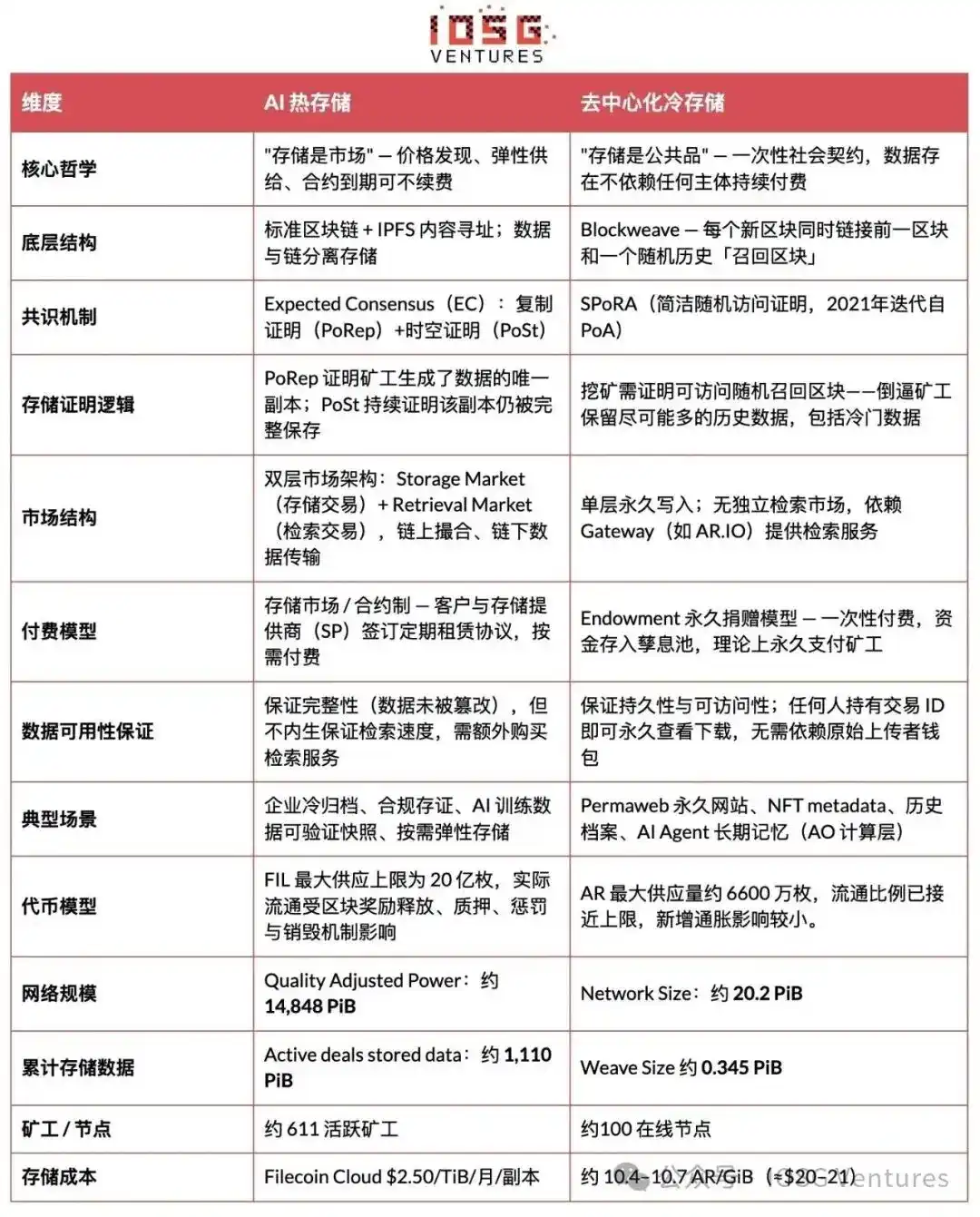
The predicament of decentralized storage projects like Filecoin and Arweave lies not in a flawed value proposition, but in the long-term misalignment among productization, retrieval experience, real-world demand, and token incentives. This reveals a significant gap between geek idealism and mainstream commercial adoption:

  • Supply-Demand Incentive Misalignment: Early networks like Filecoin rapidly expanded capacity via token incentives but failed to build sufficiently strong paid demand, resulting in vast capacity but low utilization and conversion. It rewards "I can store" rather than "need me to store."

  • Lack of Enterprise-Grade Service Capabilities: AWS's moat isn't hard drives, but the "data operating system" composed of APIs, SLAs, access management, compliance auditing, and technical support. Enterprises buy "peace of mind," not experimental infrastructure requiring them to handle keys and node selection themselves.

  • Retrieval Experience Shortcomings: "Storing in" does not equal "retrieving stably and with low latency." Distributed nodes, complex topology, and a lack of unified SLAs make it difficult to handle AI hot data workflows. It's more suitable for trustworthy cold archiving and data provenance.

  • Inadequate Privacy & Compliance: Enterprise private data cannot simply be written to a public, permanent network; the right to be forgotten inherently conflicts with permanent immutability. Decentralized storage is better suited for public data and long-term archives, not indiscriminately hosting core private data.

  • Token Economics Amplifying Cycles: Bull market financialization masks insufficient demand; bear market ROI decline for miners exposes commercialization shortcomings. Tokens can bootstrap supply but cannot automatically create demand and sustainable revenue.

Other decentralized storage projects mostly focus on specific ecosystems or niche segments: Storj/Sia have weaker cross-cycle industry mindshare and Web3 narrative influence compared to Filecoin/Arweave; BNB Greenfield/Walrus are tied to specific public chain ecosystems like BNB or SUI; Celestia/EigenDA belong to the Data Availability (DA) layer, serving Rollup transaction confirmation rather than long-term archival; AI/DA hybrid narrative projects like 0G attempt to integrate storage, data availability, computation, and AI agent settlement into an AI-native modular infrastructure, but their real-world demand, developer adoption, and commercial closure remain to be validated.

Future Opportunities for Decentralized Storage: The Long-Term Pendulum of Efficiency and Trust

During periods of technological红利爆发, capital frantically chases efficiency. Assets like GPUs and HBM are assigned extremely high premiums, while decentralized storage advocating "trust and fairness" is naturally marginalized. However, history's pendulum will not remain forever on the side of efficiency. Unjustifiable platform bans and content takedowns, AI copyright lawsuits forcing data provenance, geopolitical conflicts sparking data sovereignty disputes, data monopolies leading to the disappearance of public archives, and regulatory pressure for compliance auditing of model training data—all such events could potentially brew a repricing of "trustworthy storage." Decentralized storage's future opportunities may still manifest unique value in the following directions:

  • AI Data Provenance: Combining cryptographic proofs to build "data lineage proofs," addressing regulatory and audit pressures.

  • Public Datasets & Civilizational Archives: Anchoring censored archives and cultural heritage, building irreplaceable, undeletable memory.

  • Trustworthy Archival & Compliance Attestation: Achieving trustworthy self-attestation through hash storage, providing high-grade digital notarization.

  • Integration with ZK/TEE/DID Technologies: Mitigating privacy tensions, upgrading from a single "storage protocol" to "trustworthy data infrastructure."

  • Invisible Product Route: Offering S3-compatible APIs and fiat billing, allowing users to directly purchase "trustworthy archival" services.

AI storage and decentralized storage—one pursues ultimate efficiency, providing fuel for our sprint into the future; the other defends silent memory, safeguarding our right to look back at the past. The current market unhesitatingly rewards efficiency, which is why decentralized storage appears silent, even collapsing. However, when the AI era further amplifies data monopolies, copyright disputes, and the fragility of historical memory, decentralized storage may experience a revaluation as a "trustworthy cold layer." Those memories that cannot be easily erased by platforms, corporations, or any single authority might transition from an idealistic romance, from a fringe belief, into necessary infrastructure.


Crypto di tendenza

Domande pertinenti

QWhat is the fundamental difference between the value proposition of AI storage and decentralized storage, according to the article?

AThe core difference lies in their value functions. AI storage is driven by efficiency maximization, focusing on maximizing GPU utilization and lowering per-token costs to accelerate computing power and serve productivity. Decentralized storage is driven by trust maximization, focusing on data permanence, censorship resistance, authenticity, and serving as a long-term, immutable memory base for fairness and civilizational heritage.

QWhy is HBM considered a critical and bottleneck component in the AI storage chain?

AHBM is critical because it is the 'bandwidth organ' closest to the compute unit (GPU/CPU). Its core mission is not to preserve data but to feed data to the compute unit with extremely high bandwidth, directly determining whether the GPU can be fully utilized ('fed'). Its production involves complex system engineering with high barriers including advanced DRAM process, TSV technology, ultra-thin stacking, packaging, thermal management, and customer certification. Currently, only SK hynix, Samsung, and Micron can produce it stably.

QWhat are the four core layers of the AI storage architecture as outlined in the article?

AThe four core layers are: 1) Compute-proximate memory layer (Bandwidth Core), primarily HBM, supplemented by DRAM and CXL memory pooling. 2) High-speed persistent storage layer (I/O Hub), centered on enterprise SSD components. 3) Low-cost, high-capacity storage layer (Capacity Base), consisting of HDDs and cold storage/archive systems. 4) AI storage system and data software (Orchestration Brain), including parallel file systems, object storage, vector databases, and RAG data governance layers.

QWhat are the main challenges or mismatches currently facing decentralized storage projects like Filecoin and Arweave?

AThe main challenges include: 1) Supply-demand incentive mismatch, where networks incentivize storage capacity but lack strong paying demand. 2) Lack of enterprise-grade service capabilities like comprehensive APIs, SLA guarantees, permission management, and support. 3) Poor retrieval experience, making them unsuitable for hot data workflows. 4) Privacy and compliance issues, as permanent storage conflicts with deletion rights. 5) Token economies amplifying market cycles, where bull market speculation masks weak fundamentals.

QAccording to the article, what are the potential future opportunities for decentralized storage to demonstrate unique value?

APotential opportunities include: 1) AI Data Provenance: Providing cryptographic proof for data lineage and model training data to meet audit and regulatory needs. 2) Public Datasets & Civilizational Archives: Hosting censored records, cultural heritage, and public data. 3) Trusted Archiving & Compliance Attestation: Offering immutable hash-based proof for digital notarization. 4) Integration with technologies like ZK, TEE, and DID to enhance privacy and evolve into trusted data infrastructure. 5) An 'invisible' product route, offering S3-compatible APIs and fiat billing for easy enterprise adoption of 'trusted archive' services.

Letture associate

Critical Moments in Bitcoin: Cost Zones That Demand Attention Have Been Identified!

Analytics firm Glassnode reported that reduced expectations for U.S. interest rate cuts, along with pricing in possible rate hikes, have suppressed risk appetite in the cryptocurrency market. The Fed's interest rate decisions are crucial for market direction. U.S. Treasury yields have surpassed returns from crypto carry trades, leading investors to favor cash and low-risk interest-bearing instruments over crypto assets. A strong U.S. dollar further weakens marginal demand for crypto. Bitcoin is currently trading below its most intensive cost basis level, with approximately $69,000 identified as the breakeven zone and significant resistance for short-term investors. For a stronger recovery, Bitcoin needs to reclaim the $69,000 threshold with increased trading volume. Renewed active demand for spot Bitcoin ETFs is also deemed critical. According to Glassnode, the current Bitcoin decline represents the shallowest bear market in terms of price drawdown depth to date. However, based on previous cycle durations, this downturn may not be over yet. Spot trading volumes have fallen to multi-year lows, and sell-side order books have thinned, though many buy orders are placed significantly below current prices. Glassnode's risk indicator, Vector, signaled "risk off," suggesting a capital preservation mindset. The current market structure is being driven more by macroeconomic factors like monetary policy, bond yields, and dollar strength than by crypto-sector developments. Losing Bitcoin's support range of $62,000-$68,000, coupled with renewed exchange inflows, could negate the recovery scenario. Conversely, more favorable monetary policy, increased trading volume, a Bitcoin recovery above $69,000, and a resumption of spot ETF buying could signal a market turnaround.

cryptonews.ru1 h fa

Critical Moments in Bitcoin: Cost Zones That Demand Attention Have Been Identified!

cryptonews.ru1 h fa

Breaking News: Full Detailed Rationale and Explanation of the Fed's Interest Rate Decision Released!

As expected, the Federal Reserve kept its key interest rate unchanged at 3.50-3.75 percent, marking the fifth consecutive meeting without a rate change. The Federal Open Market Committee's (FOMC) decision passed with a 9-3 majority vote. Cleveland Fed President Loretta Mester, Minneapolis Fed President Neel Kashkari, and Dallas Fed President Lorie Logan dissented, voting in favor of a 25 basis point rate hike. This was the first meeting since 2016 where three regional Fed presidents voted against holding rates steady, signaling growing influence among members advocating for tighter monetary policy to combat inflation. The Fed's statement noted that economic activity has been expanding at a solid pace despite high uncertainty, partly due to Middle East conflicts. It highlighted that growth in productivity and investment remained strong, employment gains have aligned with labor force growth, and the unemployment rate has remained relatively stable. The Fed also committed to maintaining ample reserves in the banking system. The statement emphasized that inflation remains above the Fed's 2% target. It noted that supply shocks, including in the energy sector, are adding to inflationary pressures. The Committee stated it will continue to closely monitor incoming data and risks in pursuit of its price stability goal. The dissenting members argued that the target range for the federal funds rate should have been increased by 25 basis points.

cryptonews.ru1 h fa

Breaking News: Full Detailed Rationale and Explanation of the Fed's Interest Rate Decision Released!

cryptonews.ru1 h fa

Trading

Spot

Articoli Popolari

Cosa è $S$

Comprendere SPERO: Una Panoramica Completa Introduzione a SPERO Mentre il panorama dell'innovazione continua a evolversi, l'emergere delle tecnologie web3 e dei progetti di criptovaluta gioca un ruolo fondamentale nel plasmare il futuro digitale. Un progetto che ha attirato l'attenzione in questo campo dinamico è SPERO, denotato come SPERO,$$s$. Questo articolo mira a raccogliere e presentare informazioni dettagliate su SPERO, per aiutare gli appassionati e gli investitori a comprendere le sue basi, obiettivi e innovazioni nei domini web3 e crypto. Che cos'è SPERO,$$s$? SPERO,$$s$ è un progetto unico all'interno dello spazio crypto che cerca di sfruttare i principi della decentralizzazione e della tecnologia blockchain per creare un ecosistema che promuove l'impegno, l'utilità e l'inclusione finanziaria. Il progetto è progettato per facilitare interazioni peer-to-peer in modi nuovi, fornendo agli utenti soluzioni e servizi finanziari innovativi. Al suo interno, SPERO,$$s$ mira a responsabilizzare gli individui fornendo strumenti e piattaforme che migliorano l'esperienza dell'utente nello spazio delle criptovalute. Questo include la possibilità di metodi di transazione più flessibili, la promozione di iniziative guidate dalla comunità e la creazione di percorsi per opportunità finanziarie attraverso applicazioni decentralizzate (dApps). La visione sottostante di SPERO,$$s$ ruota attorno all'inclusività, cercando di colmare le lacune all'interno della finanza tradizionale mentre sfrutta i vantaggi della tecnologia blockchain. Chi è il Creatore di SPERO,$$s$? L'identità del creatore di SPERO,$$s$ rimane piuttosto oscura, poiché ci sono risorse pubblicamente disponibili limitate che forniscono informazioni dettagliate sul suo fondatore o fondatori. Questa mancanza di trasparenza può derivare dall'impegno del progetto per la decentralizzazione—un ethos che molti progetti web3 condividono, dando priorità ai contributi collettivi rispetto al riconoscimento individuale. Centrando le discussioni attorno alla comunità e ai suoi obiettivi collettivi, SPERO,$$s$ incarna l'essenza dell'empowerment senza mettere in evidenza individui specifici. Pertanto, comprendere l'etica e la missione di SPERO rimane più importante che identificare un creatore singolo. Chi sono gli Investitori di SPERO,$$s$? SPERO,$$s$ è supportato da una varietà di investitori che vanno dai capitalisti di rischio agli investitori angelici dedicati a promuovere l'innovazione nel settore crypto. Il focus di questi investitori generalmente si allinea con la missione di SPERO—dando priorità a progetti che promettono avanzamenti tecnologici sociali, inclusività finanziaria e governance decentralizzata. Queste fondazioni di investitori sono tipicamente interessate a progetti che non solo offrono prodotti innovativi, ma contribuiscono anche positivamente alla comunità blockchain e ai suoi ecosistemi. Il supporto di questi investitori rafforza SPERO,$$s$ come un concorrente degno di nota nel dominio in rapida evoluzione dei progetti crypto. Come Funziona SPERO,$$s$? SPERO,$$s$ impiega un framework multifunzionale che lo distingue dai progetti di criptovaluta convenzionali. Ecco alcune delle caratteristiche chiave che sottolineano la sua unicità e innovazione: Governance Decentralizzata: SPERO,$$s$ integra modelli di governance decentralizzati, responsabilizzando gli utenti a partecipare attivamente ai processi decisionali riguardanti il futuro del progetto. Questo approccio favorisce un senso di proprietà e responsabilità tra i membri della comunità. Utilità del Token: SPERO,$$s$ utilizza il proprio token di criptovaluta, progettato per servire varie funzioni all'interno dell'ecosistema. Questi token abilitano transazioni, premi e la facilitazione dei servizi offerti sulla piattaforma, migliorando l'impegno e l'utilità complessivi. Architettura Stratificata: L'architettura tecnica di SPERO,$$s$ supporta la modularità e la scalabilità, consentendo un'integrazione fluida di funzionalità e applicazioni aggiuntive man mano che il progetto evolve. Questa adattabilità è fondamentale per mantenere la rilevanza nel panorama crypto in continua evoluzione. Coinvolgimento della Comunità: Il progetto enfatizza iniziative guidate dalla comunità, impiegando meccanismi che incentivano la collaborazione e il feedback. Nutrendo una comunità forte, SPERO,$$s$ può affrontare meglio le esigenze degli utenti e adattarsi alle tendenze di mercato. Focus sull'Inclusione: Offrendo basse commissioni di transazione e interfacce user-friendly, SPERO,$$s$ mira ad attrarre una base utenti diversificata, inclusi individui che potrebbero non aver precedentemente interagito nello spazio crypto. Questo impegno per l'inclusione si allinea con la sua missione generale di empowerment attraverso l'accessibilità. Cronologia di SPERO,$$s$ Comprendere la storia di un progetto fornisce preziose intuizioni sulla sua traiettoria di sviluppo e sui traguardi. Di seguito è riportata una cronologia suggerita che mappa eventi significativi nell'evoluzione di SPERO,$$s$: Fase di Concettualizzazione e Ideazione: Le idee iniziali che formano la base di SPERO,$$s$ sono state concepite, allineandosi strettamente con i principi di decentralizzazione e focus sulla comunità all'interno dell'industria blockchain. Lancio del Whitepaper del Progetto: Dopo la fase concettuale, è stato rilasciato un whitepaper completo che dettaglia la visione, gli obiettivi e l'infrastruttura tecnologica di SPERO,$$s$ per suscitare interesse e feedback dalla comunità. Costruzione della Comunità e Prime Interazioni: Sono stati effettuati sforzi attivi di outreach per costruire una comunità di early adopters e potenziali investitori, facilitando discussioni attorno agli obiettivi del progetto e ottenendo supporto. Evento di Generazione del Token: SPERO,$$s$ ha condotto un evento di generazione del token (TGE) per distribuire i propri token nativi ai primi sostenitori e stabilire una liquidità iniziale all'interno dell'ecosistema. Lancio della Prima dApp: La prima applicazione decentralizzata (dApp) associata a SPERO,$$s$ è stata attivata, consentendo agli utenti di interagire con le funzionalità principali della piattaforma. Sviluppo Continuo e Partnership: Aggiornamenti e miglioramenti continui alle offerte del progetto, inclusi partnership strategiche con altri attori nello spazio blockchain, hanno plasmato SPERO,$$s$ in un concorrente competitivo e in evoluzione nel mercato crypto. Conclusione SPERO,$$s$ rappresenta una testimonianza del potenziale del web3 e delle criptovalute di rivoluzionare i sistemi finanziari e responsabilizzare gli individui. Con un impegno per la governance decentralizzata, il coinvolgimento della comunità e funzionalità progettate in modo innovativo, apre la strada verso un panorama finanziario più inclusivo. Come per qualsiasi investimento nello spazio crypto in rapida evoluzione, si incoraggiano potenziali investitori e utenti a ricercare approfonditamente e a impegnarsi in modo riflessivo con gli sviluppi in corso all'interno di SPERO,$$s$. Il progetto mostra lo spirito innovativo dell'industria crypto, invitando a ulteriori esplorazioni delle sue innumerevoli possibilità. Mentre il percorso di SPERO,$$s$ è ancora in fase di sviluppo, i suoi principi fondamentali potrebbero effettivamente influenzare il futuro di come interagiamo con la tecnologia, la finanza e tra di noi in ecosistemi digitali interconnessi.

163 Totale visualizzazioniPubblicato il 2024.12.17Aggiornato il 2024.12.17

Cosa è $S$

Cosa è AGENT S

Agent S: Il Futuro dell'Interazione Autonoma in Web3 Introduzione Nel panorama in continua evoluzione di Web3 e criptovalute, le innovazioni stanno costantemente ridefinendo il modo in cui gli individui interagiscono con le piattaforme digitali. Uno di questi progetti pionieristici, Agent S, promette di rivoluzionare l'interazione uomo-computer attraverso il suo framework agentico aperto. Aprendo la strada a interazioni autonome, Agent S mira a semplificare compiti complessi, offrendo applicazioni trasformative nell'intelligenza artificiale (AI). Questa esplorazione dettagliata approfondirà le complessità del progetto, le sue caratteristiche uniche e le implicazioni per il dominio delle criptovalute. Cos'è Agent S? Agent S si presenta come un innovativo framework agentico aperto, progettato specificamente per affrontare tre sfide fondamentali nell'automazione dei compiti informatici: Acquisizione di Conoscenze Specifiche del Dominio: Il framework apprende in modo intelligente da varie fonti di conoscenza esterne ed esperienze interne. Questo approccio duale gli consente di costruire un ricco repository di conoscenze specifiche del dominio, migliorando le sue prestazioni nell'esecuzione dei compiti. Pianificazione su Lungo Orizzonte di Compiti: Agent S impiega una pianificazione gerarchica potenziata dall'esperienza, un approccio strategico che facilita la suddivisione e l'esecuzione efficiente di compiti complessi. Questa caratteristica migliora significativamente la sua capacità di gestire più sottocompiti in modo efficiente ed efficace. Gestione di Interfacce Dinamiche e Non Uniformi: Il progetto introduce l'Interfaccia Agente-Computer (ACI), una soluzione innovativa che migliora l'interazione tra agenti e utenti. Utilizzando Modelli Linguistici Multimodali di Grandi Dimensioni (MLLM), Agent S può navigare e manipolare senza sforzo diverse interfacce grafiche utente. Attraverso queste caratteristiche pionieristiche, Agent S fornisce un framework robusto che affronta le complessità coinvolte nell'automazione dell'interazione umana con le macchine, preparando il terreno per innumerevoli applicazioni nell'AI e oltre. Chi è il Creatore di Agent S? Sebbene il concetto di Agent S sia fondamentalmente innovativo, informazioni specifiche sul suo creatore rimangono elusive. Il creatore è attualmente sconosciuto, il che evidenzia sia la fase embrionale del progetto sia la scelta strategica di mantenere i membri fondatori sotto anonimato. Indipendentemente dall'anonimato, l'attenzione rimane sulle capacità e sul potenziale del framework. Chi sono gli Investitori di Agent S? Poiché Agent S è relativamente nuovo nell'ecosistema crittografico, informazioni dettagliate riguardanti i suoi investitori e sostenitori finanziari non sono documentate esplicitamente. La mancanza di approfondimenti pubblicamente disponibili sulle fondazioni di investimento o sulle organizzazioni che supportano il progetto solleva interrogativi sulla sua struttura di finanziamento e sulla roadmap di sviluppo. Comprendere il supporto è cruciale per valutare la sostenibilità del progetto e il suo potenziale impatto sul mercato. Come Funziona Agent S? Al centro di Agent S si trova una tecnologia all'avanguardia che gli consente di funzionare efficacemente in contesti diversi. Il suo modello operativo è costruito attorno a diverse caratteristiche chiave: Interazione Uomo-Computer Simile a Quella Umana: Il framework offre una pianificazione AI avanzata, cercando di rendere le interazioni con i computer più intuitive. Mimando il comportamento umano nell'esecuzione dei compiti, promette di elevare le esperienze degli utenti. Memoria Narrativa: Utilizzata per sfruttare esperienze di alto livello, Agent S utilizza la memoria narrativa per tenere traccia delle storie dei compiti, migliorando così i suoi processi decisionali. Memoria Episodica: Questa caratteristica fornisce agli utenti una guida passo-passo, consentendo al framework di offrire supporto contestuale mentre i compiti si sviluppano. Supporto per OpenACI: Con la capacità di funzionare localmente, Agent S consente agli utenti di mantenere il controllo sulle proprie interazioni e flussi di lavoro, allineandosi con l'etica decentralizzata di Web3. Facile Integrazione con API Esterne: La sua versatilità e compatibilità con varie piattaforme AI garantiscono che Agent S possa adattarsi senza problemi agli ecosistemi tecnologici esistenti, rendendolo una scelta attraente per sviluppatori e organizzazioni. Queste funzionalità contribuiscono collettivamente alla posizione unica di Agent S all'interno dello spazio crittografico, poiché automatizza compiti complessi e multi-fase con un intervento umano minimo. Man mano che il progetto evolve, le sue potenziali applicazioni in Web3 potrebbero ridefinire il modo in cui si svolgono le interazioni digitali. Cronologia di Agent S Lo sviluppo e le tappe di Agent S possono essere riassunti in una cronologia che evidenzia i suoi eventi significativi: 27 Settembre 2024: Il concetto di Agent S è stato lanciato in un documento di ricerca completo intitolato “Un Framework Agentico Aperto che Usa i Computer Come un Umano”, mostrando le basi per il progetto. 10 Ottobre 2024: Il documento di ricerca è stato reso pubblicamente disponibile su arXiv, offrendo un'esplorazione approfondita del framework e della sua valutazione delle prestazioni basata sul benchmark OSWorld. 12 Ottobre 2024: È stata rilasciata una presentazione video, fornendo un'idea visiva delle capacità e delle caratteristiche di Agent S, coinvolgendo ulteriormente potenziali utenti e investitori. Questi indicatori nella cronologia non solo illustrano i progressi di Agent S, ma indicano anche il suo impegno per la trasparenza e il coinvolgimento della comunità. Punti Chiave su Agent S Man mano che il framework Agent S continua a evolversi, diversi attributi chiave si distinguono, sottolineando la sua natura innovativa e il potenziale: Framework Innovativo: Progettato per fornire un uso intuitivo dei computer simile all'interazione umana, Agent S porta un approccio nuovo all'automazione dei compiti. Interazione Autonoma: La capacità di interagire autonomamente con i computer attraverso GUI segna un passo avanti verso soluzioni informatiche più intelligenti ed efficienti. Automazione di Compiti Complessi: Con la sua metodologia robusta, può automatizzare compiti complessi e multi-fase, rendendo i processi più veloci e meno soggetti a errori. Miglioramento Continuo: I meccanismi di apprendimento consentono ad Agent S di migliorare dalle esperienze passate, migliorando continuamente le sue prestazioni e la sua efficacia. Versatilità: La sua adattabilità attraverso diversi ambienti operativi come OSWorld e WindowsAgentArena garantisce che possa servire un'ampia gamma di applicazioni. Man mano che Agent S si posiziona nel panorama di Web3 e delle criptovalute, il suo potenziale per migliorare le capacità di interazione e automatizzare i processi segna un significativo avanzamento nelle tecnologie AI. Attraverso il suo framework innovativo, Agent S esemplifica il futuro delle interazioni digitali, promettendo un'esperienza più fluida ed efficiente per gli utenti in vari settori. Conclusione Agent S rappresenta un audace passo avanti nell'unione tra AI e Web3, con la capacità di ridefinire il modo in cui interagiamo con la tecnologia. Sebbene sia ancora nelle sue fasi iniziali, le possibilità per la sua applicazione sono vaste e coinvolgenti. Attraverso il suo framework completo che affronta sfide critiche, Agent S mira a portare le interazioni autonome al centro dell'esperienza digitale. Man mano che ci addentriamo nei regni delle criptovalute e della decentralizzazione, progetti come Agent S giocheranno senza dubbio un ruolo cruciale nel plasmare il futuro della tecnologia e della collaborazione uomo-computer.

620 Totale visualizzazioniPubblicato il 2025.01.14Aggiornato il 2025.01.14

Cosa è AGENT S

Come comprare S

Benvenuto in HTX.com! Abbiamo reso l'acquisto di Sonic (S) semplice e conveniente. Segui la nostra guida passo passo per intraprendere il tuo viaggio nel mondo delle criptovalute.Step 1: Crea il tuo Account HTXUsa la tua email o numero di telefono per registrarti il tuo account gratuito su HTX. Vivi un'esperienza facile e sblocca tutte le funzionalità,Crea il mio accountStep 2: Vai in Acquista crypto e seleziona il tuo metodo di pagamentoCarta di credito/debito: utilizza la tua Visa o Mastercard per acquistare immediatamente SonicS.Bilancio: Usa i fondi dal bilancio del tuo account HTX per fare trading senza problemi.Terze parti: abbiamo aggiunto metodi di pagamento molto utilizzati come Google Pay e Apple Pay per maggiore comodità.P2P: Fai trading direttamente con altri utenti HTX.Over-the-Counter (OTC): Offriamo servizi su misura e tassi di cambio competitivi per i trader.Step 3: Conserva Sonic (S)Dopo aver acquistato Sonic (S), conserva nel tuo account HTX. In alternativa, puoi inviare tramite trasferimento blockchain o scambiare per altre criptovalute.Step 4: Scambia Sonic (S)Scambia facilmente Sonic (S) nel mercato spot di HTX. Accedi al tuo account, seleziona la tua coppia di trading, esegui le tue operazioni e monitora in tempo reale. Offriamo un'esperienza user-friendly sia per chi ha appena iniziato che per i trader più esperti.

1.2k Totale visualizzazioniPubblicato il 2025.01.15Aggiornato il 2026.06.02

Come comprare S

Discussioni

Benvenuto nella Community HTX. Qui puoi rimanere informato sugli ultimi sviluppi della piattaforma e accedere ad approfondimenti esperti sul mercato. Le opinioni degli utenti sul prezzo di S S sono presentate come di seguito.

活动图片