From 'Global Computer/Settlement Layer' to 'Bulletin Board': What Are Ethereum and Vitalik Trying to Achieve?

marsbitPubblicato 2026-03-22Pubblicato ultima volta 2026-03-22

Introduzione

In a significant shift of perspective, Vitalik Buterin recently proposed that Ethereum's core value may not lie in its function as a "world computer" or "global settlement layer," but rather as a simple yet powerful primitive: a cryptographically secure, globally shared "public bulletin board." This concept emphasizes data availability—a neutral, uncensorable, and permanent data layer where anyone can read and write information, but no single entity (including governments or developers) can alter or erase it. This "global shared memory" supports applications like secure voting systems, certificate revocation lists, and decentralized coordination—scenarios that require verifiable and tamper-proof data publishing rather than complex on-chain execution. The emergence of AI further validates this direction. As AI agents and services grow, so does the need for privacy-preserving and trustless interactions. Proposals like ZK API Usage Credits illustrate how Ethereum can enable anonymous AI model access and agent-to-agent economic coordination, relying precisely on the blockchain’s transparent and immutable data layer. Rather than a step back, this reframing represents a maturation of Ethereum’s vision—from defining what it can do to serving as essential infrastructure for what the world truly needs: a foundational layer of truth in an increasingly automated and opaque digital era.

In the traditional perception of many people, Ethereum's core positioning has always been the "World Computer" or "Global Settlement Layer".

Over the past decade, it has indeed been responsible for executing smart contracts, supporting DeFi, and underpinning NFTs, effectively becoming a programmable financial and application execution layer.

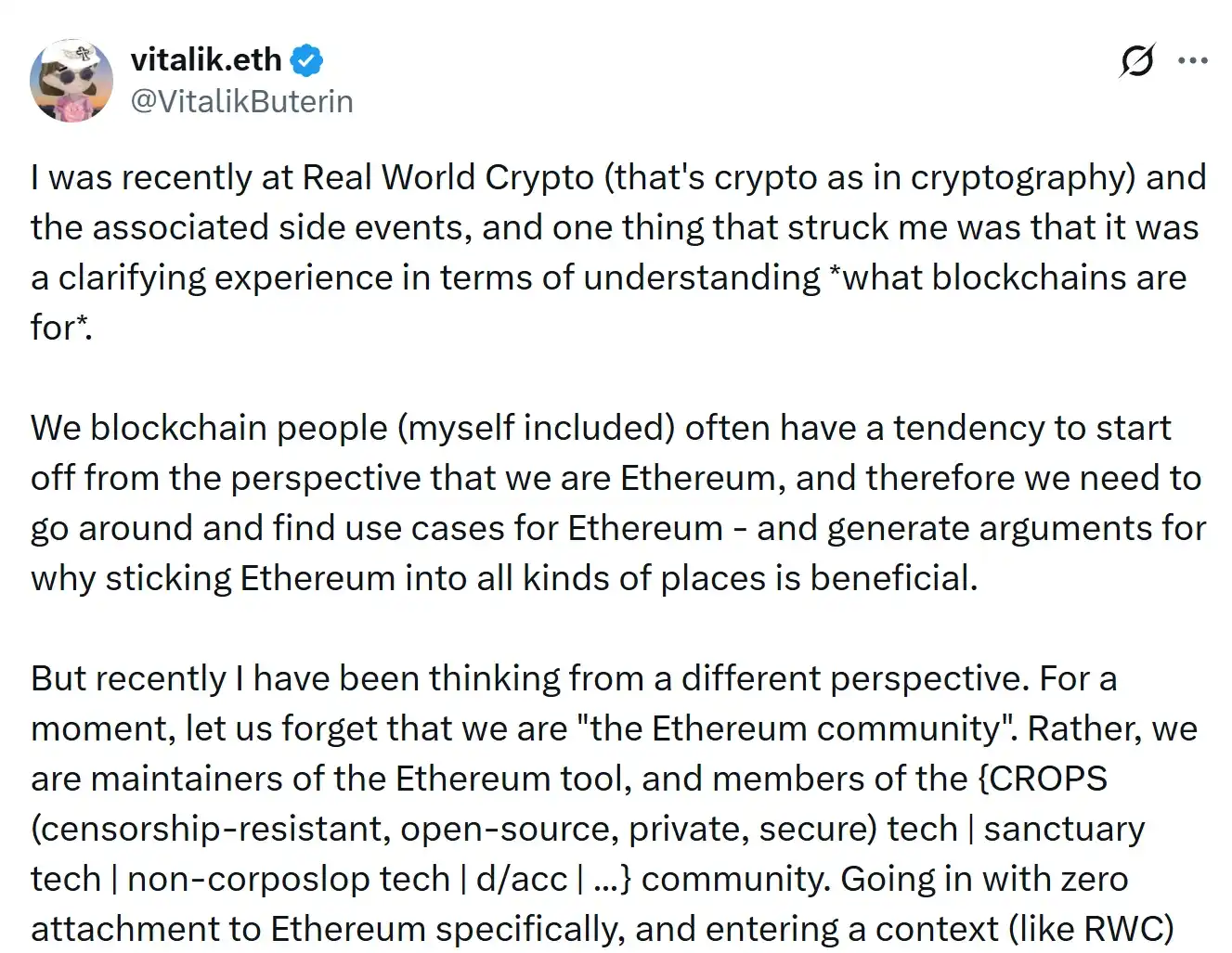
But on March 12, Vitalik Buterin proposed a rather refreshing perspective—the crypto industry may have overcomplicated the actual use cases of blockchain. The most fundamental value of Ethereum might not be the smart contract functionality we have always emphasized, but an extremely simple primitive:

A cryptographically secure, globally shared "public bulletin board".

Many users might wonder, from a "computer" to a "bulletin board", is this a functional regression, or is there another angle to consider?
I. The "Global Shared Memory" Behind the "Bulletin Board"

The so-called "public bulletin board", as the name implies, is fundamentally about data availability.

It's simple to understand: imagine a giant bulletin board posted in a central city square—anyone can read it, nothing can be withdrawn, and there is no censorship. This simply refers to a bulletin board on a global scale: global users can confirm that the data indeed exists, even the most powerful government cannot erase it, and no administrator can prevent you from publishing compliant content.

Ultimately, many digital systems, such as secure online voting and software version control, have a core need not for complex financial transactions, but for an anti-censorship, publicly verifiable data publishing space. This is precisely the "bulletin board" long sought in the field of cryptography:

  • Secure voting systems. Traditional electronic voting relies on centralized databases, which carry the risk of tampering. Publishing voting records on Ethereum allows anyone to verify the results, while the privacy of the votes is protected by cryptography;
  • Certificate revocation systems. Revocation lists for HTTPS certificates, software signing certificates, etc., need a publicly accessible, tamper-proof data source. Blockchain is naturally suited for this role;
  • Multi-party coordination and governance. Open-source projects, decentralized governance, community funds—these scenarios require multiple parties to collaborate without trusting each other. Ethereum can serve as a neutral coordination layer to publish data and verify actions;

These scenarios share a common characteristic: they don't need Ethereum to "run" anything, they just need Ethereum to "remember" something. Vitalik therefore gave a more precise ultimate definition: Ethereum is global shared memory.

Anyone can write to it, anyone can read from it, and no one can unilaterally erase it—not a company, not a government, not even Vitalik himself.

This positioning also corresponds to a clear technical path. The 2024 EIP-4844 (Blob data) was the initial scaling of this bulletin board. The full rollout of PeerDAS (Peer Data Availability Sampling) in 2026 expanded the "area" of the bulletin board a hundredfold. Ethereum is no longer fixated on the TPS of the main chain, but is committed to becoming the global storage center with the largest capacity and highest security, a foundational layer providing globally shared data availability.

II. With AI's Arrival, the Public Bulletin Board Becomes More Necessary

Understanding the essence of the "bulletin board", and then looking at the advent of AI, reveals that these are not two separate things, but two sides of the same coin.

Objectively speaking, the "bulletin board" line of thinking is actually quite related to the current impact of AI on Web3. Because increasingly, the number of conversations people have with AI daily has surpassed the number with any single human. But with current AI services, what you asked, when you asked it, how many times you asked—all are tied to your real identity.

For example, using ChatGPT requires an email and credit card; calling the Claude API leaves clear billing records; every prompt is a digital trace pointing back to you.

Therefore, in February 2026, Vitalik and the Ethereum Foundation's AI lead, Davide Crapis, jointly proposed ZK API Usage Credits, aiming to enable anonymous calls to AI large models using zero-knowledge proofs. The logic of the proposal is clear:

A user deposits funds (e.g., 100 USDC) into a smart contract, which records this deposit in an encrypted list on-chain. Thereafter, each time the user calls an AI API, they don't need to expose their identity; they just need to generate a zero-knowledge proof demonstrating "I have the right to use this credit" to complete the call.

What does this scheme require? A public bulletin board, a publicly verifiable, immutable data layer, to record "who has how much credit", without recording "who is who".

Simultaneously, the proliferation of AI Agents brings another new issue: how can these automatically running programs achieve economic coordination amongst themselves? After all, when one AI Agent needs to call the service of another AI Agent, it needs to pay, establish credibility, and handle disputes. But it has no bank account, no legal identity, and no "real-name information" trusted by centralized platforms.

Ethereum, as an economic coordination layer for AI Agents, provides a natural answer. Agents can initiate transactions on-chain, stake collateral, and establish verifiable reputation records—all built upon the transparent data layer provided by that "bulletin board".

In a broader framework, this positioning of the relationship between Ethereum and AI is even one of integration—as AI's capabilities grow stronger, the needs for privacy protection, verifiability, and decentralization become more rigid.

So, Ethereum is not competing with AI; it is aiming to become the most needed infrastructure in the AI era: a public data layer that anyone can write to, anyone can trust, and no one can shut down.

III. Is the "Smart Contract" Narrative Not Enough Anymore?

Perhaps in Vitalik Buterin's vision, the majority of future Ethereum users might not be "humans", but AI Agents.

Therefore, this shift in positioning from "World Computer" to "Bulletin Board", while easily misinterpreted as lowering expectations, is actually the opposite in understanding.

The "World Computer" is a narrative from an internal perspective, asking "what can our technology do?", while the "Bulletin Board" is a perspective from external demand, asking "what does the world truly need?".

This perhaps also benefits from the people Vitalik met at cryptography conferences—those voting system researchers, certificate protocol designers, privacy tool developers. They had no interest in blockchain or Ethereum, but the things they needed were exactly what Ethereum could provide.

Therefore, the author believes Ethereum is indeed becoming more realistic step by step, because this is the proper stance of a mature technology: it no longer tries to define application scenarios, but instead refines itself into a sufficiently reliable piece of infrastructure, waiting for the scenarios that truly need it to grow naturally.

Just like TCP/IP doesn't explain what the internet can do, but without TCP/IP, the internet can do nothing.

From this perspective, this is perhaps Ethereum's moment of "looking inward when actions don't yield results".

After all, the core, most irreplaceable value of blockchain has always been that truth which is not subject to anyone's will. This means that no matter how fast AI evolves, no matter how blurred the line between reality and illusion becomes, as long as this bulletin board exists, humanity will have a place to store "truth".

This, perhaps, is Ethereum's most honest self-positioning yet.

Crypto di tendenza

Domande pertinenti

QWhat is the new core value proposition of Ethereum as proposed by Vitalik Buterin on March 12th?

AEthereum's most fundamental value is not its smart contract functionality, but a simple primitive: a cryptographically secure, globally shared 'public bulletin board' or 'global shared memory'.

QWhat are some specific use cases mentioned for the 'public bulletin board' concept on Ethereum?

ASpecific use cases include secure online voting systems, certificate revocation systems (like HTTPS and software signing certificates), and multi-party coordination and governance for open-source projects and DAOs.

QHow does the proposed 'ZK API Usage Credits' system work for anonymous AI model calls?

AA user deposits funds (e.g., 100 USDC) into a smart contract, which records the encrypted deposit on-chain. For each API call, the user generates a zero-knowledge proof to demonstrate they have the right to use that credit, without revealing their identity.

QWhy is the 'public bulletin board' concept considered even more necessary with the rise of AI?

AAI services currently bind user queries to real identities (via email, credit cards, etc.). The bulletin board provides a privacy-preserving, verifiable data layer for anonymous interactions and serves as an economic coordination layer for AI Agents that lack traditional legal identities or bank accounts.

QHow does the shift from 'world computer' to 'bulletin board' represent a change in perspective for Ethereum?

AThe 'world computer' is an internal, technology-focused narrative asking 'what our technology can do,' while the 'bulletin board' is an external, demand-focused perspective asking 'what the world actually needs.' It represents a maturation, positioning Ethereum as reliable infrastructure rather than defining specific applications.

Letture associate

Within Strategy's Framework, STRC's Dividend Yield Remains at 12% as Share Price Stays Below Par Value

Michael Saylor, Executive Chairman of Strategy (MSTR), confirmed that the dividend rate for its STRC perpetual preferred shares will remain at 12.00% through August 2026. The rate has increased from 9% at its July 2025 launch to the current high via a "ratchet" mechanism, which permanently raises the rate by 0.5% whenever the share price falls below $95. This mechanism is intended to push the price back toward its $100 par value and support Strategy's "at-the-market" (ATM) program for issuing new shares to fund Bitcoin purchases. However, the mechanism has not worked as intended. STRC shares closed at $89.46 on July 31, remaining about 10-11% below par value despite the record-high dividend. Competition from rival Strive's higher-yielding SATA securities has pressured demand. The persistent discount has forced Strategy to suspend new STRC issuances via its ATM program, limiting this funding channel for Bitcoin acquisitions. STRC's struggles reflect Bitcoin's own volatility, as the preferred shares historically move in tandem. Analysts have warned the ratchet structure carries long-term, one-way risk. A law firm is investigating Strategy's ability to maintain dividend payments if Bitcoin's price stays low. Retail investors own roughly 83% of outstanding STRC shares, a group seen as prone to panic selling during downturns. In response, Strategy has established financial reserves, including a liquidity cushion covering about 26 months of dividend/interest obligations, and a $2 billion share buyback program alongside a Bitcoin monetization framework, though the company emphasized it is not obligated to sell any Bitcoin.

cryptonews.ru10 min fa

Within Strategy's Framework, STRC's Dividend Yield Remains at 12% as Share Price Stays Below Par Value

cryptonews.ru10 min fa

Analyst: Bitcoin's Price Will Drop to $60k in August, Then Rebound to $70k

Financial analyst Andrey Poroshin has provided a new forecast for Bitcoin's price dynamics in August. Poroshin, an analyst at the Bitbanker exchange, expects the cryptocurrency market to experience a downturn this month, with prices retesting the $60,000 level due to a lack of supportive macroeconomic catalysts. He noted that the recent US Federal Reserve decision to hold interest rates did not significantly impact the market, while inflation remains above the 2% target. Poroshin stated that Bitcoin is ending July under pressure from moderate volatility and a lack of new macroeconomic stimuli, leading to continued market caution. According to his base scenario, Bitcoin will drop to a range of $60,000 to $62,000 before recovering to $70,000. He pointed out that even $70,000 remains below the cost of mining in the US, which has prompted some miners to shift towards AI data center operations. Poroshin cited the winding down of BitMEX's operations as a potential catalyst for a price rebound, suggesting the exit of weaker players often coincides with market reversals and reduced short-term selling pressure. He believes Bitcoin is currently less susceptible to geopolitical shocks, such as the Iran-US conflict, and does not expect significant market changes in August related to the pending CLARITY Act. Looking ahead, Poroshin forecasts that September will bring more active price fluctuations driven by potential Fed rate decisions and possible discussions or approval of the CLARITY Act.

cryptonews.ru10 min fa

Analyst: Bitcoin's Price Will Drop to $60k in August, Then Rebound to $70k

cryptonews.ru10 min fa

Trading

Spot

Articoli Popolari

Come comprare LAYER

Benvenuto in HTX.com! Abbiamo reso l'acquisto di Solayer (LAYER) semplice e conveniente. Segui la nostra guida passo passo per intraprendere il tuo viaggio nel mondo delle criptovalute.Step 1: Crea il tuo Account HTXUsa la tua email o numero di telefono per registrarti il tuo account gratuito su HTX. Vivi un'esperienza facile e sblocca tutte le funzionalità,Crea il mio accountStep 2: Vai in Acquista crypto e seleziona il tuo metodo di pagamentoCarta di credito/debito: utilizza la tua Visa o Mastercard per acquistare immediatamente SolayerLAYER.Bilancio: Usa i fondi dal bilancio del tuo account HTX per fare trading senza problemi.Terze parti: abbiamo aggiunto metodi di pagamento molto utilizzati come Google Pay e Apple Pay per maggiore comodità.P2P: Fai trading direttamente con altri utenti HTX.Over-the-Counter (OTC): Offriamo servizi su misura e tassi di cambio competitivi per i trader.Step 3: Conserva Solayer (LAYER)Dopo aver acquistato Solayer (LAYER), conserva nel tuo account HTX. In alternativa, puoi inviare tramite trasferimento blockchain o scambiare per altre criptovalute.Step 4: Scambia Solayer (LAYER)Scambia facilmente Solayer (LAYER) nel mercato spot di HTX. Accedi al tuo account, seleziona la tua coppia di trading, esegui le tue operazioni e monitora in tempo reale. Offriamo un'esperienza user-friendly sia per chi ha appena iniziato che per i trader più esperti.

339 Totale visualizzazioniPubblicato il 2025.02.11Aggiornato il 2026.06.02

Come comprare LAYER

Discussioni

Benvenuto nella Community HTX. Qui puoi rimanere informato sugli ultimi sviluppi della piattaforma e accedere ad approfondimenti esperti sul mercato. Le opinioni degli utenti sul prezzo di LAYER LAYER sono presentate come di seguito.

活动图片













