From FOMO to Apathy: Altcoin Volumes Reflect Deepening Market Fatigue

bitcoinistPubblicato 2026-03-21Pubblicato ultima volta 2026-03-21

Introduzione

The altcoin market is experiencing sustained weakness and declining trading volumes, reflecting deep investor fatigue and a risk-off environment. Analysis by CryptoQuant highlights a significant drop in activity, with Binance's altcoin volumes falling to around $7.7 billion and other major exchanges totaling approximately $18.8 billion—a sharp contrast to the $40–$50 billion and $63–$91 billion seen during more active periods in late 2024 and early 2025. This contraction signals reduced participation from both retail and institutional traders. Capital continues to flow into Bitcoin rather than altcoins, exacerbating the downturn. Macroeconomic uncertainty and geopolitical tensions are further suppressing risk appetite. Historically, such low-volume environments have often preceded opportunity, but current conditions suggest a prolonged phase of apathy rather than imminent recovery.

The altcoin market continues to struggle under sustained selling pressure, with weakness persisting for several months as broader conditions remain unfavorable for risk assets. Despite intermittent relief rallies, most altcoins have failed to establish meaningful recoveries, reflecting a market still dominated by caution rather than conviction.

Recent insights shared by CryptoQuant analyst Darkfost reinforce this view. The analysis of trading volumes across Binance and other major exchanges highlights a clear and persistent decline in investor interest. Activity levels have dropped significantly compared to previous expansion phases, signaling reduced participation from both retail and institutional traders.

This trend comes as the broader bear market remains firmly in place. Altcoins are not only failing to recover but are also underperforming Bitcoin, which continues to absorb the majority of available liquidity. In risk-off environments, capital typically consolidates into stronger assets, leaving higher-beta altcoins more exposed to prolonged downside.

At the same time, macro conditions continue to weigh on sentiment. Ongoing geopolitical tensions and global economic uncertainty are limiting risk appetite, discouraging aggressive positioning in speculative assets. In this context, the altcoin market reflects a structural contraction, where declining volumes and sustained selling pressure point to a prolonged phase of weakness rather than an imminent recovery.

Altcoin Volumes Collapse as Market Participation Contracts

Darkfost further contextualizes the current weakness by pointing to a sharp decline in altcoin trading volumes across major exchanges. On Binance, volumes have dropped to approximately $7.7 billion, while other leading platforms combined account for around $18.8 billion. These figures mark a significant contraction in activity, reinforcing the view that investor participation has materially declined.
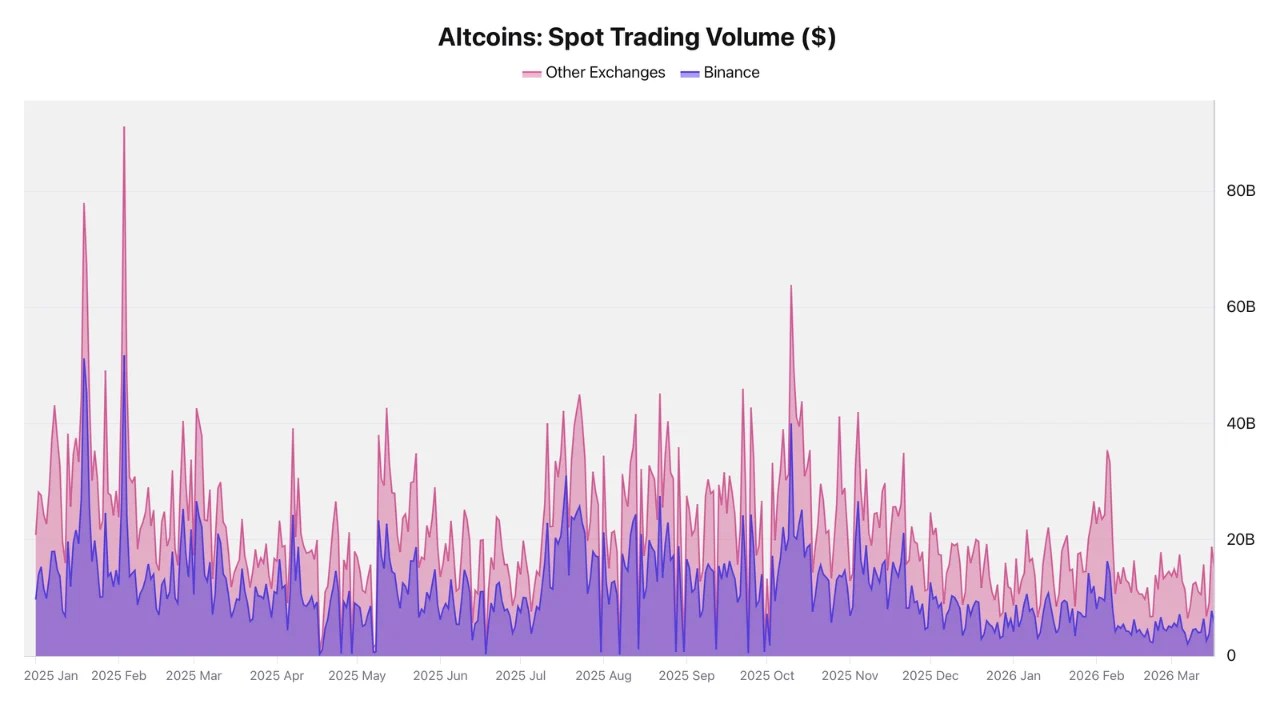
Altcoin Spot Trading Volume | Source: CryptoQuant

The contrast with previous market phases is stark. During more active periods such as October and February 2025, Binance recorded between $40 billion and $50 billion in altcoin trading volume, while other exchanges reached levels between $63 billion and $91 billion. The current environment, therefore, reflects a substantial loss of liquidity and engagement.

In relative terms, Binance now represents roughly 40% of total altcoin trading volume, underscoring its dominance as the primary venue for activity. This concentration suggests that liquidity is not only shrinking but also becoming more centralized.

Importantly, prior volume spikes coincided with local market tops, often driven by FOMO, where late entrants provided exit liquidity for more strategic participants. In contrast, today’s depressed volumes indicate a lack of speculative demand. Historically, however, such conditions have often preceded opportunity, as the most attractive setups tend to emerge when interest is minimal and positioning remains light.

Domande pertinenti

QWhat is the main trend observed in the altcoin market according to the article?

AThe altcoin market is experiencing sustained selling pressure and a persistent decline in trading volumes, reflecting deepening market fatigue and reduced investor participation.

QHow do current altcoin trading volumes on Binance compare to previous active phases?

ACurrent altcoin trading volumes on Binance have dropped to approximately $7.7 billion, a significant decline from the $40 billion to $50 billion recorded during more active periods like October and February 2025.

QWhat broader market conditions are contributing to the weakness in altcoins?

ABroader bear market conditions, ongoing geopolitical tensions, and global economic uncertainty are limiting risk appetite and discouraging aggressive positioning in speculative assets like altcoins.

QWhy are altcoins underperforming Bitcoin in the current environment?

AIn risk-off environments, capital typically consolidates into stronger assets like Bitcoin, which continues to absorb the majority of available liquidity, leaving higher-beta altcoins more exposed to prolonged downside.

QWhat does the concentration of altcoin trading volume on Binance indicate about market liquidity?

ABinance now represents roughly 40% of total altcoin trading volume, indicating that liquidity is not only shrinking but also becoming more centralized on a single exchange.

Letture associate

Can Generative Models Finally Be Trained End-to-End? The Core Is a For Loop

This article introduces a novel training paradigm for generative models called Explorative Modeling (XM), which enables true end-to-end training. Traditionally, powerful generative models like autoregressive and diffusion models are not trained end-to-end. They are trained to predict a single small step but require iterative multi-step sampling for inference. This "exposure bias" leads to error accumulation and limits performance. The core challenge XM addresses is "mode blurring." In generative tasks, a single input (e.g., "generate a dog") corresponds to many valid outputs (multiple modes). Standard training objectives like reconstruction loss force the model to average these modes, producing unrealistic, blurry outputs. To avoid this, existing models break generation into many small, almost deterministic steps, sacrificing end-to-end training. XM tackles this by restructuring the training loop itself. Its key insight is to amplify "generative expressivity." For each training input, instead of generating one sample, the model generates K candidate outputs. Only the candidate closest to the real data is used for computing the loss and updating the model via backpropagation. This simple "best-of-K" mechanism is implemented as a short for-loop. By exploring multiple possibilities, the model learns to distribute its guesses across different modes rather than collapsing to their uninformative average. The paper demonstrates that "exploration" acts as a new, powerful scaling axis. Gains from XM increase with model size, data scale, and compute. Experiments show improvements in FID scores for image generation and significant efficiency gains, sometimes outperforming larger models without exploration. When pushed to the limit, XM enables fully single-step, end-to-end generative models. In robotics tasks, an "Explorative Policy" matched the performance of a 100-step Diffusion Policy with a single forward pass, drastically improving inference speed. While the best-of-K concept is not entirely new, the authors' contribution lies in formally understanding it as a direct method to boost generative expressivity without fragmenting the generation process. This work suggests that as models scale, enhancing exploration during training may become crucial for overcoming fundamental performance bottlenecks.

marsbit29 min fa

Can Generative Models Finally Be Trained End-to-End? The Core Is a For Loop

marsbit29 min fa

Annual Salary of Millions Competing for Electricians, Meta Rushes to Open Its Own Technical School

The AI boom is facing an unexpected bottleneck: a severe shortage of skilled construction workers and electricians. As tech giants like Meta, OpenAI, and Alphabet race to build massive data centers—such as OpenAI's $16 billion "Stargate" project—they are hitting a critical labor wall. The U.S. needs an estimated 130,000 more electricians, 240,000 construction workers, and 150,000 supervisors by 2030 for AI infrastructure alone, but tens of thousands of electrician jobs go unfilled each year. While AI companies offer high premiums, with electricians earning up to $280,000 annually, worker scarcity still causes massive losses—delays on a single project can cost $14.2 million per month. The complexity of building AI data centers, which require immense power (equivalent to powering hundreds of thousands of homes), sophisticated electrical systems, and advanced liquid cooling solutions, demands highly skilled technicians who are in short supply. To combat this, companies are investing heavily in training. Meta has committed $115 million to a free training school offering tuition, housing, and stipends, targeting 5,000 new workers. OpenAI is partnering with unions to secure skilled labor. These efforts are paying off, with a significant rise in Gen Z interest in trade schools over college. However, the power demands are staggering. AI data centers are driving a rapid surge in electricity consumption, projected to account for up to 12% of U.S. power use by 2028 and raising costs for consumers. Furthermore, the construction boom is project-based, leading to a potential future glut of trained workers once building peaks, which could depress wages industry-wide. The race for AI supremacy now depends as much on skilled hands as on advanced chips.

marsbit2 h fa

Annual Salary of Millions Competing for Electricians, Meta Rushes to Open Its Own Technical School

marsbit2 h fa

Trading

Spot
活动图片