From FOMO to Apathy: Altcoin Volumes Reflect Deepening Market Fatigue

bitcoinistPubblicato 2026-03-21Pubblicato ultima volta 2026-03-21

Introduzione

The altcoin market is experiencing sustained weakness and declining trading volumes, reflecting deep investor fatigue and a risk-off environment. Analysis by CryptoQuant highlights a significant drop in activity, with Binance's altcoin volumes falling to around $7.7 billion and other major exchanges totaling approximately $18.8 billion—a sharp contrast to the $40–$50 billion and $63–$91 billion seen during more active periods in late 2024 and early 2025. This contraction signals reduced participation from both retail and institutional traders. Capital continues to flow into Bitcoin rather than altcoins, exacerbating the downturn. Macroeconomic uncertainty and geopolitical tensions are further suppressing risk appetite. Historically, such low-volume environments have often preceded opportunity, but current conditions suggest a prolonged phase of apathy rather than imminent recovery.

The altcoin market continues to struggle under sustained selling pressure, with weakness persisting for several months as broader conditions remain unfavorable for risk assets. Despite intermittent relief rallies, most altcoins have failed to establish meaningful recoveries, reflecting a market still dominated by caution rather than conviction.

Recent insights shared by CryptoQuant analyst Darkfost reinforce this view. The analysis of trading volumes across Binance and other major exchanges highlights a clear and persistent decline in investor interest. Activity levels have dropped significantly compared to previous expansion phases, signaling reduced participation from both retail and institutional traders.

This trend comes as the broader bear market remains firmly in place. Altcoins are not only failing to recover but are also underperforming Bitcoin, which continues to absorb the majority of available liquidity. In risk-off environments, capital typically consolidates into stronger assets, leaving higher-beta altcoins more exposed to prolonged downside.

At the same time, macro conditions continue to weigh on sentiment. Ongoing geopolitical tensions and global economic uncertainty are limiting risk appetite, discouraging aggressive positioning in speculative assets. In this context, the altcoin market reflects a structural contraction, where declining volumes and sustained selling pressure point to a prolonged phase of weakness rather than an imminent recovery.

Altcoin Volumes Collapse as Market Participation Contracts

Darkfost further contextualizes the current weakness by pointing to a sharp decline in altcoin trading volumes across major exchanges. On Binance, volumes have dropped to approximately $7.7 billion, while other leading platforms combined account for around $18.8 billion. These figures mark a significant contraction in activity, reinforcing the view that investor participation has materially declined.
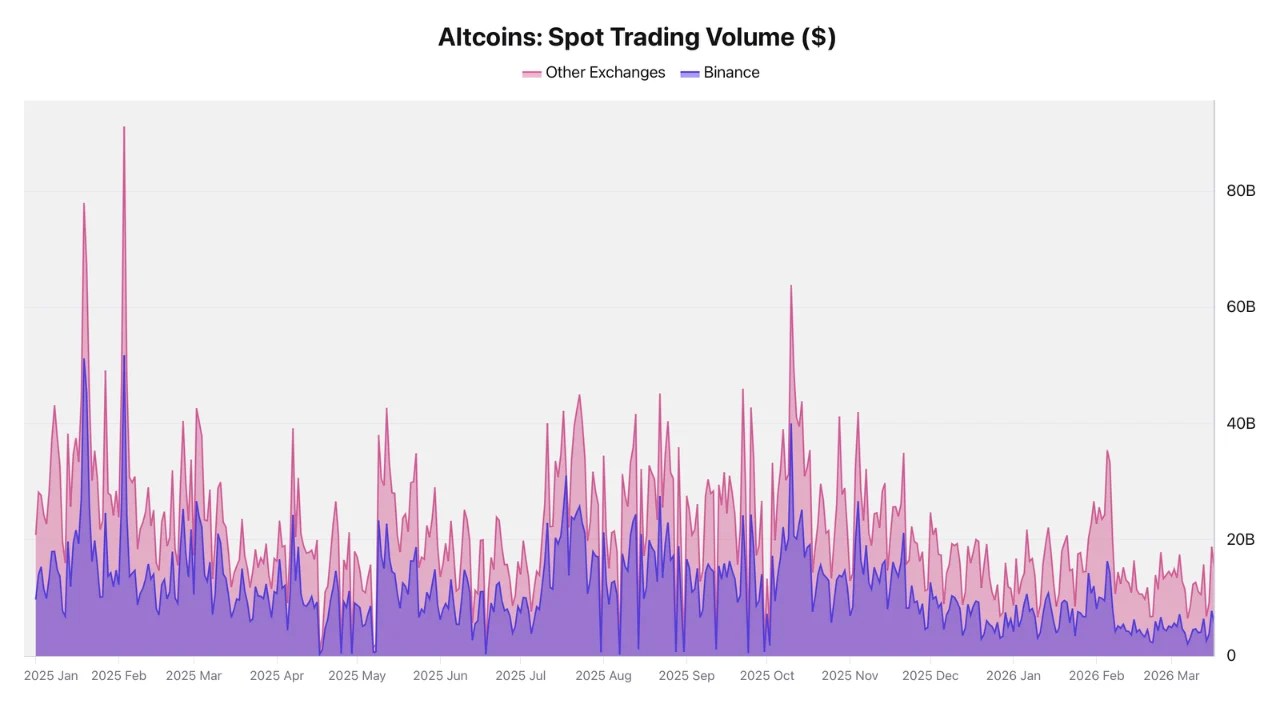
Altcoin Spot Trading Volume | Source: CryptoQuant

The contrast with previous market phases is stark. During more active periods such as October and February 2025, Binance recorded between $40 billion and $50 billion in altcoin trading volume, while other exchanges reached levels between $63 billion and $91 billion. The current environment, therefore, reflects a substantial loss of liquidity and engagement.

In relative terms, Binance now represents roughly 40% of total altcoin trading volume, underscoring its dominance as the primary venue for activity. This concentration suggests that liquidity is not only shrinking but also becoming more centralized.

Importantly, prior volume spikes coincided with local market tops, often driven by FOMO, where late entrants provided exit liquidity for more strategic participants. In contrast, today’s depressed volumes indicate a lack of speculative demand. Historically, however, such conditions have often preceded opportunity, as the most attractive setups tend to emerge when interest is minimal and positioning remains light.


Domande pertinenti

QWhat is the main trend observed in the altcoin market according to the article?

AThe altcoin market is experiencing sustained selling pressure and a persistent decline in trading volumes, reflecting deepening market fatigue and reduced investor participation.

QHow do current altcoin trading volumes on Binance compare to previous active phases?

ACurrent altcoin trading volumes on Binance have dropped to approximately $7.7 billion, a significant decline from the $40 billion to $50 billion recorded during more active periods like October and February 2025.

QWhat broader market conditions are contributing to the weakness in altcoins?

ABroader bear market conditions, ongoing geopolitical tensions, and global economic uncertainty are limiting risk appetite and discouraging aggressive positioning in speculative assets like altcoins.

QWhy are altcoins underperforming Bitcoin in the current environment?

AIn risk-off environments, capital typically consolidates into stronger assets like Bitcoin, which continues to absorb the majority of available liquidity, leaving higher-beta altcoins more exposed to prolonged downside.

QWhat does the concentration of altcoin trading volume on Binance indicate about market liquidity?

ABinance now represents roughly 40% of total altcoin trading volume, indicating that liquidity is not only shrinking but also becoming more centralized on a single exchange.

Letture associate

In Jinjiang, Fujian, a Storage Super Unicorn Lies Quiet

In Fujian's Jinjiang, a city known for sportswear, lies a quiet semiconductor giant: Fujian Jinhua Integrated Circuit Co. (JHICC). Once a promising domestic DRAM manufacturer alongside Yangtze Memory and ChangXin Memory Technologies (CXMT), its journey was derailed in 2018 when the U.S. placed it on an Entity List and filed criminal charges for alleged trade secret theft. This halted production for years. A turning point came in February 2024 when a U.S. federal court found JHICC not guilty. However, it had lost crucial time. While CXMT soared to become a top-valued A-share company in 2024, JHICC, with an estimated valuation of 80 billion RMB, was just restarting. Its current output is primarily customized DDR4 chips, not the advanced DDR5/HBM demanded for AI, but it still benefits from the broader memory chip upcycle. JHICC's story is tied to Chen Zhengkun, a veteran engineer who left Micron to lead the venture. Founded in 2016 with state-backed funding, JHICC partnered with Taiwan's UMC to develop DRAM technology. Rapid progress was cut short by the U.S. actions, which Micron initiated, partly due to its heavy reliance on the Chinese market. Post-sanctions, Chen's team worked to rebuild the production line with reduced reliance on U.S. technology. According to its records, JHICC achieved small-scale production and revenue growth under immense pressure. It now focuses on the stable "niche" DRAM market (e.g., TVs, routers) with a monthly capacity of ~40,000 wafers, aiming for 60,000 by 2026. It holds over 1,000 patents but remains on the Entity List. For Jinjiang, investing in JHICC was a bold industrial leap. The local government provided unwavering financial and logistical support during the crisis, helping the company survive. JHICC has become the anchor for a growing local semiconductor cluster. Though its scale lags behind domestic peers, JHICC's persistence symbolizes a hard-won foothold in a global market long dominated by Samsung, SK Hynix, and Micron. Having missed one boom, it seeks a place in the new AI-driven memory supercycle.

marsbit1 h fa

In Jinjiang, Fujian, a Storage Super Unicorn Lies Quiet

marsbit1 h fa

Trading

Spot
活动图片




