From Aztec to Zcash: Privacy Evolving from 'Gray Industry Tool' to 'Institutional Necessity'

比推Pubblicato 2025-12-26Pubblicato ultima volta 2025-12-26

Introduzione

From Aztec to Zcash: The Rise of Pragmatic Privacy in Blockchain In 2025, blockchain privacy evolved from a niche concern to a mainstream priority, driven by the concept of "pragmatic privacy" that balances individual anonymity with regulatory compliance. This shift is marked by the strong performance of privacy-focused assets like Zcash and new institutional initiatives. Several new privacy-centric blockchains launched or advanced significantly. Aztec Network's Ignition L2 mainnet went live, raising over 6,100 ETH. Nillion launched its "blind computer" mainnet for encrypted data computation. Cosmos-based Namada introduced a "composable privacy" L1, while Miden spun out from Polygon to build its own privacy chain. Umbra raised $154.9 million in an ICO to build on Solana. Horzen transitioned to a Base L3 privacy solution. Institutions are actively embracing privacy. Coinbase hired a team from Iron Fish to develop privacy primitives for Base. Circle is testing a privacy-preserving wrapped USDC (USDCx) on Aleo. The Canton Network and EY's Nightfall L2 are focusing on confidential enterprise solutions. The Ethereum Foundation formed a dedicated "Privacy Cluster" and an "Institutional Privacy Working Group." Vitalik Buterin also launched Kohaku, an open-source wallet framework for compliant privacy. At the application layer, tools like 0xbow's Privacy Pools (based on Vitalik's research) and Railgun (using "proof of innocence") allow users to anonymize transactions without aidi...

Source: The Block

Original Title: From Aztec to Zcash: The year 'pragmatic privacy' took root

Compiled and Edited by: BitpushNews


Since Satoshi Nakamoto wrote the Bitcoin whitepaper, the privacy limitations of blockchain have been evident. The cryptocurrency pioneer pointed out at the time: despite using anonymous mechanisms, Bitcoin addresses could still be traced back to real-world identities.

For many years since, this "pseudo-anonymous" characteristic has been tacitly accepted as "acceptable enough," causing most blockchain privacy projects to remain on the margins for a long time.

However, this year has seen a renewed interest in blockchain privacy, with Zcash becoming one of the best-performing assets of the year, and the Ethereum Foundation launching multiple end-to-end encryption initiatives. The concept of "Pragmatic Privacy" has also begun to take root, aiming to balance individual privacy with compliance considerations.

Emerging Privacy Chains

2025 has witnessed the launch of several new privacy-focused blockchains at various stages of development.

Perhaps the most notable is the Aztec Network's Ignition chain going live on mainnet in November. This is not only because it is the "first fully decentralized L2 on Ethereum," with multiple innovations in consensus and ZK technology, but also because it has overcome numerous obstacles since the project's inception in 2017.

Earlier this month, Ignition also raised 19,476 ETH (approximately $61 million) from 16,741 participants using a new "Continuous Clearing Auction" mechanism co-developed with Uniswap Labs.

Nillion is another blockchain project that launched its mainnet in 2025. This so-called "blind computer" aims to perform computations on encrypted data and has already integrated with multiple networks, including Layer 1's Near and Layer 2's Arbitrum, to enhance privacy at the application layer.

Namada, built on Cosmos, also launched its Layer 1 mainnet in June, focusing on "composable privacy" and supporting multiple blockchain ecosystems—including Bitcoin L2s (like Lombard and Babylon), Ethereum, and Solana—via cross-chain bridges.

Miden, which has been in development since at least 2022, is preparing to launch its mainnet next year. Even so, the project took a huge step towards independence this year: spinning off from Polygon and raising $25 million to build the privacy-focused blockchain Edge.

Similarly, the privacy protocol Umbra, powered by Arcium, conducted its Initial Coin Offering (ICO) on MetaDAO in October, raising $154.9 million. Umbra plans to launch concurrently with Arcium's mainnet Alpha, becoming one of the first privacy protocols built on Solana utilizing its infrastructure.

Horizen, one of the oldest crypto privacy projects, also underwent a major transformation this year: it shut down its proprietary Layer 1 and L2 incubator and relaunched as a Layer 3 privacy solution on Base, the network incubated by Coinbase.

Grayscale, which manages the ZEN token fund, also filed a registration statement with the U.S. Securities and Exchange Commission (SEC) to convert its Grayscale Zcash Trust into the first ZEC ETF. Zcash, which launched the Zebra 3.1 upgrade, has been one of the best-performing tokens in the second half of the year.

Institutional Privacy Initiatives

Coinbase signaled multiple times this year that privacy is not optional for Base. Earlier this year, the company announced it had hired a development team from Iron Fish (a long-standing PoW privacy project) to provide "privacy-preserving primitives" for Base.

Circle, the largest U.S. stablecoin issuer, also made waves by announcing it was testing a privacy-preserving wrapped USDC called USDCx on the Aleo testnet.

USDCx appears to focus on "configurable compliance," aiming to support enterprise-level use cases such as payroll management and e-commerce.

Meanwhile, the Canton Network, backed by Goldman Sachs and BNY Mellon, and Nightfall, an Ethereum L2 incubated by EY, focus on enterprise blockchain solutions that require extreme confidentiality. Nightfall has already announced support for two blockchains: the real-world asset (RWA) network Plume and CELO.

The Ethereum Foundation initiated multiple privacy programs this year, signaling that the topic has moved from a niche research area to a core concern for Ethereum developers. In October, the Foundation formed the so-called "Privacy Cluster," a dedicated team of dozens of engineers aimed at consolidating its privacy efforts, including a roadmap for achieving native end-to-end encryption. The Foundation also launched the "Institutional Privacy Working Group" to guide institutions and enterprises into Ethereum.
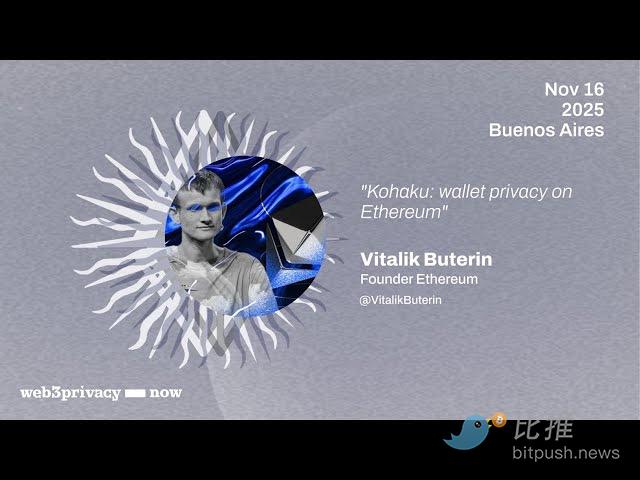
Ethereum's Vitalik Buterin also introduced Kohaku, an open-source centralized wallet framework for privacy, aimed at fostering "default and compliant" privacy features.

Pragmatic Privacy

The concept of "pragmatic privacy" is perhaps most fully realized at the application layer. This year, 0xbow launched Privacy Pools, a tool for ordinary blockchain users to erase transaction records without running into legal trouble.

Privacy Pools are based on research published by Buterin and several other senior cryptographers on "association lists," designed to prevent bad actors from profiting from crypto mixers. The 0xbow team recently raised a $3.5 million seed round, expanded support for Sky's USDS stablecoin, and provided a method for Tornado Cash users to remain anonymous "without helping hackers." It is also part of the Ethereum Foundation's Kahaku software framework.

Similarly, Railgun is listed in Kahaku's GitHub repository as a means of shielding funds. Railgun achieves blockchain privacy through a "proof of innocence" system, where users generate ZK proofs showing their funds/transactions do not belong to a preset list of flagged/malicious addresses.
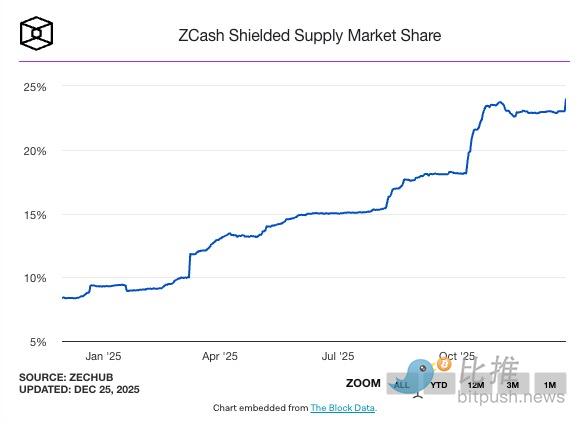
Finally, it's worth noting that as a standard-bearer for crypto privacy, Zcash's anonymous pool supply has grown to nearly 25%, marking a steady increase in network privacy adoption. Zcash provides users with functional privacy and the ability to achieve compliance through selective disclosure of information.


Twitter:https://twitter.com/BitpushNewsCN

Bitpush TG Discussion Group:https://t.me/BitPushCommunity

Bitpush TG Subscription: https://t.me/bitpush

Original link:https://www.bitpush.news/articles/7598558

Domande pertinenti

QWhat is the main concept that has gained traction in blockchain privacy in 2025, as discussed in the article?

AThe main concept is 'Pragmatic Privacy', which aims to balance individual privacy with compliance considerations.

QWhich privacy-focused blockchain launched its mainnet in November 2025 and is noted as 'Ethereum's first fully decentralized L2'?

AAztec Network's Ignition chain launched its mainnet in November 2025 and is described as Ethereum's first fully decentralized L2.

QWhat significant step did the Ethereum Foundation take in October 2025 regarding privacy?

AIn October 2025, the Ethereum Foundation formed a 'Privacy Cluster', a dedicated team of dozens of engineers to consolidate its privacy efforts, including a roadmap for native end-to-end encryption.

QWhat is the purpose of Privacy Pools, as mentioned in the article?

APrivacy Pools is a tool for ordinary blockchain users to erase transaction records without getting into legal trouble, based on research about 'association lists' to prevent bad actors from benefiting from crypto mixers.

QWhich stablecoin issuer is testing a privacy-preserving wrapped version of USDC called USDCx on the Aleo testnet?

ACircle, the largest U.S. stablecoin issuer, is testing a privacy-preserving wrapped version of USDC called USDCx on the Aleo testnet.

Letture associate

KOL's Perspective: Why Is SOL Set to Rise from This Point?

**Summary: Why SOL is Positioned for Growth at This Level** The article argues that SOL is poised for an upward move from its current price point, citing several key factors. Primarily, SOL has just broken out of a 4-month consolidation phase. This breakout signals a return of risk appetite to the broader crypto market, as SOL is seen as a key indicator of overall crypto health. The token's ownership has reportedly shifted from short-term traders and tourists to long-term accumulators, leading to low volume. Any meaningful increase in trading activity could thus trigger significant upward momentum. Fundamental strengths include strong institutional adoption, integration with DeFi and RWAs (Real-World Assets), and the potential benefits from the Clarity Act. Despite its high volatility—having dropped 70% from its all-time high but still up 12x from its bear market low—SOL is highlighted as one of the few tokens from the last cycle to reach new highs. It boasts a robust ecosystem of applications, users, and protocols. Future catalysts include the expected influx of AI developers following the Miami Accelerate conference, which focused on AI on Solana. Furthermore, Solana is positioned as the premier chain for memecoin activity, a trend expected to continue and drive network usage and fees. The article concludes that recent price action reflects a healthy transfer to long-term holders, setting the stage for growth.

marsbit28 min fa

KOL's Perspective: Why Is SOL Set to Rise from This Point?

marsbit28 min fa

Those Pre-Bitcoin PoW Protocols Have Recently Been Reimplemented

This article details a recent surge in replicating pre-Bitcoin Proof-of-Work (PoW) protocols, specifically focusing on Hal Finney's 2004 RPOW (Reusable Proofs of Work). Within five days in May 2026, multiple independent builders in the Bitcoin/cypherpunk community launched projects inspired by this early electronic cash proposal. The initiative began with Fred Krueger's `rpow2.com`, a centralized but auditable system that replaced RPOW's original IBM 4758 hardware with Ed25519 signatures. Initially a faithful replica, it later adopted Bitcoin-like features (21M supply cap, difficulty adjustment) and a controversial 5.24% founder allocation. This sparked rapid forks, including `rpow4.com` which incorporated full Bitcoin parameters, a prediction market (`rpowmarket.com`), and a DEX (`rpow2swap.com`). Concurrently, Mike In Space created a prototype of Wei Dai's 1998 b-money proposal (`b-money.replit.app`), pushing the historical exploration even further back. The article contrasts these centralized, server-dependent experiments with Bitcoin's core innovation of decentralized, trustless consensus. It also highlights a parallel development: the `HASH` project on Ethereum, which uses smart contract hooks to enable a purely fair-launch, browser-mineable PoW token with 0% allocations to team or VCs. The collective activity is framed as a meme-driven, educational exploration of cypherpunk history rather than a serious financial movement, with all projects heavily disclaiming any investment value.

marsbit33 min fa

Those Pre-Bitcoin PoW Protocols Have Recently Been Reimplemented

marsbit33 min fa

South Korean Exchanges 'Battle' Regulators, Challenging the Boundaries of Enforcement and Legislation

South Korea's cryptocurrency industry is engaged in a rare, direct confrontation with regulators. The Financial Intelligence Unit (FIU), the primary anti-money laundering (AML) watchdog, has recently imposed heavy penalties on major exchanges like Upbit and Bithumb for alleged violations involving unregistered overseas VASPs and AML procedures. However, exchanges are now actively challenging these actions in court and through industry associations. In a significant shift, the Seoul Administrative Court ruled in favor of Upbit's operator, Dunamu, overturning part of an FIU-ordered business suspension. The court found the FIU's penalty criteria and justification insufficiently clear. Similarly, the court suspended the enforcement of a six-month business suspension against Bithumb pending a final ruling, citing potential irreversible harm to the exchange. Beyond legal battles, the industry is contesting proposed legislative amendments. The Digital Asset eXchange Alliance (DAXA) strongly opposes a draft rule that would mandate Suspicious Transaction Reports (STRs) for all crypto transfers over 10 million KRW (~$6,800). DAXA argues this "poison pill" clause violates legal principles and would overwhelm the STR system, increasing reports from 63,000 to an estimated 5.45 million annually for major exchanges, thereby crippling effective AML monitoring. This conflict highlights a structural tension in South Korea's crypto governance: comprehensive digital asset laws are still developing, while regulators rely heavily on AML enforcement. The industry's move from passive compliance to active legal and legislative challenges signifies a new phase, pressing for clearer rules and more proportionate enforcement. While short-term disputes may intensify, this clash could ultimately lead to a more mature and sustainable regulatory framework for South Korea's vibrant crypto market.

marsbit1 h fa

South Korean Exchanges 'Battle' Regulators, Challenging the Boundaries of Enforcement and Legislation

marsbit1 h fa

After 50x Storage Surge, Justin Sun Always Looks to the Next Decade

Sun Yuchen, known for his controversial stunts like a $30 million lunch with Warren Buffett (canceled due to a kidney stone) and eating a $6.2 million duct-taped banana, is often overshadowed by a significant fact: his decade-long track record of spotting major investment trends. In 2016, he famously advised young people to invest in Bitcoin, Nvidia, Tesla, and Tencent instead of buying property. A hypothetical $20,000 investment in Nvidia and Tesla from that list would now be worth over 50 million RMB. His latest major call was on November 6, 2025, predicting a "50x storage opportunity" tied to the AI boom, which materialized with Sandisk's stock surging nearly 50-fold by 2026. Looking ahead, Sun now focuses on the next frontier: Physical AI. He identifies four key areas: 1. **Embodied AI/Robotics**: He sees this reaching its "iPhone moment," with companies like UBTech and Galaxy General leading in commercialization. 2. **Drones**: Viewed as the first commercially viable form of Physical AI, revolutionizing sectors from warfare (e.g., AeroVironment's Switchblade) to logistics. 3. **Spatial Computing**: Beyond VR, it's about AI understanding physical space, a foundational technology for robotics and autonomous systems, exemplified by Apple's Vision Pro. 4. **Space Exploration**: After a 2025 suborbital flight with Blue Origin, Sun advocates for space as the ultimate frontier, discussing blockchain's potential role in space asset management and data transactions. His investment philosophy involves betting on entire, inevitable trends rather than single companies. For robotics, he sees Tesla (the body/manufacturer) and Nvidia (the brain/AI platform) as complementary plays. In defense drones, he highlights companies making tanks obsolete (AeroVironment) and those augmenting fighter jets (Kratos). For space, he participated in Blue Origin's flight and anticipates SpaceX's potential IPO to redefine the sector's valuation. Sun Yuchen's vision frames the next two decades not as a revolution in information flow (like the internet), but in the fundamental operation of the physical world through AI-powered robots, autonomous systems, and spatial intelligence, ultimately extending human and AI activity into space. While many still focus on conventional assets, he continues to look toward the next technological horizon.

marsbit2 h fa

After 50x Storage Surge, Justin Sun Always Looks to the Next Decade

marsbit2 h fa

Trading

Spot
Futures
活动图片