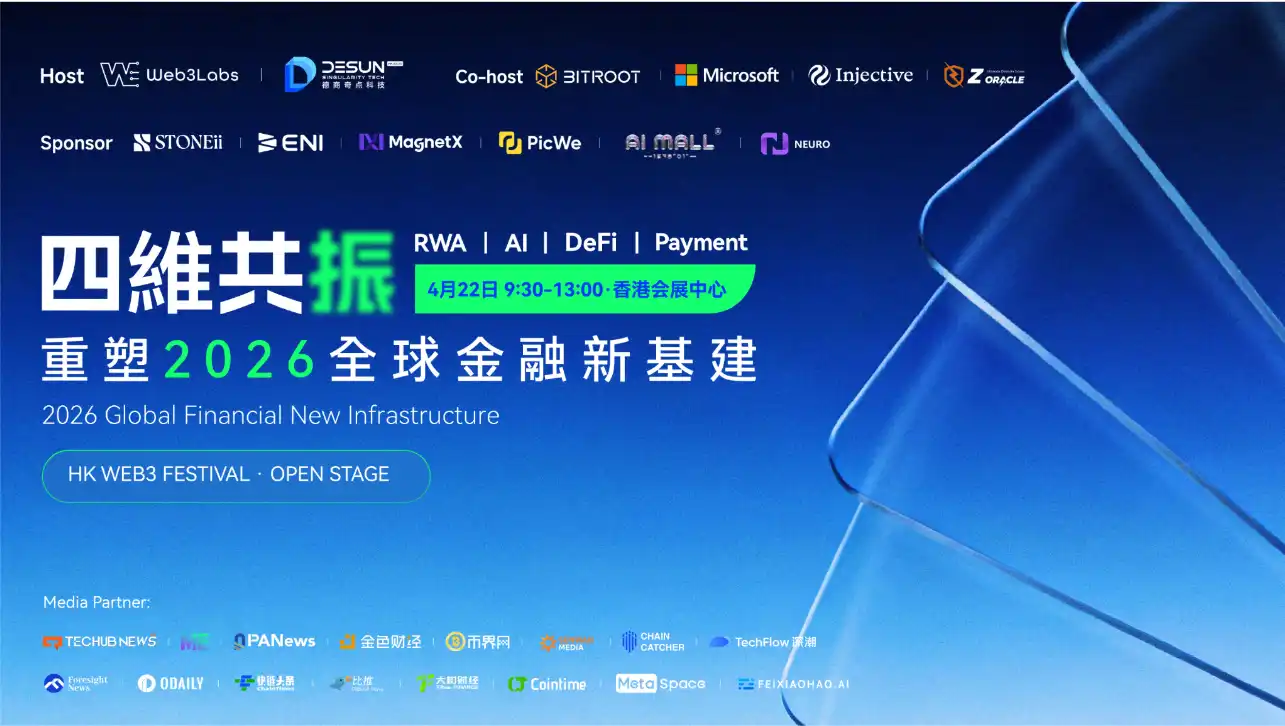
Four-Dimensional Resonance: Hong Kong Web3 Carnival Sub-Forum Co-Creates Blueprint for Global Financial New Infrastructure

marsbitPubblicato 2026-04-23Pubblicato ultima volta 2026-04-23

Introduzione

The "Four-Dimensional Resonance: 2026 Global Financial New Infrastructure" forum, a core event of the Hong Kong Web3 Festival, was successfully held at the Hong Kong Convention and Exhibition Centre. Co-hosted by Web3Labs and DeShang Singularity Tech, with joint support from Bitroot, Injective, Microsoft, and Z Oracle, the event gathered policymakers, industry leaders, and investors to explore the integration and innovation of global financial infrastructure, focusing on RWA, AI, DeFi, and compliant payments. Policy speakers, including Hong Kong Legislative Council Member Mr. Wu Jiezhuang, South Korean National Assembly Member Mr. Min Byung-duk, and ACED Chairman Mr. Yun Seok-hun, emphasized the importance of cross-border regulatory collaboration and an open policy environment for fintech innovation. Web3Labs CEO Caspar and DeShang Singularity Tech CEO Chang Shuai highlighted Hong Kong’s role as a financial innovation center and the approaching "singularity moment" for global financial infrastructure. Technical insights were shared by MagnetX, Bitroot, Microsoft, and Injective on topics including AI Agent economies, the evolution of public blockchains, and AI’s transformative role in finance. Key partnerships and initiatives were launched: - GWDC 2026 Korea collaboration between Hong Kong and South Korea. - A strategic agreement between Web3Labs and Microsoft. - The launch of a public anti-fraud alliance by Z Oracle and partners. - The "Injective Rising Star" program to s...

As one of the core sub-forums of the Hong Kong Web3 Carnival, the "Four-Dimensional Resonance: 2026 Global Financial New Infrastructure" forum was successfully held today at the OpenStage of the Hong Kong Convention and Exhibition Centre. The forum was jointly hosted by Web3Labs and DeShang Singularity Technology, co-hosted by Bitroot, Injective, Microsoft, and Z Oracle, and received strong support from Stoneii, ENI Network, MagnetX, Picwe, AI Mall, and NeuroLabs. The event gathered heavyweight guests from the political, industrial, and investment sectors, focusing on four core areas: RWA (Real World Assets), AI (Artificial Intelligence), DeFi (Decentralized Finance), and compliant payments, to jointly explore the integrated innovation and implementation paths of global financial infrastructure.

Policy Leadership: Cross-Border Collaboration to Build an Inclusive Innovation Environment

The forum specially invited Wu Jiezhuang, Member of the National Committee of the Chinese People's Political Consultative Conference and Chairman of the Hong Kong Legislative Council's Commerce and Innovation Technology Committee, South Korean National Assembly Member Min Byung-deok, and Asia Economic Development Committee Chairman Yoon Seok-hoon to deliver speeches. The three policy guests unanimously emphasized that cross-border regulatory collaboration and policy inclusivity are key to the development of financial technology, calling for the establishment of a more open international financial innovation ecosystem to provide institutional guarantees for the new financial infrastructure in Asia and globally.

Technology-Driven: Outlining the New Blueprint for Financial Infrastructure

Web3Labs CEO Caspar pointed out in the opening speech that Hong Kong, as an international financial innovation hub, needs to drive the synergy of industry, capital, and policy to accelerate the digital upgrade of financial infrastructure. DeShang Singularity Technology CEO Chang Shuai, with the theme "Consensus·Resonance·Symbiosis," proposed that the global financial new infrastructure is ushering in a "singularity moment."

In the keynote speech session, MagnetX Vice President Jerry Yu analyzed the infrastructure construction of the AI Agent economy, pointing out that intelligent agents will become the underlying support for financial operations; Bitroot CEO Juan proposed the "Third Public Chain Revolution of Web3," believing that the evolution of public chain technology will drive financial infrastructure toward a more efficient and trustworthy stage. Microsoft Strategic Technology Lead Jerry Lu and Injective representative Vincent Jin shared insights on "AI's Restructuring from Tool to Operational Layer" and "The New Era of Finance Under the AI Wave," respectively, jointly outlining a new technology-driven vision for financial infrastructure.

Ecosystem Co-Construction: Four Major Cooperation Outcomes Inject New Momentum for Development

The forum featured multiple important launch and signing ceremonies, injecting substantive momentum into the global financial new infrastructure:

· GWDC 2026 Korea Launch: Representatives from Hong Kong and South Korea jointly announced cooperation, marking the beginning of in-depth collaboration between the two regions in the fields of AI and Web3 to accelerate the internationalization process of Asia's financial new infrastructure.

· Web3Labs and Microsoft Strategic Cooperation Signing: The two parties will engage in deep collaboration in cloud computing, AI technology integration, and industrial resource alignment, achieving a powerful combination of tech giants and the Web3 ecosystem.

· Launch of the Civil Anti-Fraud Alliance Platform: Promoted by Z Oracle, the Blockchain Compliance Professionals Association, and SlowMist, among other institutions, the platform aims to build an industry security defense line and create a trustworthy financial ecosystem.

· Injective Rising Star Program Launch: Injective, in collaboration with Web3Labs and Microsoft, officially launched the program. The three parties will engage in deep cooperation in infrastructure, cloud computing, and resource incubation, providing targeted support for global developers working on AI and Web3 integration projects with industrial-level potential.

In-Depth Dialogue: Promoting the Global Layout of Asia's Financial Technology Ecosystem

In the panel discussion session, the forum delved into three core topics: "Web3×AI×Payment," "Institutional-Grade RWA," and "RWA×DeFi." Participants engaged in multi-dimensional discussions on AI-driven payment scenario intelligence, compliant paths for cross-border transactions, and the challenges faced by RWA in institutional applications, such as trust building and liquidity enhancement. There was a consensus that the deep integration of RWA and DeFi will become the core driving force of financial infrastructure, promoting a revolutionary shift from physical to digital paradigms. Through multi-dimensional resonance in policy leadership, technical discussions, and ecosystem co-construction, this forum provided a clear path for the development of global financial new infrastructure. As an international financial and innovation hub, Hong Kong continues to play a bridging role, promoting the global layout and sustainable development of Asia's financial technology ecosystem.

Domande pertinenti

QWhat was the main focus of the 'Four-Dimensional Resonance: 2026 Global Financial New Infrastructure' forum at the Hong Kong Web3 Festival?

AThe forum focused on four core areas: RWA (Real World Assets), AI (Artificial Intelligence), DeFi (Decentralized Finance), and compliant payments, exploring the integrated innovation and implementation paths of global financial infrastructure.

QWhich policy figures delivered speeches at the forum, and what key point did they emphasize?

AThe policy figures were Wu Jiezhuang (Member of the National Committee of the Chinese People's Political Consultative Conference and Chairman of the Hong Kong Legislative Council's Commerce and Innovation Technology Committee), South Korean National Assembly Member Min Byung-duk, and Asian Economic Development Committee Chairman Yoon Seok-hoon. They emphasized that cross-border regulatory collaboration and policy inclusivity are crucial for fintech development.

QWhat significant collaborations or initiatives were announced during the forum?

AKey announcements included the launch of GWDC 2026 Korea (a collaboration between Hong Kong and South Korea in AI and Web3), a strategic partnership between Web3Labs and Microsoft, the launch of the Civil Anti-Fraud Alliance Platform, and the initiation of the Injective Rising Star Program.

QHow did speakers like Jerry Yu and Juan contribute to the forum's discussion on technology-driven financial infrastructure?

AJerry Yu, Vice President of MagnetX, analyzed AI Agent economy infrastructure, stating that intelligent agents will become the underlying support for financial operations. Juan, CEO of Bitroot, proposed the 'Third Public Chain Revolution in Web3,' arguing that public chain technology evolution will drive financial infrastructure towards greater efficiency and trust.

QWhat were the core topics of the panel discussions, and what consensus was reached regarding RWA and DeFi?

AThe panel discussions centered on 'Web3 × AI × Payment,' 'Institutional-Grade RWA,' and 'RWA × DeFi.' Participants agreed that the deep integration of RWA and DeFi will be a core driver of financial infrastructure, facilitating a revolutionary shift from physical to digital finance paradigms.

Letture associate

The Value Distribution of Stablecoins

**Summary: The Value Distribution of Stablecoins** The article argues that stablecoins are evolving from mere trading tools into broader channels for dollar access. It divides the stablecoin ecosystem into four layers to analyze how value is distributed: 1. **Issuance Layer:** Mints stablecoins, holds reserve assets, and captures the spread between reserve yield and user costs (e.g., Tether, Circle). This layer currently earns the largest profit margin. 2. **Infrastructure Layer:** Connects stablecoins to the traditional financial system, handling fiat on/off-ramps, banking integration, compliance (KYC/AML), and asset management (e.g., Bridge, BVNK). This is the "unglamorous" but critical work, building the essential bridges between crypto and real-world finance. 3. **Acquiring/Distribution Layer:** Integrates stablecoins into merchant systems, manages payment flows, and provides enterprise financial software (e.g., Stripe, Coinbase). They act as the access point for businesses. 4. **Application Layer:** The end-users and businesses that ultimately use stablecoins for payments, settlements, or as a store of value. They benefit from convenience but have little pricing power. The core thesis is that while the issuance layer currently dominates profits, the often-overlooked **infrastructure layer holds significant long-term potential**. The real challenge and barrier to mass adoption is not the on-chain transfer of stablecoins (which is simple), but the complex "last mile" integration into existing business workflows, banking systems, and regulatory frameworks across different countries. Companies in this layer are currently in a "land grab" phase, investing heavily to build networks, secure bank partnerships, and establish compliance pathways. While their position is currently pressured by the profitable issuers above and distribution platforms below, the article suggests that if stablecoins become a default financial rail for businesses, the infrastructure providers who have done the hard work of integration will ultimately gain strong pricing power and become entrenched, essential players.

marsbit5 h fa

The Value Distribution of Stablecoins

marsbit5 h fa

The Value Distribution of Stablecoins

The Value Distribution of Stablecoins The article argues that stablecoins are evolving from a mere trading tool into a broad "dollar channel." It analyzes the industry's value chain through four layers: 1. **Issuance Layer (e.g., Tether, Circle):** The top layer that mints stablecoins, holds reserve assets, and captures the thickest interest rate spread. 2. **Infrastructure Layer (e.g., Bridge, BVNK):** Connects stablecoins to the traditional financial system, handling critical but complex "dirty work" like fiat on/off-ramps, banking integration, compliance (KYC/AML), and cross-border settlement. 3. **Acquiring/Distribution Layer (e.g., Stripe, Coinbase):** Embeds stablecoins into merchant systems, manages payment flows, and integrates with enterprise software. 4. **Application Layer:** End-users and businesses that ultimately use stablecoins for payments, settlement, or storing value. The author posits that while the issuance layer currently captures the most profit, the most overlooked and potentially critical layer is infrastructure. The core challenge for stablecoin adoption isn't the on-chain transfer (which is simple), but bridging the gap between blockchain and the real-world financial system. This involves solving practical problems for businesses: fiat conversion, reconciliation, tax handling, and user onboarding. Infrastructure companies are currently in a difficult "land-grab" phase—building networks, securing banking relationships, and achieving compliance country-by-country. They face pressure from both the profitable issuance layer above and distribution platforms below. However, the author suggests this layer is building a crucial moat. Once stablecoins become a default business rail, the infrastructure players who have done the hard work of integration may gain significant, durable value and pricing power.

链捕手5 h fa

The Value Distribution of Stablecoins

链捕手5 h fa

Trading

Spot
Futures

Articoli Popolari

Come comprare CORE

Benvenuto in HTX.com! Abbiamo reso l'acquisto di CORE (CORE) semplice e conveniente. Segui la nostra guida passo passo per intraprendere il tuo viaggio nel mondo delle criptovalute.Step 1: Crea il tuo Account HTXUsa la tua email o numero di telefono per registrarti il tuo account gratuito su HTX. Vivi un'esperienza facile e sblocca tutte le funzionalità,Crea il mio accountStep 2: Vai in Acquista crypto e seleziona il tuo metodo di pagamentoCarta di credito/debito: utilizza la tua Visa o Mastercard per acquistare immediatamente CORECORE.Bilancio: Usa i fondi dal bilancio del tuo account HTX per fare trading senza problemi.Terze parti: abbiamo aggiunto metodi di pagamento molto utilizzati come Google Pay e Apple Pay per maggiore comodità.P2P: Fai trading direttamente con altri utenti HTX.Over-the-Counter (OTC): Offriamo servizi su misura e tassi di cambio competitivi per i trader.Step 3: Conserva CORE (CORE)Dopo aver acquistato CORE (CORE), conserva nel tuo account HTX. In alternativa, puoi inviare tramite trasferimento blockchain o scambiare per altre criptovalute.Step 4: Scambia CORE (CORE)Scambia facilmente CORE (CORE) nel mercato spot di HTX. Accedi al tuo account, seleziona la tua coppia di trading, esegui le tue operazioni e monitora in tempo reale. Offriamo un'esperienza user-friendly sia per chi ha appena iniziato che per i trader più esperti.

229 Totale visualizzazioniPubblicato il 2024.12.13Aggiornato il 2026.06.02

Come comprare CORE

Discussioni

Benvenuto nella Community HTX. Qui puoi rimanere informato sugli ultimi sviluppi della piattaforma e accedere ad approfondimenti esperti sul mercato. Le opinioni degli utenti sul prezzo di CORE CORE sono presentate come di seguito.

活动图片




