Fortune Teller Predicted Hantavirus 4 Years in Advance, Are Market 'Prophets' Among the People?

marsbitPubblicato 2026-05-08Pubblicato ultima volta 2026-05-08

Introduzione

A mysterious 2022 tweet from a user claiming to be a fortune teller, predicting the end of COVID-19 and the emergence of a Hantavirus, has recently gone viral. The tweet resurfaced amid reports of a real Hantavirus outbreak on a cruise ship in May 2025, which resulted in several deaths. The article discusses how this event fueled speculation and anxiety online, which was quickly absorbed by the cryptocurrency market. A Hantavirus-themed meme coin, HANTA, was launched, and prediction markets like Polymarket and Predict.fun created events for users to bet on whether the Hantavirus would be declared a pandemic by the end of 2026. The piece highlights the crypto market's tendency to convert public attention, fear, and speculation into tradable assets. It concludes by noting the internet's role in blending coincidence, emotion, and imagination, creating narratives that straddle the line between reality and urban legend.

Original|Odaily Planet Daily(@OdailyChina)

Author|Wenser(@wenser 2010 )
Last night, an old tweet from June 11, 2022, detonated like a nuclear bomb across the X platform's public opinion sphere. The tweet came from a fortune teller who claimed to be able to "read the future," prophesying not only the end of the COVID-19 pandemic in 2023 but also, with the accuracy of a prophet, pinpointing the recent emergence of the Hantavirus.

For a moment, countless people flocked to the post, leaving various comments. Yet, the account vanished after posting only 5 tweets, disappearing into thin air, adding a mysterious, urban legend-like quality to the entire affair.

Amidst the lingering sense of uncertainty left by the post-pandemic era, discussions about the Hantavirus quickly spilled over from public health topics and evolved into an amplifier of emotions on social media. It was also rapidly absorbed by the crypto market as a new trading narrative. From meme coins to prediction markets, speculative funds always find the points of intense emotion first.

In the stream of information, where truth is hard to discern, and amidst the resonance of group sentiment, the crypto market once again displayed its instinct: to rapidly convert attention, anxiety, and expectations into tradable products and prices.

A Mysterious Tweet from 4 Years Ago, Tied to the Recent Cruise Ship Virus that Killed 3

The story begins with the account @soothsayer.

This account, which has only posted 5 tweets, had received little attention until now. If you ignore that "Hantavirus prophecy" tweet, you might think this account was no different from the ordinary ones on the X platform that post daily "inspirational quotes" and "motivational sayings."

But as the topic of the Hantavirus has gained momentum in recent days, this old tweet has taken on a flavor of "cyber mysticism."

In April of this year, a cruise ship named "Hondius" set sail from Argentina in South America, originally planning to cross the Atlantic to the Canary Islands in Spain. However, during the voyage, a Dutch man suddenly died on board and was later confirmed to have died from the Hantavirus. As of May 6th, the death toll has increased to 3, and the number of infections has risen to 8, including tourists from the Netherlands, the UK, Germany, and other countries. Currently, the cruise ship has been temporarily denied docking due to the Hantavirus, and the WHO is closely monitoring the situation. It's worth noting that around 30 passengers disembarked from the ship in the two weeks prior without a tracking program, spreading across 12 countries.

Therefore, although the WHO clarified that the virus has not shown signs of large-scale spread before, it has inevitably caused public anxiety, with many exclaiming "it reminds me of the fear of being dominated by COVID."

It is worth noting that, according to test results from the South African National Institute for Communicable Diseases and the Geneva University Hospital in Switzerland, the virus type for this outbreak has been confirmed as the Andes Hantavirus.

The vast majority of Hantaviruses are not transmissible between humans, but the Andes virus is the only exception. Such transmission usually occurs among close family members or healthcare workers. Additionally, Hantaviruses mostly infect humans through "rodent-borne" routes. The main transmission methods are divided into three types: respiratory infection, i.e., inhaling aerosols contaminated by rodent excreta; contact infection, i.e., direct contact of broken skin or mucous membranes with excreta from infected rodents; and digestive tract infection, i.e., consuming food contaminated by rodent excreta.

Regarding many people's concern about whether the virus will spread domestically, reliable sources indicate that in China, the disease caused by Hantavirus is known as "Epidemic Hemorrhagic Fever." China has achieved significant results in the prevention and treatment of this virus and its associated diseases, with no current risk of a large-scale outbreak. The Chinese Embassy in Cape Verde previously issued an announcement confirming there were no Chinese citizens on the ship.

Looking back at the fortune teller's tweet, one finds that it not only directly mentions Hantavirus but also dates back four years, which is indeed highly topical.

Hantavirus in Crypto: Meme Coins and Prediction Markets

Following the emergence of the Hantavirus, the crypto market also experienced tremors. Meme coins and prediction markets immediately began their performances.

Community members dug up a Meme coin created a year ago, which officially launched on external platforms on May 4th: HANTA (Hantavirus) Meme coin (2tXpgu2DLTsPUf9zFmuZmA4xrYxXKBTpVq9wAM7hzs9y). Its current market cap is reported to be $12 million, making it a veritable "OG play."

Additionally, on the prediction market front, both Polymarket and Predict.fun have launched betting events related to the Hantavirus.

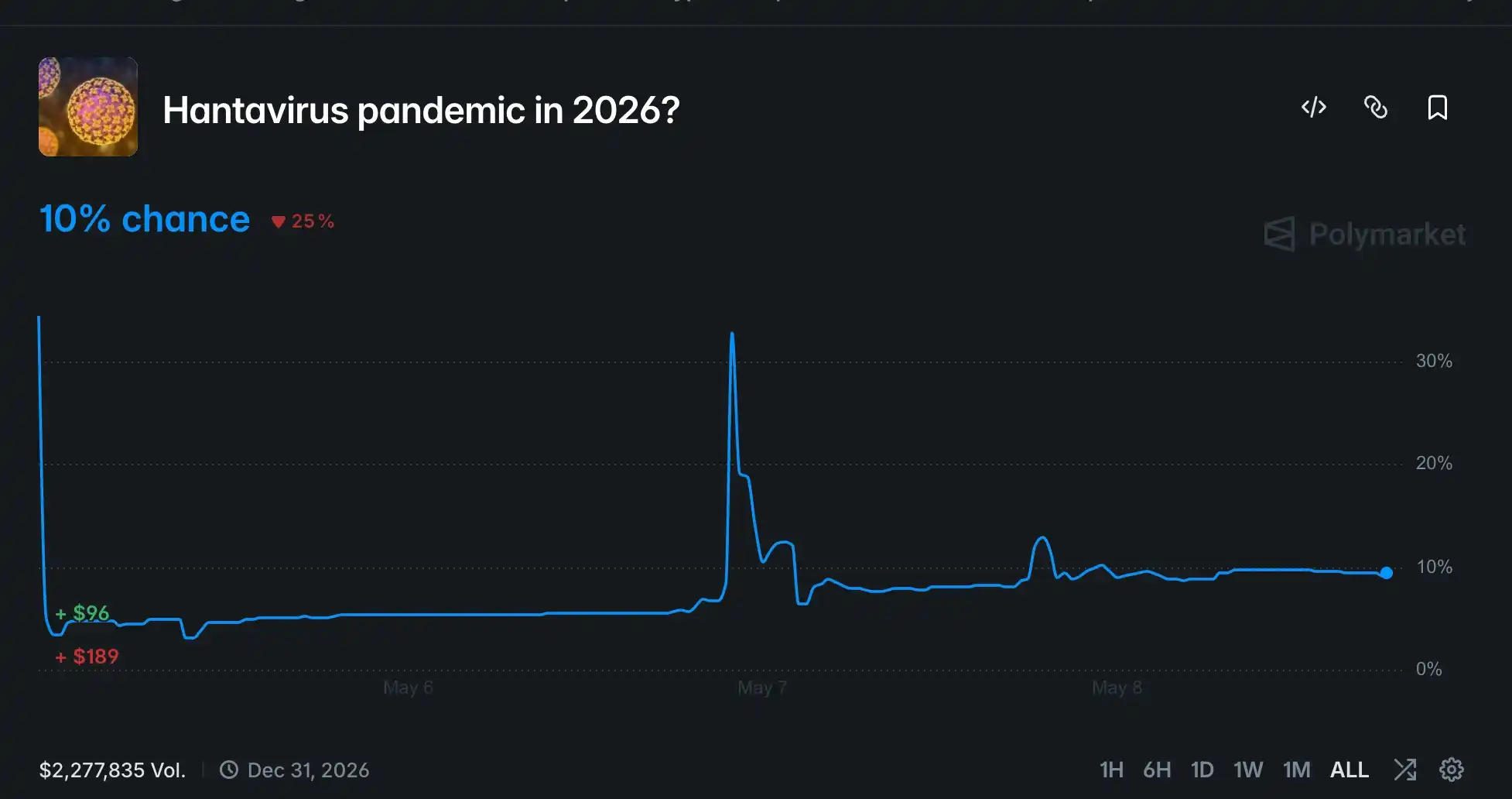
On Polymarket, the probability of the event "Hantavirus Pandemic by 2026" is currently reported at 10%, having previously surged to nearly 35%; the betting amount is currently around $2.27 million. Its resolution rules are: "If the World Health Organization, in official public communications from the time of market creation until 11:59 PM EST on December 31, 2026, explicitly characterizes the Hantavirus, Hantavirus Pulmonary Syndrome (HPS), Hemorrhagic Fever with Renal Syndrome (HFRS), or a Hantavirus-related outbreak as a 'pandemic,' then this market will resolve to 'YES'; otherwise, it will resolve to 'NO.' An explicit characterization includes official WHO statements, reports, press conferences, or publications that explicitly describe the outbreak as a 'pandemic.' Merely declaring it a Public Health Emergency of International Concern (PHEIC) does not qualify unless it is also described as a pandemic. The primary settlement basis for this market will be WHO official communications. Consensus from credible reporting may also serve as a basis."
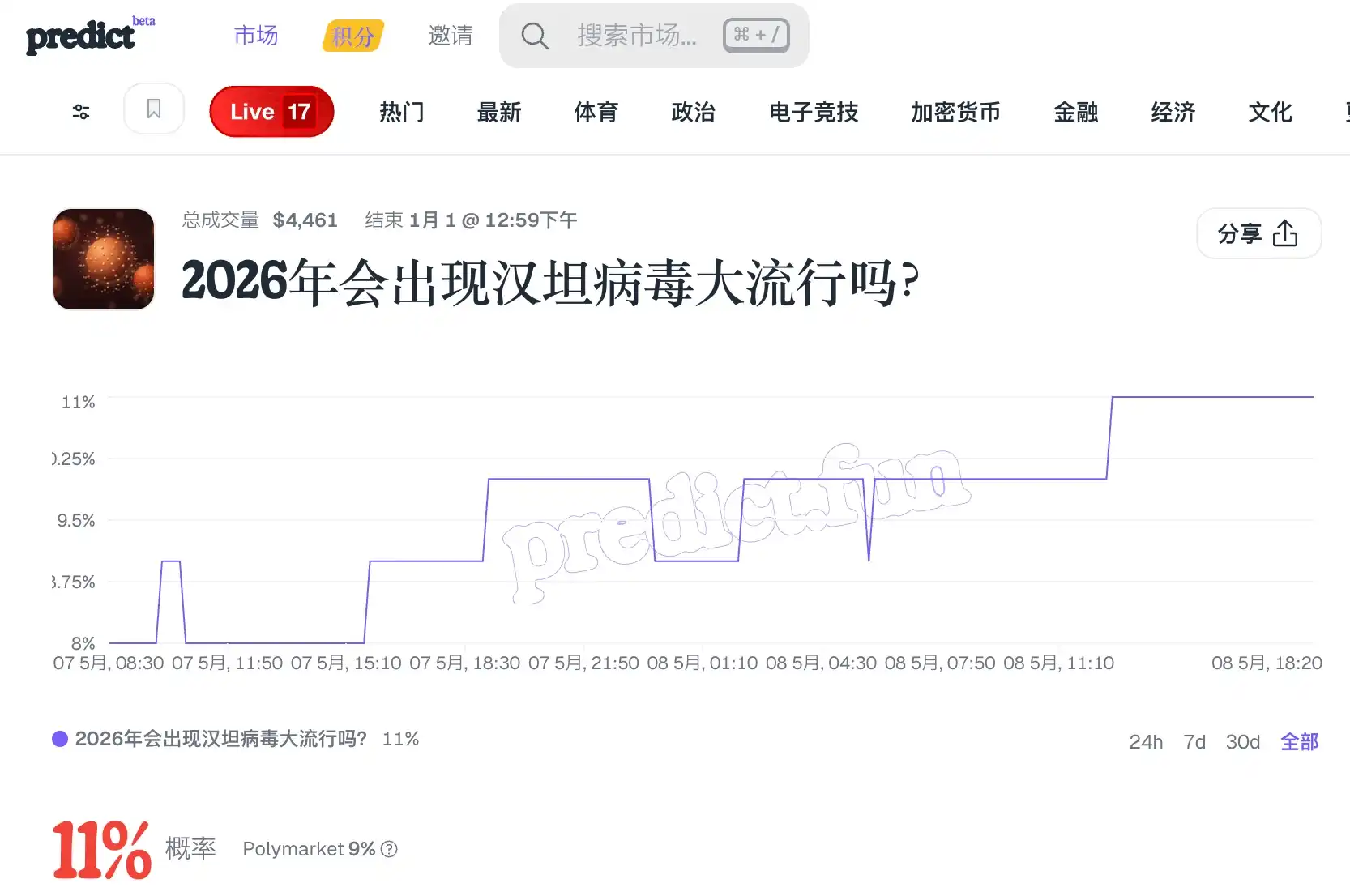
On the Predict.fun platform, the probability for the identically named betting event is currently reported at 11%, slightly higher than Polymarket's data; the betting volume is smaller, only around $4,400. Its resolution rules are similar to Polymarket's, also relying on the WHO's public statements.
For many, betting real money on the future is inherently addictive. The reason prediction markets are becoming increasingly popular is precisely because they turn humanity's anxiety, curiosity, and desire for the unknown directly into tradable commodities.

At the end of the article, let's bring our focus back to the X platform. There are still numerous ancient posts about "Hantavirus" scattered there, some from 2020, some even traceable back to 2012. Some people dig out fragments of text as "divine prophecies," some piece together blurry screenshots into complete stories, and others firmly believe everything was written in advance.

Truth is not important. What truly fascinates people is how the internet always mixes coincidence, fear, emotion, and imagination into something between reality and urban legend, making you can't help but want to click and take a look.

Just as the fortune teller @soothsayer left behind: "Laugh today, weep tomorrow."

Domande pertinenti

QWhat is the core event described in the article that sparked widespread discussion?

AThe article describes how an old tweet from a user named @soothsayer, posted in 2022, went viral because it seemed to predict the recent Hantavirus outbreak on a cruise ship, along with the end of COVID-19 in 2023.

QHow did the cryptocurrency market react to the Hantavirus news according to the article?

AThe cryptocurrency market absorbed the Hantavirus news as a new trading narrative. A Meme coin named HANTA (Hantavirus) was launched, and prediction markets like Polymarket and Predict.fun created events for users to bet on the probability of a Hantavirus pandemic by 2026.

QWhat specific type of Hantavirus was confirmed in the cruise ship outbreak, and why is it notable?

AThe confirmed virus type is the Andes Hantavirus. It is notable because, unlike most other Hantaviruses, the Andes virus is known to be capable of human-to-human transmission, usually among close contacts like family members or healthcare workers.

QWhat are the main transmission routes for Hantaviruses mentioned in the article?

AThe main transmission routes for Hantaviruses mentioned are: respiratory infection (inhaling aerosols contaminated by rodent excreta), contact infection (broken skin or mucous membranes contacting infected rodent excreta), and digestive tract infection (consuming food contaminated by rodent excreta).

QWhat is the article's perspective on the allure of prediction markets in the context of events like the Hantavirus?

AThe article suggests that prediction markets are increasingly popular because they transform human anxiety, curiosity, and desire regarding the unknown into a tradable commodity. People find it addictive to bet real money on future outcomes.

Letture associate

Missed Out on SpaceX's IPO? Take a Look at SpaceX's Complete Supply Chain

SpaceX is now public, but its high valuation and losses may deter some investors. However, the real opportunity, as seen with Apple, Tesla, and Nvidia, may lie in its extensive supply chain. SpaceX, funded primarily by its profitable Starlink service, spends hundreds of billions annually on components for its rockets, satellites, and planned orbital AI data centers, creating significant revenue streams for suppliers. Key suppliers are categorized by their indispensability. The first group includes irreplaceable players like **NVIDIA** (GPUs for AI supercomputers), **Eutelsat (SATS)** (spectrum rights), **Filtronic** (millimeter-wave amplifiers), **Materion (MTRN)** (beryllium alloys), and **STMicroelectronics (STM)** (phased array chips). The second category comprises suppliers costly to replace due to long certification cycles or deep integration, such as **Honeywell (HON)** (flight controls), **Carpenter Technology (CRS)** (specialty steel), **Hexcel (HXL)** (carbon fiber), **Broadcom (AVGO)** (data switching), and **Linde** (industrial gases). The third group involves high-volume, cost-critical manufacturers for mass-produced items like Starlink terminals. Major players here include Taiwanese contract manufacturer **Wistron NeWeb (6285)** and several Chinese-listed firms: **Sunway Communication (300136)**, **Parker Advanced Materials (605123)**, **Western Superconducting (002149)**, and **Yingliu Co., Ltd. (603308)**. Other niche providers include **Tianyin Electromechanical**, **Tongyu Communication**, **Trimble (TRMB)**, **Astronics (ATRO)**, and **CTSH**. The timing is now relevant because: 1) SpaceX's procurement is accelerating with plans for 100 launches in 2026, 30 million Starlink terminals, and orbital data centers. 2) Its IPO has brought unprecedented transparency to its supply chain. 3) This phase mirrors early days of the Tesla supply chain boom. The investment thesis shifts from betting on SpaceX's stock to betting on the steady, order-book-driven revenues of its essential suppliers. Risks remain, such as commodity cycles, geopolitical factors, and technological shifts, but the supply chain offers a potentially less speculative path to participate in SpaceX's growth.

marsbit7 min fa

Missed Out on SpaceX's IPO? Take a Look at SpaceX's Complete Supply Chain

marsbit7 min fa

Jane Street: The Most Powerful Behind-the-Scenes Operator in the Crypto Industry

Jane Street: Crypto's Most Powerful Behind-the-Scenes Operator A recent 13F filing revealed Jane Street, the secretive Wall Street quant giant, drastically reduced its Bitcoin ETF holdings while increasing stakes in Ethereum ETFs. This move highlights its role not as a directional investor, but as a critical infrastructure player extracting "tolls" from crypto's institutionalization. The firm, founded in 2000 and famously lacking a CEO, has systematically embedded itself across crypto markets. It acts as a key Authorized Participant (AP) and market maker for major Bitcoin and Ethereum ETFs, profiting from arbitrage between ETF shares and underlying assets. Its approach combines quantitative prowess with a willingness to hold positions for structural arbitrage, differing from pure high-frequency traders. Jane Street faces allegations related to the 2022 Terra (LUNA) collapse. A lawsuit claims it used non-public information to withdraw $85 million in UST minutes before a critical withdrawal by Terraform Labs, allegedly exacerbating the crash and avoiding over $200 million in losses. The company denies the claims. Further indicating its reach, a wallet suspected to be operated by Jane Street ("JaneStreetIndia") was identified on the prediction market Polymarket. This bot executed over 11,000 high-frequency trades on short-term crypto price movements with a near-perfect win rate, showcasing a套利 strategy divorced from traditional prediction. Beyond trading, Jane Street holds equity in crypto infrastructure like Kraken, 1inch, and Arbitrum, and mining stocks. Its strategy is clear: avoid betting on winners, but secure a position in the market's essential plumbing. By becoming a ubiquitous part of the liquidity infrastructure—from ETFs to OTC trading and potentially链上 markets—Jane Street operates as a market force itself, raising questions about whether crypto's decentralized,散户-friendly alpha is being permanently eroded by traditional finance's most sophisticated players.

Foresight News10 min fa

Jane Street: The Most Powerful Behind-the-Scenes Operator in the Crypto Industry

Foresight News10 min fa

U.S.-Iran Ceasefire: How Much of a Bitcoin Rally Can a Truce Agreement Support?

Headline: "U.S.-Iran Truce: How Much Can a Ceasefire Agreement Propel Bitcoin's Rebound?" On June 15th, Bitcoin rebounded to around $67,255, marking its first return to the $67,000 level since falling below $60,000 earlier in June. Ethereum and Solana also saw significant gains. The immediate driver for this market-wide recovery in crypto and global risk assets was the signing of a U.S.-Iran ceasefire memorandum, with a formal ceremony scheduled for June 19th. The agreement, which includes reopening the Strait of Hormuz, caused oil prices to plunge roughly 5%, easing inflation expectations and boosting prospects for Federal Reserve rate cuts. This macroeconomic shift fueled a rally in U.S. equities, with the Dow Jones hitting a record high. SpaceX's spectacular post-IPO performance further energized market sentiment. However, on-chain and derivatives data from Glassnode suggest this move is more indicative of a technical rebound from deeply oversold conditions rather than a confirmed trend reversal. The crypto market is undergoing noticeable capital rotation. While Bitcoin ETFs recently saw their worst outflows on record, the bleeding has slowed significantly. Meanwhile, new altcoin ETFs for assets like XRP and Solana are attracting substantial inflows, causing Bitcoin's market dominance to drop to 58%. Despite the rebound, the Crypto Fear & Greed Index remains in "Extreme Fear" territory at 22. The price quickly retreated after touching the $67,000 resistance level, indicating selling pressure persists. Analysis shows short-term speculative supply has been heavily washed out, with holder structure shifting toward a more long-term profile. While panic is subsiding and some on-chain metrics point to accumulation at lower prices, the market currently lacks the strong, sustained institutional buying needed to establish a new bullish trend.

Foresight News26 min fa

U.S.-Iran Ceasefire: How Much of a Bitcoin Rally Can a Truce Agreement Support?

Foresight News26 min fa

Copper, the Gold of 2026

Copper: The New Gold for 2026? Market focus has shifted from AI chips to underlying infrastructure, with copper emerging as a key narrative. Its role is evolving beyond "Dr. Copper"—a traditional indicator of economic cycles—due to structural demand growth from AI data centers (requiring massive electrical infrastructure), grid expansion, EVs, and re-industrialization. Estimates suggest data centers alone could require 300,000 tons of copper by 2050. The core bullish thesis is not just demand but a severe supply constraint. New copper mines take ~17 years to develop, while ore grades are declining and new discoveries are scarce, potentially leading to a 30% supply deficit by 2035. This supply rigidity, coupled with strategic importance, is giving copper a "gold-like" scarcity narrative. Major macro investors, including Stanley Druckenmiller, are allocating to copper as a hedge against dollar weakness and for its exposure to energy transition and geopolitics. Traders like Pierre Andurand have projected prices could reach $40,000/ton. Capital inflows are visible in surging futures trading volumes. Copper mining stocks act as leveraged plays on copper prices. Companies like Freeport-McMoRan (FCX) and Southern Copper (SCCO), as well as Chinese miners like CMOC, have seen significant volatility, offering high upside but also steep drawdowns, reflecting operational and geopolitical risks. While copper remains cyclical and won't fully replicate gold's monetary role, its long-term fundamentals have shifted. Its new scarcity premium, driven by a tightening supply structure and expanding electrical demand, suggests its "goldification" is just beginning.

marsbit33 min fa

Copper, the Gold of 2026

marsbit33 min fa

Trading

Spot
Futures

Articoli Popolari

Come comprare 4

Benvenuto in HTX.com! Abbiamo reso l'acquisto di 4 (4) semplice e conveniente. Segui la nostra guida passo passo per intraprendere il tuo viaggio nel mondo delle criptovalute.Step 1: Crea il tuo Account HTXUsa la tua email o numero di telefono per registrarti il tuo account gratuito su HTX. Vivi un'esperienza facile e sblocca tutte le funzionalità,Crea il mio accountStep 2: Vai in Acquista crypto e seleziona il tuo metodo di pagamentoCarta di credito/debito: utilizza la tua Visa o Mastercard per acquistare immediatamente 44.Bilancio: Usa i fondi dal bilancio del tuo account HTX per fare trading senza problemi.Terze parti: abbiamo aggiunto metodi di pagamento molto utilizzati come Google Pay e Apple Pay per maggiore comodità.P2P: Fai trading direttamente con altri utenti HTX.Over-the-Counter (OTC): Offriamo servizi su misura e tassi di cambio competitivi per i trader.Step 3: Conserva 4 (4)Dopo aver acquistato 4 (4), conserva nel tuo account HTX. In alternativa, puoi inviare tramite trasferimento blockchain o scambiare per altre criptovalute.Step 4: Scambia 4 (4)Scambia facilmente 4 (4) nel mercato spot di HTX. Accedi al tuo account, seleziona la tua coppia di trading, esegui le tue operazioni e monitora in tempo reale. Offriamo un'esperienza user-friendly sia per chi ha appena iniziato che per i trader più esperti.

355 Totale visualizzazioniPubblicato il 2025.10.20Aggiornato il 2026.06.02

Come comprare 4

Discussioni

Benvenuto nella Community HTX. Qui puoi rimanere informato sugli ultimi sviluppi della piattaforma e accedere ad approfondimenti esperti sul mercato. Le opinioni degli utenti sul prezzo di 4 4 sono presentate come di seguito.

活动图片