Former White House Crypto Adviser Confident CLARITY Act Will Pass As Deadline Nears

bitcoinistPubblicato 2026-02-17Pubblicato ultima volta 2026-02-17

Introduzione

Former White House crypto adviser Bo Hines expressed confidence that the CLARITY Act, a stalled crypto market structure bill, will pass despite delays. The legislation faces a deadline as the White House pressures the crypto and banking industries to resolve disputes over stablecoin yield restrictions, which raised concerns about deposit flight risks. Hines noted both industries are negotiating under pressure and have proposed compromises, such as giving community banks a larger role. He emphasized the current administration's pro-digital asset stance and urged leveraging this legislative window, which is "rapidly closing" due to the approaching midterm elections. Treasury Secretary Scott Bessent also stressed the urgency, warning that Democratic control in November could hinder the bill's passage.

A former White House crypto adviser has shared his thoughts on the delay of the long-awaited market structure bill and whether the banking and digital assets industry will resolve their differences soon.

Bo Hines Optimistic About Crypto Legislation

On Monday, Bo Hines, CEO of Tether US and former executive director of the US President’s Council of Advisors for Digital Assets, expressed optimism about the passage of the crypto market structure bill, known as the CLARITY Act.

In a recent interview with journalist Eleanor Terret at the Digital Assets at Duke Conference, Hines affirmed that he’s “actually confident that CALRITY will get passed” despite the delay.

It’s worth noting that the highly anticipated legislation has been stalled after hitting a roadblock a month ago due to restrictions on the payment of stablecoin yield, meant to address the banking industry’s concerns of deposit flight risk.

The crypto industry heavily criticized the Senate Banking Committee’s policy, leading to the delay of the mid-January markup session and an extended negotiation process between lawmakers and leaders from both industries.

Now, time seems to be running out, Terret noted, as we approach the alleged White House’s end-of-month deadline for the crypto and banking industries to solve the stablecoin yield dispute.

Due to this, Hines affirmed that both sides “are in the pressure cooker right now,” arguing that the two industries understand they must make concessions to reach an agreement and advance the bill.

As reported by Bitcoinist, the digital assets industry has already proposed some compromises to salvage the crypto legislation, such as giving community banks a larger role in the stablecoin system.

The former White House adviser highlighted the Office of the Comptroller of the Currency’s (OCC) recent moves. Notably, the OCC has started to issue conditional licenses to more digital assets native companies, which he considers will provide a pathway to “find a resolution that (...) protects banks from deposit flight, but also allows these crypto companies to be innovative and offer different solutions to their customers.”

CLARITY Act’s Window ‘Rapidly Closing’

Hines also noted that the crypto industry is aware that they must take advantage of the legislative momentum, “especially under this administration that’s been extremely pro- digital assets.”

As he explained, “this is where you’re going to get the best return on investment in a sense of like what you’ve been doing over the course of (...) the last few years in terms of political activity and engagement.”

Similarly, Patrick Witt, the current executive director of the US President’s Crypto Council, shared a similar perspective on Friday. The advisor affirmed that they are “working hard to address the issues that were raised that led to the postponement of that markup and hopefully get that back on the books soon.”

Nonetheless, he urged lawmakers to keep the momentum going, emphasizing that the window to pass the legislation is still open, but it is “rapidly closing” as the midterm election campaign season approaches, which “takes all the oxygen out of the room.”

The US Secretary of the Treasury Scott Bessent also pressed lawmakers to advance the bill soon, highlighting the importance of getting the legislation on President Donald Trump’s desk before the end of the spring legislative window.

Bessent stressed that the chances of getting a deal done could collapse if Democrats take control in November, recalling the crackdown on the industry during the Biden administration.

“There’s a lot of innovation that goes on adjacent to crypto, the blockchain, and DeFi. So, I think it’s important to get this clarity bill done as soon as possible and on the president’s desk this spring,” he declared on Friday.
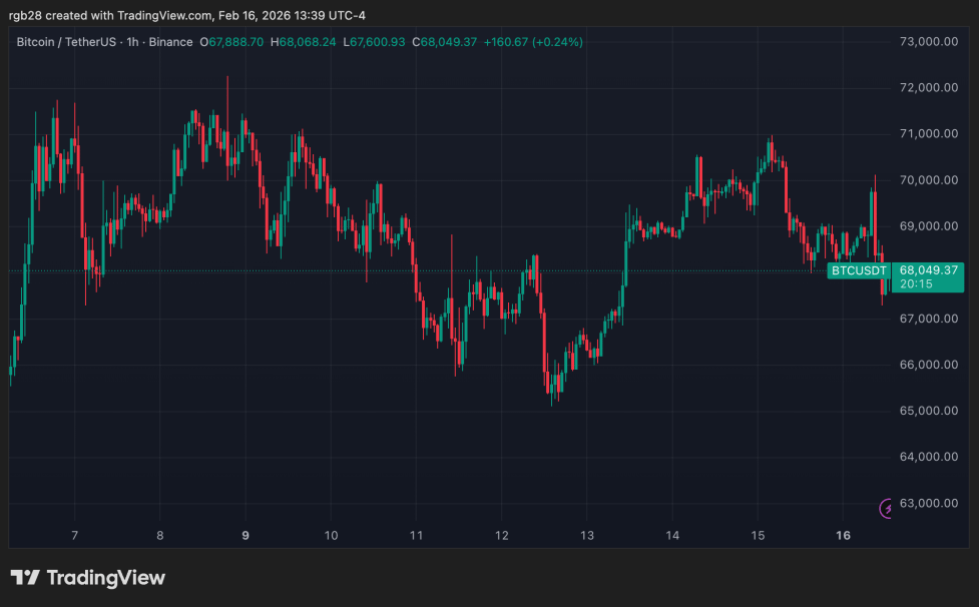
Bitcoin (BTC) trades at $68,049 in the one-week chart. Source: BTCUSDT on TradingView


Crypto di tendenza

Domande pertinenti

QWho is Bo Hines and what is his role in the crypto industry?

ABo Hines is the CEO of Tether US and the former executive director of the US President’s Council of Advisors for Digital Assets.

QWhat is the name of the crypto market structure bill discussed in the article?

AThe crypto market structure bill is called the CLARITY Act.

QWhat was the main reason for the delay of the CLARITY Act's markup session?

AThe delay was caused by restrictions on the payment of stablecoin yield, which were meant to address the banking industry's concerns about deposit flight risk.

QAccording to the article, what is the alleged deadline given to the crypto and banking industries?

AThe alleged White House deadline is the end of the month for the industries to solve the stablecoin yield dispute.

QWhy does the article suggest the window to pass the legislation is 'rapidly closing'?

AThe window is rapidly closing because the midterm election campaign season is approaching, which consumes all the political focus and oxygen in the room.

Letture associate

Must-Watch Events Next Week|CLARITY Act Could Face Senate Vote; SpaceX, Circle to Report Earnings (8.3-8.9)

**Summary: Key Events and Developments to Watch (August 3-9)** The upcoming week is marked by significant financial disclosures, key legislative deadlines, and notable product updates. **Major Financial Events:** Several companies are scheduled to release their Q2 2026 earnings. American Bitcoin (ABTC) will report on August 3, followed by SpaceX and Hut 8 Mining Corp. on August 4, and Circle on August 5. Notably, a significant portion of SpaceX shares (up to 12% of total shares) will be unlocked on August 6 following their earnings release. **Key Legislative Deadline:** The U.S. Senate faces an August 7 deadline to secure 60 votes for the CLARITY Act, a bipartisan bill aiming to establish a federal regulatory framework for cryptocurrencies. The Senate may hold a full vote on the bill during the week. **Economic Data:** The U.S. July Non-Farm Payrolls report will be released on August 7, providing crucial labor market data. **Technology & Product Updates:** * **Shutdowns:** DeFi portfolio tracker Zapper and wallet app Ctrl Wallet will cease operations on August 3. * **Upgrades:** LayerZero will deprecate its v1 relayers on August 3. XRP Ledger's new version 3.3.0, featuring five new functions, is expected next week. * **AI:** Elon Musk announced that the advanced Grok 4.6 AI model is set for release around August 7. * **Bitcoin:** The BIP-110 forced signaling for a potential Bitcoin network change is scheduled to begin around August 8. **Other Notable Events:** Chinese robotics firm Unitree Tech has set its preliminary price inquiry for its IPO for August 5. South Korean exchange Upbit will delist AQT and AERGO tokens on August 3.

marsbit51 min fa

Must-Watch Events Next Week|CLARITY Act Could Face Senate Vote; SpaceX, Circle to Report Earnings (8.3-8.9)

marsbit51 min fa

Stocks Are Plummeting More Sharply Than Cryptocurrencies. Where Has the Money Gone?

Stock Markets Plunge Deeper Than Cryptocurrencies: Where Did the Money Go? In late July, Seoul's Kospi index triggered circuit breakers for two consecutive days, plummeting over 40% from its June high. The collapse was led by heavyweight stocks like SK Hynix, whose record profits still disappointed investors, and devastating leveraged ETFs, with one major product losing over 83% of its value. This signaled a global, forced deleveraging targeting the most crowded trades. Interestingly, while stocks exhibited extreme volatility akin to crypto markets, Bitcoin rose nearly 15% in July after a prior steep drop. Analysis shows the money fleeing equities did not flow into Bitcoin. Instead, Bitcoin had already absorbed its sell-off in May-June, when U.S. spot Bitcoin ETFs saw historic outflows. The true safe-haven beneficiary was gold, whose price rose over 20% year-on-year, highlighting a decoupling between Bitcoin and gold as "digital gold." The sell-off was a targeted unwinding of leveraged positions in tech and semiconductors, accelerated by broker-dealer risk management and shifts in the AI narrative, including new competition from Chinese memory chipmakers. The retreat path was clear: from high-valuation tech stocks to cash and U.S. Treasuries, then to gold. For Bitcoin to attract sustained institutional inflows, conditions like eased global liquidity pressure, a "soft-landing" Fed rate cut, and U.S. regulatory clarity via legislation like the stalled CLARITY Act are needed. Currently, Bitcoin is not a safe haven but an already-cleared asset. Its low correlation with tech stocks, however, makes it a potential diversification play for institutional portfolios once the storm passes. The money isn't here yet, but the positioning is underway.

marsbit51 min fa

Stocks Are Plummeting More Sharply Than Cryptocurrencies. Where Has the Money Gone?

marsbit51 min fa

In Conversation with Ray Dalio: We Are Currently in an AI Bubble, with 1% of My Portfolio in Bitcoin

Ray Dalio, founder of Bridgewater Associates, warns in an interview that the current AI boom shows classic bubble characteristics, which could lead to significant economic downturns as seen in past cycles like 1929 or 2000. He explains that speculative enthusiasm, fueled by debt and overvaluation, often precedes a crash when rising rates or taxation force asset sales, causing widespread losses and recession. Dalio also outlines his "Big Cycle" theory, describing an approximate 80-year pattern where widening wealth gaps, massive government deficits, and shifting geopolitical power (like China's rise) create internal conflict and global instability. He emphasizes that we are in a late-cycle, transitional phase where traditional powers like the US and UK face decline. For personal wealth protection, Dalio advises diversification beyond cash into assets like stocks, bonds, real estate, and particularly gold, which he prefers over Bitcoin. While he holds about 1% of his portfolio in Bitcoin as a non-printable hard asset, he views gold as more secure from technological or governmental threats. Regarding AI's impact, Dalio believes it will disproportionately benefit capital owners, worsening inequality by replacing both physical and cognitive labor. He suggests that human intuition and emotional intelligence, combined with AI, will be key for future workers. On taxation, Dalio argues that wealth taxes are impractical and risk triggering asset sell-offs, reducing productive investment. He points to the UK as a cautionary example of debt, low productivity, and political strife. Geopolitically, Dalio foresees a more regionalized world, with the US showing weakness in prolonged conflicts like with Iran, akin to past imperial declines. The ideal outcome, he suggests, is coexisting powerful blocs (e.g., Americas, China-Asia Pacific) without major war.

marsbit4 h fa

In Conversation with Ray Dalio: We Are Currently in an AI Bubble, with 1% of My Portfolio in Bitcoin

marsbit4 h fa

Daily 7.2 Trillion KRW: Foreign Capital's Record Net Buying on Friday! Wall Street Says Headwinds for Korean Stock Fund Flows Have Subsided

South Korean stock market sees a dramatic shift in fund flows. On July 31, foreign investors made a record net purchase of approximately KRW 7.2 trillion in KOSPI stocks, marking a fundamental reversal from the persistent large-scale net outflows seen in previous months. This contributed to a significant narrowing of foreign net selling in July to KRW 9.8 trillion, down sharply from KRW 48.4 trillion in June and KRW 44.5 trillion in May. Simultaneously, domestic institutional pressure eased. South Korean pension funds and asset managers turned to a net buying position in July, purchasing KRW 1.0 trillion worth of KOSPI shares, contrasting with net sales in May and June. Market volatility is expected to be dampened by new financial regulations. Effective July 31, the Financial Services Commission tightened access for retail investors to single-stock leveraged ETFs by raising the minimum cash deposit requirement. Trading volumes for these products subsequently dropped to about 50% of their monthly average. Citigroup Research maintains its year-end KOSPI target of 10,000 points. The firm cites several supportive factors: the substantial easing of headwinds from capital outflows, a robust fundamental outlook for the semiconductor sector, historically low market valuations, strong economic fundamentals, and the potential for policy support from financial authorities if needed.

marsbit4 h fa

Daily 7.2 Trillion KRW: Foreign Capital's Record Net Buying on Friday! Wall Street Says Headwinds for Korean Stock Fund Flows Have Subsided

marsbit4 h fa

Trading

Spot

Articoli Popolari

Come comprare HOUSE

Benvenuto in HTX.com! Abbiamo reso l'acquisto di Housecoin (HOUSE) semplice e conveniente. Segui la nostra guida passo passo per intraprendere il tuo viaggio nel mondo delle criptovalute.Step 1: Crea il tuo Account HTXUsa la tua email o numero di telefono per registrarti il tuo account gratuito su HTX. Vivi un'esperienza facile e sblocca tutte le funzionalità,Crea il mio accountStep 2: Vai in Acquista crypto e seleziona il tuo metodo di pagamentoCarta di credito/debito: utilizza la tua Visa o Mastercard per acquistare immediatamente HousecoinHOUSE.Bilancio: Usa i fondi dal bilancio del tuo account HTX per fare trading senza problemi.Terze parti: abbiamo aggiunto metodi di pagamento molto utilizzati come Google Pay e Apple Pay per maggiore comodità.P2P: Fai trading direttamente con altri utenti HTX.Over-the-Counter (OTC): Offriamo servizi su misura e tassi di cambio competitivi per i trader.Step 3: Conserva Housecoin (HOUSE)Dopo aver acquistato Housecoin (HOUSE), conserva nel tuo account HTX. In alternativa, puoi inviare tramite trasferimento blockchain o scambiare per altre criptovalute.Step 4: Scambia Housecoin (HOUSE)Scambia facilmente Housecoin (HOUSE) nel mercato spot di HTX. Accedi al tuo account, seleziona la tua coppia di trading, esegui le tue operazioni e monitora in tempo reale. Offriamo un'esperienza user-friendly sia per chi ha appena iniziato che per i trader più esperti.

354 Totale visualizzazioniPubblicato il 2025.04.27Aggiornato il 2026.06.02

Come comprare HOUSE

Discussioni

Benvenuto nella Community HTX. Qui puoi rimanere informato sugli ultimi sviluppi della piattaforma e accedere ad approfondimenti esperti sul mercato. Le opinioni degli utenti sul prezzo di HOUSE HOUSE sono presentate come di seguito.

活动图片












