Former SEC counsel explains what it takes to make RWAs compliant

cointelegraphPubblicato 2025-12-17Pubblicato ultima volta 2025-12-17

Introduzione

Former SEC counsel Ashley Ebersole explains that regulatory engagement, not technology, has been the main constraint for real-world asset (RWA) tokenization. While the SEC initially took an enforcement-heavy approach after its 2017 DAO Report, the agency is now more open to dialogue. Compliant RWA models, such as tokenized equities that confer actual shareholder rights through regulated intermediaries, are feasible. However, challenges remain due to jurisdictional fragmentation—securities laws vary globally, and structures valid in the U.S. may not comply in the E.U. or Asia. Yield-bearing tokens also face scrutiny, as passive returns often trigger securities regulations. Despite these hurdles, growing institutional interest and regulatory shifts are enabling more compliant RWA products to advance.

The key constraint on real-world assets (RWAs) has been regulatory engagement rather than technology, and that dynamic has been shifting in the US, said Ashley Ebersole, chief legal officer of Sologenic.

Ebersole joined the Securities and Exchange Commission (SEC) in early 2015, where he served in the agency’s early internal working groups on crypto and the application of securities law to blockchain-based assets.

The securities regulator published the DAO Report in 2017, asserting its jurisdiction over tokens that met the definition of securities. What followed was an enforcement-led approach that left little room for sustained dialogue with the industry.

“After the DAO Report, it was an enforcement response for the next two years. I expected there would be more of a rotation toward policy while I was still there — that didn’t happen,” he told Cointelegraph.

Ebersole said that posture hardened after he left the agency, shortly before Gary Gensler took the helm in April 2021. From private practice, he continued engaging with the SEC until staff were later discouraged from interacting with crypto firms.

The communication breakdown made it difficult for companies to design legally compliant RWA products and delayed the development of onchain securities models that are now moving into production.
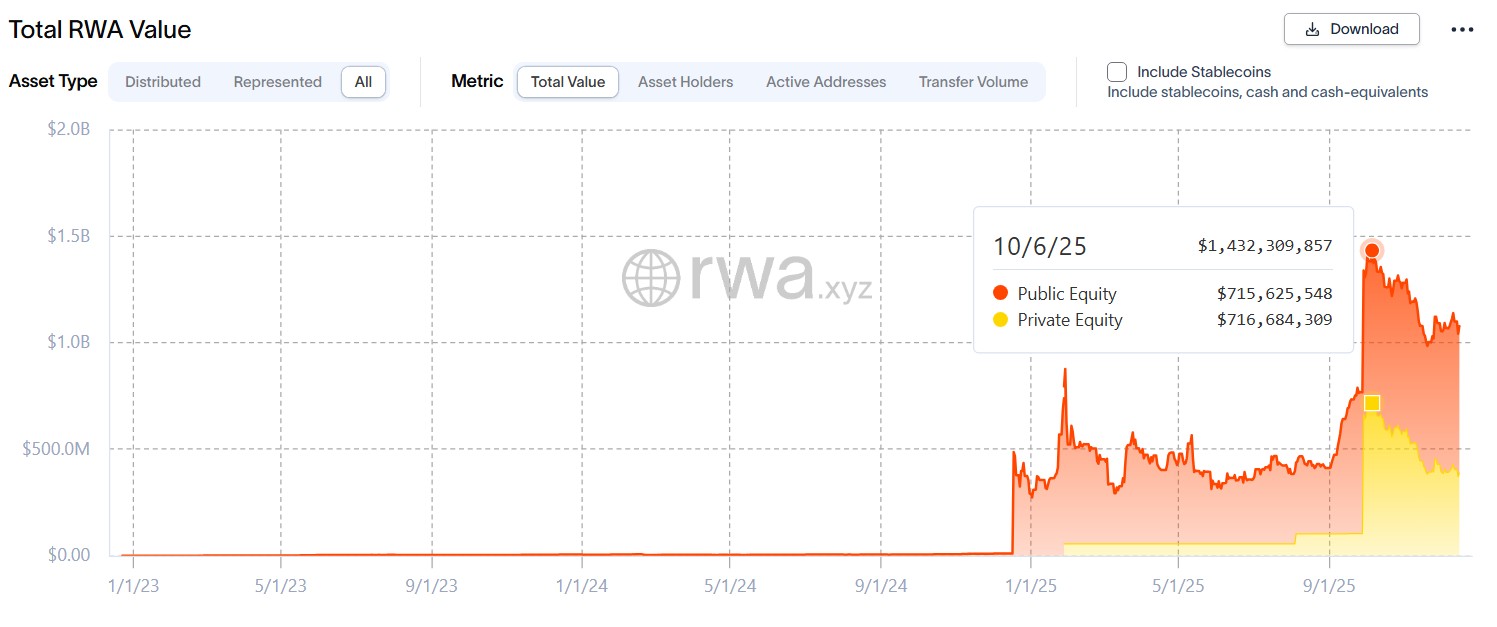
RWA products representing equity boomed in the last quarter of 2025. Source: RWA.xyz

How compliant RWAs can work in practice

The market for tokenized real-world assets is scaling quickly. Standard Chartered has projected that the value of non-stablecoin RWAs could reach $2 trillion by 2028, driven largely by tokenized equities, funds and other traditional financial instruments migrating onto blockchains.
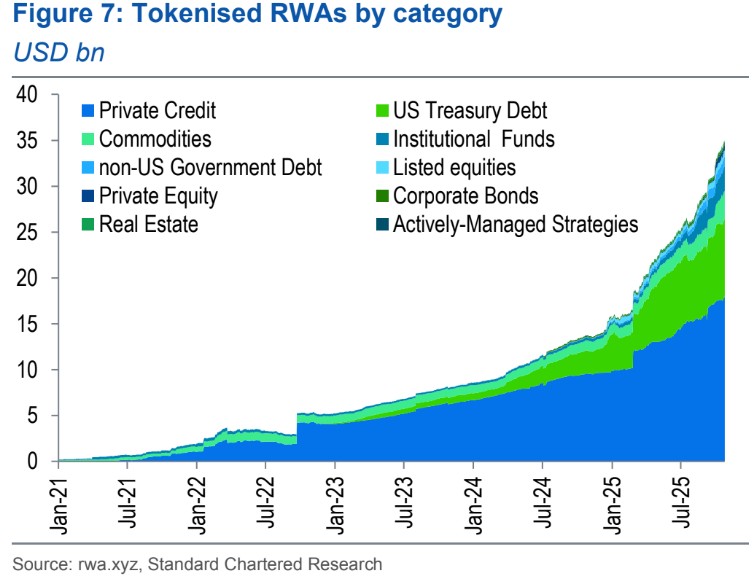
Listed equities represent a small slice of the overall RWA stack. Source: Standard Chartered

Major financial institutions are positioning for that shift. BlackRock is reportedly exploring tokenization to modernize fund infrastructure, while JPMorgan has launched tokenized money-market products on Ethereum.

“There is a right way to do compliant tokenization and issue tokenized assets. It absolutely can be done,” Ebersole said.

Related: Ronin and ZKsync’s onchain metrics fell the most in 2025

One model he pointed to involves stock tokens that function similarly to depository receipts. When a user purchases a token, a corresponding share is acquired and held by a regulated clearing broker, while a token is minted to represent contractual rights to that share.

“You own it. It’s minted at the time of purchase, and it references contractual rights to a share of stock that was purchased at the same time,” Ebersole said.

“And you get the dividends and the voting rights and everything else that comes with being a shareholder, because you are.”

Ebersole said this approach differs from other tokenized stock products that offer price exposure without conferring ownership. In those cases, stock tokens function as synthetic instruments that track the price of an equity without granting shareholder rights or a legal claim on the underlying asset.

The distinction remains relevant today. In late July, Robinhood promoted tokenized exposure linked to OpenAI. The private company publicly distanced itself from the product and said that any transfer of its equity requires approval, which did not occur.

Where RWA tokenization breaks down

Interest in tokenized RWAs is accelerating, but Ebersole warned that it does not eliminate the geographical constraints of securities regulation. In practice, many RWA initiatives run into legal and jurisdictional limits.

Securities laws remain nationally bound even if blockchain infrastructure is not. An RWA structure that complies with US requirements does not automatically translate to the European Union or Asian markets, where separate licensing, disclosure and distribution rules apply.

“The toughest thing we hear about with tokenized RWA projects is the maze of legal requirements that apply to these assets if you’re doing them in a fully legally compliant way,” Ebersole said. “That’s true in the US, and it’s even more complicated globally.”

Related: How crypto is used in 2025: YouTube, Pokémon cards and more

That fragmentation has pushed many platforms toward region-specific offerings. Robinhood’s tokenization offering is limited to EU users. It allows trading in tokenized US stocks and exchange-traded products but does not confer direct ownership of the underlying shares. Instead, the tokens mirror the prices of publicly traded securities and are regulated as blockchain-based derivatives under the bloc’s Markets in Financial Instruments Directive II (MiFID II).
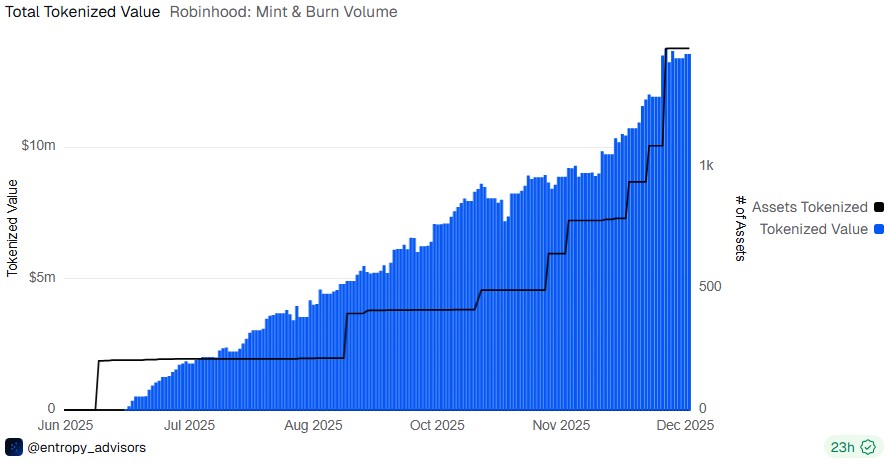
Robinhood has tokenized 1,493 assets consisting of stocks and exchange-traded products. Source: Entropy Advisors/Dune Analytics

Yield is another area where RWA tokenization often runs into regulatory friction. Ebersole noted that regulators draw a sharp distinction between yield generated through a holder’s own actions — such as participating in transaction validation — and yield that accrues passively simply by holding a token.

“If you buy an asset with an inherent yield just by virtue of holding it, regulators are still going to look at that as the hallmark of a security,” he said.

That distinction has already shaped enforcement decisions and continues to influence how tokenized products are structured. While regulatory views on staking and other forms of yield have evolved under the current SEC administration, Ebersole said inherent yield remains a sensitive trigger under current law.

The regulatory shift behind RWA momentum

The practical shift for RWAs has come from a change in how the SEC approaches the industry. During an enforcement-heavy period under the Gensler-led SEC, when staff were discouraged from engaging with crypto firms, would-be issuers were left without a workable path to build compliant onchain products, even when attempting to operate within existing securities law.

That posture has begun to soften as the agency signals greater openness to engagement. Ebersole pointed to recent leadership changes at the SEC, including the arrival of Paul Atkins, as contributing to a tone that treats blockchain technology as infrastructure with potential applications for securities markets rather than as an inherent regulatory risk.

“Now the SEC is engaging a lot with the industry and saying, ‘Come in and tell us if you are trying to do what we’re trying to do, how would you do it?’” Ebersole said.

In that environment, compliant models such as tokenized equities structured through regulated intermediaries and custody arrangements can move from concept to production, even as legal friction persists around cross-border distribution and yield-bearing designs that can still trigger additional securities obligations.

Existing securities law continues to govern RWAs, but the move away from an enforcement-only posture does not, in Ebersole’s view, foreclose the possibility of more tailored rules over time if regulators and the market continue working through remaining gaps.

Magazine: Big questions: Would Bitcoin survive a 10-year power outage?

Domande pertinenti

QWhat has been the main constraint on real-world assets (RWAs) according to Ashley Ebersole?

AThe key constraint on real-world assets (RWAs) has been regulatory engagement rather than technology.

QWhat model did Ebersole point to for compliant tokenization that functions similarly to depository receipts?

AEbersole pointed to a model involving stock tokens where a corresponding share is acquired and held by a regulated clearing broker, while a token is minted to represent contractual rights to that share, granting dividends and voting rights.

QWhy do RWA initiatives often face legal and jurisdictional challenges despite blockchain's borderless nature?

ASecurities laws remain nationally bound, and an RWA structure compliant in one jurisdiction does not automatically apply to others due to separate licensing, disclosure, and distribution rules.

QHow does the SEC's current approach to the crypto industry differ from its enforcement-heavy period under Gary Gensler?

AThe SEC has shifted toward greater openness to engagement, encouraging industry dialogue on compliant models, rather than relying solely on enforcement and discouraging interaction with crypto firms.

QWhat regulatory distinction exists regarding yield generation in tokenized assets that affects their classification as securities?

ARegulators distinguish between yield generated through a holder's active actions (like transaction validation) and passive yield accrued simply by holding a token, with the latter often viewed as a hallmark of a security.

Letture associate

Must-Watch Events Next Week|CLARITY Act Could Face Senate Vote; SpaceX, Circle to Report Earnings (8.3-8.9)

**Summary: Key Events and Developments to Watch (August 3-9)** The upcoming week is marked by significant financial disclosures, key legislative deadlines, and notable product updates. **Major Financial Events:** Several companies are scheduled to release their Q2 2026 earnings. American Bitcoin (ABTC) will report on August 3, followed by SpaceX and Hut 8 Mining Corp. on August 4, and Circle on August 5. Notably, a significant portion of SpaceX shares (up to 12% of total shares) will be unlocked on August 6 following their earnings release. **Key Legislative Deadline:** The U.S. Senate faces an August 7 deadline to secure 60 votes for the CLARITY Act, a bipartisan bill aiming to establish a federal regulatory framework for cryptocurrencies. The Senate may hold a full vote on the bill during the week. **Economic Data:** The U.S. July Non-Farm Payrolls report will be released on August 7, providing crucial labor market data. **Technology & Product Updates:** * **Shutdowns:** DeFi portfolio tracker Zapper and wallet app Ctrl Wallet will cease operations on August 3. * **Upgrades:** LayerZero will deprecate its v1 relayers on August 3. XRP Ledger's new version 3.3.0, featuring five new functions, is expected next week. * **AI:** Elon Musk announced that the advanced Grok 4.6 AI model is set for release around August 7. * **Bitcoin:** The BIP-110 forced signaling for a potential Bitcoin network change is scheduled to begin around August 8. **Other Notable Events:** Chinese robotics firm Unitree Tech has set its preliminary price inquiry for its IPO for August 5. South Korean exchange Upbit will delist AQT and AERGO tokens on August 3.

marsbit41 min fa

Must-Watch Events Next Week|CLARITY Act Could Face Senate Vote; SpaceX, Circle to Report Earnings (8.3-8.9)

marsbit41 min fa

Stocks Are Plummeting More Sharply Than Cryptocurrencies. Where Has the Money Gone?

Stock Markets Plunge Deeper Than Cryptocurrencies: Where Did the Money Go? In late July, Seoul's Kospi index triggered circuit breakers for two consecutive days, plummeting over 40% from its June high. The collapse was led by heavyweight stocks like SK Hynix, whose record profits still disappointed investors, and devastating leveraged ETFs, with one major product losing over 83% of its value. This signaled a global, forced deleveraging targeting the most crowded trades. Interestingly, while stocks exhibited extreme volatility akin to crypto markets, Bitcoin rose nearly 15% in July after a prior steep drop. Analysis shows the money fleeing equities did not flow into Bitcoin. Instead, Bitcoin had already absorbed its sell-off in May-June, when U.S. spot Bitcoin ETFs saw historic outflows. The true safe-haven beneficiary was gold, whose price rose over 20% year-on-year, highlighting a decoupling between Bitcoin and gold as "digital gold." The sell-off was a targeted unwinding of leveraged positions in tech and semiconductors, accelerated by broker-dealer risk management and shifts in the AI narrative, including new competition from Chinese memory chipmakers. The retreat path was clear: from high-valuation tech stocks to cash and U.S. Treasuries, then to gold. For Bitcoin to attract sustained institutional inflows, conditions like eased global liquidity pressure, a "soft-landing" Fed rate cut, and U.S. regulatory clarity via legislation like the stalled CLARITY Act are needed. Currently, Bitcoin is not a safe haven but an already-cleared asset. Its low correlation with tech stocks, however, makes it a potential diversification play for institutional portfolios once the storm passes. The money isn't here yet, but the positioning is underway.

marsbit41 min fa

Stocks Are Plummeting More Sharply Than Cryptocurrencies. Where Has the Money Gone?

marsbit41 min fa

In Conversation with Ray Dalio: We Are Currently in an AI Bubble, with 1% of My Portfolio in Bitcoin

Ray Dalio, founder of Bridgewater Associates, warns in an interview that the current AI boom shows classic bubble characteristics, which could lead to significant economic downturns as seen in past cycles like 1929 or 2000. He explains that speculative enthusiasm, fueled by debt and overvaluation, often precedes a crash when rising rates or taxation force asset sales, causing widespread losses and recession. Dalio also outlines his "Big Cycle" theory, describing an approximate 80-year pattern where widening wealth gaps, massive government deficits, and shifting geopolitical power (like China's rise) create internal conflict and global instability. He emphasizes that we are in a late-cycle, transitional phase where traditional powers like the US and UK face decline. For personal wealth protection, Dalio advises diversification beyond cash into assets like stocks, bonds, real estate, and particularly gold, which he prefers over Bitcoin. While he holds about 1% of his portfolio in Bitcoin as a non-printable hard asset, he views gold as more secure from technological or governmental threats. Regarding AI's impact, Dalio believes it will disproportionately benefit capital owners, worsening inequality by replacing both physical and cognitive labor. He suggests that human intuition and emotional intelligence, combined with AI, will be key for future workers. On taxation, Dalio argues that wealth taxes are impractical and risk triggering asset sell-offs, reducing productive investment. He points to the UK as a cautionary example of debt, low productivity, and political strife. Geopolitically, Dalio foresees a more regionalized world, with the US showing weakness in prolonged conflicts like with Iran, akin to past imperial declines. The ideal outcome, he suggests, is coexisting powerful blocs (e.g., Americas, China-Asia Pacific) without major war.

marsbit4 h fa

In Conversation with Ray Dalio: We Are Currently in an AI Bubble, with 1% of My Portfolio in Bitcoin

marsbit4 h fa

Daily 7.2 Trillion KRW: Foreign Capital's Record Net Buying on Friday! Wall Street Says Headwinds for Korean Stock Fund Flows Have Subsided

South Korean stock market sees a dramatic shift in fund flows. On July 31, foreign investors made a record net purchase of approximately KRW 7.2 trillion in KOSPI stocks, marking a fundamental reversal from the persistent large-scale net outflows seen in previous months. This contributed to a significant narrowing of foreign net selling in July to KRW 9.8 trillion, down sharply from KRW 48.4 trillion in June and KRW 44.5 trillion in May. Simultaneously, domestic institutional pressure eased. South Korean pension funds and asset managers turned to a net buying position in July, purchasing KRW 1.0 trillion worth of KOSPI shares, contrasting with net sales in May and June. Market volatility is expected to be dampened by new financial regulations. Effective July 31, the Financial Services Commission tightened access for retail investors to single-stock leveraged ETFs by raising the minimum cash deposit requirement. Trading volumes for these products subsequently dropped to about 50% of their monthly average. Citigroup Research maintains its year-end KOSPI target of 10,000 points. The firm cites several supportive factors: the substantial easing of headwinds from capital outflows, a robust fundamental outlook for the semiconductor sector, historically low market valuations, strong economic fundamentals, and the potential for policy support from financial authorities if needed.

marsbit4 h fa

Daily 7.2 Trillion KRW: Foreign Capital's Record Net Buying on Friday! Wall Street Says Headwinds for Korean Stock Fund Flows Have Subsided

marsbit4 h fa

Trading

Spot
活动图片





