Former SEC Chair Made Shocking Revelation to Ripple’s CEO During White House Meet

bitcoinistPubblicato 2026-03-03Pubblicato ultima volta 2026-03-03

Introduzione

Former SEC Chair Gary Gensler privately apologized to Ripple CEO Brad Garlinghouse during a White House meeting on digital asset policy in late 2024, admitting he was wrong about XRP and praising Ripple’s work. This marked a significant shift after a four-year legal battle where the SEC sued Ripple for an unregistered securities offering involving XRP. Although the case created regulatory uncertainty and led to exchange delistings, Ripple secured a partial victory in 2023 when a judge ruled XRP was not a security on public markets. Gensler, who resigned in early 2025, had been a controversial figure in crypto for his aggressive enforcement approach. His apology validates Ripple’s stance and suggests a potential change in how Washington may engage with crypto.

XRP Australia 2026 turned into an unexpected window into Washington’s inner workings when Ripple CEO Brad Garlinghouse revealed that former SEC Chair Gary Gensler had privately apologized and admitted, during a high‐level White House meeting, that he had been wrong about XRP. The revelation marks an unbelievable shift in tone after years of aggressive SEC enforcement and a bruising legal battle against Ripple.

Related Reading: XRP Ledger Positioned For Real World Asset Explosion As Securitize Teases $400-T Market

The Room Where It Happened

Ripple CEO Brad Garlinghouse could hardly believe it himself as he recounted to a stunned audience the encounter he had with former SEC Chair Gary Gensler near the end of 2024 at the White House, during a meeting on digital asset policy, just after the SEC–Ripple legal battle had finally wrapped up. According to Garlinghouse’s account, Gensler approached him in private after the session ended: “He comes up to me and he says sorry,” Garlinghouse recalled, laughing, still visibly astonished:

“I’m sorry, I was wrong, and you guys have done an incredible job”

How the SEC vs Ripple Battle Defined XRP

The four-year legal battle between the SEC and Ripple began in December 2020, when the U.S. Securities and Exchange Commission sued Ripple for allegedly raising $1.3 billion through an unregistered securities offering tied to XRP, framing XRP itself as an investment contract. This resulted in many exchanges delisting XRP, putting the token under a huge regulatory cloud for years and the Ripple vs. SEC case becoming a symbol for the entire crypto market.

However, in 2023, Ripple achieved a very important partial victory, when a judge ruled that, despise some issues with certain institutional sales, XRP was not a security when sold on public markets.

More Than An Apology

Gensler, who stepped down from his role as SEC Chair in early 2025, became the face of the enemy for many in crypto as he pushed an aggressive “regulation by enforcement” strategy against digital asset projects, with Garlinghouse himself previously labeling him a “political liability” and an “autocrat”.

Related Reading: XRP’s Macro Plan Hasn’t Changed, And This Target Remains Valid

Therefore, his brief apology to Garlinghouse behind closed doors carries immense weight: it not only validates Ripple’s narrative that the SEC overreached but also hints at a broader shift in how Washington may choose to engage with XRP and the wider crypto industry going forward.
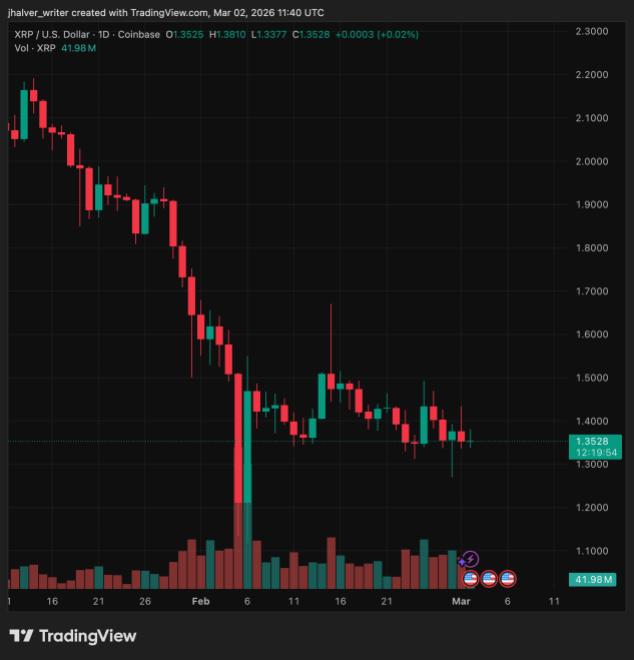
XRP's price trends to the downside on the daily chart. Source: XRPUSD on Tradingview

Cover image from ChatGPT, XRPUSD on TradingView

Domande pertinenti

QWhat shocking revelation did former SEC Chair Gary Gensler make to Ripple's CEO during a White House meeting?

AFormer SEC Chair Gary Gensler privately apologized to Ripple CEO Brad Garlinghouse and admitted, 'I'm sorry, I was wrong, and you guys have done an incredible job.'

QWhen and where did the encounter between Gary Gensler and Brad Garlinghouse take place?

AThe encounter took place near the end of 2024 at the White House, during a meeting on digital asset policy, shortly after the SEC-Ripple legal battle had concluded.

QWhat was the core allegation made by the SEC against Ripple in its 2020 lawsuit?

AThe SEC sued Ripple for allegedly raising $1.3 billion through an unregistered securities offering tied to XRP, framing XRP itself as an investment contract.

QWhat was the significant legal outcome for Ripple in 2023 that preceded this apology?

AIn 2023, a judge ruled that, despite some issues with certain institutional sales, XRP was not a security when sold on public markets, marking a major partial victory for Ripple.

QWhy does Gary Gensler's apology carry immense weight for the crypto industry, according to the article?

AThe apology not only validates Ripple's narrative that the SEC overreached but also hints at a broader shift in how Washington may choose to engage with XRP and the wider crypto industry going forward.

Letture associate

Can a Hair Dryer Earn $34,000? Deciphering the Reflexivity Paradox in Prediction Markets

An individual manipulated a weather sensor at Paris Charles de Gaulle Airport with a portable heat source, causing a Polymarket weather market to settle at 22°C and earning $34,000. This incident highlights a fundamental issue in prediction markets: when a market aims to reflect reality, it also incentivizes participants to influence that reality. Prediction markets operate on two layers: platform rules (what outcome counts as a win) and data sources (what actually happened). While most focus on rules, the real vulnerability lies in the data source. If reality is recorded through a specific source, influencing that source directly affects market settlement. The article categorizes markets by their vulnerability: 1. **Single-point physical data sources** (e.g., weather stations): Easily manipulated through physical interference. 2. **Insider information markets** (e.g., MrBeast video details): Insiders like team members use non-public information to trade. Kalshi fined a剪辑师 $20,000 for insider trading. 3. **Actor-manipulated markets** (e.g., Andrew Tate’s tweet counts): The subject of the market can control the outcome. Evidence suggests Tate’sociated accounts coordinated to profit. 4. **Individual-action markets** (e.g., WNBA disruptions): A single person can execute an event to profit from their pre-placed bets. Kalshi and Polymarket handle these issues differently. Kalshi enforces strict KYC, publicly penalizes insider trading, and reports to regulators. Polymarket, with its anonymous wallet-based system, has historically been more permissive, arguing that insider information improves market accuracy. However, it cooperated with authorities in the "Van Dyke case," where a user traded on classified government information. The core paradox is reflexivity: prediction markets are designed to discover truth, but their financial incentives can distort reality. The more valuable a prediction becomes, the more likely participants are to influence the event itself. The market ceases to be a mirror of reality and instead shapes it.

marsbit47 min fa

Can a Hair Dryer Earn $34,000? Deciphering the Reflexivity Paradox in Prediction Markets

marsbit47 min fa

First Day Review of "Musk's WeChat" XChat: Even Worse Than Expected

Elon Musk's much-anticipated "WeChat-like" app, XChat, has officially launched after multiple delays. The initial review reveals a product that falls short of expectations, offering an experience largely similar to X Platform's (formerly Twitter) direct messages, despite being marketed as an encrypted communication tool. Key observations from the first-day test include: 1. The app's promoted "end-to-end encryption" and its claimed relation to Bitcoin's architecture were criticized by experts as a superficial attempt to capitalize on crypto buzz, with no real technical connection. 2. Musk's vision of an ad-free "secure communication system" is technically met, but only because the app is currently extremely basic, featuring only a single chat interface. 3. A promised anti-screenshot feature appears inconsistent; it works in X Platform group chats but fails within the XChat app itself, where screenshots still capture avatars. 4. The app supports 45 languages and has a 16+ age rating, indicating a broader tolerance for content compared to WeChat's 13+ rating. 5. A puzzling login process requires users to verify the email associated with their X account. 6. The touted encryption" feels minimal in practice, with its presence only indicated by a simple "Encrypted - Yes" label on messages. 7. Disappearing message timers for groups can be set from 5 minutes to 4 weeks, with the timer starting upon being read by a user. 8. Group invite links are shared with X Platform groups. 9. Group size limits are planned to be increased, aiming for 1000 members, a move that has drawn user criticism. 10. The app offers 8 different colored icons, and its chat bubbles are notably similar to WeChat's. Message deletion options mimic Telegram's. Crucially, many pre-announced features like importing X contacts, integrating Grok AI, X Money payments, and Cashtags are not yet available. The initial release is seen as a bare-bones and underwhelming first step.

Odaily星球日报1 h fa

First Day Review of "Musk's WeChat" XChat: Even Worse Than Expected

Odaily星球日报1 h fa

Trading

Spot
Futures

Articoli Popolari

Come comprare HOUSE

Benvenuto in HTX.com! Abbiamo reso l'acquisto di Housecoin (HOUSE) semplice e conveniente. Segui la nostra guida passo passo per intraprendere il tuo viaggio nel mondo delle criptovalute.Step 1: Crea il tuo Account HTXUsa la tua email o numero di telefono per registrarti il tuo account gratuito su HTX. Vivi un'esperienza facile e sblocca tutte le funzionalità,Crea il mio accountStep 2: Vai in Acquista crypto e seleziona il tuo metodo di pagamentoCarta di credito/debito: utilizza la tua Visa o Mastercard per acquistare immediatamente HousecoinHOUSE.Bilancio: Usa i fondi dal bilancio del tuo account HTX per fare trading senza problemi.Terze parti: abbiamo aggiunto metodi di pagamento molto utilizzati come Google Pay e Apple Pay per maggiore comodità.P2P: Fai trading direttamente con altri utenti HTX.Over-the-Counter (OTC): Offriamo servizi su misura e tassi di cambio competitivi per i trader.Step 3: Conserva Housecoin (HOUSE)Dopo aver acquistato Housecoin (HOUSE), conserva nel tuo account HTX. In alternativa, puoi inviare tramite trasferimento blockchain o scambiare per altre criptovalute.Step 4: Scambia Housecoin (HOUSE)Scambia facilmente Housecoin (HOUSE) nel mercato spot di HTX. Accedi al tuo account, seleziona la tua coppia di trading, esegui le tue operazioni e monitora in tempo reale. Offriamo un'esperienza user-friendly sia per chi ha appena iniziato che per i trader più esperti.

243 Totale visualizzazioniPubblicato il 2025.04.27Aggiornato il 2025.04.27

Come comprare HOUSE

Discussioni

Benvenuto nella Community HTX. Qui puoi rimanere informato sugli ultimi sviluppi della piattaforma e accedere ad approfondimenti esperti sul mercato. Le opinioni degli utenti sul prezzo di HOUSE HOUSE sono presentate come di seguito.

活动图片