Former New York Mayor Involved in Rug Pull Allegations: On-Chain Investigation into NYC Token

marsbitPubblicato 2026-01-15Pubblicato ultima volta 2026-01-15

Introduzione

Former New York City Mayor Eric Adams faces allegations of a "rug pull" following the launch of the NYC token. Shortly after its debut on January 13, the token’s value plummeted over 80% when the liquidity pool creator address (9Ty4M4t9MZArhJBKFWbYrzeqdMf2Ua5eHWSRW3LXKyGt) removed approximately 2.377 million USDC just 30 minutes post-launch. This caused the token’s market cap to crash from a high of $600 million to under $100 million. Beosin’s on-chain analysis traced the initial funding to a Mayan bridge and Kraken. After the crash, the same address began making small purchases of NYC tokens, but the price only recovered to around $0.133. The address still holds 1.332 million USDC, resulting in an estimated profit of $330,000. Adams denied personal profit or involvement in removing funds. However, the analysis confirms liquidity manipulation, with only about $1 million returned to liquidity after $2.37 million was withdrawn. This incident highlights the significant risks associated with celebrity-backed tokens.

Author: Beosin

On January 13-14, former New York City Mayor Eric Adams faced significant scrutiny after the token he launched, NYC, experienced a sharp price drop shortly after its release. The Beosin security team conducted a detailed on-chain analysis of the incident and shares the findings below:

Event Overview

On January 13, Beijing time, former New York City Mayor Eric Adams announced the launch of the NYC token (token contract address: Ho5fkxk9uqUuVN5kt7TUFacduWCpKPAuYkM9HD3KAXA2) on social media. However, just 30 minutes after the token went live, the address that created the liquidity pool, 9Ty4M4t9MZArhJBKFWbYrzeqdMf2Ua5eHWSRW3LXKyGt, began removing liquidity:
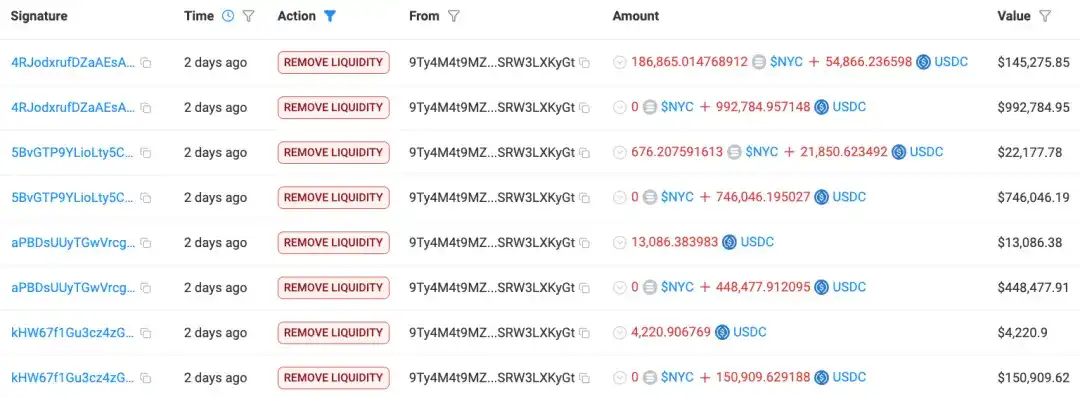
https://solscan.io/account/9Ty4M4t9MZArhJBKFWbYrzeqdMf2Ua5eHWSRW3LXKyGt

This address removed approximately 2,377,376 USDC, causing the price of the NYC token to plummet by over 80%, and its market capitalization to shrink from a peak of $600 million to less than $100 million.
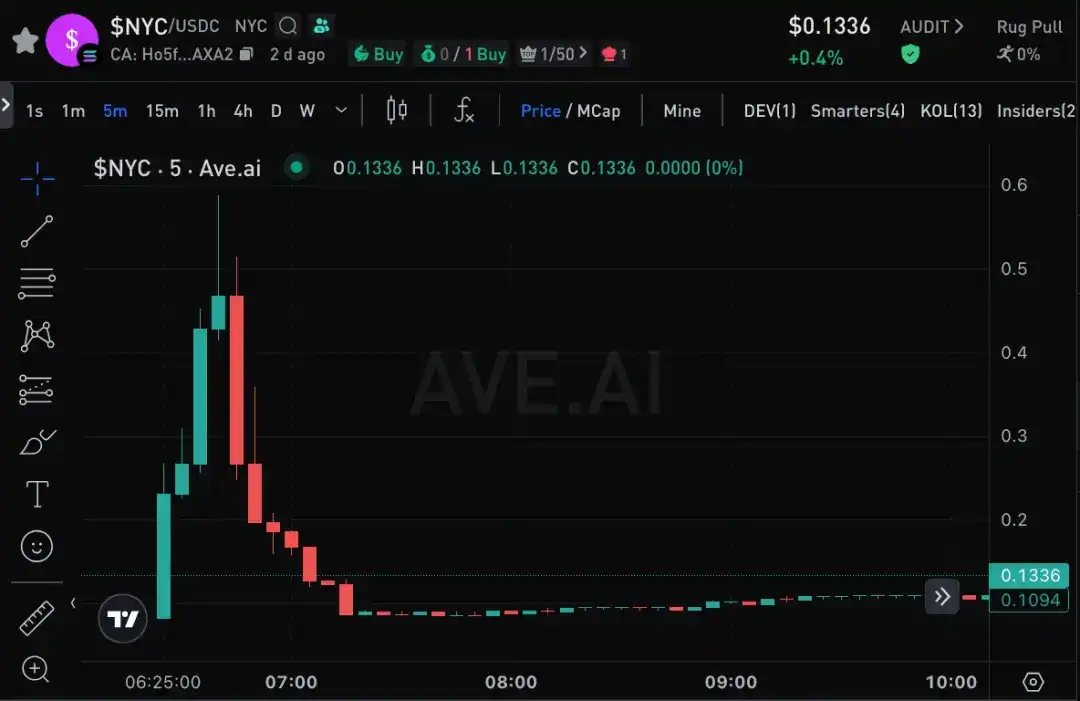
https://ave.ai/token/Ho5fkxk9uqUuVN5kt7TUFacduWCpKPAuYkM9HD3KAXA2-solana

On January 15, Adams continued to promote the NYC token by retweeting related posts and issued a statement through his representative, Todd Shapiro, claiming that he did not profit from the NYC token and did not withdraw any funds from it. However, the community remains skeptical.

On-Chain Data Analysis

Using BeosinTrace to analyze the Solana address 9Ty4M4t9MZArhJBKFWbYrzeqdMf2Ua5eHWSRW3LXKyGt, we obtained the following results regarding its on-chain activities.

1. On-Chain Activity Overview

The address 9Ty4M obtained 1,000,001 USDC from the Mayan cross-chain bridge and a Kraken user address, then created the NYC-USDC liquidity pool. After removing liquidity at 6:43 Beijing time on January 13, which caused the price to crash, the address 9Ty4M began making small purchases of NYC tokens starting at 16:15 on the same day, continuing to the present.
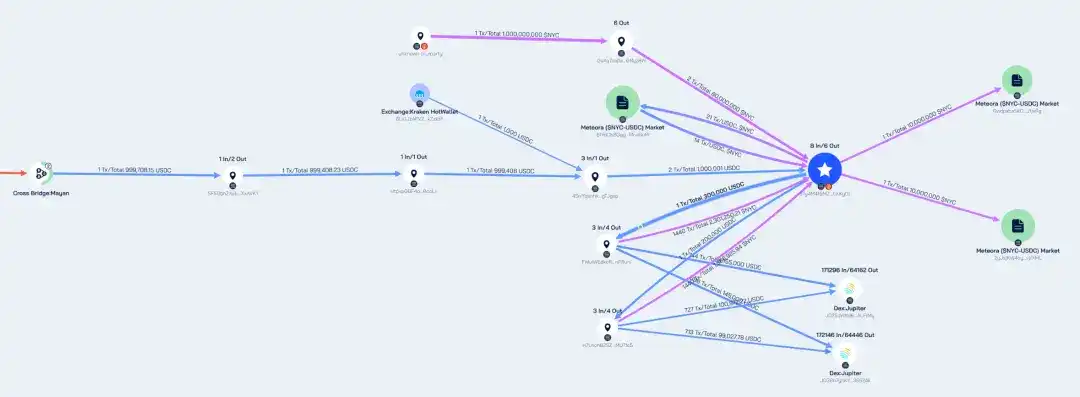
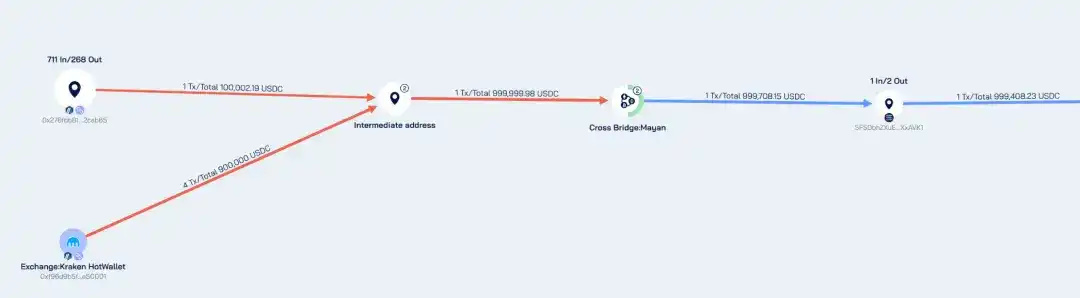
Further tracing of the cross-chain funds reveals that they originated from the Arbitrum address 0xBc985b167C5F3801B19E2Dec7082c2fcbBF07e91. Continuing the trace, it was found that 90% of these funds were withdrawn from Kraken, while 10% came from an unknown multi-chain active trading address, 0x276fbb81c8a7567ad2412469a549bd4dc82cab65.
2. Transaction Data Analysis

According to BeosinTrace data statistics, the address 9Ty4M has purchased 2,301,250 and 1,566,926 NYC tokens via the addresses FWuiWEdkcR1NLPjozcEuErtGGDZG5kyPu3oszmnF8uni and H7Lnoh82SZghsXmoqffoCiFz7U3D1cwZ8ZPjRUMU7fc5, respectively, on Jupiter. However, the price of NYC has only recovered to 0.133-0.134, with a total market capitalization of approximately $130 million.
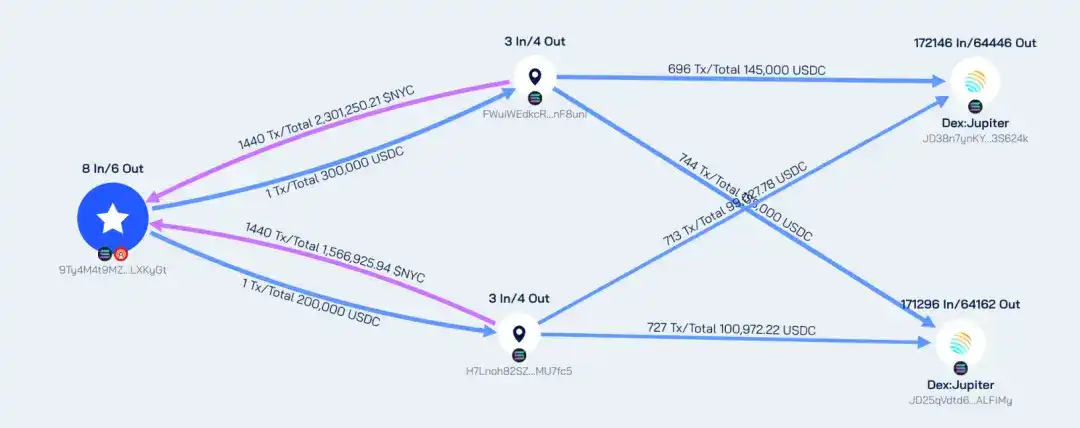
Currently, the address 9Ty4M still holds 1,332,243.85 USDC. Excluding any gains from NYC tokens, this address has profited by approximately $330,000 due to the limited liquidity of the NYC token.

Conclusion

This celebrity token launch has once again sparked significant controversy. Token issuance itself involves risks related to compliance, technology, and fund security. The removal of liquidity, which led to a sharp decline in the token's price, has negatively impacted investors and the market.

The on-chain analysis using BeosinTrace confirms the existence of "liquidity manipulation" behavior. After withdrawing $2.37 million in liquidity, the issuer continued to make purchases but only returned approximately $1 million, with the remaining $1.33 million still held in the issuer's address. Users should enhance their security awareness and avoid trading such high-risk, easily manipulated tokens. Beosin will continue to monitor the token's liquidity situation and the fund movements of related addresses to safeguard users' funds.


Domande pertinenti

QWhat is the main controversy surrounding former New York City Mayor Eric Adams and the NYC token?

AFormer NYC Mayor Eric Adams is facing controversy after the NYC token, which he promoted, experienced a price crash of over 80% shortly after launch. This occurred when the address that set up the liquidity pool removed approximately 2.38 million USDC, leading to accusations of a 'Rug Pull'.

QWhat on-chain evidence from BeosinTrace suggests a 'liquidity manipulation' in the NYC token incident?

ABeosinTrace analysis revealed that the address '9Ty4M...' removed liquidity worth about 2.38 million USDC 30 minutes after the token launch, causing the price to crash. Later, the same address began buying back NYC tokens in small amounts, but only returned approximately 1 million USDC worth of value, while 1.33 million USDC remained in their wallet, indicating a net withdrawal of funds.

QWhat was the source of the initial funds used to create the NYC token liquidity pool according to the investigation?

AThe investigation traced the initial 1,000,001 USDC used to create the liquidity pool. It originated from the Mayan cross-chain bridge and a Kraken user address. Further tracing showed these funds came from an Arbitrum address, with 90% withdrawn from Kraken and 10% from an unknown multi-chain active trading address.

QHow did Eric Adams and his spokesperson respond to the allegations regarding the NYC token?

AEric Adams continued to promote the NYC token after the incident. His spokesperson, Todd Shapiro, stated that Adams did not personally profit from the token and did not remove any funds from it, though the statement did not alleviate community skepticism.

QWhat is the current status of the address that removed the liquidity, and what is their estimated profit?

AThe address '9Ty4M...' still holds 1,332,243.85 USDC. After accounting for the value of the NYC tokens it bought back, the investigation estimates the address has a profit of approximately $330,000 from this activity.

Letture associate

Stuck Polymarket: The Real Test After Riding the Traffic Boom Has Arrived

Polymarket, a leading prediction market platform, is facing significant technical challenges as its growth outpaces its current infrastructure on Polygon. Users are experiencing laggy transactions, unresponsive orders, and delayed confirmations, severely impacting the trading experience. In response, DeFi Engineering VP Josh Stevens outlined a comprehensive engineering overhaul. The plan includes reducing on-chain data delays, fixing order cancellation issues, rebuilding the central limit order book (CLOB), improving website performance, and developing a unified SDK and API. A major revelation was the ongoing "chain migration," indicating a potential move away from Polygon. The core issue is that Polymarket has evolved from a simple prediction market into a high-frequency trading platform, making Polygon's limitations—such as block space, gas fees, and block time—a ceiling for further growth. The migration is not just a simple chain switch but a fundamental rebuild of its trading system to support more complex products like perpetual contracts (Perps). This announcement has sparked competition among chains like Solana, Sui, and Algorand, all vying to host Polymarket. For Polygon, losing this key application, which contributes significantly to its gas fee revenue, would be a major setback. The real test for Polymarket is no longer attracting users but proving it can provide a stable, reliable trading environment that retains them.

Odaily星球日报1 h fa

Stuck Polymarket: The Real Test After Riding the Traffic Boom Has Arrived

Odaily星球日报1 h fa

Trading

Spot
Futures
活动图片