Ford's stock price surged 20% in a single day: The traditional automaker is also pivoting to AI

marsbitPubblicato 2026-05-15Pubblicato ultima volta 2026-05-15

Introduzione

Ford's stock surged 20% after it announced the creation of a new subsidiary, Ford Energy, investing $2 billion to build a 20 GWh energy storage system plant. Morgan Stanley valued this business at $10 billion, betting its margins could far exceed Ford's traditional auto division. The valuation is tied to a projected 49 GW U.S. power shortage by 2028, driven by booming data center demand concentrated in four key corridors. However, the massive subsidies funding this AI infrastructure boom, like a $3.3 billion package for a Meta data center in Louisiana, face growing scrutiny. Public opposition to local data centers (70%) now exceeds that for nuclear plants due to their strain on grids, limited job creation, and high fiscal cost. Ford's $8 billion market cap gain hinges on the continuation of this ecosystem: sustained subsidies, unmet power demand, and manageable public backlash. If any of these constraints—physical power shortages, state budget limits, or voter opposition—tightens, a widespread repricing could follow.

On May 11th, Ford established its wholly-owned subsidiary Ford Energy, investing $2 billion to transform its Glendale factory in Kentucky, targeting an annual production capacity of 20 GWh for energy storage systems. The next day, Morgan Stanley analyst Andrew Percoco valued this standalone business unit at $10 billion. The market reaction was immediate: Ford's stock price rose from $11.99 to $14.48 over two trading days, adding approximately $8 billion to its market cap.

The story up to this point resembles the standard script of another "traditional automaker being repriced by AI." But a look at the supply-side ledger reveals another name: the state of Louisiana.

What is the market revaluing?

Morgan Stanley's $10 billion valuation for Ford Energy was not pulled out of thin air. Percoco's report assumed Ford Energy would achieve a 25% gross margin and $346 million in EBIT by 2028, then applied the price-to-sales multiples of leading energy storage companies to work backwards. Compared to the profit structure of Ford's existing business, this is an entirely different species.

Ford's 2024 financial report shows that its Ford Blue internal combustion engine division generated annual revenue of $145.4 billion with an EBIT of only $5.28 billion, a margin of 3.6%. Industry estimates place the per-vehicle gross margin for selling an F-150 in the 10-13% range. The energy storage industry, meanwhile, operates on a completely different scale. According to various company reports, Tesla's Megapack business boasts a 26.2% gross margin, Sungrow Power's energy storage business exceeded 28% in the first half of 2024, and pure-play system integrator Fluence sits between 12-14%. Morgan Stanley is betting that Ford's cost structure—building its own LFP battery cells and retrofitting existing EV factories—can place it within the leading range, with a per-GWh gross margin at least double that of selling an F-150.
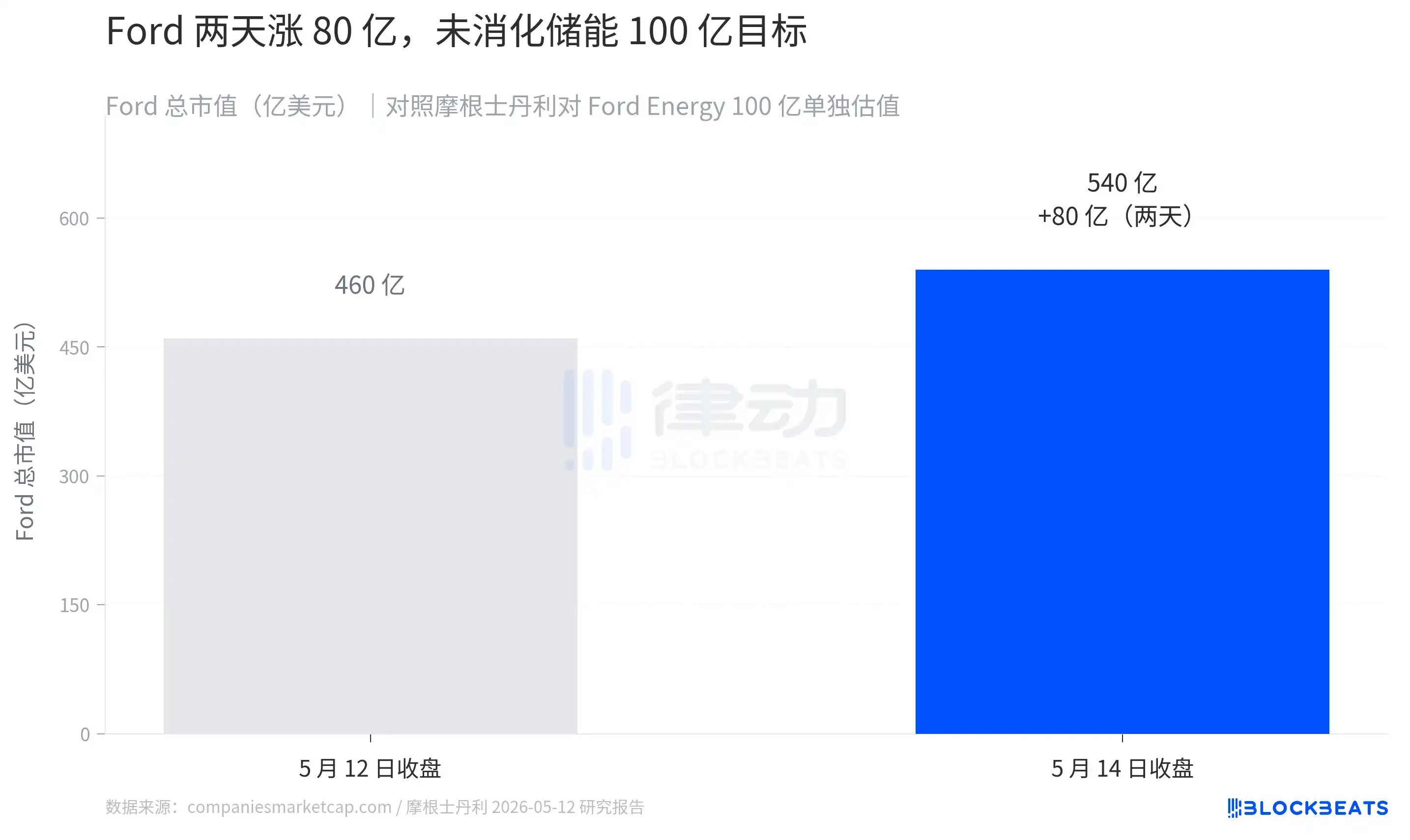
This is the reason the market is willing to pay a premium. But the market has only priced in $8 billion so far. Morgan Stanley's $10 billion target implies an additional $2 billion not yet digested. The revaluation is in its early stages.

To absorb that remaining $2 billion, Ford Energy needs to deliver on capacity, contracts, and pricing. Production capacity is expected only in the second half of 2027, while contracts depend on downstream buyers—those regions scrambling most aggressively for electricity.

The Four Corridors

In the same research report, Morgan Stanley provided another figure. U.S. data center installed power capacity was 40 GW in 2024 and is projected to reach 79 GW by 2027. By 2028, a gap of approximately 49 GW is expected between demand and supply, representing a 20% shortfall. This gap will not be evenly distributed across 50 states.

Based on currently public data center power applications, the gap is concentrated in four corridors. The APS service area in Phoenix, Arizona, has a backlog of 30 GW in its queue. Loudoun County, Virginia, has capacity either signed or nearing signature of 14.2 GW. In Abilene, Texas, the OpenAI-led Stargate project alone requires 1.2 GW. Hillsboro, Oregon, has another 0.4 GW. The figures differ in scope: Phoenix's 30 GW includes projects in utility queues yet to be finalized, while Loudoun's 14.2 GW represents actual capacity close to being contracted.
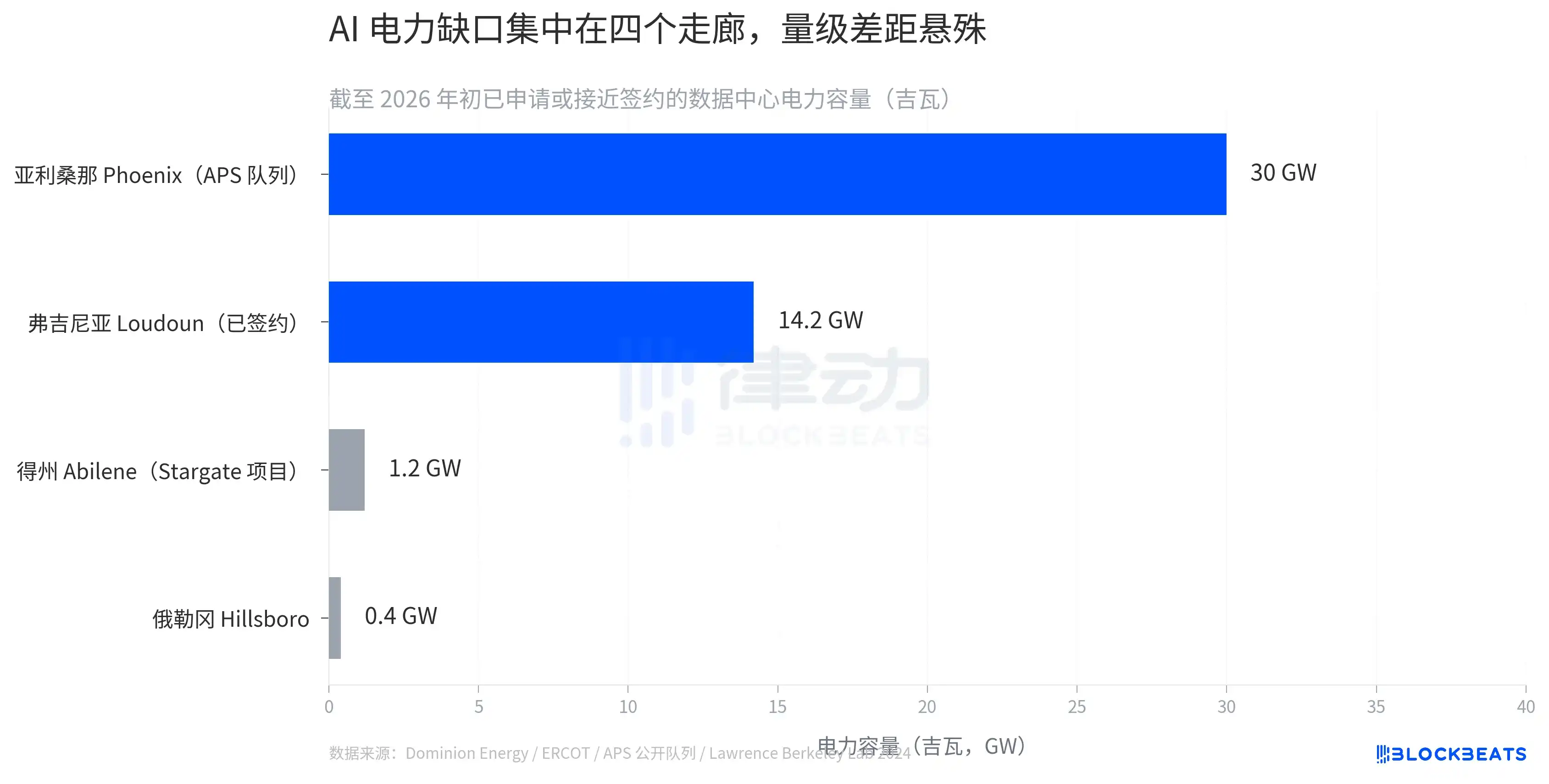
This is the demand-side foundation for Ford Energy's $10 billion valuation. When a region's grid capacity growth can't keep pace with data centers' electricity grab, space for energy storage arbitrage is created. On one side are training loads during peak hours that are almost impossible to cut, and on the other is a supply curve the grid cannot instantly respond to. In the middle lies the deterministic cash flow for energy storage providers.

But grabbing electricity comes at a cost. The question is, who pays?

The Bill Lands in Louisiana

On May 14th, Fortune's front page reported on Meta's Hyperion project in Richland Parish, Louisiana. This flagship data center, Meta's bet on "AI advantage," costs $10 billion. In July 2024, the Richland Parish Commission approved sales and use tax exemptions totaling $3.3 billion, covering 20 years.

This abatement exceeds the combined police budgets of the state of Louisiana for seven years.

Meta also secured a 60% local property tax exemption through a PILOT agreement, conditional on hiring 300 local permanent positions. This project's predicted power consumption could account for 20% of Louisiana's total electricity usage.

A more crucial comparison lies across state lines. Texas's total data center sales tax exemption losses for the 2025 fiscal year amounted to about $1 billion, making it the state's costliest industry subsidy. Virginia's was $1.02 billion in FY2024, and Illinois's was $371 million in 2023. The $3.3 billion subsidy for Meta's single project exceeds any single state's total annual data center subsidies.
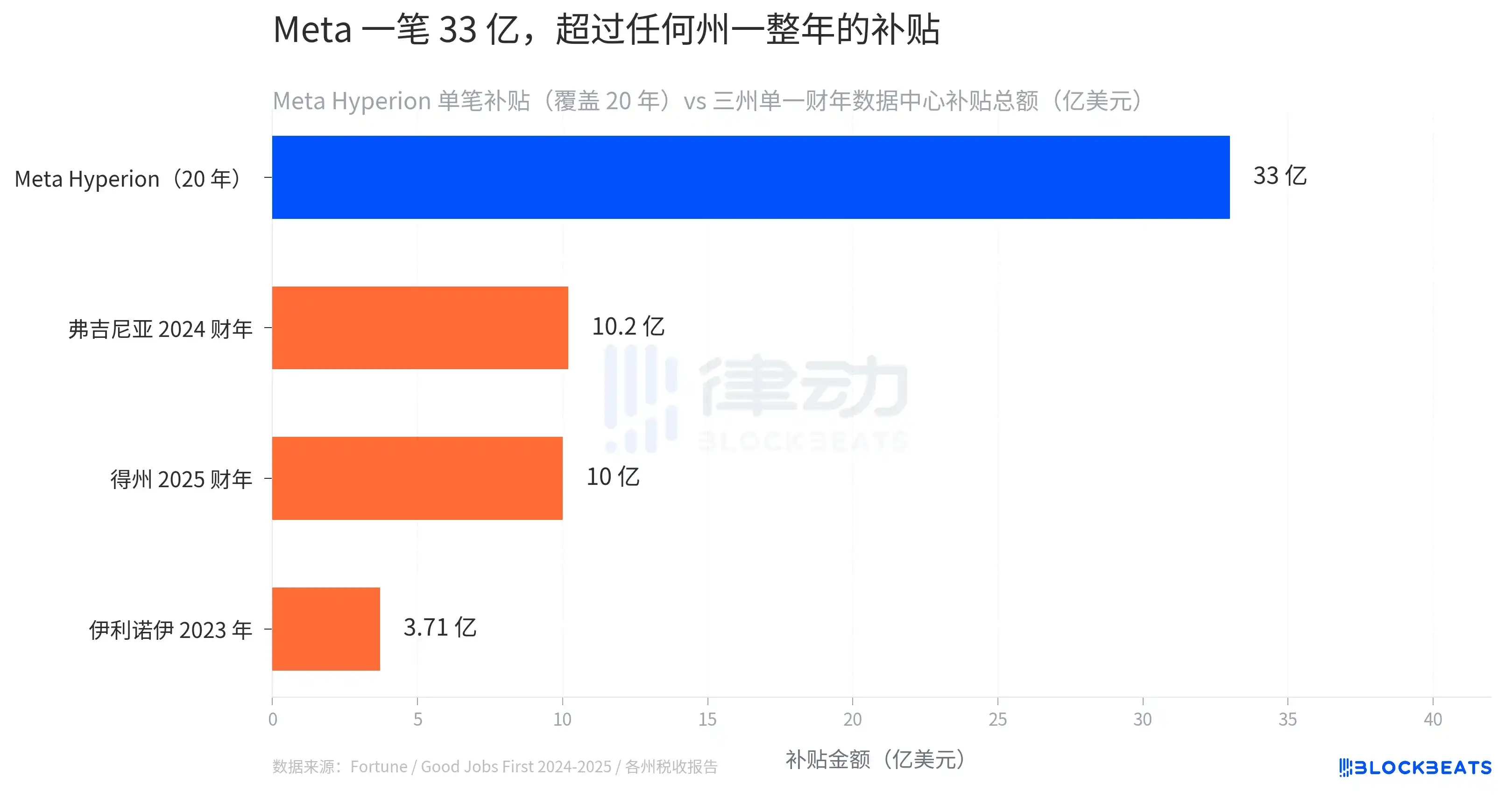
This is not an isolated case. According to Good Jobs First, at least 36 states have authorized data center sales tax exemptions through specific legislation, with only 11 publicly disclosing beneficiary company names. Official calculations in some states are more direct: for every dollar given in data center tax breaks, state coffers incur a net loss of 52 to 70 cents. The $8 billion increase in Ford's valuation is built on the implicit assumption that "this subsidy arms race will continue."

The continuation of this subsidy arms race depends on state legislators' ability to explain why an abatement exceeding seven years of police budgets is justified. This is becoming increasingly difficult.

Data Center Opposition Rates Now Exceed Nuclear Power Plants

A 2025 Gallup national survey shows 70% of respondents oppose building a data center near their homes. The opposition rate for nuclear power plants in the same survey is 53%. Data centers are now the most opposed-to infrastructure in the United States.

This is not an abstract number. Data Center Watch's database as of early 2026 shows 69 jurisdictions have halted approvals or rejected data centers through local referendums or moratorium resolutions, stalling $64 billion in planned projects. In Loudoun County, Virginia, data center tax breaks caused a $267 million loss for the public school system in 2024, a fact now entering voters' consciousness.
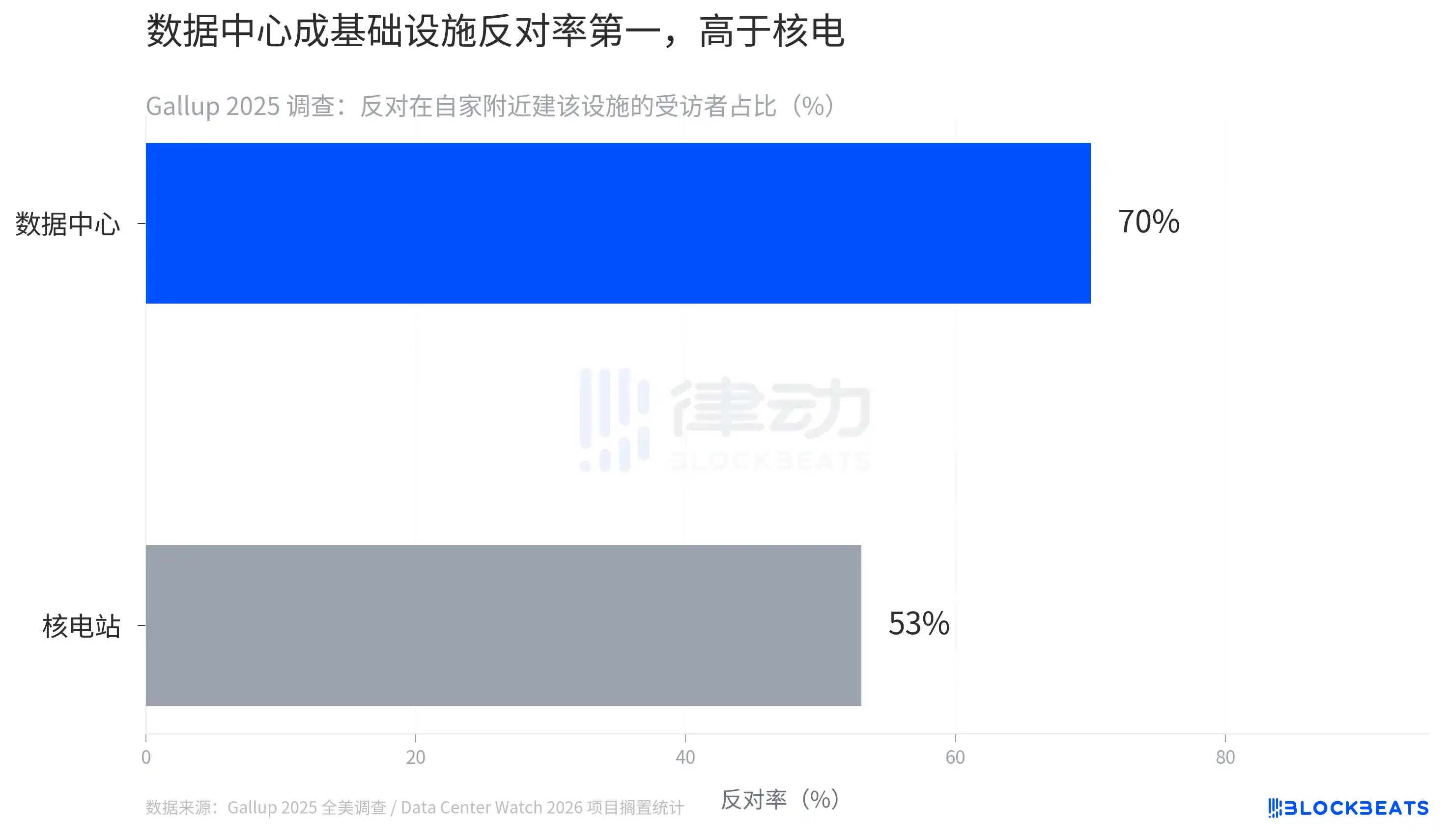
The reasons data centers are disliked are more complex than those for nuclear plants. Nuclear plants are typically tens of kilometers from residential areas, while data centers hug urban edges. They consume water for cooling, increase grid load, generate low-frequency noise, yet provide local employment mostly in the hundreds, far lower than the job density of steel mills or auto plants. Hyperion's 326 operational jobs for $3.3 billion in abatement equates to a fiscal cost of $10 million per job. The room for explanation by local governments is narrowing.

The path to realizing Ford Energy's $10 billion valuation requires this grid to keep running, subsidies to hold, the electricity grab to proceed as usual, and opposition not to translate into legal mandates. If any link weakens, repricing will follow.

Ford's $8 billion gain, Meta's $3.3 billion subsidy, Phoenix's 30 GW queue, and the 70% opposition rate are readings from four cross-sections of the same grid. They remain disparate data points for now. Once one hard constraint emerges—whether physical power shortage, state fiscal breach, or public vote—the others will be repriced simultaneously.


Domande pertinenti

QAccording to the article, what is the estimated valuation given by Morgan Stanley for Ford's new energy subsidiary 'Ford Energy', and what key assumptions underpin this valuation?

AMorgan Stanley analyst Andrew Percoco gave Ford Energy a separate valuation of $10 billion. The valuation is based on the assumptions that Ford Energy will achieve a 25% gross margin and $346 million in EBIT by 2028, and that it will be valued using the price-to-sales multiples of leading energy storage companies like Tesla.

QWhy is the energy storage business considered significantly more profitable than Ford's traditional automotive business, based on the figures provided?

ABased on 2024 financials, Ford's Blue (internal combustion engine) division had an EBIT margin of only 3.6%. In contrast, the energy storage industry shows much higher profitability: Tesla's Megapack business has a gross margin of 26.2%, and Sungrow's energy storage business exceeded 28% in the first half of 2024. Morgan Stanley estimates that the gross margin per GWh for Ford Energy could be at least double that of selling an F-150 truck.

QThe article states that a massive power supply-demand gap for data centers is projected by 2028. What is the estimated size of this gap, and where is the demand primarily concentrated?

AMorgan Stanley projects that by 2028, the power demand from US data centers will reach about 79 GW, creating a supply-demand gap of approximately 49 GW. This demand is primarily concentrated in four key corridors: Phoenix, Arizona (30 GW in the utility queue); Loudoun County, Virginia (14.2 GW nearing contract); Abilene, Texas (e.g., the 1.2 GW Stargate project); and Hillsboro, Oregon (0.4 GW).

QWhat specific tax incentives did Meta secure for its Hyperion data center project in Louisiana, and how do these subsidies compare to those in other states?

AMeta secured a combined $3.3 billion in sales and use tax exemptions over 20 years for its Hyperion project in Richland Parish, Louisiana. This single project's subsidy exceeds the total annual data center tax exemptions for any other state, such as Texas's ~$1 billion in FY2025 or Virginia's $1.02 billion in FY2024.

QWhat is the primary public sentiment towards building new data centers in the US according to the article, and what are some key reasons behind this opposition?

AA 2025 Gallup poll cited in the article shows that 70% of respondents oppose building a data center in their local area, making it the most opposed type of infrastructure (more than nuclear power at 53%). Key reasons for opposition include high water and electricity consumption, low-frequency noise, proximity to residential areas, and the perception of providing relatively few local jobs (often in the hundreds) compared to the massive scale of tax incentives received.

Letture associate

The Shutdown of Claude Mythos Revealed the True Cost of Renting AI to Me

The sudden shutdown of Claude Mythos this week starkly highlights a critical, often overlooked risk for founders: when your core capability relies entirely on someone else's platform, your fate is not in your own hands. The key question becomes: who truly owns the intelligence your product depends on? For years, the debate around open-source models focused on cost. Now, the evidence is clear: fine-tuned open-source models can achieve frontier-level quality for specific, mission-critical tasks at a fraction of the cost. However, the deeper issue is control. Relying on a third-party API is like renting; it works until the landlord changes the rules, raises the rent, or asks you to leave—as Mythos experienced. The lesson is not to stop using frontier models—they are incredible infrastructure. The goal is ownership. Ownership means starting with a powerful open-source model and shaping it around what makes your company unique: your data, workflows, domain expertise, and definition of "good." Over time, the model becomes less generic and more reflective of your business, creating durable value. The optimistic conclusion is that AI's future doesn't hinge on one superior model. There is no single frontier. The frontier includes proprietary models, models fine-tuned on company-specific knowledge, specialized models for narrow problems, and intelligent routers orchestrating model ensembles. The most interesting development is not models getting smarter, but intelligence becoming increasingly customizable. The winning companies will be those that transform intelligence into a unique, owned asset. Looking ahead, the vision is not one model dominating all, but many teams owning the part of the frontier that matters most to them.

marsbit3 min fa

The Shutdown of Claude Mythos Revealed the True Cost of Renting AI to Me

marsbit3 min fa

Tiger Research: U.S. Strategic Bitcoin Reserve - Should the Market Be Happy or Disappointed?

Tiger Research analyzes the evolution of U.S. legislative efforts regarding a strategic Bitcoin reserve, concluding the market impact is limited in the short term but potentially positive long-term. The core event was a March 2025 executive order by former President Trump, which designated confiscated Bitcoin as a strategic reserve and promised not to sell existing holdings (approx. 190k BTC). As it contained no mandate to purchase new Bitcoin, the market reacted negatively, with prices dropping 5.7%. Legislative history shows a significant retreat from initial ambitions. The 2024 "BITCOIN Act" proposed mandatory purchases of 1 million BTC over five years. Reintroduced in 2025, it stalled due to high fiscal costs, concerns over dollar hegemony, and opposition from the Treasury Secretary. The current frontrunner, the 2026 "American Retirement and Monetary Advancement (ARMA) Act," is a compromise. It lacks any purchase requirement, instead focusing on consolidating existing government-held Bitcoin and legally prohibiting its sale for at least 20 years. While ARMA has higher passage odds due to bipartisan support and no purchase mandate, its immediate market effect is neutral. It eliminates potential government selling pressure but creates no new demand. The long-term significance is that formally establishing Bitcoin as a national reserve asset in law could later reignite debates on mandatory purchases. Therefore, the path to a government buyer is longer than initially priced by the market, but the directional narrative remains intact.

marsbit6 min fa

Tiger Research: U.S. Strategic Bitcoin Reserve - Should the Market Be Happy or Disappointed?

marsbit6 min fa

US Stock Market Trend (June 16): SpaceX Rises 42% in Two Days, New Fed Chairman Takes Office Today

**U.S. Stocks Trend (June 16): SpaceX Soars 42% in Two Days, New Fed Chair Takes Office Today** Markets surged on Monday following former President Trump's social media announcement of a completed U.S.-Iran deal to reopen the Strait of Hormuz, pending a June 19 signing. The news triggered a broad risk-on rally: oil prices crashed, tech stocks soared, bond yields fell, and defensive sectors lagged. **Market Performance:** The Nasdaq jumped 3.07%, led by semiconductor stocks like Micron (+9.2%). The S&P 500 gained 1.65%, and the Dow rose 0.92% to a record high. However, the Russell 2000 small-cap index underperformed (+0.72%). SpaceX continued its hot streak, rising another 5% pre-market after disclosures of large buys by an Australian billionaire and Cathie Wood's ARK. Boeing also rallied on the transportation optimism. Conversely, energy stocks like Chevron fell over 3% on the oil price plunge, with other defensive sectors also selling off. The day's action showed a clear rotation of funds from energy/defensive plays into AI and tech narratives. **Macro & Outlook:** The VIX fear index fell 8.37%. Treasury yields declined, and WTI crude dropped over 5%. Attention now shifts to a packed schedule: the Bank of Japan is widely expected to hike rates to 1.0% on Tuesday. The Fed's June meeting concludes Wednesday, marking new Chair Wash's debut. While rates are expected to hold, his tone on stubborn inflation and the "dot plot" will be crucial for gauging the 2024 rate path. The formal Iran deal signing is set for Friday. **Trend Perspective:** While the peace deal is a genuine positive, Monday's explosive rally may have gotten ahead of itself, pricing in a swift resolution to inflation concerns. The shortened trading week faces a triple test: BoJ tightening, the Fed's policy stance, and deal implementation details. Tech and semiconductors, which led the surge, remain vulnerable to any disappointment from these key events. The real price discovery begins with the central banks' communications this week.

marsbit27 min fa

US Stock Market Trend (June 16): SpaceX Rises 42% in Two Days, New Fed Chairman Takes Office Today

marsbit27 min fa

Xiaohongshu's Second Great Voyage, This Time Sailing Towards AI

Xiaohongshu's Second Voyage: Navigating Towards AI Since ChatGPT's emergence, Xiaohongshu's founder Mao Wenchao has been acutely aware of AI's potential threat, recognizing that the life advice people seek from chatbots overlaps directly with his platform's core business. Founded in 2013 as a PDF shopping guide for Chinese tourists, Xiaohongshu evolved into a massive community where millions share authentic, personal experiences—from product reviews to travel tips. This vast repository of "I've tried this" human judgment became its most valuable asset. However, the rise of AI, which delivers instant answers, challenges the very need for users to sift through numerous personal notes. Fearing its treasure trove of lived experience could become mere training data for others, Xiaohongshu is proactively adapting. In 2026, it established a dedicated AI division (Dots), launched RED Skill to turn user experiences into usable AI tools, and acquired the AI search product "Diandian." Its investments now extend to AI firms like MiniMax and hardware startups, moving upstream to address needs before they even become search queries. The platform's commercialization strategy is also evolving. With a newly acquired payment license and tools like the AIPS model to track consumer decision journeys, Xiaohongshu aims to seamlessly integrate recommendations with transactions, embedding commerce within AI-generated answers. Yet, a critical tension remains. While building smarter machines to organize and leverage its human experiences, Xiaohongshu must prevent AI from drowning out the authentic, flawed, and trustworthy "I've tried this" voices that built its community. Its core challenge is to harness AI's power without letting the map—the machine's perfect, synthesized answer—replace the territory of genuine human experience. This balance between technological advancement and preserving human trust defines its current journey and its future.

marsbit59 min fa

Xiaohongshu's Second Great Voyage, This Time Sailing Towards AI

marsbit59 min fa

Trading

Spot
Futures
活动图片