Author:Zhou, ChainCatcher
If there are still any investors in the current crypto industry worth looking forward to, Cai Wensheng should be one of them.
Starting from the early domain name business, to the successive successes of 58.com, Storm Player, and Meitu, then to strongly advocating for Meitu to hoard cryptocurrencies, facing billions in floating losses and being criticized for speculative trading, stepping down as chairman, cashing out to buy buildings, and betting on Hong Kong Web3.
He is a person who has been repeatedly misunderstood by the times, yet repeatedly validated by the times.
Only this time, he decided to "get his hands dirty."
Last Time, Didn't Get a Good Result
2021 年, Cai Wensheng strongly advocated for Meitu to buy Bitcoin and Ethereum, with a total investment of about $100 million.
When buying, Cai Wensheng once said in his WeChat Moments: "Someone has to be the first to eat the crab. This should be the first Hong Kong-listed company to purchase BTC digital currency, and also the world's first listed company to use ETH Ethereum as a monetary value reserve."
However, as a Hong Kong-listed company, any major asset allocation by Meitu needed to be approved by the board of directors. Although he held over 25% of the shares at the time and, as chairman, could push for the purchase, he could not prevent the sale.
2022 年, the crypto market plummeted, and Meitu's paper losses exceeded 280 million RMB, with accusations of "speculative crypto trading" flooding in. The stock price of Meitu in Hong Kong also hit a historic low.
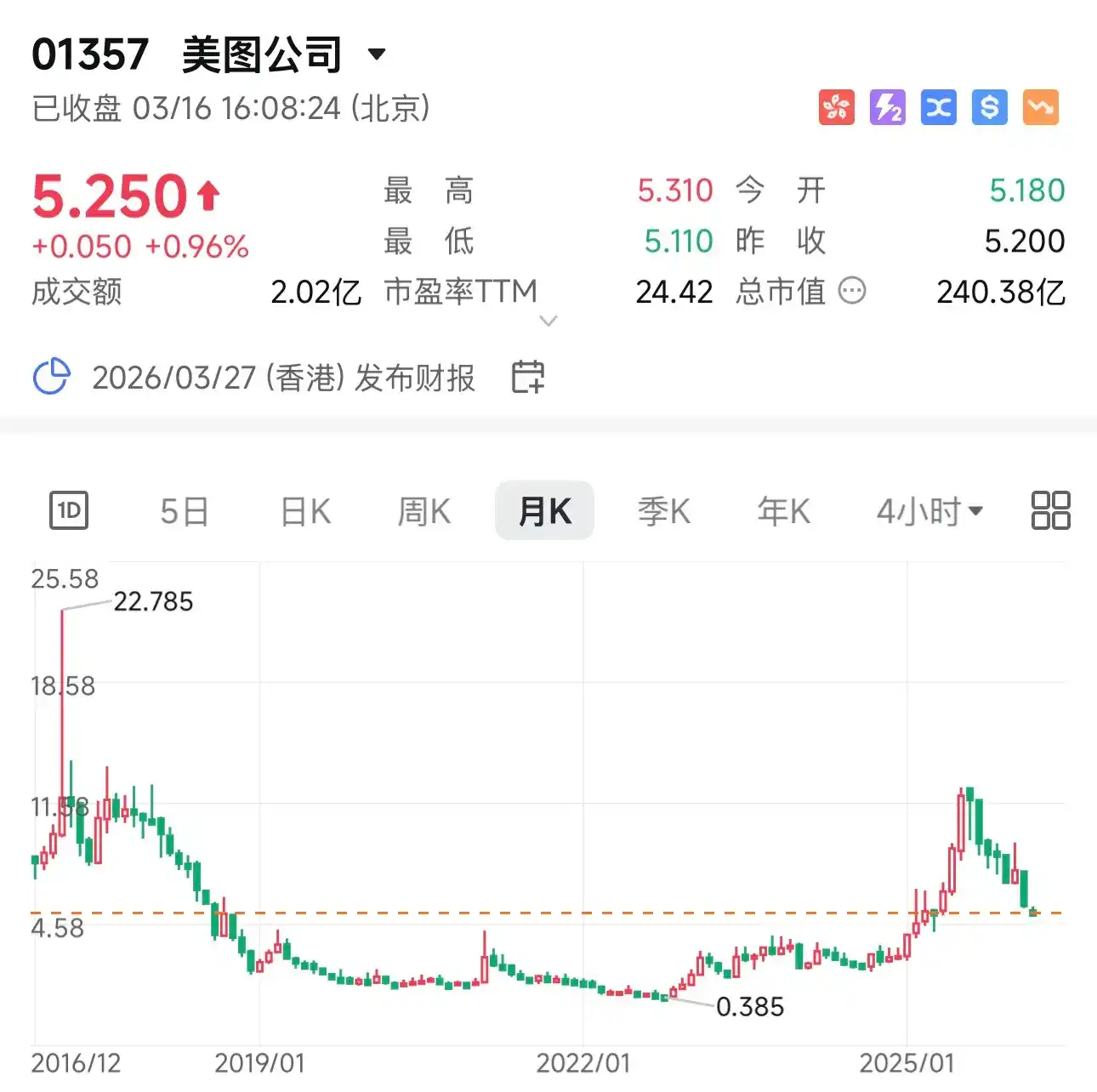
Publicly listed companies sometimes have less tolerance for floating losses than individual investors—stock price pressure, shareholder doubts, media siege—these were external pressures that anyone at the time could not withstand.
2023 年, he stepped down as chairman amid skepticism, and Wu Xinhong returned to take charge, immediately beginning to "tear off the Cai Wensheng label," with the strategic focus fully shifting to AI.
The ending of the story is quite ironic. Meitu issued an announcement in early December 2024, stating that as of that date, it had sold all its cryptocurrency, with a total cash consideration of approximately $180 million, realizing a gain of about $79.63 million, equivalent to approximately RMB 571 million.
If they had held on back then, Meitu would have been one of the first batch of DAT companies in Hong Kong.
The trend was validated, but it was no longer related to him.
Getting Involved, Getting Hands Dirty
From domain names, mobile internet, to Web3, people in each era said he was gambling.
He once said in an interview that what Web3 entrepreneurs do is often not understood, especially by traditional investors.
At the same time, he expressed firm belief in the explosion of Web3, though the timing is hard to predict, just like AI went through many years of dormancy before迎来 the ChatGPT explosion.
According to RootData显示, Cai Wensheng's Longling Capital早年 invested in the crypto exchange OKX (formerly OKCoin). In 2018, he revealed publicly that he had invested in over 10 blockchain projects, including Theta, Ontology, Zipper, etc.
img style="max-width:100%;overflow:hidden;" src="https://d1x7dwosqaosdj.cloudfront.net/images/2026-03/ba38047c3f24461f9b57e864d3fc5780.jpg" alt="">
This time, he simply increased his bet.
After stepping down, Cai Wensheng chose to reduce his stake in Meitu, with his shareholding比例 dropping from a peak of about 25% to less than 10%.
650 million Hong Kong dollars to buy a 25-story commercial building in Tin Hau, Hong Kong, renamed CAI Building. He specifically stated: "CAI is the abbreviation of Crypto and AI, not my surname."
It is reported that CAI Building does not charge rent, only asks for the优先 investment right in the first round of financing, no discount, no controlling stake. He publicly stated that the goal is to incubate 5 unicorns within three years.
Last November, Cai Wensheng said at Hong Kong Fintechweek that buying this building was to "set an example." Now this building is fully occupied by AI and Web3 companies.
Capital operations also followed. He successively acquired two Hong Kong-listed companies—China New Economy Investment and China Financial Leasing, renamed them CAI Holdings and LONG Investment Group respectively,打造 a Web3+AI asset management platform.
In early 2026, CAI Holdings又 acquired the equity of two early-stage projects, Forestheaven and EXIO, by issuing new shares. The seller was precisely Longling Capital, wholly owned by Cai Wensheng.
Among them, EXIO is a licensed virtual asset trading platform in Hong Kong, holding SFC Type 1 and Type 7 licenses. It is the first compliant exchange in Hong Kong with a securities background. Longling Capital was one of its early investors.
Incorporating this piece into CAI Holdings means his ecosystem extends from incubation to circulation—projects cultivated in the CAI Building can be directly listed for compliant trading on a licensed exchange.
Crypto OGs Need a Decent Victory
Among the crypto OGs we know, Cai Wensheng is not the one who has benefited the most.
The fates of early crypto OGs vary.
Some achieved financial freedom and completely faded out—Babbitt founder Chang Jia was once the most powerful spokesperson for long-termism in the crypto industry. Since 2023, he has turned to AI entrepreneurship.
Multicoin Capital co-founder Kyle Samani became famous for early bets on Solana. When leaving the圈, he publicly stated that "cryptocurrency is not as interesting as many people think."
Some stay in the圈, but their focus has shifted—Shenyu was a representative figure in the mining圈 early on. Now, content about AI tools占了大半 on his social accounts.
And those who, like Cai Wensheng, choose to stay include Xiao Feng and Feng Bo, etc.
Xiao Feng turned from traditional finance, leading HashKey on an institutionalized compliance path, operating with licenses, and connecting with traditional capital; Feng Bo布局 in a professional crypto VC manner, closer to the standard institutional investor approach.
They are同样 optimistic about this industry, but their paths are截然不同.
Cai Wensheng chose a "dirtier" path: not taking the institutional route, not making pure financial bets, personally putting down roots in Hong Kong, getting involved hands-on.
At the 2023 Hong Kong Web3 Carnival, Cai Wensheng said: "People who have worked from Web1 to Web3, this seems like a compliment, but it actually means that we have not been successful from Web1 to Web3, we have always been on the road. But many people from Web1 to Web3 are no longer here, but we are still here,说明 we are veterans. Old soldiers never die, they just fade away."
In early 2026, he predicted that Bitcoin would rise to $1.1 million, which means the total market capitalization of Bitcoin would be about $21 trillion. Previously, he publicly stated that he held about 10,000 Bitcoins. There is no news yet showing that he has exited.
Of course, the controversy has not disappeared. Continuously endorsing during a bear market, whether it is坚守 against the market or having to tell stories after being trapped, is still difficult for outsiders to distinguish.
But the ammunition from cashing out, the buildings bought, the companies acquired—these are all actions with real money.
This industry has experienced too many indecent endings. Project方 running away, whales dumping and fleeing, OGs quietly leaving the scene. What remains in the public eye are often only those news about changes in whale addresses.
This industry does not lack people who喊单, it lacks people who truly stay and get their hands dirty.
A bull market unlocking cannot solve the industry's root problems. In the end, it still relies on projects that truly succeed and ecosystems that truly land to win a decent victory for crypto OGs.