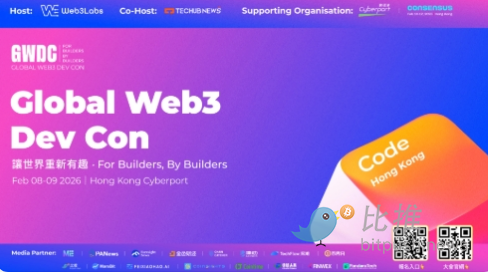
For Builders, By Builders — Global Web3 Developers Conference 2026 Coming to Hong Kong

比推Pubblicato 2026-01-09Pubblicato ultima volta 2026-01-09

Introduzione

"Global Web3 Dev Con 2026 (GWDC) is set to take place in Hong Kong's Cyberport on February 8–9, 2026. Hosted by Web3Labs and co-hosted by Techub News, this event will serve as a major official side event to Consensus Hong Kong 2026. As the first comprehensive Web3 conference in Asia centered on developers, it embraces a "For Builders, By Builders" ethos. The conference aims to gather over 1,000 global Web3 enthusiasts and more than 200 top developers, with a goal of incubating 50+ innovative projects. GWDC will feature a dual-track format: a Main Stage for in-depth discussions on cutting-edge trends like AI × Web3, DeFi, Layer 2, and RWA, and a Hackathon Zone for three days of non-stop coding where developers can tackle real-world tasks on major public chains with guidance from top mentors. The event will also include multiple interactive zones designed to provide a full Web3 experience, offering opportunities for collaboration with industry leaders, VCs, and founders."

Amid the surging global Web3 wave and Hong Kong's active promotion of virtual asset policies and digital economic transformation, the "Global Web3 Developers Conference 2026 | Global Web3 Dev Con," hosted by Web3Labs and co-hosted by Techub News, will be held at Hong Kong Digital Port on February 8–9, 2026!

As an official major side event of Consensus Hong Kong 2026, GWDC will kick off the developer-exclusive climax three days in advance, providing a seamless and in-depth practical platform for industry leaders, investors, and builders arriving early in Hong Kong. Leveraging Hong Kong's "One Country, Two Systems" institutional advantages and Digital Port's positioning as a Web3 base, the conference is committed to incubating Asia's next blockchain blockbuster project.

This is Asia's first comprehensive Web3 event centered on developers, focusing on the spirit of "For Builders, By Builders." It is expected to bring together 1,000+ global Web3 enthusiasts and 200+ top developers, fostering 50+ innovative projects.

The conference adopts a "dual-core driving" model:

  • Main Venue: In-depth analysis of cutting-edge trends such as AI × Web3, DeFi, Layer 2, RWA, etc.

  • Hackathon Zone: 3 days of non-stop practical coding, perfectly integrating insights and action.

Four interactive zones covering the full Web3 chain experience

1. Main Stage | Ideological High Ground

  • 30+ industry leaders deliver Keynotes and Panels, engaging directly with VCs, exchange executives, and public chain founders to build leadership and strategic partnership opportunities.

2. Hackathon Zone | Hardcore Scene

  • 200+ developers form teams to tackle real tasks from mainstream public chains, receiving 1:1 guidance from top mentors (technical experts, star founders, VCs).


  • Note: All articles on Bitpush represent the author's views only and do not constitute investment advice

Domande pertinenti

QWhat is the name of the event and when will it be held?

AThe event is called the Global Web3 Dev Con 2026 (GWDC), and it will be held on February 8-9, 2026.

QWhere is the Global Web3 Dev Con 2026 taking place and who are the main organizers?

AIt will be held at Hong Kong's Cyberport. The main organizer is Web3Labs, and it is co-hosted by Techub News.

QWhat is the core spirit or theme of the GWDC 2026 conference?

AThe core spirit of the conference is 'For Builders, By Builders'.

QWhat are the two main components of the conference's 'dual-core driving' model?

AThe two main components are the Main Stage, for in-depth analysis of trends like AI x Web3 and DeFi, and the Hackathon Zone, for 3 days of non-stop practical coding.

QWhat is the expected scale of attendance and participation for the event?

AThe event is expected to bring together over 1,000 global Web3 enthusiasts and more than 200 top developers, aiming to catalyze over 50 innovative projects.

Letture associate

Soaring Export Data for Memory Chips, Market Is Redefining the Valuation Anchor for Memory Stocks

Korean storage export data for the first 20 days of June shows substantial year-on-year increases in both value and price-per-kilogram for categories like DRAM, NAND, and SSDs. This signals a potential shift beyond simple demand recovery, indicating rising prices and a product mix shift towards higher-value items, possibly influenced by AI infrastructure needs. A key point is that the surge in price-per-kilogram is not simply a uniform chip price hike. It reflects a combination of actual price increases and, more importantly, an export structure increasingly dominated by high-value-density products like HBM (High-Bandwidth Memory) and advanced DRAM, which are critical for AI servers. This suggests AI-driven demand may be spilling over from just HBM into broader memory markets. SK Hynix stands to benefit directly due to its leading HBM position. For Samsung and Micron, the implication is potential for greater margin elasticity if the tightness in high-end memory spreads to enterprise SSD and NAND prices. However, the storage sector remains cyclical. Risks include supply expansion, inventory changes, and potential slowdowns in broader AI capital expenditure. Ultimately, while the strong export data supports upward revisions for storage company earnings and fuels discussion of an "AI infrastructure bottleneck premium," a definitive valuation shift from a cyclical to a structural story depends on upcoming quarterly reports. Investors need confirmation from SK Hynix, Samsung, and Micron that improvements in average selling prices, product mix, and, crucially,毛利率 are sustained over multiple quarters.

marsbit18 min fa

Soaring Export Data for Memory Chips, Market Is Redefining the Valuation Anchor for Memory Stocks

marsbit18 min fa

Why Does SpaceX Have Such a High Valuation Ceiling? The Answer Lies in Musk's Business Blueprint

SpaceX achieved a record-breaking IPO on June 12, 2026, with its market cap surging past $2.1 trillion. This valuation reflects its central role within Elon Musk's expansive, interconnected technological ecosystem. The article details how four core components form a synergistic closed-loop system: 1) **The "Brain" (xAI & Orbital Compute):** xAI provides AI models and massive ground/space-based supercomputing for simulation and decision-making across the system. 2) **The "Neural Logistics Core" (Starlink & Starship):** Starlink's low-latency satellite network enables global data transmission, while Starship's low-cost, reusable launch capacity aims to make large-scale space deployment economically viable. 3) **The "Physical Body" (Tesla & Optimus):** Tesla's manufacturing prowess and energy products support hardware production and power, pivoting toward mass-producing the Optimus humanoid robot for terrestrial and potential space-based labor. 4) **The "Human Interface" (Neuralink & X):** Neuralink seeks direct brain-computer communication, and the X platform provides real-time societal data. Together, these elements create three reinforcing "flywheels": manufacturing/logistics, data-driven iteration, and energy/compute/network synergy. This integrated approach promises lower costs, faster innovation cycles, and potential infrastructure-as-a-service offerings. However, it also concentrates technical, regulatory, and corporate governance risks. Ultimately, SpaceX's high valuation stems from its position as the indispensable infrastructural backbone—handling space transport, global communications, and future orbital computing—tying together Musk's entire vision for a self-reinforcing technological empire.

marsbit23 min fa

Why Does SpaceX Have Such a High Valuation Ceiling? The Answer Lies in Musk's Business Blueprint

marsbit23 min fa

Snap, Unprofitable for Nine Years, and a Decade-Long AR Obsession Without Return

Snap's AR Obsession: A Decade of Betting Against the Odds On June 16, Snap CEO Evan Spiegel unveiled the new AR glasses, Specs, priced at $2,195, causing the company's stock (SNAP) to plummet nearly 10%. The launch was met with intense criticism online, with investors questioning why a consistently unprofitable company would stake its future on an expensive product its core young user base can't afford. Snapchat, known for pioneering features like ephemeral Stories and popular AR lenses (like the iconic dog filter), has a history of innovation often copied by rivals like Instagram and Meta. Despite this, it has struggled to translate first-mover advantage into commercial success. Since its 2017 IPO, Snap has reported annual net losses, with a Q1 2026 loss of $89 million. Its stock is down 94% from its 2021 peak, hampered by iOS privacy changes, competition, and a young demographic less attractive to major advertisers. In this challenging context, Spiegel is doubling down on AR. He calls 2026 a "crucible moment," having recently laid off 16% of staff while reportedly investing over $3.5 billion cumulatively in its AR glasses line over nearly a decade. The new Specs represent a significant leap from the 2016 camera-focused Spectacles, offering true AR overlays, gesture control, and standalone operation. However, at $2,195, it faces tough comparisons. While more advanced than Meta's $799 Ray-Ban smart glasses, critics point to its heavier weight, short battery life, and features largely replicable by a smartphone. Facing pressure from investors to cut losses on the Specs project, Spiegel has refused, framing it as essential to Snap's long-term vision. The company finds itself in a paradoxical position: cutting costs while heavily funding a decade-long, unproven bet. Some see Specs as an awkward but necessary step in AR's evolution, akin to early mobile phones. Whether Spiegel is a visionary outlier or a gambler destined to fail remains an open question, highlighting the tension between long-term ambition and short-term market demands.

marsbit45 min fa

Snap, Unprofitable for Nine Years, and a Decade-Long AR Obsession Without Return

marsbit45 min fa

Annualized Revenue Exceeds $20 Billion, Kalshi Aims to Become the First Prediction Platform IPO?

Kalshi, a leading U.S. prediction markets platform, is reportedly in early, informal discussions for an Initial Public Offering (IPO). The company's annualized revenue now exceeds $2 billion, fueled by its dominance of over 90% of the domestic prediction market activity. This growth stems from a surge in trading volume—reaching a total of $52.7 billion—and an increase in fee rates, largely driven by sports event contracts like the NBA playoffs and the 2026 FIFA World Cup. Monthly active users are approximately 2 million. Kalshi recently raised $1 billion in a funding round led by Coatue Management, valuing the company at $22 billion. It has also expanded its offerings to include Bitcoin perpetual contracts and plans to launch a dedicated trading platform, Kalshi Pro. However, Kalshi's path to an IPO faces significant regulatory hurdles. The core risk involves jurisdictional conflicts, as multiple U.S. states are challenging its operations under local gambling laws. For instance, Arizona has filed criminal charges against the platform, while states like Kentucky have filed lawsuits. Kalshi and the Commodity Futures Trading Commission (CFTC) argue that its event contracts fall under exclusive federal jurisdiction as "swaps." The outcomes of these ongoing legal battles could critically impact Kalshi's core revenue and its IPO timeline. Analysts suggest that while an IPO could theoretically occur by late 2026, a more likely timeframe is late 2027 or 2028, contingent on resolving legal issues and favorable market conditions. If successful, its fundraising could significantly exceed $1 billion, given its current valuation and revenue multiple.

Foresight News1 h fa

Annualized Revenue Exceeds $20 Billion, Kalshi Aims to Become the First Prediction Platform IPO?

Foresight News1 h fa

Trading

Spot
Futures
活动图片