For Builders, By Builders — Global Web3 Developers Conference 2026 Coming to Hong Kong

比推Pubblicato 2026-01-09Pubblicato ultima volta 2026-01-09

Introduzione

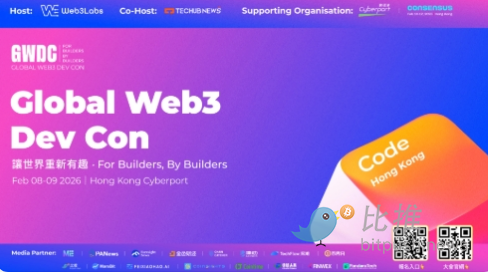
"Global Web3 Dev Con 2026 (GWDC) is set to take place in Hong Kong's Cyberport on February 8–9, 2026. Hosted by Web3Labs and co-hosted by Techub News, this event will serve as a major official side event to Consensus Hong Kong 2026. As the first comprehensive Web3 conference in Asia centered on developers, it embraces a "For Builders, By Builders" ethos. The conference aims to gather over 1,000 global Web3 enthusiasts and more than 200 top developers, with a goal of incubating 50+ innovative projects. GWDC will feature a dual-track format: a Main Stage for in-depth discussions on cutting-edge trends like AI × Web3, DeFi, Layer 2, and RWA, and a Hackathon Zone for three days of non-stop coding where developers can tackle real-world tasks on major public chains with guidance from top mentors. The event will also include multiple interactive zones designed to provide a full Web3 experience, offering opportunities for collaboration with industry leaders, VCs, and founders."

Amid the surging global Web3 wave and Hong Kong's active promotion of virtual asset policies and digital economic transformation, the "Global Web3 Developers Conference 2026 | Global Web3 Dev Con," hosted by Web3Labs and co-hosted by Techub News, will be held at Hong Kong Digital Port on February 8–9, 2026!

As an official major side event of Consensus Hong Kong 2026, GWDC will kick off the developer-exclusive climax three days in advance, providing a seamless and in-depth practical platform for industry leaders, investors, and builders arriving early in Hong Kong. Leveraging Hong Kong's "One Country, Two Systems" institutional advantages and Digital Port's positioning as a Web3 base, the conference is committed to incubating Asia's next blockchain blockbuster project.

This is Asia's first comprehensive Web3 event centered on developers, focusing on the spirit of "For Builders, By Builders." It is expected to bring together 1,000+ global Web3 enthusiasts and 200+ top developers, fostering 50+ innovative projects.

The conference adopts a "dual-core driving" model:

  • Main Venue: In-depth analysis of cutting-edge trends such as AI × Web3, DeFi, Layer 2, RWA, etc.

  • Hackathon Zone: 3 days of non-stop practical coding, perfectly integrating insights and action.

Four interactive zones covering the full Web3 chain experience

1. Main Stage | Ideological High Ground

  • 30+ industry leaders deliver Keynotes and Panels, engaging directly with VCs, exchange executives, and public chain founders to build leadership and strategic partnership opportunities.

2. Hackathon Zone | Hardcore Scene

  • 200+ developers form teams to tackle real tasks from mainstream public chains, receiving 1:1 guidance from top mentors (technical experts, star founders, VCs).


  • Note: All articles on Bitpush represent the author's views only and do not constitute investment advice

Domande pertinenti

QWhat is the name of the event and when will it be held?

AThe event is called the Global Web3 Dev Con 2026 (GWDC), and it will be held on February 8-9, 2026.

QWhere is the Global Web3 Dev Con 2026 taking place and who are the main organizers?

AIt will be held at Hong Kong's Cyberport. The main organizer is Web3Labs, and it is co-hosted by Techub News.

QWhat is the core spirit or theme of the GWDC 2026 conference?

AThe core spirit of the conference is 'For Builders, By Builders'.

QWhat are the two main components of the conference's 'dual-core driving' model?

AThe two main components are the Main Stage, for in-depth analysis of trends like AI x Web3 and DeFi, and the Hackathon Zone, for 3 days of non-stop practical coding.

QWhat is the expected scale of attendance and participation for the event?

AThe event is expected to bring together over 1,000 global Web3 enthusiasts and more than 200 top developers, aiming to catalyze over 50 innovative projects.

Letture associate

ETFs Are Just the Ticket: The True Institutionalization of Bitcoin Is Happening Where You Can't See It

Beyond the Bitcoin ETF spotlight, a deeper institutionalization is underway, leveraging Bitcoin as a foundational financial primitive. Institutions are using Bitcoin for purposes long reserved for assets like U.S. Treasuries and gold: as collateral for loans, insurance reserves, and the backbone of rated bonds. Examples include a Barbados-based insurer capitalizing with $40M in Bitcoin reserves and Ledn's $188M securitization of Bitcoin-backed loans, which received the first-ever investment-grade rating (BBB-) from S&P for a digital asset-backed security. This structure was stress-tested during a 27% price drop in early 2026, triggering automatic liquidations that functioned as designed but revealed the systemic risk of synchronized selling across leveraged positions. Infrastructure is evolving to support this, with platforms like Anchorage Digital's Atlas network enabling secure, institutional-grade settlement and collateral management. Strategies like basis trades and corporate treasuries (exemplified by companies like MicroStrategy issuing billions in equity and debt to fund Bitcoin acquisitions) further integrate Bitcoin into financial mechanics. While ETFs solved "how to own" Bitcoin, these developments answer "what to do with it," embedding the asset into the working machinery of finance—as collateral upon which loans, derivatives, and structured products are built. The real, enduring institutional shift is happening in these largely invisible plumbing and financing systems.

marsbit4 min fa

ETFs Are Just the Ticket: The True Institutionalization of Bitcoin Is Happening Where You Can't See It

marsbit4 min fa

ZEC Co-Founder Responds to Orchard Vulnerability: No Signs of Theft, Orchard Pool to Be Sealed

ZEC Co-Founder Addresses Orchard Vulnerability: No Signs of Theft, Plans to Sunset Orchard Pool A security vulnerability was recently discovered in Zcash's Orchard shielded pool, raising key concerns. The primary questions are whether the flaw was exploited, if user funds are safe, whether users can verify the total ZEC supply, and if other similar vulnerabilities exist. Analysis suggests the vulnerability was likely not exploited prior to its discovery. It was found proactively by a researcher using specialized tools, not due to an active breach. The development team and mining pools acted quickly to contain the issue. Typical financially-motivated attacks would likely have left visible on-chain evidence, which has not been observed. User funds in Orchard are considered safe and should be recoverable, assuming no prior exploitation. If the flaw was never used, all legitimate funds can be withdrawn. The article outlines risks associated with moving funds to transparent addresses or other pools, but concludes that leaving assets in place is a reasonable option. Currently, users cannot independently verify that the total ZEC supply hasn't been inflated due to this bug. However, the planned Ironwood network upgrade is designed to resolve this. It will permanently close the Orchard pool to new deposits and internal transfers, allowing only withdrawals. This mechanism will cap total withdrawals at the amount of legitimately deposited funds, enabling anyone to cryptographically verify the supply post-upgrade. Multiple teams, including Shielded Labs, have conducted extensive audits focused on counterfeiting vulnerabilities, assisted by advanced AI tools. No additional flaws of this type have been found so far, increasing confidence that no other similar undisclosed vulnerabilities exist. In summary, evidence indicates the Orchard bug was probably not used, user funds are secure, and no other counterfeiting flaws are currently known. The upcoming Ironwood upgrade will restore users' ability to independently verify the total ZEC supply, closing this chapter.

Foresight News9 min fa

ZEC Co-Founder Responds to Orchard Vulnerability: No Signs of Theft, Orchard Pool to Be Sealed

Foresight News9 min fa

Microsoft Announces Commercial-Grade Quantum Computer to be Completed in Three Years: Will the Boots Land?

Microsoft announces plans to build a commercially viable quantum computer by 2029, a significant acceleration from the previous industry consensus of a decade. The breakthrough is fueled by their new Majorana 2 quantum chip, which boasts a record-breaking average qubit lifetime of 20 seconds—a 1,000-fold reliability improvement over its predecessor. This leap was achieved by leveraging topological qubits, a theoretically more stable technology using Majorana zero modes, and switching the core superconducting material from aluminum to lead. Crucially, Microsoft's "Discovery" agentic AI platform accelerated the R&D process. AI agents autonomously analyzed vast experimental data, optimized manufacturing parameters (like the lead alloy composition), and solved issues like "ghost noise," dramatically speeding up experimentation. While the 20-second coherence time is a landmark, challenges remain: scaling from 12 qubits to the millions needed for practical applications, managing compilation costs, and verifying quantum results. Skeptics call for peer-reviewed data, and questions persist about whether even 20 seconds is sufficient for complex algorithms like breaking RSA encryption. The race is on with other approaches (superconducting, trapped ions), but Microsoft's confidence in its topological roadmap signals a potential shortcut to a scalable quantum future.

marsbit27 min fa

Microsoft Announces Commercial-Grade Quantum Computer to be Completed in Three Years: Will the Boots Land?

marsbit27 min fa

Trading

Spot
Futures
活动图片