Fogo Countdown to Binance Spot Listing: Can FDV Reach $300 Million?

marsbitPubblicato 2026-01-13Pubblicato ultima volta 2026-01-13

Introduzione

Fogo, a high-performance SVM Layer 1 blockchain, is set to launch its FOGO token on Binance Spot. The token was offered in a Pre-TGE Prime Sale on Binance Wallet on January 13, raising approximately $7 million by selling 200 million FOGO (2% of total supply) at $0.035 per token, implying a fully diluted valuation (FDV) of $3.5 billion. Pre-TGE perpetual contracts are already trading at around $0.056, suggesting a potential 60% profit for sale participants. Market sentiment is optimistic, with a 93% probability that FDV will exceed $3 billion the day after listing. Fogo is designed for low-latency and high-throughput applications like trading and DeFi, featuring a 40ms block time. The project has raised $550 million in a seed round and $800 million in a community round. The total token supply is 10 billion FOGO, with 16.68% allocated to the community, 34% to core contributors, and significant portions to investors and the foundation. Most investor and team tokens are locked with a 12-month cliff followed by a 4-year vesting period.

On January 12, the Fogo public chain initiated its token sale through Binance Wallet's Pre-TGE Prime Sale, marking the project's transition from the testing phase to mainnet and TGE, becoming the third Pre-TGE Prime Sale project on Binance.


Binance Prime Sale is a pre-TGE token sale mechanism launched by Wallet. Fogo's FOGO token sale involves 200 million FOGO tokens, accounting for 2% of the total supply, priced in BNB, with a total fundraising of approximately $7 million. The fixed sale price is $0.035 per FOGO (based on the current BNB exchange rate), resulting in a sale FDV of $350 million.

Previously, on January 10, Binance announced the listing of FOGO pre-listing perpetual contracts. As of the time of writing, the token is quoted at $0.056 USDT, with an FDV of $560 million. If estimated based on the current FDV, the profit margin for this Binance Pre-TGE Prime Sale is approximately 60% (yield).

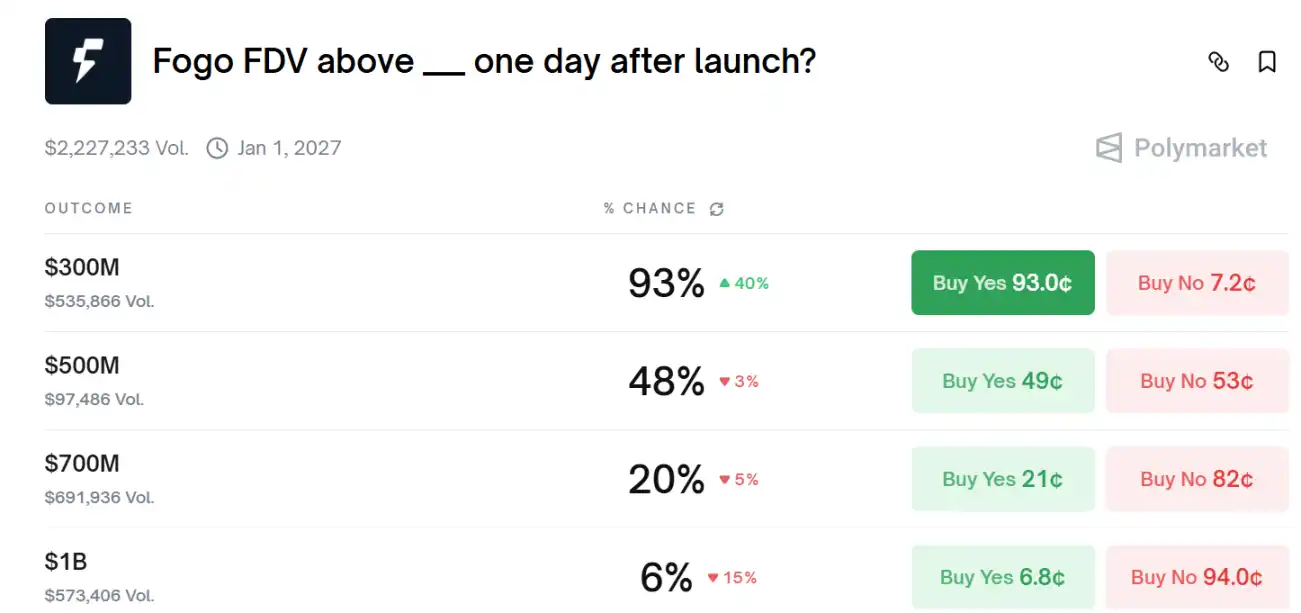
Currently, Polymarket data shows that the probability of the market betting on Fogo's token FDV exceeding $300 million the day after listing has risen to 93%.
The subscription for this project is scheduled from 16:00 to 18:00 Beijing Time on January 13. Participating users must have at least 200 Alpha points. Each Binance Wallet user can submit up to 6 BNB. Binance will distribute tokens proportionally based on user submissions. If the total subscription is oversubscribed, allocations will be reduced proportionally.

Compared to other Prime Sale projects (such as the first two), Fogo's sale places greater emphasis on community access, eliminating early presales and instead screening active users through Alpha points.

Historical data shows that the average oversubscription rate for the first two Prime Sales reached 150%, resulting in actual allocations being reduced by 20%-30%. Currently, both Binance and Bybit have announced the listing of FOGO spot trading.

High-Performance L1

Fogo is a high-performance SVM Layer 1 public chain with the core goal of achieving a "real-time experience," optimized for trading, DeFi, and social payments rather than general computation. Unlike Solana's distributed architecture, Fogo adopts a centralized optimization strategy to ensure low latency and high throughput. According to its official introduction, its block time is 40ms, significantly lower than Solana's 400ms, supporting high-frequency trading such as perpetual contracts (perps) and arbitrage. Fogo focuses more on performance benchmarking and has demonstrated a 1.3s confirmation rate on its testnet.

The two founders of the Fogo team have extensive industry backgrounds. Co-founder Doug Colkitt is also the founder of Ambient Finance and has a deep background in quantitative trading. Earlier in his career, he worked as a quantitative researcher at Citadel Securities, focusing on high-frequency trading and arbitrage strategies. The other co-founder, Robert Sagurton, previously served as an executive at Jump Crypto and has worked at institutions such as JPMorgan, Morgan Stanley, and R3, focusing on banking and trading exchange systems.

In December 2024, Fogo completed a $5.5 million seed round led by Distributed Global. In January 2025, Fogo completed an $8 million community round led by Echo (associated with Cobie) at the same valuation of $100 million.

Total Supply of 10 Billion Tokens, Community Allocation Accounts for 16.68%

Fogo's token is FOGO, and its utility primarily includes two aspects: first, as transaction Gas fees. Second, it can be used for staking rewards: token holders and validators earn native rewards by securing the network.

On January 13, Fogo updated its tokenomics, with a total supply of 10 billion tokens.
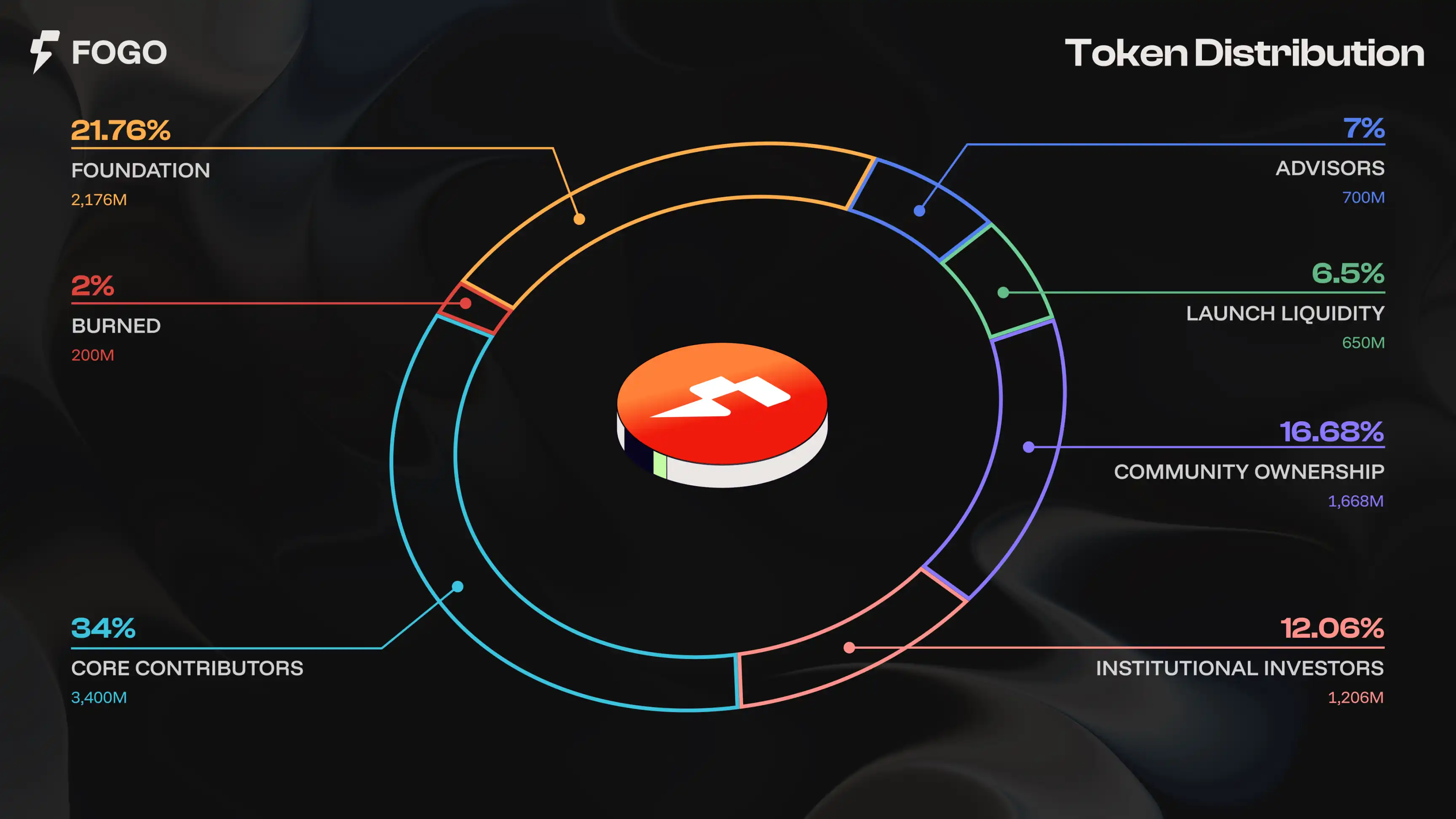
Among these, the community allocation totals 16.68%, including Echo fundraising, Binance priority purchase, and airdrop activities, all categorized under community ownership. Previously, Fogo completed two rounds of fundraising on the Echo platform: the first round raised $8 million at an FDV of $100 million, and the second round raised $1.25 million at an FDV of $200 million, with approximately 3,200 participants. The Echo fundraising share (8.68%) tokens are fully locked at TGE. Starting from September 26, 2025, the Echo share will unlock over 4 years, with a 12-month lock-up period. The Binance priority purchase share (2%) tokens are fully unlocked. The community airdrop share (6%) tokens are fully unlocked. 6% of the genesis supply is allocated to airdrop activities.
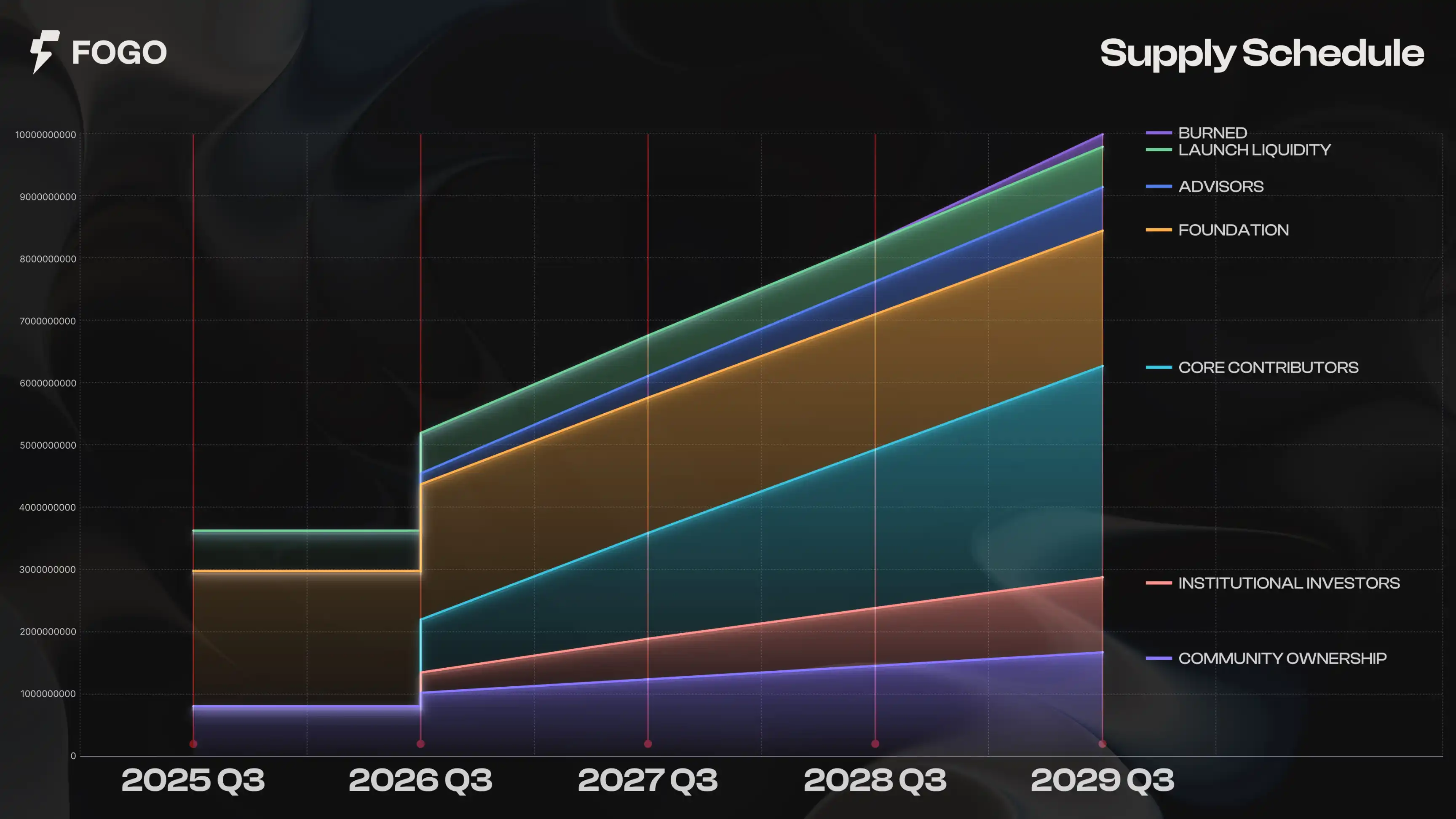
· January 15 allocation share (1.5%): At mainnet launch, 1.5% of the share will be allocated to reward early community members and initial network participants. Future reward allocation (4.5%) is reserved for ongoing promotion activities.

· Institutional investor share (12.06%): Tokens are fully locked. The institutional investor share will begin unlocking starting September 26, 2026.

· Core contributor share (34%): Core contributors hold 34% of the supply. Tokens are fully locked. Starting from September 26, 2025, the core contributor share will unlock over 4 years, with a 12-month lock-up period.

· Foundation share (21.76%): This allocation is used to fund grants, incentives, and ecosystem projects. These tokens are fully unlocked.

· Advisor share (7%): Tokens are fully locked. Starting from September 26, 2025, the advisor share will unlock over 4 years, with a 12-month lock-up period. This is used to reward strategic support and ongoing contributions.

· Listing liquidity share (6.5%) (formerly named "Airdrop & Listing"): Tokens are fully unlocked to support liquidity provided by third parties at listing.

· Burned share (2%): The number of tokens burned to date.

Crypto di tendenza

Domande pertinenti

QWhat is the total supply of FOGO tokens and what percentage was sold in the Binance Pre-TGE Prime Sale?

AThe total supply of FOGO tokens is 10 billion. The amount sold in the Binance Pre-TGE Prime Sale was 200 million FOGO, which is 2% of the total supply.

QWhat was the fundraising amount and the fixed sale price per FOGO token in the Binance Pre-TGE Prime Sale?

AThe total fundraising amount was approximately $7 million. The fixed sale price was $0.035 per FOGO token.

QWhat is the probability, according to Polymarket data, that FOGO's FDV will exceed $300 million the day after its listing?

AAccording to Polymarket data, the probability that FOGO's FDV will exceed $300 million the day after its listing is 93%.

QWhat are the two main utilities of the FOGO token according to the article?

AThe two main utilities of the FOGO token are: 1) to be used as a Gas fee for transactions, and 2) to be staked for yield, allowing token holders and validators to earn native rewards for securing the network.

QWhich two major exchanges have announced that they will list FOGO spot trading?

ABoth Binance and Bybit have announced that they will list FOGO for spot trading.

Letture associate

Dialogue with Jia Hang | Looking Back at Two Decades of Chinese Payment Going Global

**Summary: A Conversation with Jia Hang on Two Decades of China's Payment Globalization** Jia Hang, a veteran with over twenty years in payments, reflects on China's attempts to build a global payment network through three key phases: UnionPay (card networks), Alipay+ (digital wallets), and now, stablecoins. His journey began at UnionPay International, aiming to establish China's card network abroad. While successful in following Chinese tourists ("where Chinese go, UnionPay goes"), it struggled to achieve true global scale. The core lesson: card networks like Visa/Mastercard's unassailable advantage isn't just technical standards, but their deeply entrenched **governance and profit-sharing models** that create powerful network effects. Competing as the "same species" is nearly impossible. At Ant Group, he led Alipay+, a strategy to bypass card networks by interconnecting local e-wallets worldwide. While innovative, it faced a similar ceiling. Mobile QR payments and card swipes were essentially **the same species competing for the same pie**, lacking a disruptive value proposition for users or a sustainable new incentive model to replace the card networks' established flywheel. Today, at Singapore's DCS, Jia focuses on stablecoin-based payments. He argues stablecoins represent a fundamental shift. They are not competing with Visa for consumer payments but challenging the **traditional banking and account system for value movement**. Products like "U Cards" (stablecoin-linked payment cards) are transitional, leveraging existing card networks for acceptance while building new rails. The real potential lies in stablecoins enabling seamless, low-cost global value transfer, potentially reorganizing the financial infrastructure around **accounts rather than cards**. Jia believes stablecoin adoption for local retail payments, cross-border transactions, and as high-yield savings vehicles is becoming irreversible. This could gradually reduce reliance on traditional fiat channels, especially in regions with weak currencies or capital controls. The quest for the "next global payment network" continues, now centered on whether stablecoins can successfully bridge Web2 and Web3, establish new governance, and create compelling user value beyond mere cost reduction.

marsbit13 min fa

Dialogue with Jia Hang | Looking Back at Two Decades of Chinese Payment Going Global

marsbit13 min fa

Circle's Stock Price Plunges 76%, Hong Kong Dollar Stablecoin Set to Launch Within Two Weeks

Circle's stock price has plunged approximately 76% from its 2023 peak, reflecting a major market revaluation. Despite this, Circle President Heath Tarbert emphasized the company's focus on long-term execution and its dominant position with USDC's $73 billion circulation across 34 blockchains. The competitive landscape is intensifying. A new consortium-backed stablecoin, Open USD, is attempting to challenge incumbents by sharing reserve yields with partners. More significantly, Visa's new stablecoin platform, initially supporting Open USD while also being compatible with USDC, could erode Circle's network effects. In response, Circle is expanding into real-world payments through partnerships like the one with Japan's JCB. Separately, Tether (USDT) faces a two-year compliance window under new U.S. regulations, requiring it to adjust its reserve composition away from assets like Bitcoin and loans towards cash and U.S. Treasuries. Meanwhile, in Hong Kong, Standard Chartered-backed fintech firm Dian Dian is poised to launch a licensed HKD-pegged stablecoin (HKDAP), moving the industry into a phase where the real test is integrating licensed stablecoins into actual payment flows and corporate treasury systems. The sharp decline in Circle's stock underscores a broader shift: the stablecoin market is moving from a winner-takes-all dynamic to a multi-player competitive arena where execution, compliance, and real-world utility are becoming paramount.

marsbit14 min fa

Circle's Stock Price Plunges 76%, Hong Kong Dollar Stablecoin Set to Launch Within Two Weeks

marsbit14 min fa

Amidst Capital's Encirclement, Decentralization is the Sole Defense for Public Blockchains

In a landscape dominated by power and profit motives, the author argues that decentralization is not merely one desirable feature among many in blockchain design—it is the singular, non-negotiable defense against corporate and capital capture. The article adopts a Machiavellian, realist perspective on human institutions, positing that businesses will inevitably attempt to co-opt any valuable network to protect their profits and dominance. While external attacks like 51% forks are often discussed, the greater existential risk is internal capture—the gradual erosion of a protocol’s neutrality by vested interests, as seen historically with platforms like Visa and Google. The piece critiques permissioned chains, highly centralized “permissionless” layer-1s, and layer-2s without sufficient decentralization (e.g., single sequencers) as inherently vulnerable. These compromised systems, promoted by established financial players, are framed as delaying tactics to stifle truly open networks that threaten existing high-fee, inefficient business models. Real-world examples, such as closed enterprise consortiums that exclude competitors, illustrate how such systems cement oligopolies rather than foster innovation. The author concludes that while decentralized protocols like Ethereum are imperfect and costly to operate, they represent the only viable long-term equilibrium. In a market where value naturally flows to the most secure and neutral settlement layer, only maximally decentralized public blockchains can resist being subsumed by capital and powerful incumbents.

Foresight News24 min fa

Amidst Capital's Encirclement, Decentralization is the Sole Defense for Public Blockchains

Foresight News24 min fa

Who Decides the Rules of Bitcoin? BIP-110 Ignites Governance Debate

Bitcoin's governance is once again at the center of a heated debate, this time ignited by BIP-110, the "Reduced Data Temporary Softfork." This proposal aims to curb non-monetary data (like inscriptions and Runes) by introducing seven new consensus-layer restrictions over a year, such as limiting new output scripts to 34 bytes and restoring the OP_RETURN cap to 83 bytes. The controversy stems from BIP-110's fundamental shift: it moves the battle against "spam" from node relay and miner policies to the consensus layer, rendering currently valid transactions invalid. Supporters, arguing that default policy governance has failed (highlighted by Bitcoin Core v30's relaxation of OP_RETURN limits), see this as necessary to protect node resources and Bitcoin's monetary focus. Opponents, led by figures like Michael Saylor and Adam Back, warn it dangerously centralizes governance. Saylor listed 110 reasons against it, criticizing its low 55% miner activation threshold and potential for chain splits. Back emphasized Bitcoin's "permissionless" ethos, arguing no single group should impose value judgments via consensus rules. Further complicating matters, technical critiques suggest BIP-110 may be technically circumventable, and a "BlockSlop" vulnerability in its upgrade path poses a consensus risk. The debate has drawn in diverse stakeholders: miners (with pools like Ocean signaling support and Foundry polling clients), node operators (like Bitcoin Knots), and new players like corporate treasury holder MicroStrategy (Saylor), whose market influence adds a novel dimension. Ultimately, BIP-110 acts as a governance stress test, exposing the unresolved question: who decides Bitcoin's rules? It pits the authority of miners, node operators, developers, and capital holders against each other, with each side claiming to defend Bitcoin's core principles of neutrality and security.

marsbit41 min fa

Who Decides the Rules of Bitcoin? BIP-110 Ignites Governance Debate

marsbit41 min fa

Trading

Spot

Articoli Popolari

Cosa è BNB WHALES

Comprendere le Balene BNB: Un Approfondimento nel Paesaggio delle Cryptovalute Introduzione alle Balene BNB Nel vibrante mondo delle criptovalute, emergono regolarmente nuovi progetti, spesso promettendo soluzioni innovative ed esperienze uniche. Uno di questi progetti è Balene BNB, lanciato nel 2023 e costruito sulla BNB Smart Chain (BEP20). Balene BNB si propone di stabilire una presenza distintiva all'interno dell'ecosistema delle criptovalute, concentrandosi sulla creazione di una piattaforma coinvolgente che unisce i benefici della tecnologia blockchain con interazioni sociali e di gioco. Questo articolo mira a esplorare più a fondo Balene BNB, analizzando i suoi componenti principali, meccaniche e traiettoria di sviluppo. Cosa sono le Balene BNB? Le Balene BNB sono un'iniziativa criptovalutaria che cerca di fornire una gamma diversificata di funzionalità e opportunità per i propri utenti nel crescente ambiente del Web3. Utilizzando lo standard BEP20, il progetto opera con un'offerta totale di token di 100 trilioni (100.000.000.000.000.000). Nonostante questa cifra significativa, è interessante notare che attualmente non ci sono token in circolazione, indicando che il progetto potrebbe essere ancora nelle sue fasi iniziali di sviluppo. Il principale obiettivo delle Balene BNB è creare una piattaforma in cui gli utenti possano partecipare a varie attività interattive beneficiando della sicurezza e della trasparenza offerte dalla tecnologia blockchain. Promuovendo un ambiente unico e coinvolgente, Balene BNB punta a costruire una comunità forte di utenti che sono coinvolti nel progetto e nel suo sviluppo. Chi è il Creatore delle Balene BNB? L'identità del creatore delle Balene BNB rimane non divulgata al momento, presentando una sfida per coloro che cercano di capire i principi fondanti e le intuizioni visionarie del progetto. Questa assenza di informazioni disponibili pubblicamente riguardo alla leadership del progetto può sollevare domande tra i potenziali investitori e utenti sulla sua governance e struttura di responsabilità. Chi sono gli Investitori delle Balene BNB? Con l'evoluzione delle Balene BNB, le informazioni riguardanti investitori specifici o supporto da fondazioni di investimento non sono attualmente disponibili. La documentazione ufficiale del progetto, incluso il suo whitepaper, non divulga né sostenitori finanziari individuali né istituzionali. La mancanza di trasparenza in questo senso può talvolta sollevare interrogativi sulla legittimità e sostenibilità dei nuovi progetti all'interno dell'ecosistema delle criptovalute. Come Funzionano le Balene BNB? Le Balene BNB operano sulla BNB Smart Chain utilizzando lo standard BEP20, noto per la sua efficienza e basse commissioni di transazione, attirando una varietà di sviluppatori e progetti. L'aspetto unico delle Balene BNB risiede nella sua attenzione alla creazione di una piattaforma guidata dalla comunità. Sebbene i dettagli operativi precisi siano scarsi, il progetto enfatizza l'interazione e il coinvolgimento, potenzialmente incorporando elementi gamificati nelle sue offerte. L'enfasi sulla comunità è fondamentale, poiché si allinea con le tendenze prevalenti nel campo delle criptovalute, dove il contributo e la partecipazione degli utenti spesso determinano il successo di un progetto. Ulteriori innovazioni potrebbero essere previste, ma attualmente, i meccanismi specifici e le funzionalità che differenziano Balene BNB da altre iniziative crittografiche devono ancora essere completamente chiariti. Senza informazioni dettagliate riguardo alla sua funzionalità, è difficile valutare in modo completo i differenziali del progetto. Timeline delle Balene BNB Lo sviluppo delle Balene BNB si è svolto attraverso tappe chiave, segnando il suo percorso nel panorama delle criptovalute. Di seguito è riportata una cronologia di eventi significativi riguardanti il progetto: 2023: Lancio delle Balene BNB, segnando l'ingresso del progetto nel mercato. 2023: Pubblicazione del whitepaper del progetto, che delinea gli obiettivi generali e il framework operativo. In Corso: Le Balene BNB continuano a sviluppare le proprie funzionalità, puntando a costruire una base utenti solida e ad espandere le proprie offerte. Punti Chiave sulle Balene BNB Piattaforma: BNB Smart Chain (BEP20) Offerta Totale: 100 trilioni di token (100.000.000.000.000.000) Offerta Circolante: 0 token (indicando una fase nascente) Obiettivo del Progetto: Favorire una piattaforma di criptovalute coinvolgente per l'interazione e la costruzione di comunità. Creatore: Sconosciuto Investitori: Non divulgati Stato Operativo: Attivo con sviluppo e espansione in corso Conclusione Nel mentre le Balene BNB navigano nel competitivo panorama delle criptovalute, offrono uno sguardo sul potenziale dei progetti guidati dalla comunità costruiti sulle fondamenta della tecnologia blockchain. Concentrandosi sul coinvolgimento e sull'interazione, l'iniziativa si pone all'avanguardia dell'innovazione nel campo del Web3. Tuttavia, il successo del progetto dipenderà alla fine dalla chiarezza delle sue meccaniche operative, dalla divulgazione della sua governance e dalla creazione di una solida comunità di utenti. Per potenziali utenti e investitori, le Balene BNB rappresentano un caso studio nella natura in evoluzione dei progetti di criptovalute—una che illustra sia le emozionanti possibilità che le complessità associate a nuove iniziative. Con il paesaggio che continua a evolversi, sarà essenziale monitorare i progressi delle Balene BNB e il loro impatto sull'ecosistema più ampio delle criptovalute.

393 Totale visualizzazioniPubblicato il 2024.04.05Aggiornato il 2024.12.03

Cosa è BNB WHALES

Come comprare BNB

Benvenuto in HTX.com! Abbiamo reso l'acquisto di Binance Coin (BNB) semplice e conveniente. Segui la nostra guida passo passo per intraprendere il tuo viaggio nel mondo delle criptovalute.Step 1: Crea il tuo Account HTXUsa la tua email o numero di telefono per registrarti il tuo account gratuito su HTX. Vivi un'esperienza facile e sblocca tutte le funzionalità,Crea il mio accountStep 2: Vai in Acquista crypto e seleziona il tuo metodo di pagamentoCarta di credito/debito: utilizza la tua Visa o Mastercard per acquistare immediatamente Binance CoinBNB.Bilancio: Usa i fondi dal bilancio del tuo account HTX per fare trading senza problemi.Terze parti: abbiamo aggiunto metodi di pagamento molto utilizzati come Google Pay e Apple Pay per maggiore comodità.P2P: Fai trading direttamente con altri utenti HTX.Over-the-Counter (OTC): Offriamo servizi su misura e tassi di cambio competitivi per i trader.Step 3: Conserva Binance Coin (BNB)Dopo aver acquistato Binance Coin (BNB), conserva nel tuo account HTX. In alternativa, puoi inviare tramite trasferimento blockchain o scambiare per altre criptovalute.Step 4: Scambia Binance Coin (BNB)Scambia facilmente Binance Coin (BNB) nel mercato spot di HTX. Accedi al tuo account, seleziona la tua coppia di trading, esegui le tue operazioni e monitora in tempo reale. Offriamo un'esperienza user-friendly sia per chi ha appena iniziato che per i trader più esperti.

994 Totale visualizzazioniPubblicato il 2024.12.12Aggiornato il 2026.06.02

Come comprare BNB

Cosa è BNB CARD

Comprendere BNB Card: Rivoluzionare l'Identità Digitale in Web3 Nel panorama in rapida evoluzione della tecnologia blockchain e delle criptovalute, la BNB Card o $BNBCARD si distingue come un progetto notevole. Questo token meme utilitario guidato dalla comunità sfrutta la BNB Smart Chain (BSC), mirando a integrare la cultura meme con soluzioni innovative per l'identità digitale. Man mano che sempre più utenti si immergono nei regni della decentralizzazione, è fondamentale analizzare cosa offre BNB Card, le sue sfumature operative e il suo potenziale impatto sul mercato. Cos'è BNB Card ($BNBCARD)? Alla sua essenza, BNB Card rappresenta un token meme con una sostanziale utilità. È progettato per dare potere agli utenti consentendo la creazione di carte d'identità digitali personalizzate che sono sia espressive che funzionali. Il progetto racchiude diverse caratteristiche chiave: Carte d'Identità Personalizzabili: Gli utenti hanno la possibilità di progettare carte d'identità digitali a tema Binance, fornendo loro una piattaforma per l'auto-espressione e un'interazione comunitaria migliorata. Struttura Decentralizzata: Sviluppata sulla BSC, BNB Card enfatizza attributi chiave come sicurezza, trasparenza e sovranità degli utenti. La natura decentralizzata della struttura consente transazioni che sono sia efficienti che sicure. Modello Centrato sulla Comunità: L'enfasi sulla partecipazione di base piuttosto che su modelli finanziari guidati da laboratori crea un ambiente coinvolgente per i suoi utenti. Sfruttando la viralità intrinseca della cultura meme, BNB Card promuove un robusto movimento comunitario. L'obiettivo primario di BNB Card è democratizzare gli strumenti di identità digitale in Web3, offrendo soluzioni accessibili che avvantaggiano gli utenti senza i vincoli tipicamente associati ai sistemi di gestione dell'identità tradizionali. Creatore e Investitori Quando si esplora l'identità dietro BNB Card, è importante notare che nessun singolo creatore è esplicitamente accreditato. Invece, il progetto sembra essere guidato dalla comunità, suggerendo uno sforzo collettivo ispirato al concetto della “Early Builder Card” di Binance. Questo approccio allo sviluppo organico è comune tra i progetti all'interno dello spettro dei token meme, dove lo sviluppo è spesso influenzato dalla passione della comunità piuttosto che da un'autorità centrale. In termini di investimento, l'assenza di sostenitori istituzionali pubblicamente dichiarati evidenzia ulteriormente la base comunitaria del progetto. Esso prospera grazie al supporto organico della comunità, riflettendo una caratteristica abituale dei progetti guidati dai meme che spesso coinvolgono il loro pubblico attraverso canali social piuttosto che percorsi di investimento formali. Come Funziona BNB Card impiega diversi meccanismi che delineano il suo funzionamento e spirito innovativo: Utilità del Token: Il token BNBCARD consente agli utenti di accedere a un insieme di strumenti per la creazione di ID, fornendo anche una piattaforma per la governance comunitaria. Il token funge da elemento centrale che abilita queste funzionalità. Integrazione Blockchain: Utilizzando la BSC, BNB Card garantisce compatibilità con applicazioni basate su Ethereum Virtual Machine (EVM). Questa integrazione offre agli utenti i vantaggi di basse commissioni di transazione migliorando l'accessibilità. Ecosistema Fai-da-te (DIY): Centrale nell'appeal di BNB Card è il suo approccio fai-da-te (DIY) alla generazione di carte d'identità digitali. Questo elemento partecipativo incoraggia gli utenti a impegnarsi nell'espressione creativa, promuovendo una cultura inclusiva che prospera sulla contribuzione e collaborazione. Cronologia La cronologia è fondamentale per comprendere la traiettoria di BNB Card. I traguardi importanti nella storia del progetto includono: 18 marzo 2025: BNB Card è stata quotata su LBank, segnando un passo significativo nel suo percorso di scambio e aprendo porte per liquidità e accessibilità per gli utenti. 19 marzo 2025: Un momento cruciale si è verificato quando il token ha registrato un aumento astronomico del 26.000% in 24 ore, attirando l'attenzione per il suo potenziale e l'entusiasmo della comunità. Sviluppi in Corso: Il progetto sta continuamente espandendo le sue partnership con scambi decentralizzati (DEX) come PancakeSwap, migliorando ulteriormente la liquidità e il coinvolgimento degli utenti. Innovazione e Differenziazione Comprendere cosa distingue BNB Card richiede un'esplorazione più profonda del suo framework innovativo: Ibrido Meme-Utilità: BNB Card fonde con successo il fascino giocoso della cultura meme con applicazioni pratiche nella gestione dell'identità digitale. Questo approccio di nicchia si rivolge efficacemente a un ampio pubblico, attirando sia utenti esperti di tecnologia che quelli nuovi nel mondo delle criptovalute. Governance Decentralizzata: Operare senza controllo centralizzato consente al progetto di sfruttare direttamente il contributo della comunità. Il processo decisionale collettivo sostenuto dal coinvolgimento della comunità dà potere agli utenti, assicurando che le loro voci contribuiscano allo sviluppo e alla direzione del progetto. Scalabilità: BNB Card può beneficiare enormemente dagli aggiornamenti della roadmap 2025 per la BNB Chain, che includono miglioramenti come l'aumento della velocità delle transazioni e l'integrazione di strumenti di intelligenza artificiale. Questi miglioramenti posizionano il progetto in modo vantaggioso all'interno di un ambiente altamente competitivo. Conclusione BNB Card è emblematica di una nuova ondata di soluzioni per l'identità digitale all'interno dell'ecosistema Web3. Fondendo divertimento, coinvolgimento della comunità e utilità pratica, invita gli utenti a partecipare attivamente nella definizione delle loro persone digitali. Mentre il progetto naviga nel dinamico panorama delle criptovalute, il suo successo dipenderà probabilmente dal mantenimento di un forte supporto della comunità mentre si adatta ai progressi tecnologici e alle esigenze degli utenti. L'integrazione della decentralizzazione con la cultura meme non serve solo come mezzo per il coinvolgimento guidato dagli utenti, ma anche come base per la narrazione in evoluzione riguardante l'identità digitale nell'era della blockchain. In sintesi, BNB Card non solo esemplifica la convergenza di creatività e utilità all'interno dello spazio crypto, ma sottolinea anche l'importanza della comunità nel guidare il futuro delle tecnologie decentralizzate.

363 Totale visualizzazioniPubblicato il 2025.03.26Aggiornato il 2025.03.26

Cosa è BNB CARD

Discussioni

Benvenuto nella Community HTX. Qui puoi rimanere informato sugli ultimi sviluppi della piattaforma e accedere ad approfondimenti esperti sul mercato. Le opinioni degli utenti sul prezzo di BNB BNB sono presentate come di seguito.

活动图片