Flow Foundation Fights Korean Delisting After Binance Clears Crypto Security Fears

bitcoinistPubblicato 2026-03-10Pubblicato ultima volta 2026-03-10

Introduzione

Flow Foundation and Dapper Labs have filed a motion with the Seoul Central District Court to halt the planned delisting of FLOW on major South Korean exchanges Upbit, Bithumb, and Coinone. The delisting followed a December protocol-level exploit that allowed the minting of duplicate tokens, though no user funds were lost. While global exchanges like Binance, Coinbase, and Kraken have since reviewed and fully restored FLOW trading—with Binance removing its monitoring tag—Korean platforms maintained heightened scrutiny. Flow expressed gratitude for the Korean community’s support and emphasized its commitment to the market through legal action, potential new listings, and ecosystem development. Despite regulatory challenges, Flow’s network continues to attract major partners like Disney and the NBA, with strong consumer adoption and NFT distribution.

Flow Foundation is asking a Seoul court to halt the delisting of FLOW on South Korea’s biggest crypto exchanges.

FLOW Fights Back

In an announcement made on March 8, Flow Foundation and Dapper Labs (a venture‐backed Web3 company best known for creating CryptoKitties, NBA Top Shot and other major NFT products) have revealed that they filed a motion with the Seoul Central District Court to suspend the planned termination of FLOW trading on Upbit, Bithumb and Coinone.

Crypto Security Fears

On Dec. 27, Flow suffered a protocol‐level exploit that allowed an attacker to mint roughly 3.9 million duplicate tokens, triggering an emergency halt. Initial recovery proposals included a full chain rollback, which drew pushback from partners over double balances and bridge losses; the team pivoted to an “isolated recovery” that targeted and destroyed only the counterfeit tokens.

Despite no user funds on exchanges were ultimately lost, Korean platforms kept FLOW under heightened scrutiny. Upbit, Bithumb and Coinone announced on Feb. 12 that they would end trading support for FLOW on March 16, citing the December protocol-level exploit.

Security Concerns Are Now Resolved

However, every major global venue, including Binance, Coinbase, Kraken and HTX, have now independently reviewed the incident and fully restored FLOW trading, with Binance even removing its monitoring tag after a joint resolution on March 6. This confirms, according to Flow Foundation and Binance itself, that “all issues related to the security incident have been resolved”.

“A Commitment To Korea”

In Korea, Korbit (one of South Korea’s oldest regulated cryptocurrency exchanges, focused on KRW spot trading for major coins and retail users) conducted its own review, Korbit removed a trading-caution label on Feb. 27, and continues to support unrestricted FLOW trading. Flow Foundation expressed its special gratitude towards his Korean community continued support:

The Foundation recognizes the uncertainty the Korean community has faced since February, and is grateful for the patience and support of Korean holders through this process

The filing of the motion with the Seoul Central District Court is a step that “reflects the responsibility of the Foundation to advocate for the Korean community using every available pathway”, Flow Foundation claims. The Foundation has also assured that it “remains open to constructive conversation with all parties involved”.

Alongside this, The Foundation is pursuing new listings and expands self-custody options for local users while pushing ahead with its consumer DeFi roadmap, including on-chain automation, EVM‐equivalent infrastructure and an enshrined lending protocol, betting that long‐term adoption will outlast short‐term regulatory frictions in one market.

The Growth Of The Flow Ecosystem

While Korea wrestles over FLOW’s listing status, the underlying network is quietly behaving like a top‐tier consumer chain. Disney, the NBA, the NFL and Ticketmaster all continue to build on Flow, together distributing over 100 million NFTs to more than 13 million fans and generating billions in primary and secondary sales.

As Flow’s ecosystem momentum continues to build, the real question for investors watching the Korean injunction drama is whether a localized delisting can truly derail it.
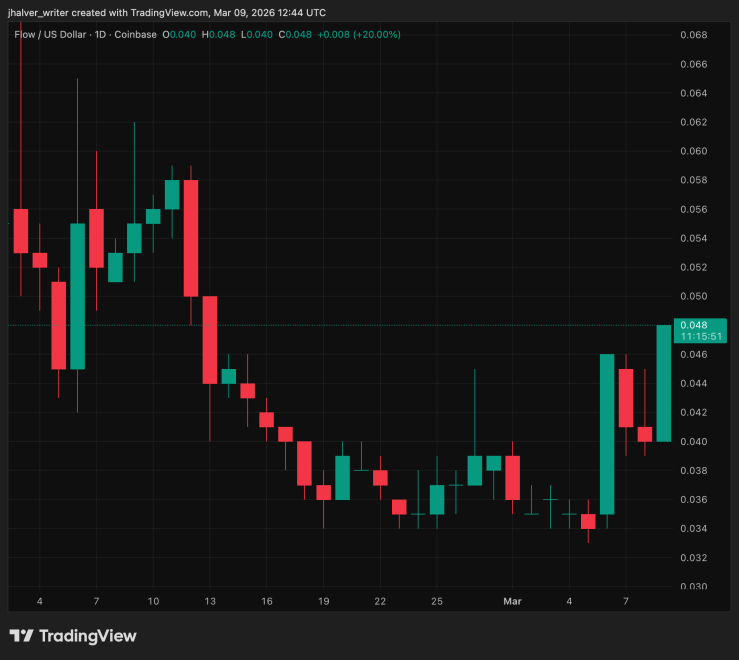
FLOW's price trends to the upside on the daily chart. Source: FLOWUSD on Tradingview

Cover image from ChatGPT, FLOWUSD chart from Tradingview

Crypto di tendenza

Domande pertinenti

QWhat action did Flow Foundation take in response to the planned delisting of FLOW on major South Korean exchanges?

AFlow Foundation filed a motion with the Seoul Central District Court to suspend the planned termination of FLOW trading on Upbit, Bithumb, and Coinone.

QWhat was the primary reason cited by the Korean exchanges for their decision to delist FLOW token?

AThe exchanges cited the December protocol-level exploit that allowed an attacker to mint approximately 3.9 million duplicate tokens as the reason for the delisting.

QWhich major global cryptocurrency exchange removed its monitoring tag for FLOW after a joint resolution on March 6?

ABinance removed its monitoring tag for FLOW after the joint resolution on March 6, confirming that all security issues were resolved.

QWhich South Korean exchange conducted its own review and continued to support unrestricted FLOW trading, removing its trading-caution label?

AKorbit conducted its own review, removed a trading-caution label on February 27, and continues to support unrestricted FLOW trading.

QWhat major corporations are mentioned as continuing to build on the Flow network, contributing to its ecosystem growth?

ADisney, the NBA, the NFL, and Ticketmaster are all mentioned as continuing to build on Flow, having distributed over 100 million NFTs to more than 13 million fans.

Letture associate

New Fire Research Institute: Inflation May Become a Stubborn Problem, Can Cryptocurrencies Achieve Independent Performance in the Short Term?

New Fire Research Institute argues that despite the recent U.S. June CPI decline to 3.5% year-on-year—primarily driven by energy—core goods inflation remains persistent, with core PCE likely showing slight growth. Federal Reserve Chairman Wash has emphasized the Fed's independence and a "zero tolerance" stance on inflation, suggesting a continued hawkish posture that will pressure risk assets, especially if energy prices rise again. Concurrently, the semiconductor memory sector faces structural pressures, as seen in significant sell-offs for Micron and SK Hynix. High leverage in markets like South Korea is triggering deleveraging, amplifying volatility. Investors are also questioning the sustainability of AI-related capital expenditures. In contrast, the crypto market showed relative stability last week, with BTC and ETH gaining slightly. Positive developments include a shift to net inflows for U.S. Bitcoin spot ETFs, a narrowing Coinbase discount, and strong activity on the Robinhood Chain ecosystem. The potential advancement of the U.S. CLARITY Act provides a policy catalyst. Overall, the probability of an independent crypto bull run in the short term is low, given overarching macro pressures. However, fundamentals are improving with ETF inflows and robust on-chain activity, providing solid support. Technically, BTC and ETH show strong support at key moving averages. New Fire Research maintains that Bitcoin around $60,000 represents a high-value allocation zone, with limited downside risk near current levels. The true bull market catalyst awaits a confirmed market bottom combined with a macro policy shift and legislative progress.

marsbit5 min fa

New Fire Research Institute: Inflation May Become a Stubborn Problem, Can Cryptocurrencies Achieve Independent Performance in the Short Term?

marsbit5 min fa

Base Under Pressure

**Title: The Pressure Mounts for Base** Base, the Ethereum Layer 2 scaling solution backed by Coinbase, is facing significant pressure and public scrutiny from its leadership following the launch of Robinhood Chain. Base co-founder Jesse Pollak recently acknowledged strategic missteps, admitting that the chain's past focus on social and creator tokens (e.g., through Farcaster, Zora) failed to deliver sustainable adoption. He has refocused on core infrastructure, handing leadership of the Base App back to Coinbase's Cobie. While Base remains a top L2 contender alongside OP Mainnet and Arbitrum, and boasts the highest TVL (nearly $12B), its weaknesses are being highlighted by the new competitor. Key criticisms include its slow progress on decentralization. Base has faced issues with its single sequencer causing block production halts, and L2BEAT is reportedly considering downgrading its decentralization rating from Stage 1 to Stage 0. This contrasts sharply with the rapid initial success of Robinhood Chain, whose DEX quickly entered the top five by volume. The leadership styles of the parent companies are also being compared: Robinhood's CEO actively engages with new projects, while a recent incident where Coinbase's Brian Armstrong briefly changed his profile picture—sparking and then crashing a related meme token—drew community ire and mockery. Pollak stated Base is working with Coinbase on tokenized stocks backed 1:1 by real equity, differentiating it from Robinhood's derivatives model. However, the article argues that Base's most urgent task is to address its long-standing technical and trust issues. With more traditional finance players likely to emulate Robinhood's path, Base must use this competitive pressure to solidify its position as long-term financial infrastructure.

Foresight News21 min fa

Base Under Pressure

Foresight News21 min fa

White House Concession Removes Ethical Hurdle, Clarity Act Races Against Final Window Before Recess?

On July 21st, industry sources reported that the Trump administration has agreed to include an ethics provision in the "Clarity Act" (Digital Asset Market Clarity Act of 2025). This concession addresses the long-standing conflict-of-interest concerns regarding government officials and the crypto industry, potentially removing the final major obstacle to the bill's progress. Additionally, Patrick Witt, the executive director of the White House's Digital Asset Advisory Committee, confirmed he will remain in his role to help finalize the bill, alleviating previous concerns about his potential departure. The Clarity Act aims to establish a unified federal regulatory framework for the U.S. digital asset market. Its core objective is to resolve regulatory ambiguity by defining different types of digital assets (digital commodities, investment contract assets, and permitted payment stablecoins) and clarifying the respective oversight roles of the SEC and CFTC. This would end the long-running jurisdictional dispute between the two agencies and provide clearer compliance paths for the industry. With the ethics issue moving toward resolution, the most urgent challenge now is time. The U.S. Congress is set to begin its August recess in mid-August, leaving only a few working weeks to finalize the text and advance the bill through the Senate. Industry advocates, like the Blockchain Association's Kristin Smith, stress that this is a critical moment. If negotiations conclude successfully in the coming weeks, the Clarity Act could pass a key hurdle before the recess; otherwise, it may face significant delays. If enacted, the Clarity Act could mark a historic turning point in crypto regulation. By providing a clearer and more predictable legal framework, it aims to reduce uncertainty for businesses, developers, and traditional financial institutions looking to enter the digital asset space, potentially setting a global benchmark for market structure regulation.

Odaily星球日报27 min fa

White House Concession Removes Ethical Hurdle, Clarity Act Races Against Final Window Before Recess?

Odaily星球日报27 min fa

Trading

Spot

Articoli Popolari

Come comprare FLOW

Benvenuto in HTX.com! Abbiamo reso l'acquisto di Flow (FLOW) semplice e conveniente. Segui la nostra guida passo passo per intraprendere il tuo viaggio nel mondo delle criptovalute.Step 1: Crea il tuo Account HTXUsa la tua email o numero di telefono per registrarti il tuo account gratuito su HTX. Vivi un'esperienza facile e sblocca tutte le funzionalità,Crea il mio accountStep 2: Vai in Acquista crypto e seleziona il tuo metodo di pagamentoCarta di credito/debito: utilizza la tua Visa o Mastercard per acquistare immediatamente FlowFLOW.Bilancio: Usa i fondi dal bilancio del tuo account HTX per fare trading senza problemi.Terze parti: abbiamo aggiunto metodi di pagamento molto utilizzati come Google Pay e Apple Pay per maggiore comodità.P2P: Fai trading direttamente con altri utenti HTX.Over-the-Counter (OTC): Offriamo servizi su misura e tassi di cambio competitivi per i trader.Step 3: Conserva Flow (FLOW)Dopo aver acquistato Flow (FLOW), conserva nel tuo account HTX. In alternativa, puoi inviare tramite trasferimento blockchain o scambiare per altre criptovalute.Step 4: Scambia Flow (FLOW)Scambia facilmente Flow (FLOW) nel mercato spot di HTX. Accedi al tuo account, seleziona la tua coppia di trading, esegui le tue operazioni e monitora in tempo reale. Offriamo un'esperienza user-friendly sia per chi ha appena iniziato che per i trader più esperti.

207 Totale visualizzazioniPubblicato il 2024.12.10Aggiornato il 2026.06.02

Come comprare FLOW

Discussioni

Benvenuto nella Community HTX. Qui puoi rimanere informato sugli ultimi sviluppi della piattaforma e accedere ad approfondimenti esperti sul mercato. Le opinioni degli utenti sul prezzo di FLOW FLOW sono presentate come di seguito.

活动图片