Flow Foundation Fights Korean Delisting After Binance Clears Crypto Security Fears

bitcoinistPubblicato 2026-03-10Pubblicato ultima volta 2026-03-10

Introduzione

Flow Foundation and Dapper Labs have filed a motion with the Seoul Central District Court to halt the planned delisting of FLOW on major South Korean exchanges Upbit, Bithumb, and Coinone. The delisting followed a December protocol-level exploit that allowed the minting of duplicate tokens, though no user funds were lost. While global exchanges like Binance, Coinbase, and Kraken have since reviewed and fully restored FLOW trading—with Binance removing its monitoring tag—Korean platforms maintained heightened scrutiny. Flow expressed gratitude for the Korean community’s support and emphasized its commitment to the market through legal action, potential new listings, and ecosystem development. Despite regulatory challenges, Flow’s network continues to attract major partners like Disney and the NBA, with strong consumer adoption and NFT distribution.

Flow Foundation is asking a Seoul court to halt the delisting of FLOW on South Korea’s biggest crypto exchanges.

FLOW Fights Back

In an announcement made on March 8, Flow Foundation and Dapper Labs (a venture‐backed Web3 company best known for creating CryptoKitties, NBA Top Shot and other major NFT products) have revealed that they filed a motion with the Seoul Central District Court to suspend the planned termination of FLOW trading on Upbit, Bithumb and Coinone.

Crypto Security Fears

On Dec. 27, Flow suffered a protocol‐level exploit that allowed an attacker to mint roughly 3.9 million duplicate tokens, triggering an emergency halt. Initial recovery proposals included a full chain rollback, which drew pushback from partners over double balances and bridge losses; the team pivoted to an “isolated recovery” that targeted and destroyed only the counterfeit tokens.

Despite no user funds on exchanges were ultimately lost, Korean platforms kept FLOW under heightened scrutiny. Upbit, Bithumb and Coinone announced on Feb. 12 that they would end trading support for FLOW on March 16, citing the December protocol-level exploit.

Security Concerns Are Now Resolved

However, every major global venue, including Binance, Coinbase, Kraken and HTX, have now independently reviewed the incident and fully restored FLOW trading, with Binance even removing its monitoring tag after a joint resolution on March 6. This confirms, according to Flow Foundation and Binance itself, that “all issues related to the security incident have been resolved”.

“A Commitment To Korea”

In Korea, Korbit (one of South Korea’s oldest regulated cryptocurrency exchanges, focused on KRW spot trading for major coins and retail users) conducted its own review, Korbit removed a trading-caution label on Feb. 27, and continues to support unrestricted FLOW trading. Flow Foundation expressed its special gratitude towards his Korean community continued support:

The Foundation recognizes the uncertainty the Korean community has faced since February, and is grateful for the patience and support of Korean holders through this process

The filing of the motion with the Seoul Central District Court is a step that “reflects the responsibility of the Foundation to advocate for the Korean community using every available pathway”, Flow Foundation claims. The Foundation has also assured that it “remains open to constructive conversation with all parties involved”.

Alongside this, The Foundation is pursuing new listings and expands self-custody options for local users while pushing ahead with its consumer DeFi roadmap, including on-chain automation, EVM‐equivalent infrastructure and an enshrined lending protocol, betting that long‐term adoption will outlast short‐term regulatory frictions in one market.

The Growth Of The Flow Ecosystem

While Korea wrestles over FLOW’s listing status, the underlying network is quietly behaving like a top‐tier consumer chain. Disney, the NBA, the NFL and Ticketmaster all continue to build on Flow, together distributing over 100 million NFTs to more than 13 million fans and generating billions in primary and secondary sales.

As Flow’s ecosystem momentum continues to build, the real question for investors watching the Korean injunction drama is whether a localized delisting can truly derail it.
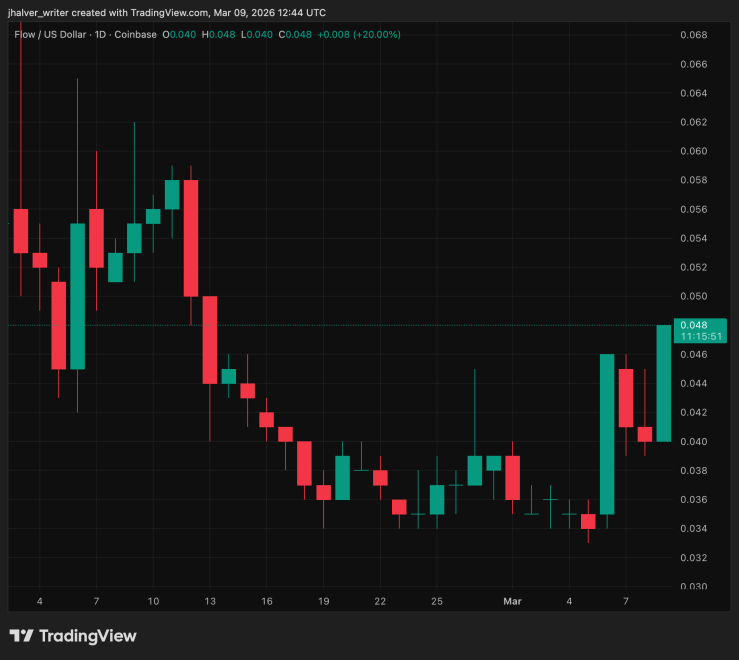
FLOW's price trends to the upside on the daily chart. Source: FLOWUSD on Tradingview

Cover image from ChatGPT, FLOWUSD chart from Tradingview

Crypto di tendenza

Domande pertinenti

QWhat action did Flow Foundation take in response to the planned delisting of FLOW on major South Korean exchanges?

AFlow Foundation filed a motion with the Seoul Central District Court to suspend the planned termination of FLOW trading on Upbit, Bithumb, and Coinone.

QWhat was the primary reason cited by the Korean exchanges for their decision to delist FLOW token?

AThe exchanges cited the December protocol-level exploit that allowed an attacker to mint approximately 3.9 million duplicate tokens as the reason for the delisting.

QWhich major global cryptocurrency exchange removed its monitoring tag for FLOW after a joint resolution on March 6?

ABinance removed its monitoring tag for FLOW after the joint resolution on March 6, confirming that all security issues were resolved.

QWhich South Korean exchange conducted its own review and continued to support unrestricted FLOW trading, removing its trading-caution label?

AKorbit conducted its own review, removed a trading-caution label on February 27, and continues to support unrestricted FLOW trading.

QWhat major corporations are mentioned as continuing to build on the Flow network, contributing to its ecosystem growth?

ADisney, the NBA, the NFL, and Ticketmaster are all mentioned as continuing to build on Flow, having distributed over 100 million NFTs to more than 13 million fans.

Letture associate

Dialogue with Jia Hang | Looking Back at Two Decades of Chinese Payment Going Global

**Summary: A Conversation with Jia Hang on Two Decades of China's Payment Globalization** Jia Hang, a veteran with over twenty years in payments, reflects on China's attempts to build a global payment network through three key phases: UnionPay (card networks), Alipay+ (digital wallets), and now, stablecoins. His journey began at UnionPay International, aiming to establish China's card network abroad. While successful in following Chinese tourists ("where Chinese go, UnionPay goes"), it struggled to achieve true global scale. The core lesson: card networks like Visa/Mastercard's unassailable advantage isn't just technical standards, but their deeply entrenched **governance and profit-sharing models** that create powerful network effects. Competing as the "same species" is nearly impossible. At Ant Group, he led Alipay+, a strategy to bypass card networks by interconnecting local e-wallets worldwide. While innovative, it faced a similar ceiling. Mobile QR payments and card swipes were essentially **the same species competing for the same pie**, lacking a disruptive value proposition for users or a sustainable new incentive model to replace the card networks' established flywheel. Today, at Singapore's DCS, Jia focuses on stablecoin-based payments. He argues stablecoins represent a fundamental shift. They are not competing with Visa for consumer payments but challenging the **traditional banking and account system for value movement**. Products like "U Cards" (stablecoin-linked payment cards) are transitional, leveraging existing card networks for acceptance while building new rails. The real potential lies in stablecoins enabling seamless, low-cost global value transfer, potentially reorganizing the financial infrastructure around **accounts rather than cards**. Jia believes stablecoin adoption for local retail payments, cross-border transactions, and as high-yield savings vehicles is becoming irreversible. This could gradually reduce reliance on traditional fiat channels, especially in regions with weak currencies or capital controls. The quest for the "next global payment network" continues, now centered on whether stablecoins can successfully bridge Web2 and Web3, establish new governance, and create compelling user value beyond mere cost reduction.

marsbit16 min fa

Dialogue with Jia Hang | Looking Back at Two Decades of Chinese Payment Going Global

marsbit16 min fa

Circle's Stock Price Plunges 76%, Hong Kong Dollar Stablecoin Set to Launch Within Two Weeks

Circle's stock price has plunged approximately 76% from its 2023 peak, reflecting a major market revaluation. Despite this, Circle President Heath Tarbert emphasized the company's focus on long-term execution and its dominant position with USDC's $73 billion circulation across 34 blockchains. The competitive landscape is intensifying. A new consortium-backed stablecoin, Open USD, is attempting to challenge incumbents by sharing reserve yields with partners. More significantly, Visa's new stablecoin platform, initially supporting Open USD while also being compatible with USDC, could erode Circle's network effects. In response, Circle is expanding into real-world payments through partnerships like the one with Japan's JCB. Separately, Tether (USDT) faces a two-year compliance window under new U.S. regulations, requiring it to adjust its reserve composition away from assets like Bitcoin and loans towards cash and U.S. Treasuries. Meanwhile, in Hong Kong, Standard Chartered-backed fintech firm Dian Dian is poised to launch a licensed HKD-pegged stablecoin (HKDAP), moving the industry into a phase where the real test is integrating licensed stablecoins into actual payment flows and corporate treasury systems. The sharp decline in Circle's stock underscores a broader shift: the stablecoin market is moving from a winner-takes-all dynamic to a multi-player competitive arena where execution, compliance, and real-world utility are becoming paramount.

marsbit17 min fa

Circle's Stock Price Plunges 76%, Hong Kong Dollar Stablecoin Set to Launch Within Two Weeks

marsbit17 min fa

Amidst Capital's Encirclement, Decentralization is the Sole Defense for Public Blockchains

In a landscape dominated by power and profit motives, the author argues that decentralization is not merely one desirable feature among many in blockchain design—it is the singular, non-negotiable defense against corporate and capital capture. The article adopts a Machiavellian, realist perspective on human institutions, positing that businesses will inevitably attempt to co-opt any valuable network to protect their profits and dominance. While external attacks like 51% forks are often discussed, the greater existential risk is internal capture—the gradual erosion of a protocol’s neutrality by vested interests, as seen historically with platforms like Visa and Google. The piece critiques permissioned chains, highly centralized “permissionless” layer-1s, and layer-2s without sufficient decentralization (e.g., single sequencers) as inherently vulnerable. These compromised systems, promoted by established financial players, are framed as delaying tactics to stifle truly open networks that threaten existing high-fee, inefficient business models. Real-world examples, such as closed enterprise consortiums that exclude competitors, illustrate how such systems cement oligopolies rather than foster innovation. The author concludes that while decentralized protocols like Ethereum are imperfect and costly to operate, they represent the only viable long-term equilibrium. In a market where value naturally flows to the most secure and neutral settlement layer, only maximally decentralized public blockchains can resist being subsumed by capital and powerful incumbents.

Foresight News27 min fa

Amidst Capital's Encirclement, Decentralization is the Sole Defense for Public Blockchains

Foresight News27 min fa

Trading

Spot

Articoli Popolari

Come comprare FLOW

Benvenuto in HTX.com! Abbiamo reso l'acquisto di Flow (FLOW) semplice e conveniente. Segui la nostra guida passo passo per intraprendere il tuo viaggio nel mondo delle criptovalute.Step 1: Crea il tuo Account HTXUsa la tua email o numero di telefono per registrarti il tuo account gratuito su HTX. Vivi un'esperienza facile e sblocca tutte le funzionalità,Crea il mio accountStep 2: Vai in Acquista crypto e seleziona il tuo metodo di pagamentoCarta di credito/debito: utilizza la tua Visa o Mastercard per acquistare immediatamente FlowFLOW.Bilancio: Usa i fondi dal bilancio del tuo account HTX per fare trading senza problemi.Terze parti: abbiamo aggiunto metodi di pagamento molto utilizzati come Google Pay e Apple Pay per maggiore comodità.P2P: Fai trading direttamente con altri utenti HTX.Over-the-Counter (OTC): Offriamo servizi su misura e tassi di cambio competitivi per i trader.Step 3: Conserva Flow (FLOW)Dopo aver acquistato Flow (FLOW), conserva nel tuo account HTX. In alternativa, puoi inviare tramite trasferimento blockchain o scambiare per altre criptovalute.Step 4: Scambia Flow (FLOW)Scambia facilmente Flow (FLOW) nel mercato spot di HTX. Accedi al tuo account, seleziona la tua coppia di trading, esegui le tue operazioni e monitora in tempo reale. Offriamo un'esperienza user-friendly sia per chi ha appena iniziato che per i trader più esperti.

207 Totale visualizzazioniPubblicato il 2024.12.10Aggiornato il 2026.06.02

Come comprare FLOW

Discussioni

Benvenuto nella Community HTX. Qui puoi rimanere informato sugli ultimi sviluppi della piattaforma e accedere ad approfondimenti esperti sul mercato. Le opinioni degli utenti sul prezzo di FLOW FLOW sono presentate come di seguito.

活动图片