FlightAware drops Kalshi lawsuit one day after filing

cointelegraphPubblicato 2026-08-12Pubblicato ultima volta 2026-08-12

Introduzione

FlightAware voluntarily dismissed its lawsuit against prediction market platform Kalshi just one day after filing it in a New York court. The initial suit alleged trademark infringement, breach of contract, and unfair competition, claiming Kalshi used FlightAware's name and data for "gambling markets on flight cancellations." The quick dismissal hints at a possible private settlement, though neither company commented. Notably, Kalshi had already altered its event contracts to replace "FlightAware" with a generic "Primary Source Agency" disclaimer. The lawsuit was part of broader legal challenges for prediction markets. Kalshi and similar platforms face actions from multiple US state authorities over alleged illegal sports betting. This case also highlights a jurisdictional conflict: while states like New York and Michigan have moved to restrict Kalshi, the US Commodity Futures Trading Commission (CFTC) asserts exclusive federal authority, recently using emergency powers to block a New York restraining order against the company.

Just a day after real-time flight tracking website FlightAware filed a lawsuit against prediction markets platform Kalshi over use of its name and data, the flight data company gave notice of voluntary dismissal of the case.

In a Tuesday filing in the US District Court for the Southern District of New York, attorneys for FlightAware said that they had voluntarily dismissed the case against Kalshi. The flight tracking company had filed the lawsuit a day earlier, claiming that Kalshi had used its “data and name to run gambling markets on flight cancellations.”

While the immediate turnaround could suggest a closed-door settlement, neither company had publicly commented on the case as of Wednesday. On Tuesday, a judge ordered Kalshi to show cause why the court should not issue a temporary restraining order over FlightAware’s trademark and data.

Notably, at least one event contract showed that Kalshi had changed its language from “FlightAware“ to “Primary Source Agency” as the entity responsible for verifying data related to the outcome of flight cancellations, including that the trade did not “indicate an endorsement of this product or any affiliation” between FlightAware and Kalshi. Primary Source Agency linked to FlightAware’s website. Cointelegraph reached out to the companies for comment but did not receive an immediate response.
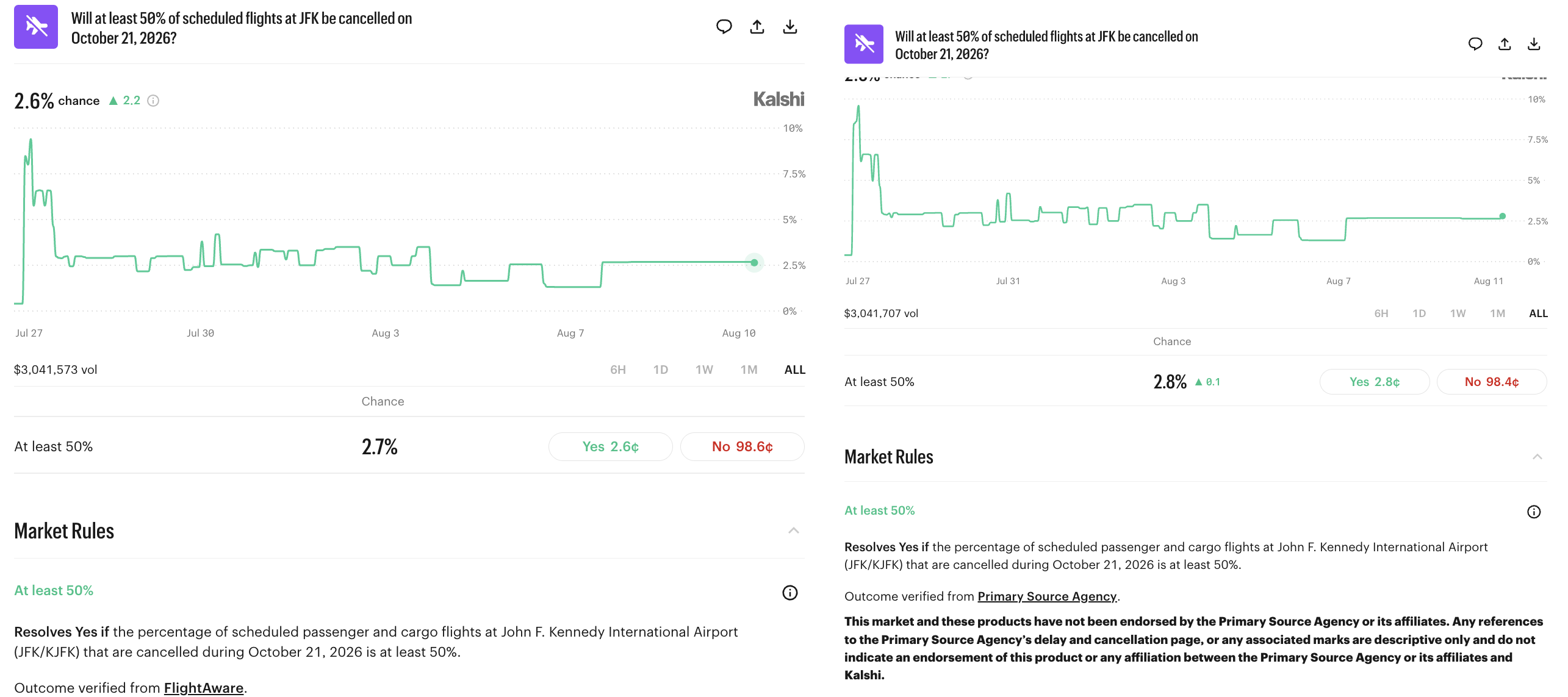
Side-by-side comparison of event contract citing FlightAware data before the lawsuit was dropped (left) and after (right). Source: Kalshi

Related: Kalshi launches sports and crypto perps data feed on DoubleZero

FlightAware’s suit had alleged trademark infringement, breach of contract, injury to its reputation and unfair competition in the latest legal action involving prediction market companies. Kalshi, Polymarket and other prediction market companies face legal action brought by many US state gaming authorities and regulators over alleged illicit sports betting offered to residents.

CFTC still at odds with state authorities over prediction markets

On Tuesday, the US Commodity Futures Trading Commission (CFTC), whose chair Michael Selig has repeatedly claimed the agency has “exclusive jurisdiction“ over prediction markets, said it had invoked “emergency authority“ to block New York state officials’ attempts to seek a temporary restraining order prohibiting the company from offering event contracts nationwide. The action followed New York authorities filing a lawsuit against Kalshi in July, alleging that the company was operating an unlicensed gambling platform through its contracts on sports and other events.

The CFTC decision echoed the agency’s actions in a Michigan case over Kalshi. In June, a Michigan judge ordered the company to stop offering sports betting contracts to residents until the civil case reached a conclusion. However, the CFTC under Selig ordered Kalshi not to comply with the state order — something the company’s head of enforcement and legal counsel said put it in an “impossible position“ between US state and federal orders.

Magazine: El Salvador’s Bitcoin experiment turns 5: ‘It was for us, not them’

Crypto di tendenza

Domande pertinenti

QWhy did FlightAware drop its lawsuit against Kalshi just one day after filing it?

AFlightAware voluntarily dismissed the lawsuit. While the immediate turnaround could suggest a settlement was reached behind closed doors, neither company had publicly commented on the case at the time of the report, so the official reason is not stated.

QWhat specific claims did FlightAware's lawsuit make against Kalshi?

AThe lawsuit alleged that Kalshi used FlightAware's name and data to run gambling markets on flight cancellations, constituting trademark infringement, breach of contract, injury to reputation, and unfair competition.

QWhat notable change did Kalshi make to its event contracts after the lawsuit was filed?

AKalshi changed the language in its contracts from citing "FlightAware" to "Primary Source Agency" as the entity responsible for verifying data. The contracts were updated to state they did not indicate an endorsement or affiliation with FlightAware, though the 'Primary Source Agency' still linked to FlightAware's website.

QWhat is the broader regulatory context involving Kalshi and other prediction market companies mentioned in the article?

ACompanies like Kalshi and Polymarket face legal actions from U.S. state gaming authorities and regulators over allegedly offering illicit sports betting to residents. There is an ongoing jurisdictional conflict between state authorities and the federal CFTC regarding oversight of these markets.

QHow is the CFTC's position on prediction markets creating a conflict with state authorities, as illustrated with Kalshi?

AThe CFTC, claiming "exclusive jurisdiction" over prediction markets, used its emergency authority to block New York's attempt to halt Kalshi's nationwide operations. This echoes its action in a Michigan case, where the CFTC ordered Kalshi not to comply with a state court order, putting the company in an "impossible position" between conflicting federal and state directives.

Letture associate

If Ethereum Had Never Switched from PoW to PoS: An Unrealized Game

"The Great Merge: What If Ethereum Had Stayed on PoW?" This article explores a counterfactual scenario: What if Ethereum had not transitioned from Proof-of-Work (PoW) to Proof-of-Stake (PoS) in 2022? It examines the potential trade-offs of this historical decision. The key argument for a continued PoW path is the missed opportunity in the AI era. Ethereum's GPU miners, unlike Bitcoin's specialized ASICs, could have formed a massive, globally distributed computing network. This infrastructure might have evolved into a decentralized AI cloud, giving Ethereum a strategic position in the AI compute market. Critics argue the switch to PoS prematurely ended this possibility. However, sticking with PoW would have carried significant costs. PoS drastically reduced ETH's daily issuance and miner sell pressure, aiding its "digital gold" narrative and attracting institutional capital. PoW's higher, continuous inflation could have hindered price stability. Furthermore, PoS provides greater design flexibility for scaling solutions (like Rollups and data blobs) and aligns better with environmental (ESG) and regulatory concerns for mainstream finance adoption. In conclusion, the shift from PoW to PoS represented a fundamental strategic choice between two distinct paths: one potentially leading to a smart-contract-enabled "digital commodity" network with vast compute resources, and the other aiming to become a global, efficient settlement layer for the digital economy. The rise of AI has only made the road not taken more intriguing to contemplate.

marsbit3 h fa

If Ethereum Had Never Switched from PoW to PoS: An Unrealized Game

marsbit3 h fa

Trading

Spot

Articoli Popolari

Come comprare ONE

Benvenuto in HTX.com! Abbiamo reso l'acquisto di Harmony (ONE) semplice e conveniente. Segui la nostra guida passo passo per intraprendere il tuo viaggio nel mondo delle criptovalute.Step 1: Crea il tuo Account HTXUsa la tua email o numero di telefono per registrarti il tuo account gratuito su HTX. Vivi un'esperienza facile e sblocca tutte le funzionalità,Crea il mio accountStep 2: Vai in Acquista crypto e seleziona il tuo metodo di pagamentoCarta di credito/debito: utilizza la tua Visa o Mastercard per acquistare immediatamente HarmonyONE.Bilancio: Usa i fondi dal bilancio del tuo account HTX per fare trading senza problemi.Terze parti: abbiamo aggiunto metodi di pagamento molto utilizzati come Google Pay e Apple Pay per maggiore comodità.P2P: Fai trading direttamente con altri utenti HTX.Over-the-Counter (OTC): Offriamo servizi su misura e tassi di cambio competitivi per i trader.Step 3: Conserva Harmony (ONE)Dopo aver acquistato Harmony (ONE), conserva nel tuo account HTX. In alternativa, puoi inviare tramite trasferimento blockchain o scambiare per altre criptovalute.Step 4: Scambia Harmony (ONE)Scambia facilmente Harmony (ONE) nel mercato spot di HTX. Accedi al tuo account, seleziona la tua coppia di trading, esegui le tue operazioni e monitora in tempo reale. Offriamo un'esperienza user-friendly sia per chi ha appena iniziato che per i trader più esperti.

555 Totale visualizzazioniPubblicato il 2024.12.12Aggiornato il 2026.06.02

Come comprare ONE

Discussioni

Benvenuto nella Community HTX. Qui puoi rimanere informato sugli ultimi sviluppi della piattaforma e accedere ad approfondimenti esperti sul mercato. Le opinioni degli utenti sul prezzo di ONE ONE sono presentate come di seguito.

活动图片