Five Years Later, Vitalik Overturns the Future He Set for Ethereum

marsbitPubblicato 2026-02-04Pubblicato ultima volta 2026-02-04

Introduzione

Five years after championing Layer 2 (L2) scaling as Ethereum's future, Vitalik Buterin has dramatically reversed his position, declaring that L2s have largely failed to fulfill their original vision of "branded sharding." In a pivotal post, he argued that most L2 solutions remain highly centralized, reliant on multi-signature bridges and sequencers, and thus are not truly extending Ethereum's security or decentralization. The initial push for L2s was a survival response to Ethereum's cripplingly high fees and congestion during the 2021 DeFi and NFT boom, when competitors like Solana gained traction. However, despite massive venture funding—with projects like Arbitrum, Optimism, and Starknet raising billions—progress toward full decentralization (Stage 2) has been slow. Many operate more like centralized databases, prioritizing control and regulatory compliance over Ethereum's core values. Meanwhile, Ethereum itself has scaled significantly. Through upgrades like EIP-4844 and increased gas limits, L1 transaction fees have plummeted by over 99%, often costing just cents. This reduces L2's cost advantage and exposes their drawbacks: bridge vulnerabilities, fragmented liquidity, and complex user experiences. Vitalik now urges L2s to pivot from mere scaling to providing unique functional value—like privacy, ultra-fast finality, or application-specific optimizations—that L1 cannot easily offer. He reframes L2s as a spectrum of specialized "plugins" rather than essential scaling...

On February 3, 2026, Vitalik Buterin said something on X.

The shockwaves this statement sent through the Ethereum community were no less than those caused by his vigorous promotion of the "Rollup-centric" roadmap in 2020. In that post, Vitalik admitted: "The initial vision of Layer2 as 'Branded Sharding' to solve Ethereum's scalability is no longer valid."

One sentence, almost declaring the end of Ethereum's mainstream narrative of the past five years. The Layer2 camp, once seen as the lifeline and savior of Ethereum, is facing its biggest legitimacy crisis since its birth. More direct criticism followed. Vitalik wrote mercilessly in the post: "If you create an EVM that handles 10,000 transactions per second, but its connection to L1 is through a multi-signature bridge, then you are not scaling Ethereum."

Why has the former lifeline become the burden to be discarded today? This is not just a shift in technical路线, but a brutal game of power, profit, and ideals. The story begins five years ago.

How Did Layer2 Become Ethereum's Lifeline?

The answer is simple: it wasn't a technical choice, but a survival strategy. Let's go back to 2021. Ethereum was then mired in the quagmire of being a "noble chain".

The data doesn't lie: On May 10, 2021, Ethereum's average transaction fee reached a historical peak of $53.16. During the craziest period of the NFT boom, Gas prices once soared above 500 gwei. What does this mean? A simple ERC-20 token transfer could cost tens of dollars, and a token swap on Uniswap could cost $150 or even more.

The DeFi Summer of 2020 brought unprecedented prosperity to Ethereum, with the Total Value Locked (TVL) skyrocketing from $700 million at the beginning of the year to $15 billion by the end of the year, an increase of over 2100%. But the price of this prosperity was extreme network congestion. By 2021, when the NFT wave hit, the minting and trading of blue-chip projects like Bored Ape Yacht Club made the network worse. The Gas fee for a single NFT transaction often amounted to hundreds of dollars. A collector was once offered over 1000 ETH for a Bored Ape in 2021 but ultimately gave up due to the high Gas fees and complex transaction process.

At the same time, a challenger named Solana emerged. Its data was staggering: tens of thousands of transactions per second throughput, transaction fees as low as $0.00025. The Solana community not only mocked Ethereum's performance but also directly attacked its bloated and inefficient architecture. The rhetoric that "Ethereum is dead" was rampant, and the community was filled with anxiety.

It was against this backdrop that in October 2020, Vitalik formally proposed a concept in "A Rollup-Centric Ethereum Roadmap": positioning Layer2 as Ethereum's "Branded Sharding". The core of this idea was that Layer2 would process massive transactions off-chain, then package and send the compressed results back to the mainnet, theoretically achieving infinite scaling while inheriting the security and censorship resistance of the Ethereum mainnet.

At that point in time, the entire future of the Ethereum ecosystem was almost entirely bet on the success of Layer2. From the Dencun upgrade in March 2024 introducing EIP-4844 (Proto-Danksharding), specifically providing cheaper data availability space for Layer2, to various core developer meetings, everything was paving the way for Layer2. After the Dencun upgrade, Layer2 data publishing costs dropped by at least 90%, and Arbitrum's transaction fees plummeted from about $0.37 to $0.012. Ethereum tried to gradually push L1 into the background, making it a quiet "settlement layer".

But why didn't this bet pay off?

Those "Centralized Databases" with $1.2 Billion Valuations

If Layer2 had truly realized its initial vision, it wouldn't be falling out of favor today. But the problem is, what exactly did they do wrong?

Vitalik pointed out the fatal flaw in his article: the progress towards decentralization is too slow. The vast majority of Layer2s have not yet reached Stage 2—having a fully decentralized fraud or validity proof system and allowing users to withdraw assets permissionlessly in emergencies. They are still controlled by centralized sequencers that manage the packaging and ordering of transactions. In essence, they are closer to centralized databases disguised as blockchains.

The conflict between commercial reality and technological ideals is exposed here. Take Arbitrum as an example. Its development company, Offchain Labs, received a $120 million investment in its Series B round in 2021, valuing the company at $1.2 billion, with investors including top-tier firms like Lightspeed Venture Partners. But until today, this behemoth with over $15 billion in locked funds, holding about 41% of the Layer2 market share, remains at Stage 1.

Optimism's story is equally intriguing. This project, led by Paradigm and Andreessen Horowitz (a16z), completed a $150 million Series B round in March 2022, with total funding reaching $268.5 million. In April 2024, a16z privately purchased $90 million worth of OP tokens. But even with such strong capital support, Optimism also only reached Stage 1.

The rise of Base reveals another dimension of the problem. As a Layer2 launched by Coinbase, Base quickly became a market darling after its mainnet launch in August 2023. By the end of 2025, Base's TVL reached $4.63 billion, capturing 46% of the entire Layer2 market share, surpassing Arbitrum to become the Layer2 with the highest DeFi TVL. But Base is even less decentralized, as it is entirely controlled by Coinbase, making its technical architecture closer to a centralized sidechain.

Starknet's story is even more ironic. This Layer2 using ZK-Rollup technology, developed by Matter Labs, has raised a total of $458 million, including a $200 million Series C round led by Blockchain Capital and Dragonfly in November 2022. But its token STRK price has shrunk by 98% compared to its historical high, with a market cap of about $283 million. According to on-chain data, the protocol revenue it generates daily is not even enough to cover the operating costs of a few servers, and its core nodes remain highly centralized, only reaching Stage 1 by mid-2025.

Some project teams have even privately admitted that they may never fully decentralize. Vitalik cited a case in his post: a certain project argued that they would never further decentralize because "the regulatory needs of their clients require them to have ultimate control." This彻底激怒了Vitalik, and he responded毫不客气地:

"This might be the right thing for your clients. But it's clear that if you do this, then you are not 'scaling Ethereum.'"

This comment almost sentences to death all projects that fly the Ethereum L2 flag but refuse to decentralize. Ethereum wants a分身 that can extend decentralization and security to a broader space, not a group of附庸 that wear the skin of Ethereum but practice centralization.

The deeper problem is that there is an irreconcilable conflict between decentralization and commercial interests. Centralized sequencers mean project parties can control MEV (Maximal Extractable Value) income, respond more flexibly to regulatory requirements, and iterate products faster. Full decentralization means giving up this control and handing power over to the community and the validator network. For those with venture capital funding and growth pressure, this is a difficult choice.

If Layer2 had truly achieved full decentralization, would they still fall out of favor? The answer might still be yes. Because, Ethereum itself has changed.

When the Mainnet is Faster and Cheaper than Sidechains

Why does Ethereum no longer need Layer2 for scaling as much?

As early as February 14, 2025, Vitalik released a key signal. He published an article titled "Even in an L2-heavy Ethereum, there are reasons to have a higher L1 Gas limit," clearly stating that "L1 is scaling." This sounded more like comfort for mainnet fundamentalists at the time, but looking back now, it was actually the charge for the Ethereum mainnet to start competing with Layer2 again.
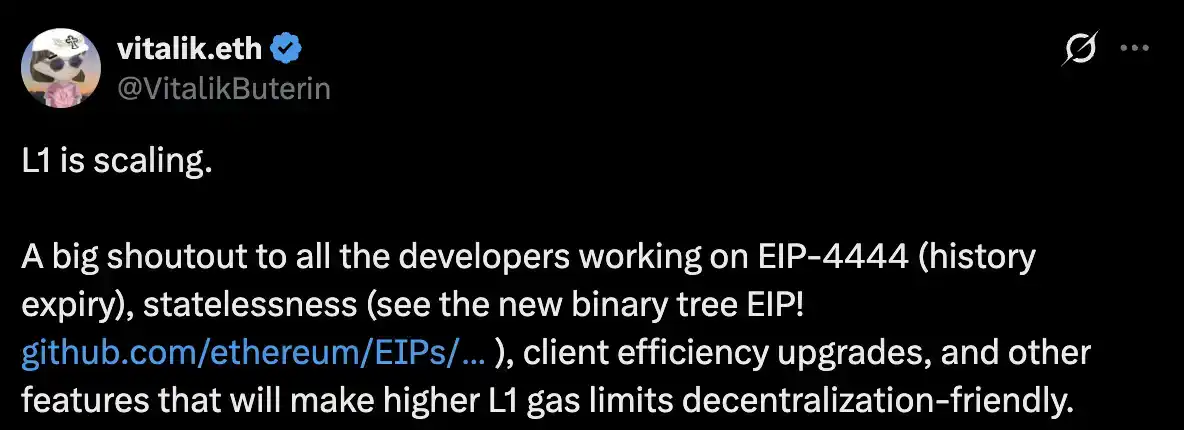
Over the past year, the scaling speed of Ethereum L1 has far exceeded everyone's expectations. Technological breakthroughs came from multiple dimensions: EIP-4444 reduced the storage需求 for historical data, stateless client technology made node operation lighter, and most critically, the continuous increase in the Gas Limit. At the beginning of 2025, Ethereum's Gas Limit was still 30 million; by mid-year, it had increased to 36 million, a 20% growth. This was the first significant increase in Ethereum's Gas Limit since 2021.

But this was just the beginning. According to the plans of Ethereum core developers, there will be two major hard fork upgrades in 2026. The Glamsterdam upgrade will introduce perfect parallel processing capabilities, and the Gas Limit will soar from 60 million to 200 million, an increase of over 3 times. The Heze-Bogota fork will add the FOCIL (Fork-Choice Enforced Inclusion Lists) mechanism, further improving block construction efficiency and censorship resistance.

The Fusaka upgrade completed on December 3, 2025, already allowed the market to witness the power of L1 scaling. After the upgrade, Ethereum's daily transaction volume increased by about 50%, the number of active addresses rose by about 60%, and the 7-day moving average of daily transaction volume reached a historical high of 1.87 million, surpassing the records of the 2021 DeFi peak period.

The results are astounding: Ethereum mainnet transaction fees have dropped to extremely low levels. In January 2026, the average transaction fee on Ethereum dropped to $0.44, a decrease of over 99% compared to the peak of $53.16 in May 2021. During off-peak hours, the cost of a transaction is often below $0.1, sometimes even as low as $0.01, with Gas prices as low as 0.119 gwei. This number is already close to Solana's level, and Layer2's biggest cost advantage is being quickly erased.

Vitalik did a detailed calculation in that February article. He assumed an ETH price of $2500, a Gas price of 15 gwei (long-term average), and a demand elasticity close to 1 (i.e., doubling the Gas Limit would halve the price). Under this assumption:

Censorship resistance demand: Currently, enforcing a transaction censored by L2 through L1 requires about 120,000 gas, costing $4.5. To reduce the cost to below $1, L1 needs to scale 4.5 times.

Cross-L2 asset transfer: Currently, withdrawing from one L2 to L1 requires about 250,000 gas, and depositing into another L2 requires 120,000 gas, totaling $13.87. With an ideal optimized design, it would only require 7,500 gas, costing $0.28. To reach the target of $0.05, it needs to scale 5.5 times.

Mass exit scenario: Taking Sony's Soneium as an example, PlayStation has about 116 million monthly active users. Using an efficient exit protocol (7,500 gas per user), the current Ethereum can just support the emergency exit of 121 million users within a week. But to support multiple applications of this scale, L1 needs to scale about 9 times.

And these scaling goals are being realized step by step in 2026. Technological progress has彻底改变了the rules of the game. When L1 itself can become fast and cheap, why should users still endure the cumbersome cross-chain bridging, complex interaction experience, and potential security risks of Layer2?

The security issues of cross-chain bridges are not unfounded fears. In 2022, cross-chain bridges became a major target for hacker attacks. In February, the Wormhole bridge was hacked for $325 million; in March, the Ronin bridge suffered the largest DeFi attack in history, losing $540 million; and bridge protocols like Meter and Qubit were successively breached. According to Chainalysis statistics, in 2022 alone, the total amount of cryptocurrency stolen from cross-chain bridges reached $2 billion, accounting for the majority of all DeFi attack losses that year.

Liquidity fragmentation is another pain point. With the surge in the number of Layer2s, the liquidity of DeFi protocols is分散到dozens of different chains, leading to increased transaction slippage, reduced capital efficiency, and worsened user experience. A user wanting to move assets between different Layer2s needs to go through a complex bridging process, wait for long confirmation times, and bear additional costs and risks.

This leads to the next, and most brutal, question: what should those Layer2 projects that raised huge funds and issued tokens do now?

Valuation Bubbles and Ghost Towns

Where did all the Layer2 money go?

In the past few years, the Layer2 track has been more like a huge financial game than a technological revolution. Venture capital firms waved checks, pushing the valuations of L2 projects to staggering heights. zkSync raised a total of $458 million, Arbitrum's背后的Offchain Labs was valued at $1.2 billion, Optimism raised $268.5 million, Starknet raised $458 million. Behind these numbers are top VCs like Paradigm, a16z, Lightspeed, Blockchain Capital.

Developers were keen on "套娃" (nesting) across different L2s, building complex DeFi legos to attract more liquidity and airdrop hunters. But real users were worn out by the tedious cross-chain operations and high hidden costs.

A残酷的现实is that the market is highly concentrated towards the top. According to data from crypto research firm 21Shares, the three major L2s—Base, Arbitrum, and Optimism—already control nearly 90% of the transaction volume. Base, leveraging Coinbase's traffic advantage and user base, achieved explosive growth in 2025, its TVL soaring from $1 billion at the beginning of the year to $4.63 billion by the end of the year, with quarterly transaction volume reaching $59 billion, a 37% increase quarter-on-quarter. Arbitrum followed closely with about $19 billion TVL, and Optimism after that.

But outside the top tier, most L2 projects, after losing the drive of airdrop expectations, saw their real user numbers quickly drop to freezing point, becoming名副其实的"ghost towns". Starknet is the most typical example. Although its token price has fallen 98% from its high, its price-to-earnings ratio is still in a very high bubble range relative to its extremely low daily active users and fee income. This means there is a huge gap between the market's expectations for its future and its current ability to create real value.

More ironically, when Layer2 fees dropped significantly due to EIP-4844, the data availability fees they paid to L1 also plummeted, which in turn reduced the fee income of Ethereum L1. In January 2026, an analysis pointed out that the Dencun upgrade caused a large number of transactions to shift from L1 to cheaper L2s, which was one of the main reasons for Ethereum network fees dropping to their lowest level since 2017. While Layer2 was reducing its own costs, it was also "emptying" the economic value of L1.

21Shares predicted in its 2026 Layer2 Outlook report that most Ethereum Layer2s may not survive 2026, the market will experience a残酷的整合, and ultimately only those projects with high performance, true decentralization, and unique value propositions will prevail.

This is the real intention behind Vitalik's recent "challenge". He wants to burst this "infrastructure circle-jerk" bubble and pour a bucket of cold water on this sick market. If a Layer2 cannot provide functions more interesting and valuable than L1, then it will ultimately become just an expensive transitional product in Ethereum's development history.

Ethereum is Taking Back Its Sovereignty

Vitalik's latest suggestion points out a new way out for Layer2: abandon "scaling" as the only selling point, and instead explore functional additional value that L1 cannot or is unwilling to provide in the short term. He specifically listed several directions: privacy protection (achieving on-chain private transactions through zero-knowledge proof technology), application-specific efficiency optimization (such as games, social networks, AI computing), ultra-fast transaction confirmation (millisecond level instead of second level), and exploration of non-financial use cases.

In other words, the role of Layer2 will change from Ethereum's "分身" (avatar) to functional "plugins". They are no longer the only savior for scaling, but a functional extension layer in the Ethereum ecosystem. This is a fundamental shift in positioning and a return of power—Ethereum's core value and sovereignty will be re-anchored on L1.

Vitalik also proposed a new framework: view Layer2 as a spectrum, not a binary classification. Different L2s can have different trade-offs in terms of decentralization degree, security guarantees, and functional characteristics. The key is to clearly explain to users what guarantees they provide, rather than all claiming to be "scaling Ethereum".

This清算has already begun. Those Layer2s that rely on expensive valuations but have no real daily activity are facing their final judgment. Those that can find their unique value positioning and truly achieve decentralization may survive in the new landscape. Base may continue to lead依靠Coinbase's traffic advantage and Web2 user onboarding ability, but it needs to face questions about its lack of decentralization. Arbitrum and Optimism need to accelerate the process towards Stage 2 to prove they are more than just centralized databases. ZK-Rollup projects like zkSync and Starknet need to prove the unique value of their zero-knowledge proof technology while significantly improving user experience and ecological prosperity.

Layer2 has not disappeared, but their era as Ethereum's only hope is彻底结束了. Five years ago, when cornered by competitors like Solana, Ethereum handed the hope of scaling to Layer2 and重构ed the entire technical roadmap for it. Five years later, it found that the best scaling solution is to make itself stronger.

This is not betrayal, but growth. And those Layer2s that cannot adapt to this evolution will become the cost. When the Gas Limit冲向200 million at the end of 2026, when Ethereum L1 transaction fees stabilize at a few cents or even lower, when users find they no longer need to endure the complexity and risks of cross-chain bridges, the market will vote with its feet. Those projects that once had sky-high valuations but did not create real value for users will be forgotten by history in this great浪淘沙.


Domande pertinenti

QWhat was the core reason behind Vitalik Buterin's statement that Layer2 solutions are no longer fulfilling their original vision for Ethereum scaling?

AVitalik stated that Layer2 solutions have failed to achieve sufficient decentralization, with most remaining at Stage 1 (lacking fully decentralized fraud or validity proof systems and permissionless user exits), making them more like centralized databases rather than true extensions of Ethereum's security and decentralization.

QHow has Ethereum's Layer1 scalability improved to the point where it competes with Layer2 solutions?

AEthereum L1 scalability improved through technical breakthroughs like EIP-4444 reducing historical data storage, stateless clients, and significant Gas Limit increases (from 30 million to 36 million in 2025, with plans to reach 200 million by end of 2026). This reduced average transaction fees by over 99%, from $53.16 in 2021 to $0.44 in January 2026, making L1 nearly as cheap and fast as many Layer2s.

QWhat are the major criticisms Vitalik raised against current Layer2 projects regarding their business models and decentralization?

AVitalik criticized Layer2 projects for prioritizing commercial interests over decentralization, citing examples like projects refusing further decentralization due to 'client regulatory demands,' controlling MEV revenue through centralized sequencers, and relying on venture capital funding that pressures them to maintain control rather than cede it to the community.

QWhat new role does Vitalik propose for Layer2 solutions in Ethereum's future, instead of mere scaling?

AVitalik proposes that Layer2 should shift from being primarily scaling solutions to providing functional additive value that L1 cannot easily offer, such as privacy features via zero-knowledge proofs, application-specific optimizations (e.g., for gaming or AI), ultra-fast transaction confirmations, and exploration of non-financial use cases, acting as 'plugins' rather than 'scaling layers'.

QAccording to the article, what is the predicted outcome for most Layer2 projects in 2026 due to market consolidation and L1 scalability?

AThe article predicts a brutal market consolidation where most Layer2 projects will not survive in 2026, as they lack real user activity and value proposition beyond speculation. Only high-performance, truly decentralized projects with unique value (e.g., Base with Coinbase's user base, or those achieving Stage 2 decentralization) may endure, while others become 'ghost towns' or are forgotten.

Letture associate

Trading

Spot
Futures

Articoli Popolari

Cosa è ETH 3.0

ETH3.0 e $eth 3.0: Un'Analisi Approfondita del Futuro di Ethereum Introduzione Nel panorama in rapida evoluzione delle criptovalute e della tecnologia blockchain, ETH3.0, spesso indicato come $eth 3.0, è emerso come un argomento di considerevole interesse e speculazione. Il termine comprende due concetti principali che warrantono chiarimenti: Ethereum 3.0: Questo rappresenta un potenziale futuro aggiornamento volto ad aumentare le capacità dell'attuale blockchain di Ethereum, concentrandosi principalmente sul miglioramento della scalabilità e delle prestazioni. ETH3.0 Meme Token: Questo progetto di criptovaluta distinto cerca di sfruttare la blockchain di Ethereum per creare un ecosistema incentrato sui meme, promuovendo il coinvolgimento all'interno della comunità delle criptovalute. Comprendere questi aspetti di ETH3.0 è essenziale non solo per gli appassionati di criptovalute, ma anche per coloro che osservano tendenze tecnologiche più ampie nello spazio digitale. Che cos'è ETH3.0? Ethereum 3.0 Ethereum 3.0 è pubblicizzato come un aggiornamento proposto per la rete Ethereum già stabilita, che è stata la spina dorsale di molte applicazioni decentralizzate (dApps) e contratti smart sin dalla sua nascita. I miglioramenti previsti si concentrano principalmente sulla scalabilità, integrando tecnologie avanzate come lo sharding e le prove a conoscenza zero (zk-proofs). Queste innovazioni tecnologiche mirano a facilitare un numero senza precedenti di transazioni al secondo (TPS), potenzialmente raggiungendo milioni, affrontando così una delle limitazioni più significative della tecnologia blockchain attuale. Il miglioramento non è meramente tecnico, ma anche strategico; è volto a preparare la rete Ethereum per un'adozione e un'utilità diffuse in un futuro contrassegnato da un aumento della domanda di soluzioni decentralizzate. ETH3.0 Meme Token Al contrario di Ethereum 3.0, l'ETH3.0 Meme Token si avventura in un dominio più leggero e giocoso, combinando la cultura dei meme di internet con la dinamica delle criptovalute. Questo progetto consente agli utenti di acquistare, vendere e scambiare meme sulla blockchain di Ethereum, fornendo una piattaforma che promuove il coinvolgimento della comunità attraverso la creatività e interessi condivisi. L'ETH3.0 Meme Token mira a dimostrare come la tecnologia blockchain possa intersecarsi con la cultura digitale, creando casi d'uso che siano sia divertenti che finanziariamente praticabili. Chi è il Creatore di ETH3.0? Ethereum 3.0 L'iniziativa verso Ethereum 3.0 è principalmente propulsa da un consorzio di sviluppatori e ricercatori all'interno della comunità di Ethereum, tra cui Justin Drake. Conosciuto per le sue intuizioni e contributi all'evoluzione di Ethereum, Drake è stato una figura di spicco nelle discussioni riguardanti la transizione di Ethereum verso un nuovo livello di consenso, chiamato “Beam Chain.” Questo approccio collaborativo allo sviluppo significa che Ethereum 3.0 non è il prodotto di un creatore singolo, ma piuttosto una manifestazione di ingegno collettivo focalizzato sul progresso della tecnologia blockchain. ETH3.0 Meme Token I dettagli riguardanti il creatore dell'ETH3.0 Meme Token sono attualmente non rintracciabili. La natura dei token meme conduce spesso a una struttura più decentralizzata e guidata dalla comunità, il che potrebbe spiegare la mancanza di attribuzione specifica. Questo si allinea con l'etica della comunità crypto più ampia, dove l'innovazione spesso nasce da sforzi collaborativi piuttosto che individuali. Chi sono gli Investitori di ETH3.0? Ethereum 3.0 Il supporto per Ethereum 3.0 proviene principalmente dalla Ethereum Foundation insieme a una comunità entusiasta di sviluppatori e investitori. Questa associazione fondamentale fornisce un considerevole grado di legittimità e migliora le prospettive di implementazione di successo poiché sfrutta la fiducia e la credibilità costruite nel corso degli anni di operazioni della rete. Nel clima in rapida evoluzione delle criptovalute, il supporto della comunità gioca un ruolo cruciale nello sviluppo e nell'adozione, posizionando Ethereum 3.0 come un serio contenditore per i futuri progressi della blockchain. ETH3.0 Meme Token Sebbene le fonti attualmente disponibili non forniscano informazioni esplicite riguardo ai fondamenti o alle organizzazioni di investimento che sostengono l'ETH3.0 Meme Token, ciò è indicativo del modello di finanziamento tipico per i token meme, che spesso si basa sul supporto di base e sul coinvolgimento della comunità. Gli investitori in tali progetti sono tipicamente individui motivati dal potenziale per innovazioni guidate dalla comunità e dallo spirito di cooperazione trovato all'interno della comunità crypto. Come Funziona ETH3.0? Ethereum 3.0 Le caratteristiche distintive dell'Ethereum 3.0 risiedono nella sua proposta di implementazione della tecnologia di sharding e zk-proof. Lo sharding è un metodo di partizionamento della blockchain in pezzi più piccoli e gestibili o “shard,” che possono elaborare transazioni in modo concorrente piuttosto che sequenziale. Questa decentralizzazione dell'elaborazione aiuta a prevenire la congestione e garantisce che la rete rimanga reattiva anche sotto un carico pesante. La tecnologia delle prove a conoscenza zero (zk-proof) contribuisce con un ulteriore livello di sofisticazione consentendo la validazione delle transazioni senza rivelare i dati sottostanti coinvolti. Questo aspetto non solo migliora la privacy, ma aumenta anche l'efficienza complessiva della rete. Si parla anche di incorporare una macchina virtuale Ethereum a conoscenza zero (zkEVM) in questo aggiornamento, amplificando ulteriormente le capacità e l'utilità della rete. ETH3.0 Meme Token L'ETH3.0 Meme Token si distingue capitalizzando sulla popolarità della cultura dei meme. Stabilisce un mercato per gli utenti che desiderano partecipare al trading di meme, non solo per divertimento, ma anche per potenziale guadagno economico. Integrando funzioni come lo staking, la fornitura di liquidità e meccanismi di governance, il progetto promuove un ambiente che incentiva l'interazione e la partecipazione della comunità. Offrendo una miscela unica di intrattenimento e opportunità economica, l'ETH3.0 Meme Token mira ad attrarre un pubblico variegato, che va dagli appassionati di crypto ai semplici intenditori di meme. Timeline di ETH3.0 Ethereum 3.0 11 Novembre 2024: Justin Drake accenna al prossimo aggiornamento ETH 3.0, incentrato sui miglioramenti della scalabilità. Questo annuncio segna l'inizio delle discussioni formali riguardo l'architettura futura di Ethereum. 12 Novembre 2024: La proposta attesa per Ethereum 3.0 dovrebbe essere svelata a Devcon a Bangkok, preparando il terreno per un feedback più ampio della comunità e potenziali passi successivi nello sviluppo. ETH3.0 Meme Token 21 Marzo 2024: L'ETH3.0 Meme Token viene ufficialmente elencato su CoinMarketCap, segnando il suo ingresso nel dominio pubblico delle criptovalute e aumentando la visibilità per il suo ecosistema basato sui meme. Punti Chiave In conclusione, Ethereum 3.0 rappresenta una significativa evoluzione all'interno della rete Ethereum, concentrandosi sul superamento delle limitazioni riguardanti scalabilità e prestazioni attraverso tecnologie avanzate. I suoi aggiornamenti proposti riflettono un approccio proattivo alle future esigenze e usabilità. D'altra parte, l'ETH3.0 Meme Token incarna l'essenza della cultura guidata dalla comunità nello spazio delle criptovalute, sfruttando la cultura dei meme per creare piattaforme coinvolgenti che incoraggiano la creatività e la partecipazione degli utenti. Comprendere gli scopi e le funzionalità distinte di ETH3.0 e $eth 3.0 è fondamentale per chiunque sia interessato ai continui sviluppi nello spazio crypto. Con entrambe le iniziative che tracciano percorsi unici, esse sottolineano collettivamente la natura dinamica e multifacetica dell'innovazione blockchain.

170 Totale visualizzazioniPubblicato il 2024.04.04Aggiornato il 2024.12.03

Cosa è ETH 3.0

Cosa è ETHEREUM

HarryPotterTrumpHomerSimpson777Inu: Panoramica di un Progetto Crypto Web3 Introduzione Nel mondo in rapida evoluzione delle criptovalute e della finanza decentralizzata, progetti innovativi emergono frequentemente, catturando l'interesse della comunità degli investitori e degli appassionati di crypto. Uno di questi progetti è HarryPotterTrumpHomerSimpson777Inu, una criptovaluta che si trova all'incrocio tra cultura popolare e tecnologia blockchain. Questo token guidato dalla comunità mescola personaggi e figure politiche ben noti, con l'obiettivo di creare una piattaforma coinvolgente e promuovere un'adozione diffusa. Che cos'è HarryPotterTrumpHomerSimpson777Inu? HarryPotterTrumpHomerSimpson777Inu è un token costruito sulla blockchain di Ethereum, progettato per essere accessibile e divertente per un pubblico diversificato. L'unicità di questo progetto deriva dal suo approccio tematico, che intreccia elementi di fantasia, politica e intrattenimento. Sfruttando il fascino nostalgico di personaggi amati, il progetto cerca di creare un'esperienza di criptovaluta coinvolgente, incoraggiando il coinvolgimento e la partecipazione della comunità. L'obiettivo principale di HarryPotterTrumpHomerSimpson777Inu è stabilire un token che risuoni con gli utenti a livello personale, promuovendo sia il divertimento che il coinvolgimento nell'ambito crypto. Questo branding distintivo mira ad attrarre individui che in precedenza potrebbero non essersi interessati alle criptovalute, facilitando un nuovo punto di ingresso per utenti potenziali. Creatore di HarryPotterTrumpHomerSimpson777Inu L'identità del creatore dietro HarryPotterTrumpHomerSimpson777Inu rimane sconosciuta. Questa non è una pratica rara nel dominio delle criptovalute, dove l'anonimato è spesso preferito dai fondatori come mezzo di protezione della privacy e promozione di un ethos decentralizzato. Questa oscurità non diminuisce il valore del progetto; al contrario, riflette una tendenza più ampia all'interno del settore, dove molti progetti di successo sono emersi da origini anonime. Investitori di HarryPotterTrumpHomerSimpson777Inu Le informazioni pubbliche riguardo agli investitori di HarryPotterTrumpHomerSimpson777Inu sono limitate. La natura del progetto, incentrata sul coinvolgimento della comunità, suggerisce una dipendenza da investimenti di piccole dimensioni da parte di singoli appassionati piuttosto che da sostegni sostanziali da fondazioni di investimento consolidate o corporation. Questo livello di trasparenza nel finanziamento è tipico di molti progetti di criptovaluta guidati dalla comunità, dove il supporto spesso proviene da movimenti di base piuttosto che da investitori istituzionali. Come Funziona HarryPotterTrumpHomerSimpson777Inu? Operando sulla blockchain di Ethereum, HarryPotterTrumpHomerSimpson777Inu sfrutta la sua solida infrastruttura per facilitare transazioni e promuovere interazioni tra gli utenti all'interno della comunità. Ciò che distingue questo progetto è il suo posizionamento tematico: canalizzando il carisma di personaggi iconici provenienti da diversi ambiti culturali, crea un'identità di marca distintiva. Questo approccio non solo attrae gli utenti, ma coltiva anche una comunità fedele attorno al token. Le meccaniche operative del progetto si concentrano sul coinvolgimento della comunità. Adotta un modello decentralizzato che incoraggia la partecipazione, consentendo agli utenti di interagire attraverso vari canali mentre promuovono lo scambio di idee e esperienze. Inoltre, il progetto abbraccia i principi del Web3, privilegiando la sovranità degli utenti e la decentralizzazione, che sono i pilastri del futuro di Internet. Timeline di HarryPotterTrumpHomerSimpson777Inu La storia di HarryPotterTrumpHomerSimpson777Inu è segnata da diversi eventi decisivi: 12 agosto 2023: L'inizio di HarryPotterTrumpHomerSimpson777Inu, segnando il suo ingresso nell'ecosistema delle criptovalute. Fase di Sviluppo: Un periodo focalizzato sulla costruzione di una strategia completa per stimolare la crescita guidata dalla comunità e il coinvolgimento degli utenti. Listing sugli Scambi: Sebbene i dettagli specifici di listing non siano stati divulgati, il progetto è stato reso accessibile su vari scambi di criptovalute, migliorando la sua visibilità nel mercato. Coinvolgimento della Comunità: Sforzi continui per coinvolgere attivamente la comunità, stabilendo canali di dialogo e promuovendo la partecipazione attraverso varie attività, tra cui concorsi, discussioni e votazioni comunitarie. Aspetti Chiave di HarryPotterTrumpHomerSimpson777Inu Focus sulla Comunità Un tratto distintivo di HarryPotterTrumpHomerSimpson777Inu è la sua forte enfasi sul coinvolgimento della comunità. Il progetto incoraggia attivamente gli utenti a partecipare a discussioni, condividere idee e contribuire all'evoluzione del progetto. Questa interazione coltiva un senso di appartenenza e di ownership tra i membri della comunità, essenziale per la sostenibilità a lungo termine del token. Utilizzo della Blockchain di Ethereum La scelta di costruire sulla blockchain di Ethereum consente a HarryPotterTrumpHomerSimpson777Inu di sfruttare le sue caratteristiche di sicurezza ben consolidate e architettura decentralizzata. Questa base garantisce affidabilità per le transazioni e fornisce un framework affidabile su cui sviluppare varie funzionalità. Approccio Tematico Unico Fusione di elementi della cultura pop nella sua identità, HarryPotterTrumpHomerSimpson777Inu crea una narrazione coinvolgente che lo differenzia da altre criptovalute. L'amalgama di personaggi e temi genera riconoscimento e intrigo immediati, rendendo il token relazionabile a un'ampia gamma di utenti potenziali. Anonimato nello Sviluppo Il creatore anonimo del progetto rimane una caratteristica ricorrente in molte iniziative di criptovaluta. Questo aspetto evidenzia un ethos di decentralizzazione, introducendo anche un livello di mistero che potrebbe affascinare un segmento della comunità crypto, attirando l'attenzione sul progetto e invitando l'impegno da parte di utenti che supportano l'idea di un'iniziativa decentralizzata e gestita dalla comunità. Conclusione HarryPotterTrumpHomerSimpson777Inu si presenta come un'aggiunta distintiva al panorama delle criptovalute, combinando il fascino della cultura popolare con le meccaniche innovative della tecnologia blockchain. Sebbene i dettagli riguardanti il creatore e gli investitori specifici rimangano non divulgati, il focus del progetto sulla comunità e il suo approccio tematico lo contraddistinguono come un potenziale attore influente nel contesto del Web3 e delle criptovalute. Man mano che l'ecosistema delle criptovalute continua ad espandersi, iniziative come HarryPotterTrumpHomerSimpson777Inu ci ricordano le molteplici modalità in cui la blockchain può connettere le comunità globali attraverso narrazioni e valori condivisi.

725 Totale visualizzazioniPubblicato il 2024.04.06Aggiornato il 2024.12.03

Cosa è ETHEREUM

Come comprare ETH

Benvenuto in HTX.com! Abbiamo reso l'acquisto di Ethereum (ETH) semplice e conveniente. Segui la nostra guida passo passo per intraprendere il tuo viaggio nel mondo delle criptovalute.Step 1: Crea il tuo Account HTXUsa la tua email o numero di telefono per registrarti il tuo account gratuito su HTX. Vivi un'esperienza facile e sblocca tutte le funzionalità,Crea il mio accountStep 2: Vai in Acquista crypto e seleziona il tuo metodo di pagamentoCarta di credito/debito: utilizza la tua Visa o Mastercard per acquistare immediatamente EthereumETH.Bilancio: Usa i fondi dal bilancio del tuo account HTX per fare trading senza problemi.Terze parti: abbiamo aggiunto metodi di pagamento molto utilizzati come Google Pay e Apple Pay per maggiore comodità.P2P: Fai trading direttamente con altri utenti HTX.Over-the-Counter (OTC): Offriamo servizi su misura e tassi di cambio competitivi per i trader.Step 3: Conserva Ethereum (ETH)Dopo aver acquistato Ethereum (ETH), conserva nel tuo account HTX. In alternativa, puoi inviare tramite trasferimento blockchain o scambiare per altre criptovalute.Step 4: Scambia Ethereum (ETH)Scambia facilmente Ethereum (ETH) nel mercato spot di HTX. Accedi al tuo account, seleziona la tua coppia di trading, esegui le tue operazioni e monitora in tempo reale. Offriamo un'esperienza user-friendly sia per chi ha appena iniziato che per i trader più esperti.

2.7k Totale visualizzazioniPubblicato il 2024.12.10Aggiornato il 2025.03.21

Come comprare ETH

Discussioni

Benvenuto nella Community HTX. Qui puoi rimanere informato sugli ultimi sviluppi della piattaforma e accedere ad approfondimenti esperti sul mercato. Le opinioni degli utenti sul prezzo di ETH ETH sono presentate come di seguito.

活动图片














