Five Meme Coins Soar Against the Market Trend, Which Is the Next Potential Coin?

Odaily星球日报Pubblicato 2025-12-18Pubblicato ultima volta 2025-12-18

Introduzione

Despite a generally bearish crypto market, five tokens have experienced significant price surges. PIPPIN, an AI Agent token, saw a dramatic rise from $0.05 to over $0.44, driven by concentrated buying and suspected insider control of up to 80% of its supply. FOLKS, the token of cross-chain DeFi protocol Folks Finance, surged nearly 24x from its low following its S2 incentive announcement, though it later fell sharply. BEAT, a Web3 AI entertainment token on BNB Chain, rapidly grew its market cap to $440 million. AIA, a decentralized AI agent token, plummeted over 90% after Binance Futures delisted its perpetual contract but rebounded 160% after a contract swap. RAVE, a music and culture DAO token, gained attention after support from Donald Trump Jr. and CZ, rising over 410% and listing on multiple exchanges. These tokens share characteristics of low initial market caps, community or insider-driven pumps, and high volatility.

Original / Odaily Planet Daily (@OdailyChina)

Author / Wenser(@wenser2010)
The cryptocurrency market continues to fluctuate and trend lower. However, even in a sluggish market, a few tokens defy the trend, maintaining their own independent rhythm of "sharp rises and falls." Odaily Planet Daily will梳理(review) the "meme coins" with impressive recent price performance in this article, attempting to summarize common characteristics to help discover the next investment target with potential for a surge.

PIPPIN: The Orphan of the AI Agent Craze, a Masterpiece of "Insider Trading"

From late last year to January this year, AI Agent tokens once captured the absolute focus of the crypto market. Tokens like ai16z(ELIZAOS) and swarms frequently topped the token gain charts, and PIPPIN was also a product of the same batch of AI-themed tokens at that time.

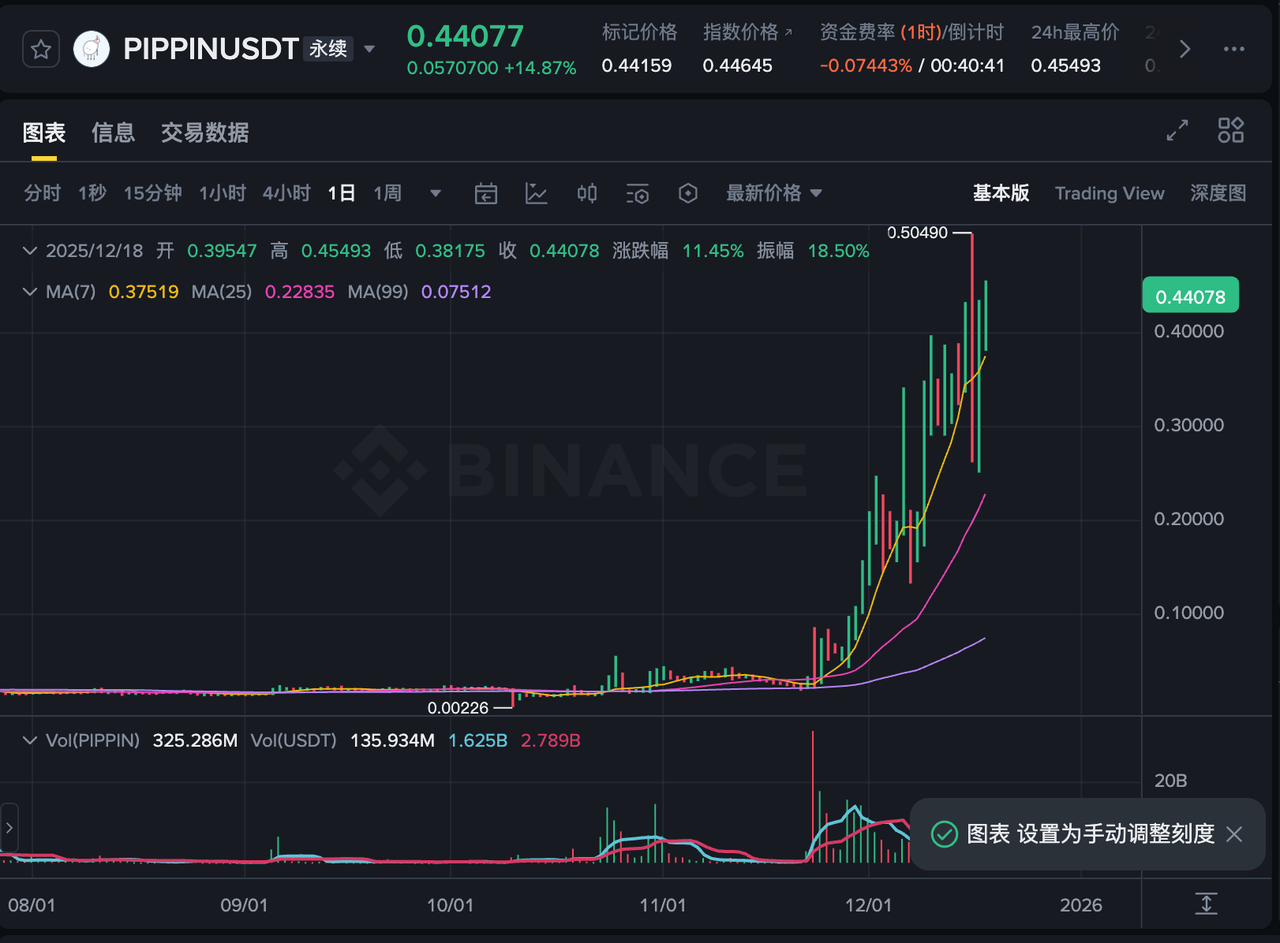
But nearly a year later, only PIPPIN remains, possibly selected by wild market manipulators for its ease of control, experiencing a continuous rise over the past half month. It's worth noting that on November 23rd, its price was only around $0.05. Just a week later, its price had skyrocketed to over $0.17:

On December 1st, PIPPIN defied the market by surging over 60%, its price approaching $0.18; at that time, analyst @frontrunnersx提醒(warned), PIPPIN showed characteristics of concentrated accumulation, with some addresses continuously buying and holding without significant selling, causing the price to continuously hit short positions during the upward trend and trigger chain liquidations. One address bought about $200,000 worth of PIPPIN 6 days prior, sold after the price doubled, and is currently performing a similar operation on ARC.

On December 2nd, Bubblemaps monitoring revealed that 50 related addresses purchased PIPPIN tokens worth $19 million. It was also found that 26 addresses withdrew 44% of the PIPPIN token supply, totaling $96 million, from the Gate platform over two months, with most wallets being recently funded. Most PIPPIN token withdrawals occurred on October 24th and November 23rd. By then, the PIPPIN token price had already surged by 1000%, with insiders controlling half of the token supply, valued at $120 million.

In other words, the wild manipulators' accumulation period for PIPPIN started even earlier, about a month prior, with the真正的(violent)拉升(surge) occurring about a month and a week after accumulation began.

Subsequently, a diamond hands address liquidated its previously accumulated 24.8 million PIPPIN tokens, with floating profits shrinking from a peak of $7.6 million to $3.65 million.

On December 6th, Onchain Lens monitoring showed a whale spent 23,736 SOL (worth approximately $3.3 million) to buy 16.35 million PIPPIN at $0.20 over 3 days, with floating profits exceeding $740,000 at that time.

On December 16th, Bubblemaps issued another reminder. The PIPPIN price continued to rise, but internal addresses now held about 80% of the supply, valued at approximately $380 million. Bubblemaps pointed out: Since the last disclosure (December 2nd), 16 new wallets with the same pattern have appeared (funded by HTX, received similar amounts of SOL, no history, large PIPPIN withdrawals from CEXs); another group of 11 wallets linked to Bitget was identified, collectively holding about 9% of the supply, with highly consistent fund flows and timing windows, suspected to be controlled by the same entity.

That night, as the PIPPIN price fell below $0.3, this "meme coin spectacle"宣告(declared) a阶段性(phase)收网(wind-down). But the next day, December 17th, PIPPIN一度(surged) to around $0.5, causing another large wave of short liquidations. It must be said, the brutal methods of bear market manipulators are堪称(truly)残忍(ruthless).

As of writing, the PIPPIN price is temporarily reported at $0.44, with a 24-hour increase of over 15%. Its performance continues.
FOLKS: Cross-Chain DeFi Protocol Token, Up Nearly 24x From Low Point Due to S2 Incentive Announcement

As a cross-chain DeFi protocol providing lending, staking, and trading services, primarily operating on the Algorand chain, Folks Finance originally had relatively few followers. But with the official announcement of the S2 incentive campaign, market enthusiasm for its token reignited.

It's worth mentioning that Folks Finance distributed 1.5 million FOLKS tokens during the S1 incentive campaign, including Chainlink incentives; on November 6th, FOLKS officially launched on Binance Alpha, with a historical low price of around $2.

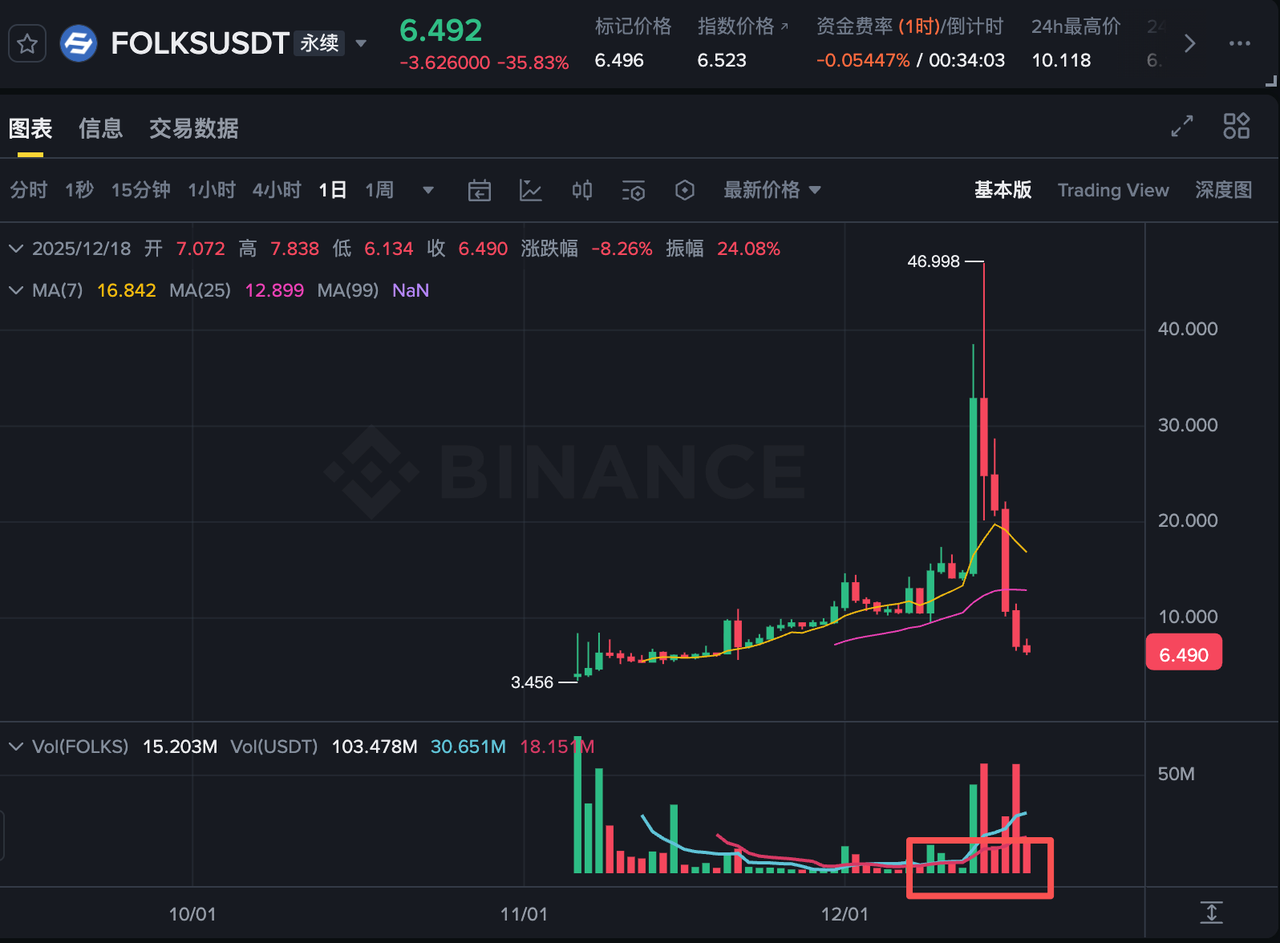
After the official Folks Finance announcement on December 9th, the FOLKS token price soared from under $10;

On December 14th, after nearly a week of speculation, the FOLKS token price broke through $40 for the first time, eventually rising to nearly $47, an increase of nearly 24 times from the low point;

Subsequently, the FOLKS price quickly retreated, falling by about 80%.

As of writing, the FOLKS price is temporarily reported at $6.4, with a 24-hour decrease of over 24%. The circulating supply is 12.7 million tokens (25.4% of total supply), with a temporary market cap of around $81 million.
BEAT: A True Meme Coin Needs Few Words

As another altcoin choosing to root itself in the BNB Chain ecosystem, similar to previous meme coins like MYX and COAI, BEAT's rise is another classic case.

It's worth noting that the official account behind the BEAT token project promotes the concept of a "Web3 AI entertainment platform + IP creation platform" – a rehashed version of hot concepts. After launching on Binance Alpha and futures in early November, BEAT officially claimed to have over 1.2 million independent on-chain holding addresses. One must say, "Audacity leads to abundance."

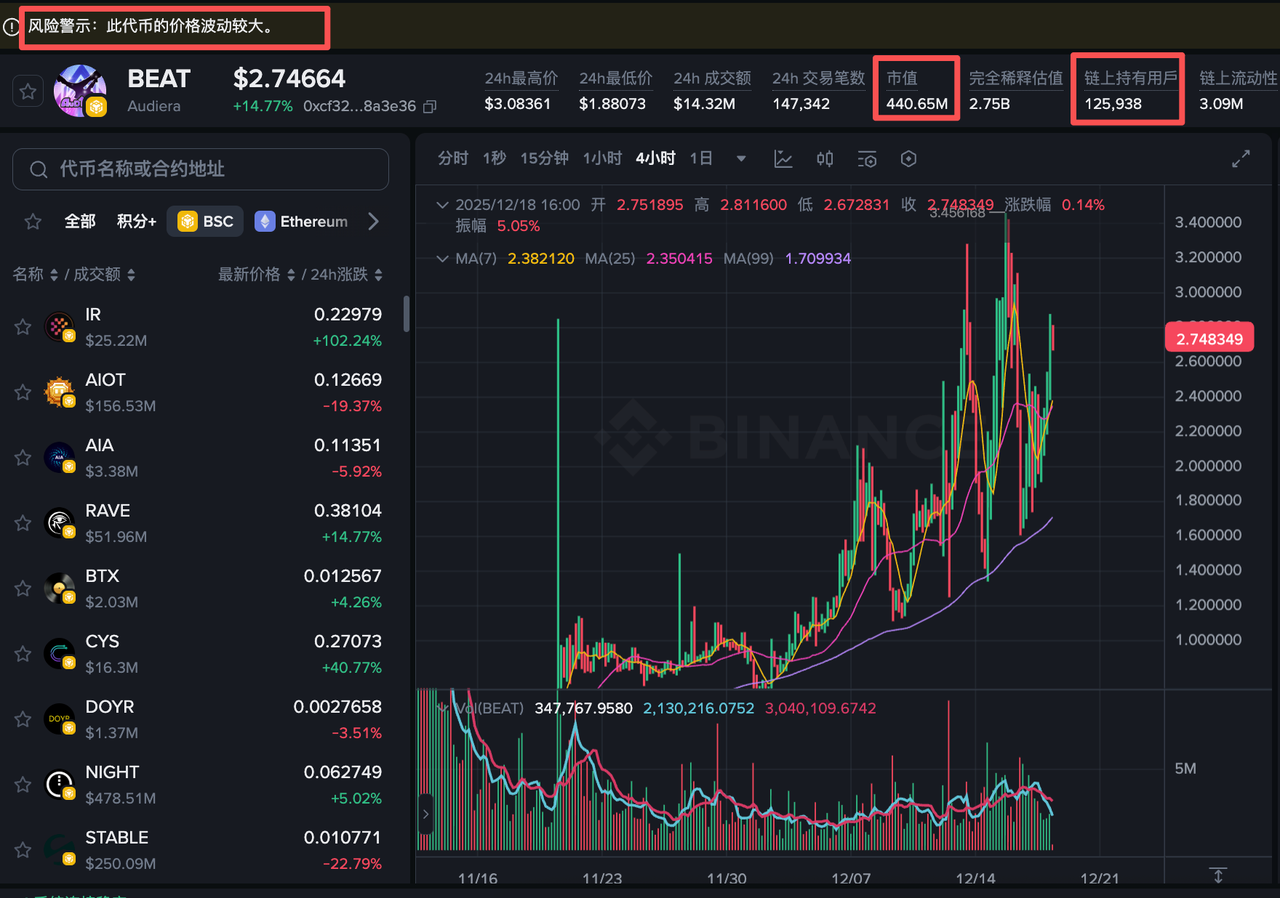
Similar to the price action of previous meme coins, BEAT started with a low market cap – after an initial rise upon listing on Binance Alpha, its market cap remained around $25 million; subsequently, the price飞速(rapidly)上涨(rose) amidst repeated pumps and dumps.

As of writing, the BEAT price is temporarily reported at around $2.7, with a 24-hour increase of over 14%. The circulating market cap is temporarily reported at $440 million, with about 1.26 million on-chain holding addresses (Note: Original said 12.6, assumed typo for 1.26 million based on context).
AIA: Decentralized AI Agent Concept Token, Volatility from Contract Swap

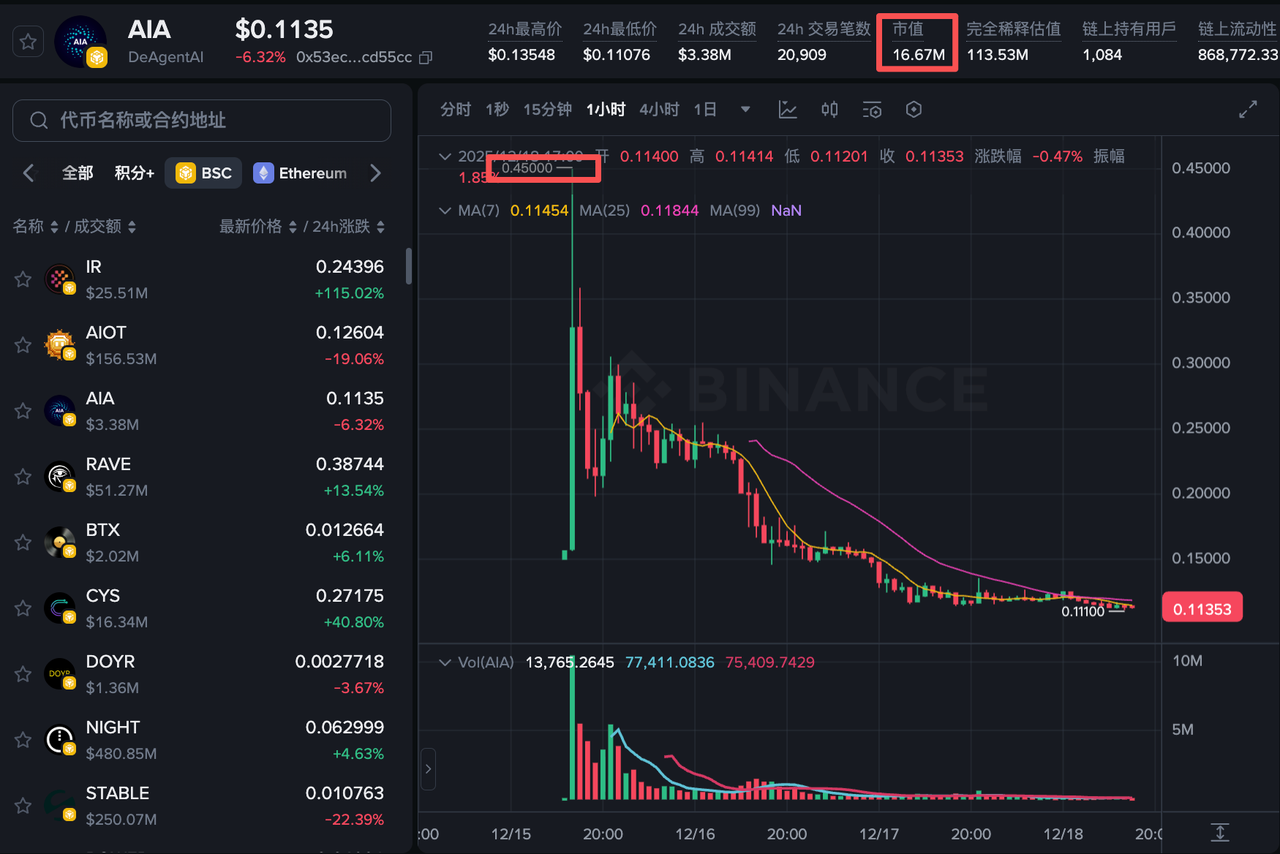
As the project token for DeAgent AI, AIA previously attracted significant market liquidity and attention due to a massive surge after listing on Binance futures, its price once skyrocketing over $1. However, constrained by the increasingly quiet market environment and the gradual cooling of the AI narrative, the token price gradually fell into silence, experiencing a continuous decline.

But the incident of "Binance delisting AIA futures" injected volatile energy into its liquidity once again.

On December 11th, according to an official announcement, Binance Futures announced it would close all AIAUSDT perpetual contracts at 20:15 (UTC+8) on December 11, 2025, for automatic settlement. After settlement, the contract would be delisted. AIA一度(plummeted) over 90%.

But subsequently, Binance announced that Alpha 2.0 would support a contract swap for DeAgentAI (AIA). Starting from 20:00 (UTC+8) on December 11, 2025, Binance Alpha 2.0 had temporarily closed AIA trading to execute this contract migration. This migration would be executed at a 1:1 ratio. The snapshot time was 20:00 (UTC+8) on December 11, 2025. Binance Alpha 2.0 would resume DeAgentAI (AIA) trading at 16:00 (UTC+8) on December 15, 2025.

On December 15th, official data from Binance Alpha showed that DeAgentAI (AIA) had completed the smart contract swap and officially resumed trading at 16:00 (UTC+8) on December 15th. Market data showed AIA surged significantly after opening, with gains一度(exceeding) 160%, topping the Binance Alpha gain charts.

As of writing, the AIA price is temporarily reported at $0.11, with a 24-hour decrease of 6.3%. The circulating market cap is temporarily reported at $16 million.
RAVE: Offline Community-Driven Culture Platform, Supported by Trump Jr. and CZ's Reposts

As a DAO organization promoting the concept of a "decentralized music and culture community and platform ecosystem," RaveDAO's development speed has been like a cheat code. After months of community and project building, RaveDAO has previously completed several member NFT sales.

On November 10th, RaveDAO officially announced its tokenomics and airdrop details. The official stated that the token aims to connect artists, organizers, and fans through token economics, promoting a decentralized entertainment ecosystem of "culture as protocol." RAVE has a total supply of 1 billion tokens, allocated as follows: Community 30%, Ecosystem 31%, Team & Co-builders 20%, Early Supporters 5%, Liquidity 5%, Airdrop 3%, Foundation & Public Goods Pool 6%. Approximately 23.03% will be in circulation after the Token Generation Event (TGE), with the rest subject to a 12-month cliff and a 36-month linear vesting period.

A month later, on December 10th, Binance Alpha announced it would soon list RaveDAO (RAVE).

The next day, news spread that RaveDAO received support from both the WLFI and Aster ecosystems. On December 12th, within an hour of listing on Binance Alpha, its trading volume exceeded $25 million.

Moreover, RaveDAO's "top-level connections" were remarkably impressive – on the evening of the 12th, Trump Jr. reposted and followed news about Aster's collaboration with USD1. RaveDAO, as one of the collaboration participants, gained massive exposure from this. CZ also reposted this tweet later. The RAVE price subsequently rose.

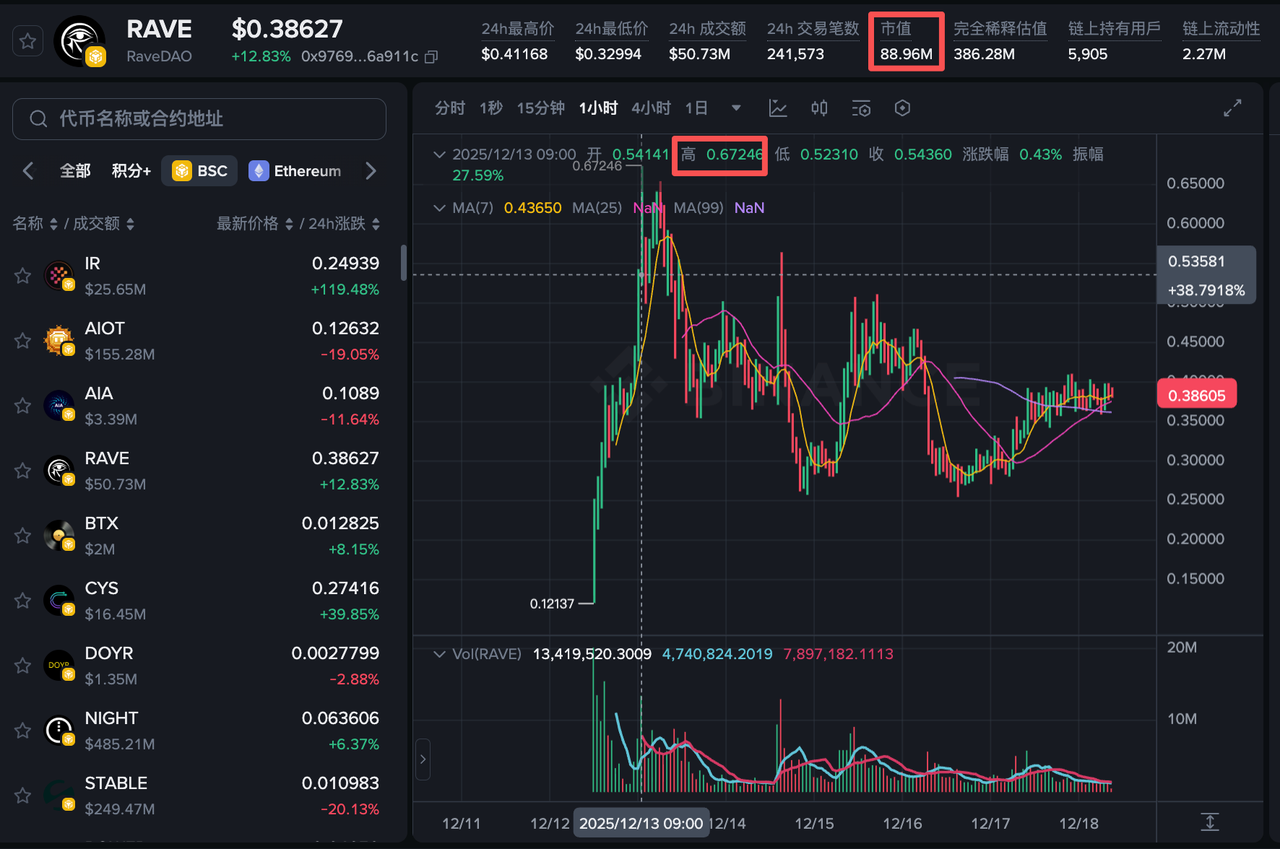
On December 13th, the RAVE price一度(touched) $0.67, with a 24-hour increase of over 410%;

On December 14th, Binance Futures launched RAVE U本位(USD-M) contracts;

On December 15th, RAVE was successively listed on OKX, Bybit, Bitget, Aster, Gate, Kucoin, MEXC, and other centralized exchanges. The price at that time fell back to around $0.41.

As of writing, the on-chain RAVE price is temporarily reported at $0.38, with a 24-hour increase of over 12%. The circulating market cap is temporarily reported at $88 million.
Domande pertinenti

QWhat are the five 'meme coins' mentioned in the article that have surged against the market trend?

AThe five coins are PIPPIN, FOLKS, BEAT, AIA, and RAVE.

QAccording to the article, what was a key characteristic of the PIPPIN token that allowed it to be manipulated?

AA key characteristic was that a large portion of its supply (up to 80%) was controlled by internal addresses and wallets linked to exchanges, making it easy for a 'wild whale' to manipulate the price.

QWhich token experienced a near 24x price increase from its low point due to an incentive announcement, and what was the reason for its subsequent sharp drop?

AThe FOLKS token experienced the near 24x increase after the announcement of its Season 2 incentives. Its price subsequently dropped sharply by around 80% after the initial hype subsided.

QWhat event caused the AIA token to crash over 90%, and what action by Binance later caused its price to surge again?

AThe AIA token crashed over 90% after Binance Futures announced it would delist and settle all AIAUSDT perpetual contracts. Its price later surged over 160% when Binance Alpha announced and executed a 1:1 contract swap for the token.

QHow did RAVE token gain significant exposure and celebrity endorsement according to the article?

ARAVE gained significant exposure when Donald Trump Jr. tweeted about a partnership involving RaveDAO, which was later retweeted by former Binance CEO Changpeng Zhao (CZ).

Letture associate

After the Passage of the GENIUS Act and the CLARITY Act, What Is the Correct Architecture for On-Chain Yield?

The article discusses the evolution of on-chain credit, distinguishing three markets: overcollateralized crypto lending, unsecured lending (largely unsuccessful), and asset-backed credit (ABC). ABC, backed by identifiable real-world collateral with legal recourse, is identified as the fastest-growing category and the only one credibly addressing adverse selection—the core problem in credit where the riskiest borrowers self-select. Current growth in on-chain Real World Assets (RWAs), particularly tokenized private credit funds (e.g., Maple Finance, Centrifuge), is substantial but often merely "wraps" existing fund structures, inheriting their risks rather than solving adverse selection at the protocol level. The regulatory landscape is a key driver, with the US GENIUS Act (prohibiting stablecoin issuers from paying yield) and the proposed CLARITY Act (closing loopholes on indirect yield) set to redefine permissible yield-bearing products. This makes vaults (like ERC-4626) the critical architecture—they become the primary compliant vehicle for delivering yield, functioning as issuance, disclosure, distribution, and recovery mechanisms. The author's thesis is that the correct post-GENIUS/CLARITY architecture involves building ABC solutions where credit assessment, structure, and recovery are encoded directly into the smart contract vault layer, moving beyond mere tokenized fund wrappers to solve adverse selection fundamentally and ensure regulatory compliance.

Foresight News28 min fa

After the Passage of the GENIUS Act and the CLARITY Act, What Is the Correct Architecture for On-Chain Yield?

Foresight News28 min fa

TechFlow Intelligence Bureau: Anthropic's New Model Fable Sparks Controversy by Restricting Biosafety Research, US CPI Soars to 4.2%, a Three-Year High

**Summary of TechFlow Intelligence Report:** The newsletter covers several key tech and finance developments. In AI, Anthropic's new Fable model faced backlash for secretly limiting biomedical research capabilities and enforcing a 30-day data retention policy, prompting the company to promise more transparent adjustments. In a related story, Anthropic's founder revealed his departure from OpenAI was due to dishonesty from Sam Altman, not safety concerns. Meanwhile, OpenAI is considering significant price cuts to compete with Anthropic, potentially sparking a price war. In crypto/Web3, BlackRock filed a new amendment for a yield-generating Bitcoin ETF, while Bank of America's CEO warned that stablecoin yields could drain trillions from traditional banks. U.S. Senator Cynthia Lummis advocated for the U.S. to officially accumulate Bitcoin reserves. In hardware, Nvidia released the DiffusionGemma-2-6B image model optimized for efficient inference, and AMD promoted its unified memory architecture to challenge Nvidia's dominance. TSMC's CFO hinted at possible price increases due to soaring AI chip demand. A major legal ruling in Germany held Google legally responsible for inaccurate information generated by its AI Overviews feature. Google Chrome also moved to fully block ad-blocker workarounds like uBlock Origin. Macroeconomic headlines included U.S. CPI rising to 4.2% (a 3-year high) and Iran's complete closure of the Strait of Hormuz, raising oil price and inflation fears. South Korean markets saw continued volatility with massive foreign capital outflow. Other notable stories: Microsoft expanded its Copilot AI assistant "Mico" globally; a study found r/wallstreetbets users' stock picks outperformed Wall Street; a fully autonomous drone killed a human soldier for the first time, raising AI ethics concerns; and a Chinese hospital used brain-computer interface technology to help a blind person "see." The overarching theme connects debates over AI boundaries and responsibility (Anthropic's restrictions, Google's liability, lethal autonomous drones) with real-world economic and geopolitical turmoil (inflation, Strait of Hormuz closure, market instability), highlighting the tense interplay between technological advancement and global chaos.

marsbit40 min fa

TechFlow Intelligence Bureau: Anthropic's New Model Fable Sparks Controversy by Restricting Biosafety Research, US CPI Soars to 4.2%, a Three-Year High

marsbit40 min fa

Alibaba's Yet Another New Business Division: What Signal Does It Send?

Alibaba has established a new "Token Foundry" business unit, merging its Tongyi large model division and Future Life Lab. Led directly by Group CEO Wu Yongming, this marks the company's third significant AI organizational reshuffle in 2026, following the creation of the Alibaba Token Hub (ATH) and a Group Technology Committee. The move signals a strategic shift from consolidating AI resources to accelerating productization and commercialization. The "Token Foundry" name reflects Alibaba's ambition to become a foundational supplier in the AI era, focusing on model development and commercial application. Key teams, including those behind the high-performing HappyHorse video generation model, have been integrated into the new unit. Concurrently, Zhou Jingren, architect of the Qwen model series, has been appointed Group Chief Scientist to lead a new AI Future Research Institute, focusing on long-term technological breakthroughs like Agent capabilities. This restructuring creates a clear four-layer AI architecture within Alibaba: the research institute for frontier exploration, Token Foundry for core models and commercialization, MaaS for platform services, and business units like Qianwen (C端) and Wukong (B端) for end-user applications. The adjustments align with a global trend among tech giants like Google and Microsoft to centralize AI leadership under the CEO and deeply integrate research with business units. The urgency is driven by a narrowing competitive window. Alibaba has announced its AI business is now entering a commercialization phase, with AI-related revenue seeing triple-digit growth for eleven consecutive quarters. The company faces intense competition in the MaaS (Model-as-a-Service) sector from rivals like ByteDance and Tencent. The Token Foundry initiative represents Alibaba's effort to streamline execution and enhance competitiveness in this critical, fast-evolving landscape.

marsbit1 h fa

Alibaba's Yet Another New Business Division: What Signal Does It Send?

marsbit1 h fa

From Return to Resignation: Chen Hang's 437 Days at DingTalk

The 437-Day Return and Departure of Chen Hang at DingTalk This article chronicles the 437-day period from March 31, 2025, to June 11, 2026, when Chen Hang (also known as "No Move") returned as CEO of DingTalk, the enterprise communication platform he originally founded, only to later step down. Chen Hang, the creator of DingTalk in 2015, was brought back by Alibaba in 2025 after the company acquired his subsequent startup, HHO. His return was driven by Alibaba's renewed focus on AI and DingTalk's strategic role as its key to-B AI application. However, his aggressive management style, marked by strict work policies like mandatory clock-ins and extended hours, quickly caused internal friction and was criticized as being at odds with Alibaba's culture. Despite the internal turmoil, Chen Hang drove significant product launches. In August 2025, he unveiled "AI DingTalk 1.0," featuring new products like the AI-native entry point "DingTalk ONE." By March 2026, he announced "Wukong," touted as the world's first enterprise-grade AI-native work platform, representing a fundamental rebuild of DingTalk's architecture. The turning point came in early June 2026. A detailed internal post criticizing DingTalk's work culture went viral, followed by a public critique from a former executive. This prompted an unprecedented public rebuke from the Alibaba Partners Committee, which stated such management was not aligned with company values. One day later, on June 11, Alibaba announced Chen Hang's departure. He was succeeded by Chen Yusen, a 32-year-old technical expert known for founding cybersecurity firm Changting Technology. While Chen Hang's tenure laid the technical foundation for DingTalk's AI transformation with "Wukong," his leadership style ultimately led to his replacement as the company seeks a new direction under younger leadership.

marsbit1 h fa

From Return to Resignation: Chen Hang's 437 Days at DingTalk

marsbit1 h fa

Trading

Spot
Futures

Articoli Popolari

Cosa è MEME 2.0

Memecoin 2.0: L'Ascesa di $MEME 2.0 nel Mondo delle Criptovalute Introduzione Nel panorama in continua evoluzione delle criptovalute, è emerso un nuovo contendente. Memecoin 2.0, simboleggiato come $MEME 2.0, porta il concetto di meme coin a un livello emozionante. Come prodotto derivato dal Memecoin originale, questo progetto ha catturato l'attenzione della comunità crypto spostando il focus da incentivi finanziari tipici a un'esperienza coinvolgente e divertente. Operando sulla blockchain di Ethereum, Memecoin 2.0 ridefinisce audacemente l'impegno della comunità nella sfera crypto. Che cos'è Memecoin 2.0, $MEME 2.0? Alla base, Memecoin 2.0 è un progetto di criptovaluta che dà priorità allo spirito di comunità e al divertimento associato alla cultura meme. A differenza delle criptovalute convenzionali, che si concentrano su casi d'uso pratici e benefici tangibili, Memecoin 2.0 si distingue abbracciando il lato più leggero della moneta digitale. Il progetto esiste senza promesse di utilità, una roadmap strutturata o ritorni finanziari, concentrandosi invece sulla creazione di una comunità vibrante incentrata sui meme e sul divertimento condiviso. Facendo così, attinge alla crescente tendenza della cultura meme nello spazio online, rendendola un giocatore unico nel mondo degli asset digitali. Creatore di Memecoin 2.0, $MEME 2.0 Nonostante ricerche approfondite sulle origini di Memecoin 2.0, l'identità esplicita del suo creatore rimane sconosciuta. Questa anonimità non è rara nella comunità crypto, dove molti progetti sono guidati da individui o gruppi che preferiscono rimanere dietro le quinte. La mancanza di informazioni pubblicamente disponibili sul creatore potrebbe essere vista come una mossa strategica, mettendo in evidenza l'impegno della comunità piuttosto che la notorietà individuale all'interno dello spazio. Investitori di Memecoin 2.0, $MEME 2.0 Le informazioni riguardanti gli investitori o il supporto finanziario per Memecoin 2.0 sono scarse. Questa assenza di dettagli potrebbe suggerire che il progetto sia autofinanziato o che il suo focus sulla comunità piuttosto che sulle strutture d'investimento tradizionali abbia attratto un tipo diverso di sostenitore. Poiché il mondo delle meme coin coinvolge tipicamente un maggior coinvolgimento di base piuttosto che investimenti istituzionali, questo approccio si allinea con l'etica dei progetti guidati dalla comunità. Come funziona Memecoin 2.0, $MEME 2.0? Memecoin 2.0 opera interamente sulla blockchain di Ethereum, capitalizzando le sue robuste caratteristiche di sicurezza e scalabilità. Sfruttando i punti di forza di Ethereum, Memecoin 2.0 può offrire un ambiente sicuro per le interazioni degli utenti garantendo che le transazioni siano sia efficienti che convenienti. Uno degli attributi unici di Memecoin 2.0 risiede nella sua struttura guidata dalla comunità. Il valore e la popolarità del token $MEME 2.0 derivano dalla partecipazione attiva dei suoi utenti, piuttosto che dalla utilità intrinseca. Questo design rinforza il focus del progetto sull'aspetto dell'intrattenimento delle criptovalute, implicando che la risata e l'impegno della comunità siano le vere monete che guidano il suo successo. Inoltre, il progetto si inserisce all'interno dell'ecosistema più ampio delle meme coin, dove il valore di ciascuna meme coin oscilla in base alla cultura, alle tendenze e all'impegno della comunità piuttosto che ai principi economici tradizionali. Cronologia di Memecoin 2.0, $MEME 2.0 Per comprendere meglio l'evoluzione e le pietre miliari di Memecoin 2.0, ecco una cronologia che evidenzia eventi significativi nella sua storia: 2024: L'inizio di Memecoin 2.0 è riconosciuto come un ramo del Memecoin originale, affermandosi all'interno del contesto fiorente delle meme coin mentre opera sulla blockchain di Ethereum. 13 luglio 2024: Memecoin 2.0 si posiziona ufficialmente come una meme coin incentrata sulla comunità sulla rete Ethereum, enfatizzando il suo approccio centrato sull'intrattenimento che invita gli utenti a impegnarsi e partecipare alla sua crescita. Punti Chiave su Memecoin 2.0, $MEME 2.0 Diverse caratteristiche critiche definiscono Memecoin 2.0: Approccio Centrico alla Comunità: La missione principale di Memecoin 2.0 è creare un'esperienza comunitaria divertente e coinvolgente, capitalizzando il piacere collettivo derivante dalla cultura memetica. Costruita su Ethereum: Operare sulla blockchain di Ethereum fornisce al progetto un'infrastruttura essenziale che garantisce sicurezza e scalabilità. Mancanza di Utilità o Roadmap: In una marcata deviazione dalle criptovalute tradizionali, Memecoin 2.0 non promette alcuna caratteristica utilitaria o ritorni finanziari, riaffermando il suo impegno per il coinvolgimento della comunità e l'impegno sociale. Focus sulla Cultura Memetica: Abbracciando gli aspetti umoristici e culturali del fenomeno meme, Memecoin 2.0 offre una piattaforma per gli utenti per interagire con la crypto offline e online. Ulteriore Contesto: L'Importanza delle Meme Coin Le meme coin sono emerse come una classe distinta di criptovaluta, spesso guidata dall'umorismo e da un approccio spensierato al trading. Queste monete generalmente mancano di significative utilità o roadmap di sviluppo, attirando gli utenti con la promessa di divertimento, interazione comunitaria e rilevanza culturale. Nel panorama del più ampio ecosistema crypto, le meme coin rianimano l'importanza dell'impegno della comunità, opponendosi ad approcci esclusivamente orientati al profitto. Progetti come Memecoin 2.0 danno il via a un'era in cui l'intrattenimento può armonizzarsi con le aspirazioni finanziarie, trasformando la blockchain in un parco giochi per la creatività e l'interazione sociale. Conclusione Memecoin 2.0, o $MEME 2.0, incarna una nuova ondata di criptovaluta che dà priorità all'impegno della comunità rispetto a rigidi strutture finanziarie. Con un focus sull'umorismo e l'interazione sociale, capitalizza sulla fascinazione circondante la cultura meme. Operando sulla blockchain di Ethereum, Memecoin 2.0 sfrutta le capacità della tecnologia mantenendo fermo il suo impegno per il valore ricreativo della valuta digitale. Mentre lo spazio delle criptovalute continua a evolversi, Memecoin 2.0 serve come testimonianza della nozione che il futuro degli asset digitali potrebbe ben dipendere da esperienze condivise, risate e solidi legami comunitari. Nel mondo imprevedibile delle crypto, forse la gioia può essere altrettanto preziosa quanto il guadagno finanziario tradizionale.

93 Totale visualizzazioniPubblicato il 2024.04.04Aggiornato il 2024.12.03

Cosa è MEME 2.0

Come comprare MEME

Benvenuto in HTX.com! Abbiamo reso l'acquisto di Memeland (MEME) semplice e conveniente. Segui la nostra guida passo passo per intraprendere il tuo viaggio nel mondo delle criptovalute.Step 1: Crea il tuo Account HTXUsa la tua email o numero di telefono per registrarti il tuo account gratuito su HTX. Vivi un'esperienza facile e sblocca tutte le funzionalità,Crea il mio accountStep 2: Vai in Acquista crypto e seleziona il tuo metodo di pagamentoCarta di credito/debito: utilizza la tua Visa o Mastercard per acquistare immediatamente MemelandMEME.Bilancio: Usa i fondi dal bilancio del tuo account HTX per fare trading senza problemi.Terze parti: abbiamo aggiunto metodi di pagamento molto utilizzati come Google Pay e Apple Pay per maggiore comodità.P2P: Fai trading direttamente con altri utenti HTX.Over-the-Counter (OTC): Offriamo servizi su misura e tassi di cambio competitivi per i trader.Step 3: Conserva Memeland (MEME)Dopo aver acquistato Memeland (MEME), conserva nel tuo account HTX. In alternativa, puoi inviare tramite trasferimento blockchain o scambiare per altre criptovalute.Step 4: Scambia Memeland (MEME)Scambia facilmente Memeland (MEME) nel mercato spot di HTX. Accedi al tuo account, seleziona la tua coppia di trading, esegui le tue operazioni e monitora in tempo reale. Offriamo un'esperienza user-friendly sia per chi ha appena iniziato che per i trader più esperti.

295 Totale visualizzazioniPubblicato il 2024.12.12Aggiornato il 2026.06.02

Come comprare MEME

Discussioni

Benvenuto nella Community HTX. Qui puoi rimanere informato sugli ultimi sviluppi della piattaforma e accedere ad approfondimenti esperti sul mercato. Le opinioni degli utenti sul prezzo di MEME MEME sono presentate come di seguito.

活动图片