Five Institutions Outline the 2026 Crypto Blueprint: Will the 'Super App' Arrive? Is the 'Four-Year Cycle' Ending?

Odaily星球日报Pubblicato 2025-12-25Pubblicato ultima volta 2025-12-25

Introduzione

Five major crypto research institutions (Coinbase, a16z Crypto, Four Pillars, Messari, and Delphi Digital) forecast a shift in the crypto landscape for 2026, marked by structural maturation rather than short-term speculation. Key predictions include: - The end of the 4-year market cycle driven by Bitcoin halvings, replaced by institutional adoption and macro liquidity. - Rise of the "Agent Economy": AI agents will autonomously manage funds and execute complex DeFi strategies, requiring new infrastructure like KYA (Know Your Agent) protocols. - Emergence of "Super Apps": User-friendly applications will abstract blockchain complexity, integrating payments, investing, and lending, fueled by clearer U.S. regulations. - Growth of "Ownership Tokens": Tokens with integrated economic, legal, and governance rights will gain prominence, alongside revenue-sharing models. - Privacy and DePIN convergence: Privacy-focused assets (e.g., ZEC) and decentralized physical infrastructure networks will see renewed demand, especially for AI and data computation. - Institutional liquidity from ETFs and tokenization of real-world assets (RWA) will formalize crypto as an asset class. Overall, the focus shifts from speculation to utility, driven by regulatory clarity, AI integration, and infrastructure scalability.

Original fromEli5DeFi

Compiled by | Odaily Planet Daily Golem(@web 3_golem)

As 2025 draws to a close, major crypto research institutions are releasing reports and making predictions on industry trends for the coming year, forming a new consensus: the era of pure speculation is fading, replaced by structural maturation, driven not by short-term profit motives but by liquidity convergence, infrastructure development, and integration.

Odaily Planet Daily has compiled the core predictions for 2026 from five research institutions—Coinbase, A16Z Crypto, Four Pillars, Messari, and Delphi Digital:

  • End of the Four-Year Cycle: Research institutions unanimously agree that the four-year speculative halving cycle is fading. It is being replaced by structural maturation, where value will flow to "ownership tokens" with profit-sharing models and projects with practical utility, rather than being driven by short-term gains.
  • Rise of the Agent Economy: Major research institutions (Delphi Digital, a16z, Coinbase) predict that AI agents will become primary economic actors. Market focus may shift to KYA (Know Your Agent) identity protocols and machine-native settlement layers.
  • Super Apps: With the clarification of US regulatory policies (Four Pillars, Messari), complex crypto experiences will be simplified into user-friendly "super apps" and privacy-preserving blockchains, thus abstracting away the technology to enable mass adoption.

Delphi Digital 2026 Outlook
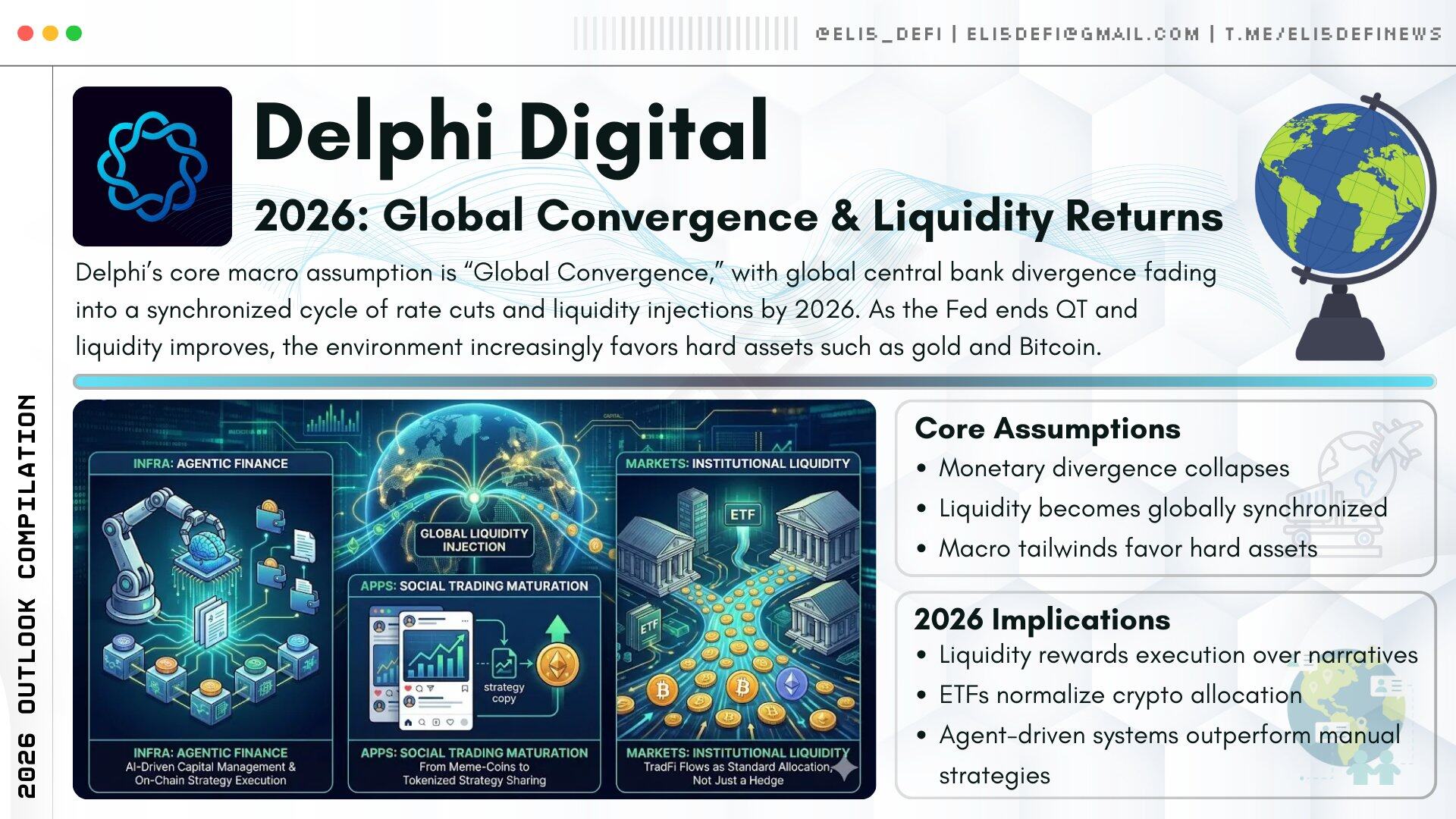
Delphi Digital bases its outlook on a "global convergence" macro assumption. They predict that by 2026, the divergence in global central bank policies will end, shifting towards a unified cycle of interest rate cuts and liquidity injection. As the Federal Reserve ends quantitative tightening (QT) and global liquidity improves, the market environment will favor hard assets like gold and Bitcoin.

Agent Economy

A major expansion of infrastructure is the rise of the "agent economy." AI agents will no longer be just chatbots but will actively manage funds, execute complex DeFi strategies, and optimize on-chain yields without human intervention.

Social Trading and the "Pump" Economy

On the consumer application front, Delphi highlighted the user stickiness of platforms like pump.fun and predicts that "social trading" will mature. This trend will evolve from simple meme coin gambling to complex copy-trading tiers, with strategy sharing becoming a tokenized product.

Institutional Liquidity

Market structure will be altered by the deepening adoption of ETFs, with traditional finance liquidity flowing into the crypto market not just as a hedge but as a standard portfolio allocation driven by macro liquidity easing.

Full report link: https://members.delphidigital.io/reports/the-year-ahead-for-infra-2026

Messari 2026 Outlook
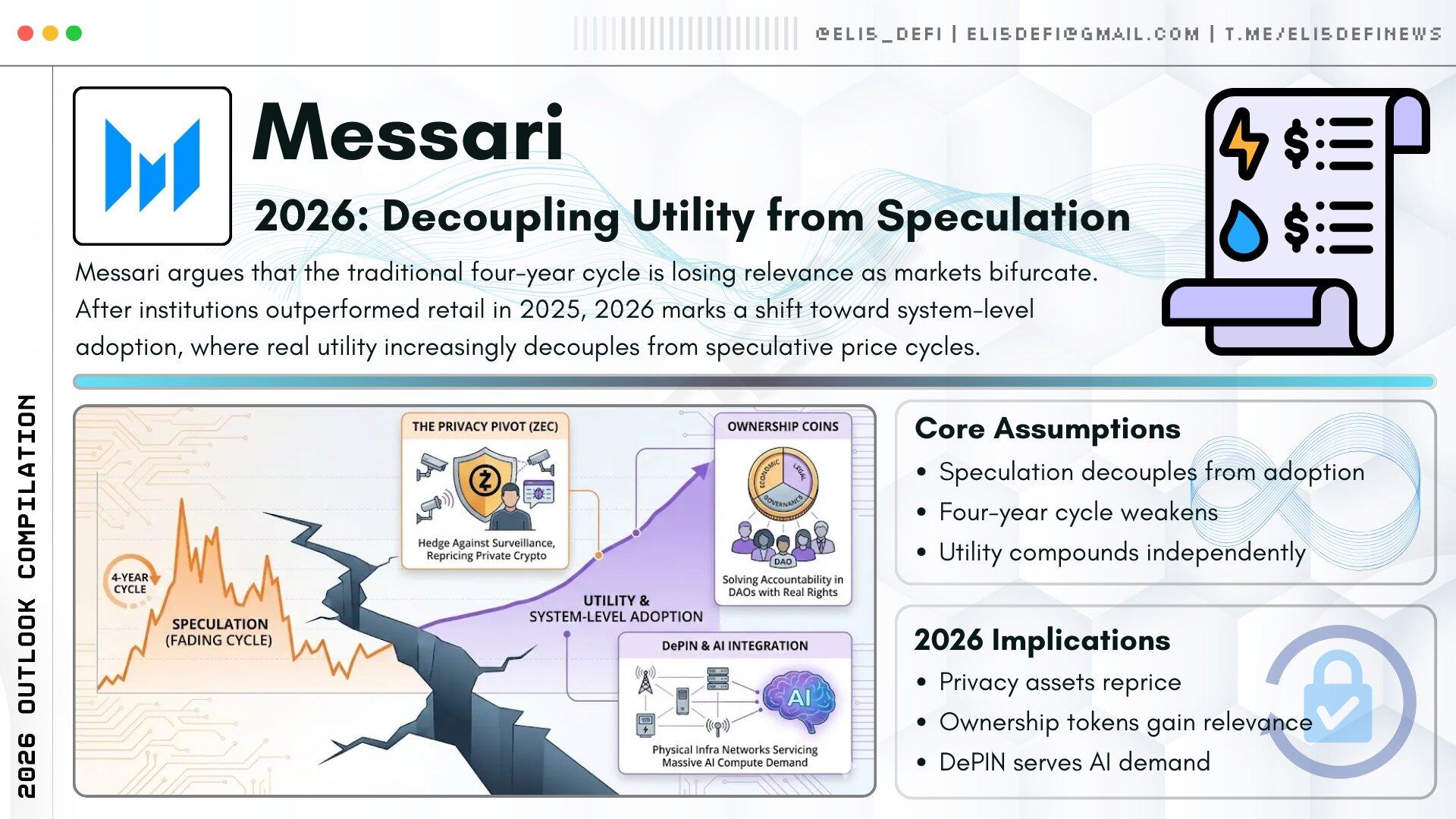
Messari's core thesis is the "decoupling of utility and speculation." They argue that as the market bifurcates, the relevance of the "four-year cycle" model is diminishing. They posit that 2025 was a year where institutional investors won and retail investors struggled, setting the stage for 2026 to be about "system-level adoption" rather than mere asset price speculation.

Rise of Privacy Coins ($ZEC)

A contrarian expansion trend is the renaissance of privacy. Messari emphasizes that Zcash (ZEC) and similar assets are not just "privacy coins" but necessary hedges against growing surveillance and corporate control, predicting a repricing of "private cryptocurrencies."

Ownership Tokens

2026 will see the emergence of a new category—"ownership tokens"—which combine economic, legal, and governance rights. Messari believes ownership tokens can address the accountability crisis in DAOs and potentially spawn the first billion-dollar projects in this specific niche.

DePIN and AI Convergence

This thesis focuses on DePIN (Decentralized Physical Infrastructure Networks), expecting these protocols to find real product-market fit by meeting the massive computational and data demands of the AI sector.

Full report link: https://messari.io/report/the-crypto-theses-2026

Four Pillars 2026 Outlook
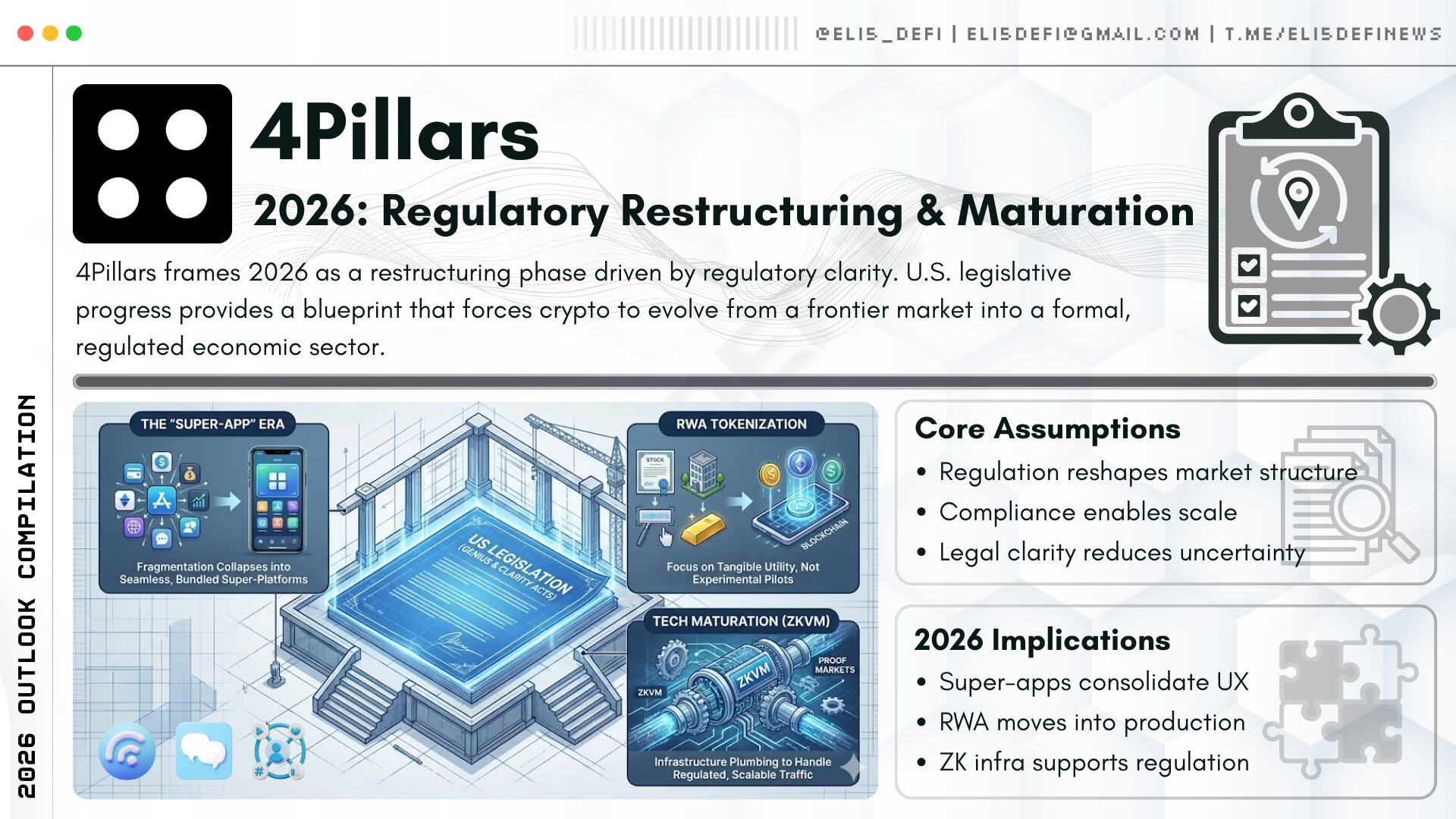
Four Pillars' outlook centers on "regulatory restructuring." Their core assumption is that US legislative initiatives (specifically mentioning the "GENIUS Act" and "CLARITY Act" in their predictions) will provide a blueprint for a comprehensive market overhaul.

This regulatory clarity is the catalyst for restructuring the market from a "Wild West" frontier into a formal economic sector.

The Era of "Super Apps"

Four Pillars predict that the fragmentation of crypto applications will finally coalesce into "super apps"—stablecoin-powered platforms that seamlessly integrate payment, investment, and lending functions. The complexity of blockchain will be completely abstracted away.

RWA Tokenization

Restructuring will drive the tokenization of equities and traditional assets, but the focus will be on actual utility, not experimental pilot programs.

Crypto Tech Maturation

On the technology side, they delve into the role of Zero-Knowledge Virtual Machines (ZKVM) on Ethereum and proof markets, seeing them as necessary infrastructure to handle the scale of this new, regulated institutional flow.

Full report link: https://4pillars.io/en/articles/2026-outlook-restructuring-100ys-perspective

Coinbase 2026 Outlook

Coinbase's report predicts the "end of the four-year cycle." They state clearly that 2026 will mark the end of the traditional Bitcoin halving cycle theory. Instead, the market will be driven by structural factors, macro demand for alternative stores of value, and the formalization of crypto as a mid-sized alternative asset class.

Tokenomics 2.0

A shift from "governance-only" tokens to "revenue-linked" models. Protocols will increasingly implement buyback-and-burn or fee-sharing mechanisms (compliant with new regulations) to align token holder incentives with platform success.

DAT 2.0 (Digital Asset Trading)

A move towards professionalized trading and "sovereign block space" procurement, treating block space as a key commodity for the digital economy.

AI and Crypto Intersection

Coinbase anticipates significant growth in AI agents using crypto payment rails. They predict the market will need "crypto-native settlement layers" capable of handling persistent micro-transactions between machines, which traditional payment rails cannot support.

Full report link: https://www.coinbase.com/en-sg/institutional/research-insights/research/market-intelligence/2026-crypto-market-outlook

a16z Crypto 2026 Outlook
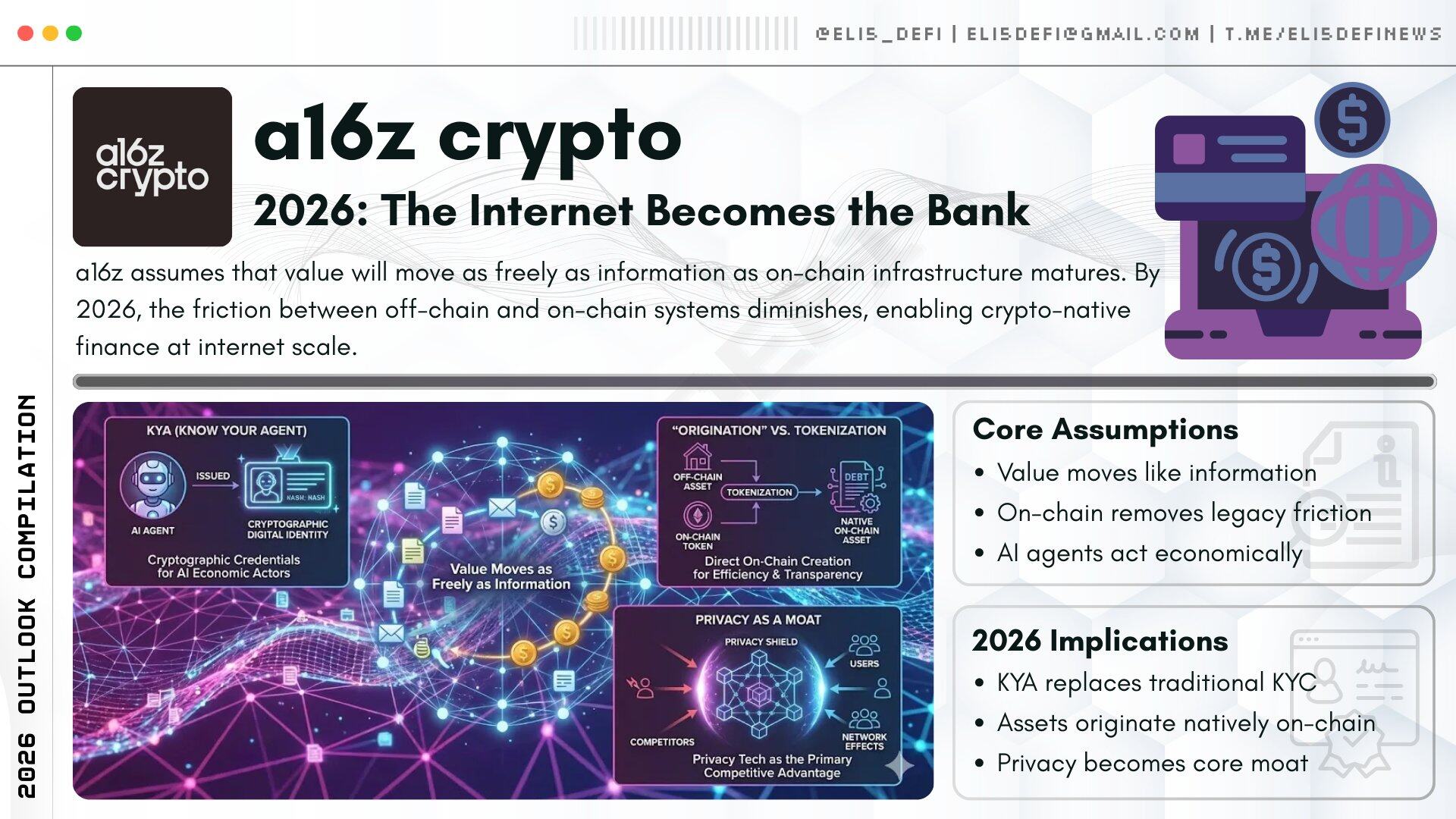
a16z crypto's outlook is that "the internet will become the bank." Their foundational belief is that value is beginning to flow as freely as information. They see the friction between the "off-chain" and "on-chain" worlds as the primary bottleneck, and 2026 will see this friction removed through better infrastructure.

KYA (Know Your Agent)

A key expansion is the shift from KYC (Know Your Customer) to KYA. As AI agents become primary economic participants, they will need cryptographically signed credentials to transact, creating a new layer of identity infrastructure.

"Native Bonds" vs. Tokenization

a16z predicts a future where instead of tokenizing off-chain assets as in the past (e.g., buying a treasury bill and putting it on-chain), debt and assets will be originated directly on-chain to lower the cost of service and increase transparency.

Privacy Tech Moat

They argue that in the era of open-source code, privacy technology (and the ability to protect state privacy) will become the most important competitive moat for blockchains, creating powerful network effects for privacy-enabled chains.

Wealth Management for All

The combination of AI and crypto infrastructure will democratize complex wealth management (e.g., asset rebalancing, tax-loss harvesting), previously accessible only to high-net-worth individuals, for the masses.

Full report link: https://a16zcrypto.com/posts/article/big-ideas-things-excited-about-crypto-2026/


Domande pertinenti

QWhat is the consensus among major crypto research institutions regarding the future of the four-year market cycle?

AMajor research institutions like Coinbase, a16z, and Messari believe the traditional four-year speculative cycle driven by events like Bitcoin halvings is ending. It is being replaced by structural maturity, where value flows to 'ownership tokens' with revenue-sharing models and projects with real utility, rather than being driven by short-term speculation.

QWhat is the 'Agent Economy' predicted by Delphi Digital and other firms for 2026?

AThe 'Agent Economy' refers to a future where AI agents evolve beyond simple chatbots to become primary economic actors. These agents will autonomously manage capital, execute complex DeFi strategies, and optimize on-chain yields without human intervention, requiring new infrastructure like KYA (Know Your Agent) protocols and machine-native settlement layers.

QAccording to Four Pillars and Messari, what will drive the emergence of 'Super Apps' in crypto?

AThe emergence of 'Super Apps' is predicted to be driven by clearer US regulatory policies. These user-friendly applications will abstract away blockchain's complexity, seamlessly integrating functions like payments, investing, and lending, all powered by stablecoins, to achieve mass adoption.

QHow does Messari define 'Ownership Tokens' and what problem do they aim to solve?

AMessari defines 'Ownership Tokens' as a new asset class that combines economic, legal, and governance rights. They aim to solve the accountability crisis in DAOs by better aligning incentives and could potentially birth the first billion-dollar projects within that specific niche.

QWhat key shift in tokenomics does Coinbase predict for 2026, moving away from the current model?

ACoinbase predicts a shift from tokens that are 'governance-only' to a 'Tokenomics 2.0' model where tokens are linked to protocol revenue. This involves the implementation of mechanisms like buybacks, burns, or fee-sharing (in compliance with new regulations) to directly tie tokenholder incentives to the platform's financial success.

Letture associate

Gary Yang: Agent Economy and AI Submicroeconomics

**Title:** Agent Economy and AI Sub-Microeconomics - Gary Yang **Summary:** Following the AI singularity, the pace of evolution has accelerated rapidly, creating new generational disparities in technological advancement globally. While many regions are still grappling with single-agent bottlenecks, Silicon Valley has moved ahead into the next dimension: the Agent Economy and A2A ecosystems. The article outlines six key areas of this emerging paradigm: 1. **AI Payment Competition & H2A Bottlenecks:** A fierce battle for AI Agent payment protocol standards is underway (e.g., MPP, x402). However, most current efforts remain Human-to-Agent (H2A), essentially grafting AI onto traditional human-centric commerce, which creates a non-AI-native bottleneck. The true potential lies in Agent-to-Agent (A2A) autonomous economies. 2. **Agent Economy & the Inevitable A2A Trend:** The Agent Economy is defined by autonomous AI Agents creating, exchanging, and capitalizing value as independent economic actors. The A2A ecosystem describes their interactions. This represents the next major investment frontier, akin to the early days of e-commerce or DeFi, but with faster iteration and an AI-native, efficiency-first perspective that often diverges from human needs. 3. **AI Protocol vs. Crypto Protocol:** AI Protocols are the foundational rules for Agent interaction in an open network (communication, discovery, collaboration), akin to the governance and economic laws of the AI world. Currently, they focus on communication and weak boundaries, unlike Crypto Protocols which emphasize asset rights and clear ownership. While they appear different due to political-economic factors and legacy system constraints, their eventual convergence into a unified Digital Protocol system is seen as inevitable, driven by first principles. 4. **AI Agent Sub-Microeconomics & Biological Analogy:** AI Agent economics differ fundamentally from human economics: higher frequency/lower value transactions, energy/value direct correlation, efficiency-driven (not emotional) decisions, task-oriented (not consumption-oriented) behavior, and near-zero organizational/communication costs. A powerful analogy frames the Agent economy as a biological system: the LLM is the nucleus, the Agent harness is the cytoplasm, the Agent itself is a cell, its communication protocol is the cell membrane, and external tools (Skills, Prompts) are the extracellular environment. 5. **The Inevitability of AIFi & FinChip:** AIFi (AI Finance) represents the financial system where AI-native value within the Agent economy is tokenized and exchanged. Unlike TradFi/DeFi where value resides *in* finance, in AIFi, value originates *in* AI, and finance becomes its form. This shift is enabled by Agents taking over value discovery. FinChip (Financial Chip) is introduced as a key infrastructure—a fusion of AI autonomy and crypto smart contracts—forming intelligent financial assets to power the future A2A economy. 6. **AI-Native as a Paradigm Shift:** Adopting AI is not akin to "Internet+". It requires AI-Native thinking—designing systems based on first principles, the shortest energy-value path, and maximum efficiency. This abstract, counter-intuitive logic poses a significant, ongoing challenge for all practitioners, as effective, generalized upgrade methodologies will be slow to emerge in this rapidly evolving landscape.

链捕手4 min fa

Gary Yang: Agent Economy and AI Submicroeconomics

链捕手4 min fa

From 'The Big Short' to San Francisco: The Revelry and Dizziness Within the AI Bubble

From "The Big Short" to San Francisco: The Frenzy and Dizziness in the AI Bubble The article captures the intense, frenetic atmosphere in San Francisco, the epicenter of the current AI boom. Drawing a parallel to the "smell of money" from *The Big Short*, the author observes a city gripped by a singular status game centered entirely on AI and technology. This manifests in a palpable, caffeine-fueled anxiety ("people are shaking"), rampant comparison using vanity metrics like funding rounds, and pervasive "Big Bubble Behavior." The piece explores the city's stark contrasts: its dystopian streets versus beautiful vistas, and the disconnect between the doomsday concerns of some AI researchers and the optimistic, growth-focused "GTM" teams. It critiques the obsession with "math genius" founders as the new ticket to outsized returns, akin to scouting sports prodigies. Referencing economic historian Carlota Perez's "frenzy phase" and Karl Polanyi's "double movement," the author frames the boom as a period where financial speculation detaches from fundamentals, with society potentially becoming subordinate to a new economic force driven by "geniuses in data centers." Ultimately, while acknowledging the unprecedented wealth creation and party-like energy, the article concludes with cautionary advice: when the music is playing, you should dance, but don't get drunk. The core reminder is to stay grounded, avoid distorted judgment, and maintain perspective amidst the euphoria.

marsbit5 min fa

From 'The Big Short' to San Francisco: The Revelry and Dizziness Within the AI Bubble

marsbit5 min fa

Is AI Creating a New Class of 'Information Poor'?

AI is generating a new kind of "information poverty." The core issue isn't that AI denies answers to the poor; it's that it provides abundant, cheap, and plausible-sounding answers to everyone. This availability shifts the true scarcity from obtaining answers to possessing the **judgment to evaluate them** and the access to turn them into real-world opportunities. New information poverty thus describes those who have AI tools and outputs, but lack the complementary skills, authorization, and contextual experience to critically assess and act on them. Research reveals a multi-layered divide: access to AI is stratified by income and platform design (e.g., premium vs. free, embedded tools). In workplaces, usage heavily favors higher-paid, more experienced, or formally trained employees, with AI often automating entry-level tasks that were traditional stepping stones. Crucially, the heaviest users are often mid-career professionals whose existing expertise allows them to effectively judge and leverage AI outputs, while novices risk over-relying on them without building judgment. While controlled experiments show AI can significantly boost low-skilled workers' performance, real-world adoption and benefit are constrained by unequal social and organizational structures. Historically, general-purpose technologies first reward those with existing complementary capital. AI, by affecting judgment-based work, may accelerate and deepen this initial inequality gap, even if it narrows over decades. The danger lies in the illusion of competence it creates, potentially stunting the very critical thinking needed in an era where judgment is paramount.

marsbit39 min fa

Is AI Creating a New Class of 'Information Poor'?

marsbit39 min fa

Jensen Huang 'Saves' South Korean Stock Market: Locks In SK Hynix Memory, Chip Shortage to Continue

On June 5th, South Korea's stock market experienced a sharp decline, with major chipmakers like Samsung and SK Hynix dropping nearly 10%. Amidst the turmoil, NVIDIA CEO Jensen Huang's visit to Seoul played a dramatic role in boosting market sentiment. Following a dinner meeting with SK Group Chairman Chey Tae-won and SK Hynix CEO Kwak Noh-Jung, Huang confirmed that NVIDIA's new Vera CPU will utilize SK Hynix DRAM. The companies announced a multi-year technical partnership to co-develop next-generation memory for NVIDIA's AI infrastructure, covering products from data centers to personal AI and robotics. This collaboration extends beyond memory supply. SK Hynix is integrating NVIDIA's AI and Omniverse platform into its own semiconductor design and manufacturing processes, including computational lithography and creating digital twins of its fabrication plants for autonomous operation. While strengthening ties with SK Hynix, NVIDIA is diversifying its supply chain for the upcoming HBM4 memory, with Samsung, SK Hynix, and Micron all certified as suppliers for its Vera Rubin platform. Despite this, Huang warned that the global chip shortage, driven by relentless demand from AI factory construction, is expected to persist for several years across the entire supply chain. His visit underscores NVIDIA's systematic effort to deepen integration with South Korea's broader tech industry.

marsbit1 h fa

Jensen Huang 'Saves' South Korean Stock Market: Locks In SK Hynix Memory, Chip Shortage to Continue

marsbit1 h fa

Nasdaq Plunges 4.2% in a Single Day: Does "Black Friday" Burst the U.S. Stock Market Bubble?

The Nasdaq plunged 4.18% on June 5, 2026, its worst single-day drop in over a year, as a much stronger-than-expected US jobs report triggered fears of economic overheating and delayed Federal Reserve interest rate cuts. The selloff, centered on high-valuation tech and AI stocks like Nvidia and Broadcom, spread across major indices. The article examines whether this signals a market top. The strong May non-farm payrolls data, nearly double expectations, pushed bond yields higher, directly hurting rate-sensitive tech stocks. This exposed vulnerabilities in the crowded AI trade, where valuations had soared on narratives of infinite growth, despite emerging signs of slowing order momentum and corporate AI monetization challenges. Prior to the drop, market indicators flashed warning signs: historically high valuations (e.g., Shiller CAPE ratio near 39.5), extreme bullish sentiment, and high levels of leverage. Technical charts showed key support levels being breached. Wall Street is divided on the outlook. Bears, citing risks of "stagflation" and AI bubble comparisons to the dot-com era, warn of a potential significant correction. Bulls view the drop as a healthy correction within a bull market, underpinned by a strong economy and expected corporate earnings growth of around 7% in 2026. The immediate future hinges on upcoming key events: the May CPI inflation data and the mid-June FOMC meeting. Their outcomes will critically shape market expectations for the Fed's rate path. The article concludes that conditions for a major market top are aligning, marking a fragile transition from narrative-driven gains to a phase demanding validation from macroeconomic data and corporate fundamentals. Caution is advised.

marsbit1 h fa

Nasdaq Plunges 4.2% in a Single Day: Does "Black Friday" Burst the U.S. Stock Market Bubble?

marsbit1 h fa

Trading

Spot
Futures

Articoli Popolari

Come comprare SUPER

Benvenuto in HTX.com! Abbiamo reso l'acquisto di SuperFarm (SUPER) semplice e conveniente. Segui la nostra guida passo passo per intraprendere il tuo viaggio nel mondo delle criptovalute.Step 1: Crea il tuo Account HTXUsa la tua email o numero di telefono per registrarti il tuo account gratuito su HTX. Vivi un'esperienza facile e sblocca tutte le funzionalità,Crea il mio accountStep 2: Vai in Acquista crypto e seleziona il tuo metodo di pagamentoCarta di credito/debito: utilizza la tua Visa o Mastercard per acquistare immediatamente SuperFarmSUPER.Bilancio: Usa i fondi dal bilancio del tuo account HTX per fare trading senza problemi.Terze parti: abbiamo aggiunto metodi di pagamento molto utilizzati come Google Pay e Apple Pay per maggiore comodità.P2P: Fai trading direttamente con altri utenti HTX.Over-the-Counter (OTC): Offriamo servizi su misura e tassi di cambio competitivi per i trader.Step 3: Conserva SuperFarm (SUPER)Dopo aver acquistato SuperFarm (SUPER), conserva nel tuo account HTX. In alternativa, puoi inviare tramite trasferimento blockchain o scambiare per altre criptovalute.Step 4: Scambia SuperFarm (SUPER)Scambia facilmente SuperFarm (SUPER) nel mercato spot di HTX. Accedi al tuo account, seleziona la tua coppia di trading, esegui le tue operazioni e monitora in tempo reale. Offriamo un'esperienza user-friendly sia per chi ha appena iniziato che per i trader più esperti.

208 Totale visualizzazioniPubblicato il 2024.12.11Aggiornato il 2026.06.02

Come comprare SUPER

Discussioni

Benvenuto nella Community HTX. Qui puoi rimanere informato sugli ultimi sviluppi della piattaforma e accedere ad approfondimenti esperti sul mercato. Le opinioni degli utenti sul prezzo di SUPER SUPER sono presentate come di seguito.

活动图片