First Long-Horizon Doc2Repo Training Dataset: Code Agents Move Beyond Bug Fixing and Begin Creating Repositories

marsbitPubblicato 2026-06-25Pubblicato ultima volta 2026-06-25

Introduzione

With the advancement of LLM Code Agents, the research focus is shifting towards long-horizon, real-world tasks, moving beyond simple bug fixes to full repository generation. To address this, researchers from Renmin University of China introduced the DeNovoSWE dataset. This dataset focuses on long-term software engineering tasks, specifically the "document-to-repository" challenge—generating an entire, executable code repository from a task description. The DeNovoSWE construction method employs a Divide & Conquer approach. It breaks down target repositories into core capabilities and uses a multi-agent Draft-Critic-Repair workflow to automatically generate high-quality, evaluation-aligned task documents. The dataset also implements difficulty-aware filtering to balance quality and diversity. The result is a high-quality, anti-leakage dataset of 4,818 instances. Experiments show that models trained on DeNovoSWE achieve significant improvements in long-horizon repository generation. For instance, Qwen3-30B-A3B-Instruct's performance on the BeyondSWE-Doc2Repo benchmark increased from 5.8% to 47.2%, and on NL2RepoBench from 4.3% to 23.0%. Similar gains were observed with stronger backbones, demonstrating that dedicated long-horizon training data is crucial for advancing Code Agents from maintainers to architects capable of planning and building complete software projects from scratch.

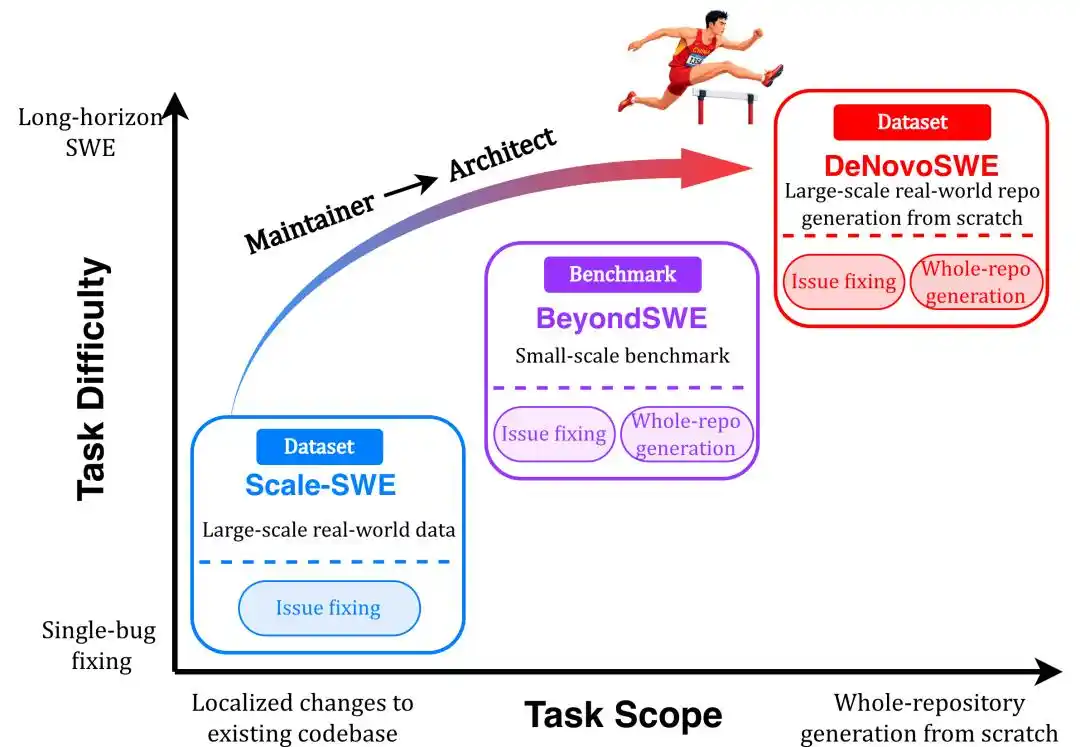
With the continuous improvement of LLM Code Agent capabilities, more and more researchers are realizing it's time to advance to the next stage of long-horizon tasks that are closer to real-world scenarios. Consequently, some benchmarks for evaluating long-horizon tasks have emerged, such as NL2RepoBench and BeyondSWE. The expected role of Code Agents is gradually shifting from repository maintainers to architects, capable of planning and completing long-horizon coding tasks for entire repositories.

Recently, the Gaoling School of Artificial Intelligence at Renmin University of China completed related research and officially released the DeNovoSWE dataset, focusing on long-horizon software engineering tasks, particularly repository-level code generation from scratch.
Paper link: https://arxiv.org/pdf/2606.10728

Repository link: https://github.com/AweAI-Team/DeNovoSWE

Data link: https://huggingface.co/collections/AweAI-Team/denovoswe

Through the mechanisms of Divide & Conquer and Critic & Repair, a high-quality dataset was constructed, successfully achieving scaling for long-horizon SWE tasks. This effort resulted in DeNovoSWE, an open-source, high-quality long-horizon SWE task dataset containing 4,818 real-world instances. This achievement provides large-scale data for training Code Agents' long-horizon capabilities, significantly enhancing their performance on such tasks.
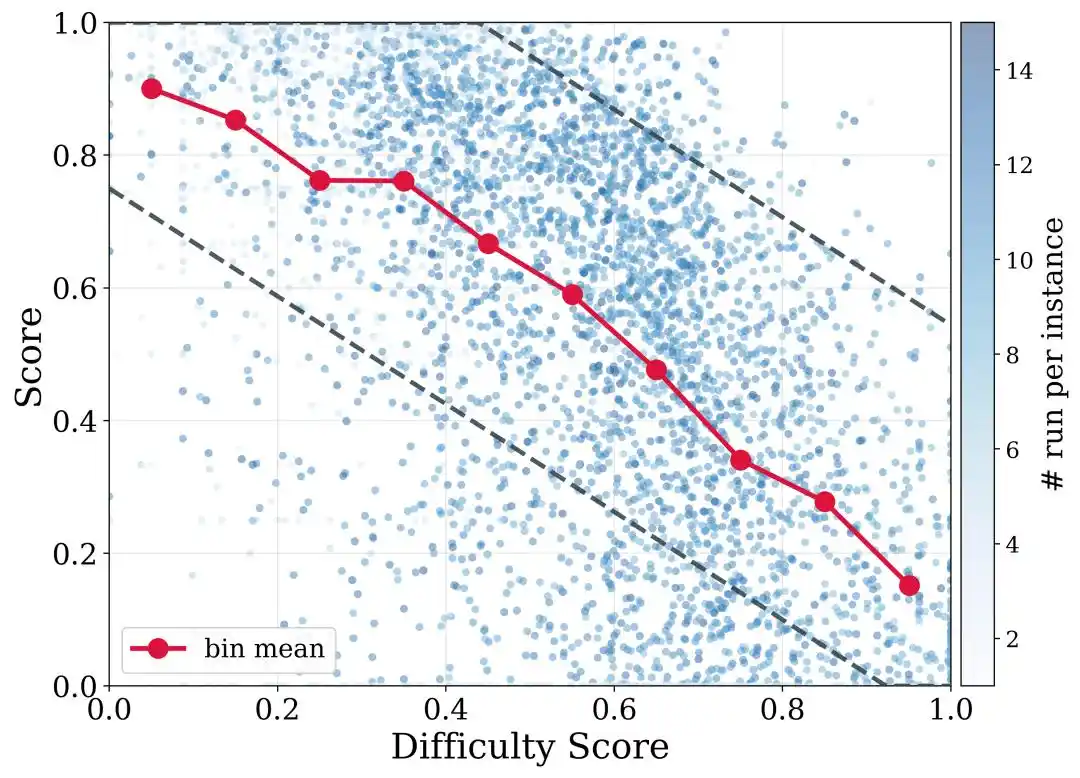
The paper also proposes methods based on difficulty score filtering, effectively alleviating the trade-off between the proportion of difficult problems and trajectory quality.
Experiments show that the Qwen3-30B-A3B-Instruct model trained on DeNovoSWE improved from 5.8% to 47.2% on BeyondSWE-Doc2Repo and from 4.3% to 23.0% on NL2RepoBench, demonstrating the significant boost in repository-level code generation capabilities brought by long-horizon data.

Rebuilding an Entire Repository from a Single Document

Over the past year, with the scaling of large-scale SWE data in works like Scale-SWE, code agents have rapidly progressed on real software engineering tasks like SWE-bench. But as models become increasingly adept at "fixing an issue" or "changing a few lines of buggy code," a more critical question arises: Do agents truly possess long-horizon software engineering capabilities? Judging from the performance of frontier models on BeyondSWE-Doc2Repo and NL2RepoBench, the results are not ideal.

Real-world software development often isn't about modifying a single function or adding a conditional statement. It involves understanding requirements, planning architecture, creating files, designing APIs, handling dependencies, connecting modules, and ultimately making the entire repository run successfully in tests.

In other words, the real challenge lies in long-horizon repository-level generation: starting from a task document and generating a complete, executable, and verifiable software repository. This is precisely the problem DeNovoSWE aims to solve.

High-Quality "Generate from Scratch" Task Documents

In document-to-repository generation, the document is not just a README, nor a simple API list. It is essentially the sole task entry point for the agent to rebuild the entire repository.

A high-quality task document needs to meet at least two core standards.

First, it must be well-organized.

Repository-level tasks are inherently complex, involving multiple modules, interfaces, configurations, data structures, and interaction flows. If the document merely piles up function descriptions, the agent can easily get lost in fragmented information. Therefore, the document should first provide a clear overview of the repository, then divide into chapters based on capabilities or workflows, ensuring each part corresponds to a clear functional boundary.

Second, it must be written from the perspective of reliable evaluation.

The document cannot be too sparse, otherwise the task becomes an underdefined problem, potentially requiring the model to guess aimlessly to pass evaluation. Nor can it be too detailed, as that would directly leak implementation details, making the task unchallenging.

A truly high-quality document should describe the key behaviors on which evaluation depends: including import paths, public APIs, inputs and outputs, default parameters, exception behaviors, configuration items, pattern strings, return fields, etc., while also outlining the general functionalities to be implemented. In other words, the document should be sufficient for the agent to reproduce testable behaviors, but it should not become a copy of the implementation code.

This is also the core idea of DeNovoSWE: making documents readable, implementable, and verifiable.

The DeNovoSWE Method

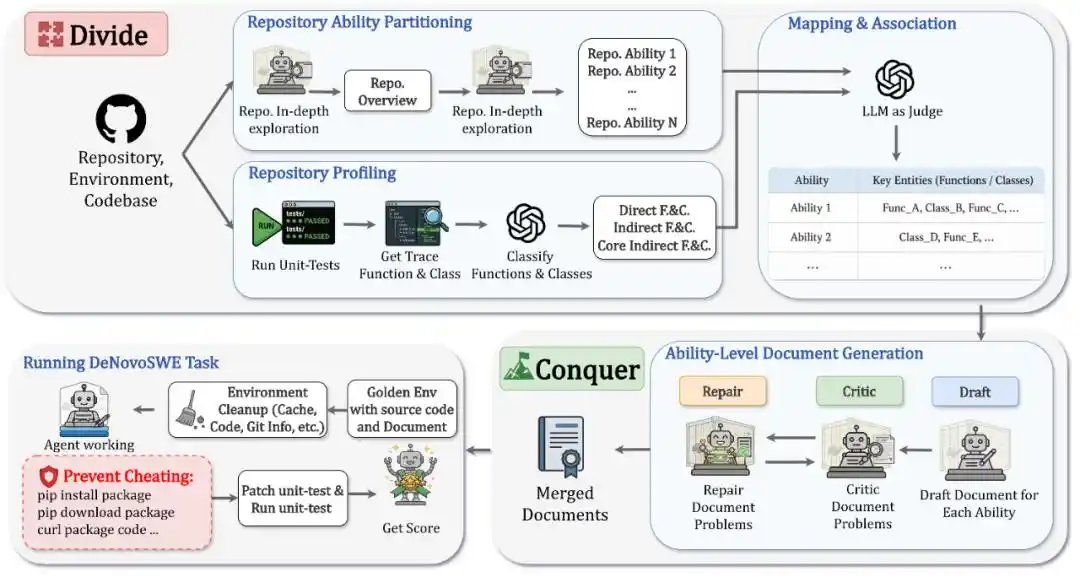
DeNovoSWE frames "generating a complete repository from a document" as a large-scale, verifiable long-horizon software engineering task. It does not rely on manually written documents but automatically constructs high-quality instances through a sandboxed multi-agent workflow. The entire method can be summarized in two steps: Divide and Conquer.

In the Divide stage, the system first analyzes the target repository, decomposing it into multiple repository capabilities.

Each capability corresponds to a core function or workflow within the repository, such as authentication and connection, data reading/writing, batch processing, export flows, etc. This way, the originally massive repository generation problem is split into several structurally clear document chapters.

Simultaneously, DeNovoSWE runs the original unit tests and collects execution traces to identify which functions, classes, and interfaces actually impact evaluation. This further distinguishes between direct components, core indirect components, and non-core indirect components: interfaces directly called by tests must be documented in detail; core indirect components that affect observable behaviors also need coverage; while non-core internal implementations can be left for the agent to handle freely.

In the Conquer stage, DeNovoSWE uses a Draft-Critic-Repair mechanism to generate documents for each capability one by one. The Draft agent writes an initial draft; the Critic agent checks for omissions of key APIs, behavioral contracts, or structural information; the Repair agent then fixes the document based on the feedback. This cycle iterates until each capability chapter is clear, complete, and aligned with evaluation.

Finally, the documents for different capabilities are merged into a single, comprehensive task document, serving as the sole basis for the agent to generate the repository from scratch.

Difficulty: Why is This a Long-Horizon Task?

The difficulty of DeNovoSWE tasks stems from a fundamental change: it's no longer issue-level fixing, but whole-repository generation.

In traditional SWE tasks, agents typically face an existing repository, needing only to locate a bug, modify local code, and pass tests.

In DeNovoSWE, the agent faces a cleaned environment: the original source code and tests are removed, git history is reset, and potential leakage channels like caches, site-packages residues, pip wheels, temporary compilation artifacts, etc., are also cleared. This means the agent must truly rely on the document to complete the entire repository rebuild. It needs to plan the project structure, create module files, define public interfaces, implement cross-file interactions, handle dependencies and configurations, and continuously fix errors across multiple rounds of editing and test feedback.

Any deviation in an API signature, return field, exception type, or default behavior can cause test failures. Errors can also accumulate over the long horizon: an early poorly designed module can affect multiple subsequent files and call chains.

To further address the difficulty variance across different repositories, DeNovoSWE also proposes difficulty-aware trajectory filtering. In simple terms, easy tasks should require a higher pass rate, while difficult tasks should not be entirely discarded just for failing to achieve a perfect score. DeNovoSWE sets different filtering thresholds for different difficulty intervals based on structural complexity and LLM difficulty assessment, thereby balancing quality and diversity.

This is particularly important for long-horizon tasks: the more complex the repository, the harder it is to pass all tests in one go. Yet, the trajectories from challenging repositories, even with low scores or partial success, still contain valuable long-horizon planning and implementation capabilities.
Experimental Results

DeNovoSWE ultimately constructed 4,818 high-quality document-to-repository task instances. It is an executable, evaluable, and trainable long-horizon software engineering environment.
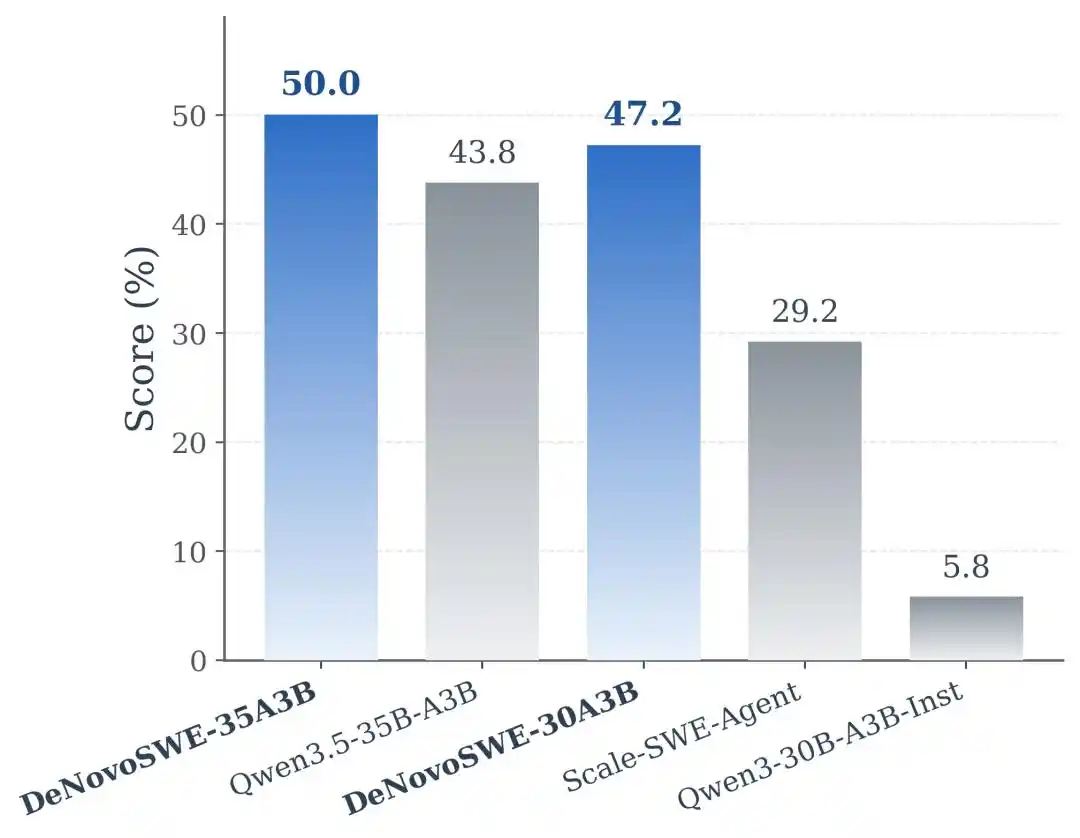
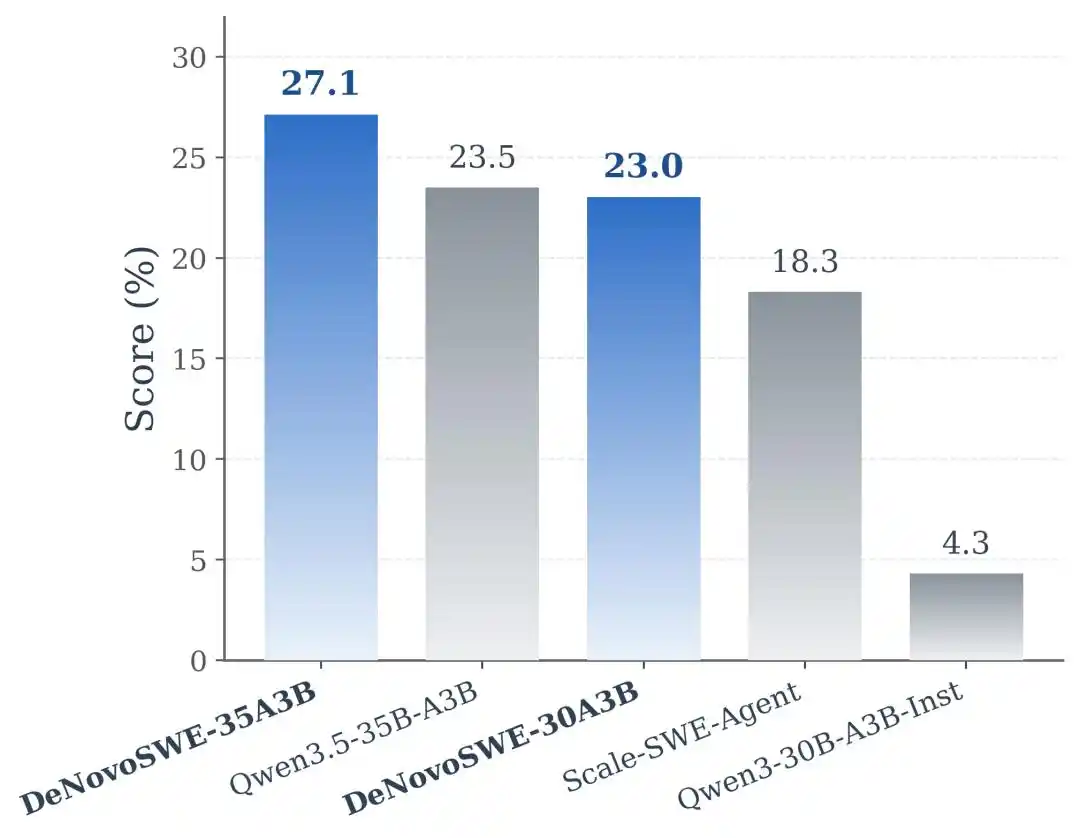
Experimental results show that DeNovoSWE brings significant improvements to models' long-horizon repository generation capabilities. For Qwen3-30B-A3B-Instruct, the original model scored only 5.8% on BeyondSWE-Doc2Repo and 4.3% on NL2RepoBench. Training with conventional issue-level SWE data like Scale-SWE-Agent improved these to 29.2% and 18.3%, indicating that general SWE data does have transfer effects. However, when the model was trained using DeNovoSWE, performance further increased to 47.2% and 23.0%.

This demonstrates that data oriented towards "fixing bugs" cannot fully replace data oriented towards "generating complete repositories" for long-horizon tasks. To truly teach agents repository-level engineering, specialized training environments built for long-horizon tasks are needed.

On the stronger Qwen3.5-35B-A3B backbone, DeNovoSWE similarly brought stable gains: BeyondSWE-Doc2Repo improved from 43.8% to 50.0%, and NL2RepoBench from 23.5% to 27.1%. This further indicates that the benefits of DeNovoSWE are not due to accidental adaptation to a specific model, but stem from the high-quality long-horizon data itself.

Conclusion

The next stage for code agents is not just about fixing individual issues faster, but about understanding documents, planning architecture, organizing modules, implementing interfaces, and ultimately generating a complete, runnable software repository.

DeNovoSWE systematically frames this goal into a trainable, verifiable, and scalable dataset. It answers a key question: What kind of data can truly train agents with long-horizon software engineering capabilities?

The answer is not more fragmented code, nor simpler problems, but high-quality, structured, evaluation-aligned, anti-leakage, full-repository generation tasks.

Starting from a single document, rebuild the entire repository. This is the threshold that long-horizon code agents need to cross.

Reference: https://arxiv.org/pdf/2606.10728

This article is from the WeChat public account "AI Era," edited by LRST.

Crypto di tendenza

Domande pertinenti

QWhat is the main contribution of the research from Renmin University of China's Gaoling School of Artificial Intelligence?

AThe research introduces and releases the DeNovoSWE dataset, which is the first long-horizon Doc2Repo training set focused on repository-level code generation from scratch in software engineering tasks.

QHow does the DeNovoSWE dataset address the challenge of long-horizon software engineering tasks?

AIt uses a sandboxed multi-agent workflow based on 'Divide & Conquer' and 'Draft-Critic-Repair' mechanisms to automatically construct high-quality task documents, ensuring they are well-organized and evaluation-aligned for whole-repository generation.

QWhat were the performance improvements observed after training a model on the DeNovoSWE dataset?

AThe Qwen3-30B-A3B-Instruct model showed significant improvement, increasing its performance on BeyondSWE-Doc2Repo from 5.8% to 47.2% and on NL2RepoBench from 4.3% to 23.0%.

QWhat are the two core standards mentioned for a high-quality task document in document-to-repository generation?

AFirst, the document must be well-organized, providing a clear overview and structured chapters. Second, it must be evaluation-aligned, describing key behaviors for verification without leaking implementation details.

QWhat is the purpose of the difficulty-aware trajectory filtering mechanism in DeNovoSWE?

AIt sets different filtering thresholds for tasks of varying difficulty levels to balance quality and diversity, ensuring that valuable but partially successful trajectories from complex repositories are not discarded.

Letture associate

Bitcoin and Ethereum Soar Together! Eight Altcoins Worth Watching in the Later Market

Bitcoin and Ethereum Surge, Fueling Altcoin Speculation. Bitcoin Eyes $77,000, Ethereum Gains 20% in a Single Day. Market anticipates capital rotation from major cryptos to high-beta altcoins, but a selective rise is expected, favoring projects with genuine users, protocol revenue, and healthy tokenomics. Analysts highlight eight altcoins across key sectors: **High-Performance Blockchains:** * **SOL (Solana):** Market cap ~$51.88B. A dominant player with a strong ecosystem. Considered a relatively safe bet for potential catch-up growth. * **SUI (Sui):** Market cap ~$3.03B. High volatility potential but faces risks from its low circulating supply and future token unlocks. **DeFi Lending:** * **UNI (Uniswap):** Market cap ~$2.38B. Transitioning to a revenue-capturing asset post-fee switch implementation. * **AAVE (Aave):** Market cap ~$1.53B. Features balanced tokenomics and revenue but has seen significant recent gains. * **MORPHO:** Market cap ~$1.50B. Rapid protocol growth but weaker token value capture and opaque supply data. **Perpetual DEX:** * **HYPE (Hyperliquid):** Market cap ~$16.41B. The clear sector leader with strong revenue but high valuation and a large portion of tokens still locked, warranting caution. **RWA & On-Chain Finance Infrastructure:** * **LINK (Chainlink):** Market cap ~$8.09B. A key oracle provider positioned to benefit from multiple trends like RWA and institutional adoption, offering strong fundamentals. * **ONDO (Ondo Finance):** Market cap ~$1.77B. Shows strong business growth but carries high risks due to concentrated token holdings and a massive unlock scheduled for 2027. **Conclusion:** The altcoin rally is expected to be selective. Recommendations include a medium position in SOL, small allocations to SUI and UNI/AAVE for DeFi exposure, and caution with HYPE and ONDO due to their specific risks. LINK is suggested as a core holding for the RWA thematic.

marsbit1 h fa

Bitcoin and Ethereum Soar Together! Eight Altcoins Worth Watching in the Later Market

marsbit1 h fa

Shanghai's $10 Billion Unicorn Is About to Go Public

Shanghai-based automotive-grade millimeter-wave radar chip unicorn Calterah Microelectronics Technology (Shanghai) Co., Ltd. has filed for an IPO on Shanghai's STAR Market, aiming to raise 3.49 billion yuan. Founded in 2014 by Chen Jiashu, a UC Berkeley PhD graduate, and his professor Ali Niknejad, Calterah pioneered CMOS technology for 77GHz radar chips, breaking the decades-long monopoly of international giants like Texas Instruments. Its low-cost, highly integrated solutions enabled millimeter-wave radar to move from luxury to mass-market vehicles. By 2025, Calterah captured a 31.1% share in China's automotive millimeter-wave radar chip market (second domestically, fourth globally), with cumulative shipments exceeding 30 million units. Its client list includes BYD, Geely, Nio, and Volvo. The company has undergone 11 funding rounds, attracting high-profile investors such as the National Integrated Circuit Industry Investment Fund Phase II, China Capital Management, and GD Capital. Its valuation has reached tens of billions of yuan, with a projected post-IPO valuation of approximately 14 billion yuan. Despite rapid revenue growth—increasing from 206 million yuan in 2023 to 632 million yuan in 2025 with a 75.28% CAGR—Calterah remains unprofitable. It reported net losses of 323 million yuan, 334 million yuan, and 193 million yuan from 2023 to 2025, accumulating over 900 million yuan in losses over three and a half years. These losses are primarily attributed to heavy R&D investment, which totaled over 1.039 billion yuan in the reporting period, often exceeding annual revenue. The company faces significant risks, including high customer concentration (its top five customers accounted for over 99% of revenue from 2023-2025, with BYD alone representing over 50% in 2025) and supply chain concentration. Revenue pressure from key customers and dependencies on overseas suppliers for EDA tools and IP pose challenges to sustainable growth. The IPO is seen as crucial for securing capital to expand production, diversify its customer base, and reduce supply chain dependencies.

marsbit1 h fa

Shanghai's $10 Billion Unicorn Is About to Go Public

marsbit1 h fa

Ray Dalio's Latest Macro Analysis Full Text: Buy More Gold, Add Some Bitcoin

In his latest macro analysis, Ray Dalio applies his framework from "How Countries Go Broke: The Big Cycle" to the current global debt environment. He highlights recent events like Japan selling U.S. Treasuries and rising U.S. long-term yields as signs of an unsustainable debt dynamic. Dalio explains that excessive government debt leads to either unacceptably high interest rates, severe economic downturns, or significant currency debasement through central bank money printing. He summarizes the U.S. fiscal situation: with $5.5 trillion in revenue, $7.5 trillion in spending, a $2 trillion deficit, and total debt at six times annual revenue, debt servicing costs are immense. Without correction, U.S. debt could reach $55-$60 trillion in a decade. Dalio proposes a "3% Three-Way" solution: reducing the budget deficit to 3% of GDP through balanced spending cuts, tax increases, and interest rate reductions to avoid a traumatic adjustment. In response to FAQs, he argues that the risk of a U.S. debt crisis is high and could materialize within a few years if the current path continues. He dismisses the notion that the dollar's reserve status makes the U.S. immune, citing historical precedents of reserve currency declines. He is also unconvinced by Japan's high-debt stability, noting poor returns for yen-denominated assets. For investors, Dalio recommends diversifying globally, underweighting bonds, and overweighting assets like gold and a small allocation to Bitcoin (around 10-15% to gold) to hedge against currency debasement and poor debt returns.

marsbit2 h fa

Ray Dalio's Latest Macro Analysis Full Text: Buy More Gold, Add Some Bitcoin

marsbit2 h fa

Stripe’s 16-Year Chronicle: From 7 Lines of Code to a $100 Billion Valuation

Stripe's 16-year journey began with a simple promise: "7 lines of code to accept payments." Founded by Patrick and John Collison, the company started by hiding the complexity of bank integrations and merchant accounts behind a clean API, initially targeting developers at startups. This early focus on user experience and technical simplicity fueled rapid adoption. A key early milestone was establishing vital bank partnerships, a challenge overcome by hiring Billy Alvarado, who brought crucial institutional relationship skills. From this foundation, Stripe systematically expanded its product boundaries. It launched Connect for platform payments, Atlas for company formation, Radar for fraud prevention, and Billing for subscriptions. This transformed Stripe from a payment processor into a broader financial infrastructure suite for internet businesses. The COVID-19 pandemic accelerated growth but also led to over-hiring. A 14% layoff in 2022 marked a period of organizational correction. Subsequently, Stripe shifted its growth strategy towards strategic acquisitions to enter new domains quickly. It acquired Bridge (stablecoin infrastructure), Privy (wallet infrastructure), Metronome (usage-based billing), and agreed to buy OpenRouter (AI model routing). These moves signal Stripe's ambition to build a "programmable money system" for the emerging AI and agent-based economy, managing not just currency flows but also the measurement and pricing of computational resources like AI tokens. Internally, Stripe leverages AI agents (like "Minions") to boost engineering productivity. Despite scaling to nearly 8,000 employees and processing $1.9 trillion in payment volume annually, the company remains private. A recent employee tender offer valued it at $159 billion. The core question for Stripe's future is whether it can successfully integrate its expanding product matrix—spanning payments, crypto, and AI infrastructure—into a cohesive platform, positioning itself as the foundational economic layer for autonomous software agents.

marsbit3 h fa

Stripe’s 16-Year Chronicle: From 7 Lines of Code to a $100 Billion Valuation

marsbit3 h fa

Trading

Spot

Articoli Popolari

Come comprare RE

Benvenuto in HTX.com! Abbiamo reso l'acquisto di Re (RE) semplice e conveniente. Segui la nostra guida passo passo per intraprendere il tuo viaggio nel mondo delle criptovalute.Step 1: Crea il tuo Account HTXUsa la tua email o numero di telefono per registrarti il tuo account gratuito su HTX. Vivi un'esperienza facile e sblocca tutte le funzionalità,Crea il mio accountStep 2: Vai in Acquista crypto e seleziona il tuo metodo di pagamentoCarta di credito/debito: utilizza la tua Visa o Mastercard per acquistare immediatamente ReRE.Bilancio: Usa i fondi dal bilancio del tuo account HTX per fare trading senza problemi.Terze parti: abbiamo aggiunto metodi di pagamento molto utilizzati come Google Pay e Apple Pay per maggiore comodità.P2P: Fai trading direttamente con altri utenti HTX.Over-the-Counter (OTC): Offriamo servizi su misura e tassi di cambio competitivi per i trader.Step 3: Conserva Re (RE)Dopo aver acquistato Re (RE), conserva nel tuo account HTX. In alternativa, puoi inviare tramite trasferimento blockchain o scambiare per altre criptovalute.Step 4: Scambia Re (RE)Scambia facilmente Re (RE) nel mercato spot di HTX. Accedi al tuo account, seleziona la tua coppia di trading, esegui le tue operazioni e monitora in tempo reale. Offriamo un'esperienza user-friendly sia per chi ha appena iniziato che per i trader più esperti.

547 Totale visualizzazioniPubblicato il 2026.06.18Aggiornato il 2026.06.29

Come comprare RE

Discussioni

Benvenuto nella Community HTX. Qui puoi rimanere informato sugli ultimi sviluppi della piattaforma e accedere ad approfondimenti esperti sul mercato. Le opinioni degli utenti sul prezzo di RE RE sono presentate come di seguito.

活动图片