Firestorm erupts in Aave governance forum over CoW Swap fees

cointelegraphPubblicato 2025-12-14Pubblicato ultima volta 2025-12-14

Introduzione

A dispute has erupted in the Aave governance forum regarding fee distribution from the protocol’s recent integration with CoW Swap. Aave DAO member EzR3aL raised concerns that swap fees—estimated at $200,000 weekly in ETH—are being sent to a private address controlled by Aave Labs rather than to the DAO treasury. They argue the DAO should receive this revenue, estimated at $10 million annually. Aave Labs responded that front-end components have always been under its control, while protocol-level changes remain under DAO oversight. It also claimed it funded the development of the integration adapters. However, several community members, including Aave-Chan Initiative founder Marc Zeller, criticized the move, arguing that the DAO funded the original adapter technology and that redirecting fees away from the treasury is unacceptable. The conflict underscores ongoing challenges in DAO governance and revenue distribution.

A dispute between the Aave decentralized autonomous organization (DAO), which governs the Aave decentralized finance (DeFi) protocol, and Aave Labs, the main development company for Aave products, over fees from the recently announced integration with decentralized exchange aggregator CoW Swap, continues to flare up.

The issue was raised by pseudonymous Aave DAO member EzR3aL, who said that the fees generated by crypto asset swaps using CoW Swap were going to a different onchain address, not the treasury of the Aave decentralized autonomous organization.

Instead, the fees are going to a private address controlled by Aave Labs. EzR3aL raised several questions, including why the DAO was not consulted before the fees were routed, and argued that the fees belong to the DAO.
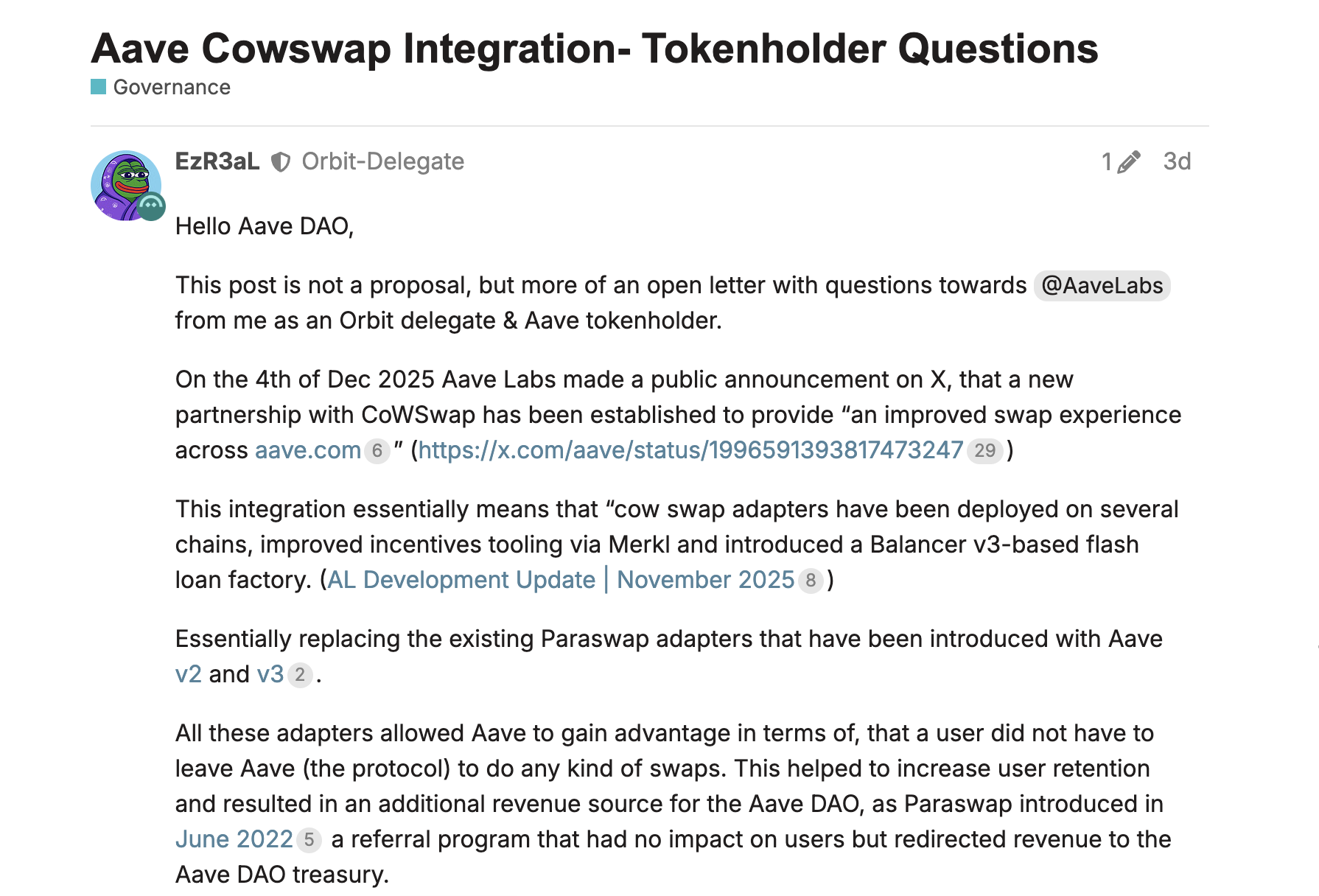
The governance forum post that sparked the debate. Source: Aave Governance

“Another entity, rather than the Aave DAO, is receiving at least $200,000 per week worth of Ether,” EzR3aL said, adding that this amounts to $10 million of potential annual revenue kept from the DAO.

Aave Labs responded that the front-end components for the website and application interfaces have always been the rightful purview of Aave Labs.

Related: Aave launches retail savings app with up to 9% APY to compete with banks

Protocol-level changes, like interest rate policies and approving changes to smart contract code, have always been subject to the DAO’s stewardship, Aave Labs said.

Aave Labs also claimed that it was the entity that funded the development of the “adapters,” the lines of code that allow swaps and other integrations to work.
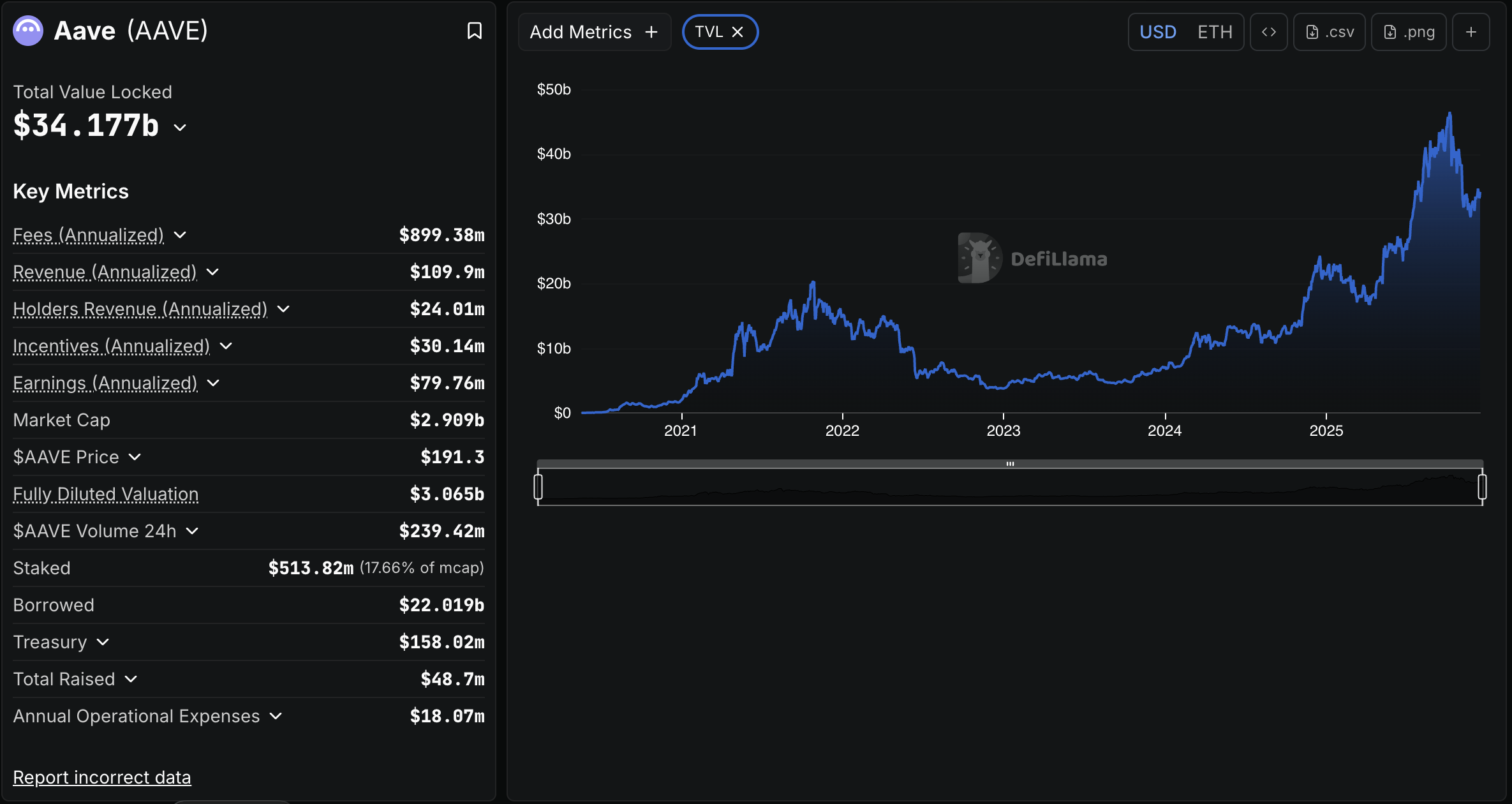
The total value locked in the Aave protocol and a financial overview of the DeFi platform. Source: DeFiLlama

However, the response did little to curb the tension, with several DAO members saying that the Aave DAO funded the development of the original adapter technology; therefore, the revenue from the integration should flow back to the DAO.

Marc Zeller, the founder of the Aave-Chan Initiative, a delegate platform serving the Aave governance community, said the decision to route the fees exclusively to Aave Labs is “extremely concerning.”

“Aave Labs, in the pursuit of their own monetization, redirected Aave user volume towards competition. This is unacceptable,” Zeller said.

Cointelegraph reached out to Aave Labs but did not obtain an immediate response by the time of publication.

The conflict highlights the complexities of running a DAO, which is a novel form of governance and organization that has benefits over traditional business structures but also brings its own unique challenges.

Magazine: The one thing these 6 global crypto hubs all have in common...

Crypto di tendenza

Letture associate

Li Fei-Fei's Latest Long-Form Article: When Video Generation, Robotics, and NVIDIA All Call Themselves World Models, We Need a Taxonomy

In a new article, Dr. Fei-Fei Li addresses the widespread and often inconsistent use of the term "world model" in AI. She proposes a clear, functional taxonomy rooted in the classic Partially Observable Markov Decision Process (POMDP) loop (agent → action → state → observation → agent). According to this framework, current systems called "world models" are different projections of this loop, categorized by their primary output: 1. **Renderers**: Output observations (pixels). Their goal is visual fidelity for human consumption (e.g., video generation models like Sora). They are the most commercially mature but are limited by a focus on appearance over physical accuracy. 2. **Simulators**: Output states (geometric, physical, dynamic representations). They provide a structurally accurate world for both human professionals (e.g., architects) and computational agents (e.g., robots for training). Li argues simulators are the crucial, underappreciated bridge, as they can underpin both rendering and planning. 3. **Planners**: Output actions. Given an observation and a goal, they decide what an agent should do next (e.g., robotic action models). This area is highly promising but remains the least mature for real-world deployment. Li highlights a key trend: the boundaries between these three categories are beginning to blur, as they all rely on a shared underlying understanding of geometry, physics, and dynamics. The logical endpoint is a unified world foundation model capable of switching between rendering, simulation, and planning based on downstream needs. This convergence, she concludes, is central to advancing spatial intelligence—enabling machines not just to talk about the world, but to truly understand, imagine, and interact with it.

marsbit1 h fa

Li Fei-Fei's Latest Long-Form Article: When Video Generation, Robotics, and NVIDIA All Call Themselves World Models, We Need a Taxonomy

marsbit1 h fa

Forbes Feature: Stablecoin Cross-Border Payments Are Faster, But Not Yet Cheaper

A Forbes feature delves into the state of stablecoin-based cross-border payments, noting rapid growth but a key shortfall: while faster and more accessible, they are not yet cheaper. At a recent industry conference in Mexico City, optimism about technology, regulation, and volume was tempered by discussions with practitioners. The core issue is liquidity. Traditional FX brokers charge 60-70 basis points, and stablecoins promise to slash this to 2-5 basis points. However, this theoretical cost advantage cannot be realized until deep liquidity pools are established at scale, requiring significant institutional capital inflow. A major adoption barrier is trust. Businesses often rely on long-standing relationships with traditional brokers, valuing reliability over marginal cost savings. This shift will be gradual. Furthermore, successful companies in the space are not positioning themselves as replacements for legacy systems like SWIFT, but as complements. They leverage stablecoins for speed while using traditional rails for their standardization and reliability in ensuring accurate payment details—a critical factor for supplier payments to avoid customs issues. Companies like Caliza, experiencing high monthly growth, exemplify this hybrid approach. The industry anticipates consolidation, as long-term viability will depend on securing the essential trifecta: proper licensing, robust fiat on/off-ramps, and deep liquidity. Without these, firms risk being mere intermediaries rather than building sustainable businesses.

marsbit1 h fa

Forbes Feature: Stablecoin Cross-Border Payments Are Faster, But Not Yet Cheaper

marsbit1 h fa

Li Feifei's Latest Article: When Video Generation, Robotics, and NVIDIA All Claim to Have 'World Models,' We Need a Taxonomy

"World Model" has become a widely used yet ambiguous term in AI. Drawing from the classic POMDP framework (agent → action → state → observation), this article proposes a functional taxonomy to clarify the concept. It identifies three distinct types, categorized by their output in the perception-action loop: 1. **Renderers**: Output visual observations (pixels). These models, like advanced video generators, prioritize visual fidelity but often lack underlying physical accuracy. 2. **Simulators**: Output the state of the world (geometry, physics, dynamics). They provide a structurally accurate representation for professionals (e.g., architects) and serve as training environments for robots and AI agents. 3. **Planners**: Output actions. Given an observation and a goal, they determine what an agent should do next, closing the perception-action loop (e.g., vision-language-action models). While renderers are currently the most commercially mature and planners are the most aspirational, the article argues that **simulators are the crucial, underappreciated hub**. By working at the level of geometry and physics, a simulator can project upwards to create visuals for humans and downwards to predict action consequences for agents. The future lies in the convergence of these three functions. Emerging research and products, like World Labs' Marble model which outputs both visual splats and physical collision meshes, are beginning to blur these boundaries. The logical endpoint is a unified world foundation model capable of rendering, simulating, and planning based on a shared understanding of spatial and temporal structures—ultimately enabling machines to understand, imagine, and interact with the physical world.

链捕手1 h fa

Li Feifei's Latest Article: When Video Generation, Robotics, and NVIDIA All Claim to Have 'World Models,' We Need a Taxonomy

链捕手1 h fa

Trading

Spot

Articoli Popolari

Come comprare AAVE

Benvenuto in HTX.com! Abbiamo reso l'acquisto di Aave Protocol (AAVE) semplice e conveniente. Segui la nostra guida passo passo per intraprendere il tuo viaggio nel mondo delle criptovalute.Step 1: Crea il tuo Account HTXUsa la tua email o numero di telefono per registrarti il tuo account gratuito su HTX. Vivi un'esperienza facile e sblocca tutte le funzionalità,Crea il mio accountStep 2: Vai in Acquista crypto e seleziona il tuo metodo di pagamentoCarta di credito/debito: utilizza la tua Visa o Mastercard per acquistare immediatamente Aave ProtocolAAVE.Bilancio: Usa i fondi dal bilancio del tuo account HTX per fare trading senza problemi.Terze parti: abbiamo aggiunto metodi di pagamento molto utilizzati come Google Pay e Apple Pay per maggiore comodità.P2P: Fai trading direttamente con altri utenti HTX.Over-the-Counter (OTC): Offriamo servizi su misura e tassi di cambio competitivi per i trader.Step 3: Conserva Aave Protocol (AAVE)Dopo aver acquistato Aave Protocol (AAVE), conserva nel tuo account HTX. In alternativa, puoi inviare tramite trasferimento blockchain o scambiare per altre criptovalute.Step 4: Scambia Aave Protocol (AAVE)Scambia facilmente Aave Protocol (AAVE) nel mercato spot di HTX. Accedi al tuo account, seleziona la tua coppia di trading, esegui le tue operazioni e monitora in tempo reale. Offriamo un'esperienza user-friendly sia per chi ha appena iniziato che per i trader più esperti.

335 Totale visualizzazioniPubblicato il 2024.12.11Aggiornato il 2026.06.02

Come comprare AAVE

Discussioni

Benvenuto nella Community HTX. Qui puoi rimanere informato sugli ultimi sviluppi della piattaforma e accedere ad approfondimenti esperti sul mercato. Le opinioni degli utenti sul prezzo di AAVE AAVE sono presentate come di seguito.

活动图片