Fintechs prediction market addons will cost them in churn: Inversion CEO

cointelegraphPubblicato 2025-12-22Pubblicato ultima volta 2025-12-22

Finance platforms racing to add prediction markets are doing so at the cost of accelerated “casino-like” user churn, says venture capital firm Inversion Capital founder and CEO, Santiago Roel Santos.

Santos argued in a blog post on Saturday that while he is a “believer in the underlying idea” of prediction markets, he thinks offering them in mainstream finance apps like Robinhood threatens future value capture by increasing the risk of user account liquidation.

“The problem with casino-like products isn’t that users lose money. It’s that casinos accelerate churn,” he said.

“The longer you exist inside a casino, the higher the probability of liquidation. And liquidation means you’re out of the game entirely. A churned user is worth zero.”

Robinhood has been ramping up its focus on prediction markets over 2025, and crypto companies Coinbase and Gemini are also soon set to offer similar products that allow users to bet on events like sports and politics.

Santos said such offerings put too much focus on an area that will ultimately impact the app’s main use case; offering easy to use financial services to retail clients.

“Products like Robinhood succeed initially because they are simpler, more accessible, and more digitally native than incumbents,” he said.

“But users age. Over time, the real opportunity is to grow with them and capture more of their financial lives, not to maximize extraction at the moment of peak speculation,” he added. “If durability matters, you optimize for staying power.”
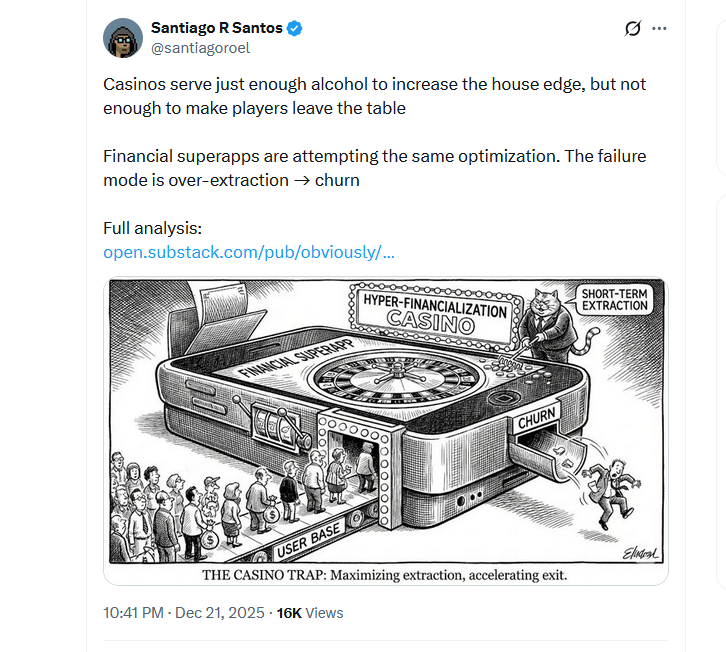
Source: Santiago Roel Santos

Blockchain-based prediction markets surged in adoption amid the US elections in 2024, with Robinhood initially jumping on the bandwagon back in March via a partnership with Kalshi.

Related: DraftKings eyes crypto offerings as it expands into prediction markets

Crypto exchange Coinbase announced on Wednesday that it was adding prediction markets as part of its “everything app” push in partnership with Kalshi, while an affiliate of Gemini won a US license to offer event contracts.

Santos ultimately thinks that while prediction markets will look good on the balance sheet in the short-term, they will later look much more fragile for financial apps as they will introduce a significant amount of risk that could destabilize users.

“Financial superapps that treat churn as a first-class risk will end up with stronger moats and better long-term outcomes,” he argued, adding:

“If I were in the seat, I’d prioritize products users naturally want as they mature financially: credit cards, insurance, savings vehicles. These are boring. The data suggests that’s precisely why they work. They are adjacent to the core relationship of managing household liquidity.”

Magazine: Bitcoin’s critical level is $82.5K, Ethereum ‘not done yet’: Trade Secrets

Letture associate

Gensyn AI: Don't Let AI Repeat the Mistakes of the Internet

In recent months, the rapid growth of the AI industry has attracted significant talent from the crypto sector. A persistent question among researchers intersecting both fields is whether blockchain can become a foundational part of AI infrastructure. While many previous AI and Crypto projects focused on application layers (like AI Agents, on-chain reasoning, data markets, and compute rentals), few achieved viable commercial models. Gensyn differentiates itself by targeting the most critical and expensive layer of AI: model training. Gensyn aims to organize globally distributed GPU resources into an open AI training network. Developers can submit training tasks, nodes provide computational power, and the network verifies results while distributing incentives. The core issue addressed is not decentralization for its own sake, but the increasing centralization of compute power among tech giants. In the era of large models, access to GPUs (like the H100) has become a decisive bottleneck, dictating the pace of AI development. Major AI companies are heavily dependent on large cloud providers for compute resources. Gensyn's approach is significant for several reasons: 1) It operates at the core infrastructure layer (model training), the most resource-intensive and technically demanding part of the AI value chain. 2) It proposes a more open, collaborative model for compute, potentially increasing resource utilization by dynamically pooling idle GPUs, similar to early cloud computing logic. 3) Its technical moat lies in solving complex challenges like verifying training results, ensuring node honesty, and maintaining reliability in a distributed environment—making it more of a deep-tech infrastructure company. 4) It targets a validated, high-growth market with genuine demand, rather than pursuing blockchain integration without purpose. Ultimately, the boundaries between Crypto and AI are blurring. AI requires global resource coordination, incentive mechanisms, and collaborative systems—areas where crypto-native solutions excel. Gensyn represents a step toward making advanced training capabilities more accessible and collaborative, moving beyond a niche controlled by a few giants. If successful, it could evolve into a fundamental piece of AI infrastructure, where the most enduring value in the AI era is often created.

marsbit6 h fa

Gensyn AI: Don't Let AI Repeat the Mistakes of the Internet

marsbit6 h fa

Why is China's AI Developing So Fast? The Answer Lies Inside the Labs

A US researcher's visit to China's top AI labs reveals distinct cultural and organizational factors driving China's rapid AI development. While talent, data, and compute are similar to the West, Chinese labs excel through a pragmatic, execution-focused culture: less emphasis on individual stardom and conceptual debate, and more on teamwork, engineering optimization, and mastering the full tech stack. A key advantage is the integration of young students and researchers who approach model-building with fresh perspectives and low ego, prioritizing collective progress over personal credit. This contrasts with the US culture of self-promotion and "star scientist" narratives. Chinese labs also exhibit a strong "build, don't buy" mentality, preferring to develop core capabilities—like data pipelines and environments—in-house rather than relying on external services. The ecosystem feels more collaborative than tribal, with mutual respect among labs. While government support exists, its scale is unclear, and technical decisions appear driven by labs, not state mandates. Chinese companies across sectors, from platforms to consumer tech, are building their own foundational models to control their tech destiny, reflecting a broader cultural drive for technological sovereignty. Demand for AI is emerging, with spending patterns potentially mirroring cloud infrastructure more than traditional SaaS. Despite challenges like a less mature data industry and GPU shortages, Chinese labs are propelled by vast talent, rapid iteration, and deep integration with the open-source community. The competition is evolving beyond a pure model race into a contest of organizational execution, developer ecosystems, and industrial pragmatism.

marsbit8 h fa

Why is China's AI Developing So Fast? The Answer Lies Inside the Labs

marsbit8 h fa

3 Years, 5 Times: The Rebirth of a Century-Old Glass Factory

Corning, a 175-year-old glass company, is experiencing a dramatic revival as a key player in AI infrastructure, driven by surging demand for high-performance optical fiber in data centers. AI data centers require vastly more fiber than traditional ones—5 to 10 times as much per rack—to handle high-speed data transmission between GPUs. This structural demand shift, coupled with supply constraints from the lengthy expansion cycle for fiber preforms, has created a significant supply-demand gap. Nvidia has invested in Corning, along with Lumentum and Coherent, in a $4.5 billion total commitment to secure the optical supply chain for AI. Corning's competitive edge lies in its expertise in producing ultra-low-loss, high-density, and bend-resistant specialty fiber, which is critical for 800G+ and future 1.6T data rates. Its deep involvement in co-packaged optics (CPO) with partners like Nvidia further solidifies its position. While not the largest fiber manufacturer globally, Corning's revenue from enterprise/data center clients now exceeds 40% of its optical communications sales, and it has secured multi-year supply agreements with major hyperscalers including Meta and Nvidia. Financially, Corning's optical communications revenue has surged, doubling from $1.3 billion in 2023 to over $3 billion in 2025. Its stock price has risen nearly 6-fold since late 2023. Key future catalysts include the rollout of Nvidia's CPO products and the scale of undisclosed customer agreements. However, risks include high current valuations and potential disruption from next-generation technologies like hollow-core fiber. The company's long-term bet on light over electricity, maintained even through the telecom bubble crash, is now being validated by the AI boom.

marsbit8 h fa

3 Years, 5 Times: The Rebirth of a Century-Old Glass Factory

marsbit8 h fa

Trading

Spot
Futures

Articoli Popolari

Come comprare CC

Benvenuto in HTX.com! Abbiamo reso l'acquisto di CC(Canton) (CC) semplice e conveniente. Segui la nostra guida passo passo per intraprendere il tuo viaggio nel mondo delle criptovalute.Step 1: Crea il tuo Account HTXUsa la tua email o numero di telefono per registrarti il tuo account gratuito su HTX. Vivi un'esperienza facile e sblocca tutte le funzionalità,Crea il mio accountStep 2: Vai in Acquista crypto e seleziona il tuo metodo di pagamentoCarta di credito/debito: utilizza la tua Visa o Mastercard per acquistare immediatamente CC(Canton)CC.Bilancio: Usa i fondi dal bilancio del tuo account HTX per fare trading senza problemi.Terze parti: abbiamo aggiunto metodi di pagamento molto utilizzati come Google Pay e Apple Pay per maggiore comodità.P2P: Fai trading direttamente con altri utenti HTX.Over-the-Counter (OTC): Offriamo servizi su misura e tassi di cambio competitivi per i trader.Step 3: Conserva CC(Canton) (CC)Dopo aver acquistato CC(Canton) (CC), conserva nel tuo account HTX. In alternativa, puoi inviare tramite trasferimento blockchain o scambiare per altre criptovalute.Step 4: Scambia CC(Canton) (CC)Scambia facilmente CC(Canton) (CC) nel mercato spot di HTX. Accedi al tuo account, seleziona la tua coppia di trading, esegui le tue operazioni e monitora in tempo reale. Offriamo un'esperienza user-friendly sia per chi ha appena iniziato che per i trader più esperti.

273 Totale visualizzazioniPubblicato il 2026.04.21Aggiornato il 2026.04.21

Come comprare CC

Come comprare BLEND

Benvenuto in HTX.com! Abbiamo reso l'acquisto di Fluent (BLEND) semplice e conveniente. Segui la nostra guida passo passo per intraprendere il tuo viaggio nel mondo delle criptovalute.Step 1: Crea il tuo Account HTXUsa la tua email o numero di telefono per registrarti il tuo account gratuito su HTX. Vivi un'esperienza facile e sblocca tutte le funzionalità,Crea il mio accountStep 2: Vai in Acquista crypto e seleziona il tuo metodo di pagamentoCarta di credito/debito: utilizza la tua Visa o Mastercard per acquistare immediatamente FluentBLEND.Bilancio: Usa i fondi dal bilancio del tuo account HTX per fare trading senza problemi.Terze parti: abbiamo aggiunto metodi di pagamento molto utilizzati come Google Pay e Apple Pay per maggiore comodità.P2P: Fai trading direttamente con altri utenti HTX.Over-the-Counter (OTC): Offriamo servizi su misura e tassi di cambio competitivi per i trader.Step 3: Conserva Fluent (BLEND)Dopo aver acquistato Fluent (BLEND), conserva nel tuo account HTX. In alternativa, puoi inviare tramite trasferimento blockchain o scambiare per altre criptovalute.Step 4: Scambia Fluent (BLEND)Scambia facilmente Fluent (BLEND) nel mercato spot di HTX. Accedi al tuo account, seleziona la tua coppia di trading, esegui le tue operazioni e monitora in tempo reale. Offriamo un'esperienza user-friendly sia per chi ha appena iniziato che per i trader più esperti.

184 Totale visualizzazioniPubblicato il 2026.04.24Aggiornato il 2026.04.24

Come comprare BLEND

Come comprare ACN

Benvenuto in HTX.com! Abbiamo reso l'acquisto di AITECH CLOUD NETWORK (ACN) semplice e conveniente. Segui la nostra guida passo passo per intraprendere il tuo viaggio nel mondo delle criptovalute.Step 1: Crea il tuo Account HTXUsa la tua email o numero di telefono per registrarti il tuo account gratuito su HTX. Vivi un'esperienza facile e sblocca tutte le funzionalità,Crea il mio accountStep 2: Vai in Acquista crypto e seleziona il tuo metodo di pagamentoCarta di credito/debito: utilizza la tua Visa o Mastercard per acquistare immediatamente AITECH CLOUD NETWORKACN.Bilancio: Usa i fondi dal bilancio del tuo account HTX per fare trading senza problemi.Terze parti: abbiamo aggiunto metodi di pagamento molto utilizzati come Google Pay e Apple Pay per maggiore comodità.P2P: Fai trading direttamente con altri utenti HTX.Over-the-Counter (OTC): Offriamo servizi su misura e tassi di cambio competitivi per i trader.Step 3: Conserva AITECH CLOUD NETWORK (ACN)Dopo aver acquistato AITECH CLOUD NETWORK (ACN), conserva nel tuo account HTX. In alternativa, puoi inviare tramite trasferimento blockchain o scambiare per altre criptovalute.Step 4: Scambia AITECH CLOUD NETWORK (ACN)Scambia facilmente AITECH CLOUD NETWORK (ACN) nel mercato spot di HTX. Accedi al tuo account, seleziona la tua coppia di trading, esegui le tue operazioni e monitora in tempo reale. Offriamo un'esperienza user-friendly sia per chi ha appena iniziato che per i trader più esperti.

95 Totale visualizzazioniPubblicato il 2026.04.28Aggiornato il 2026.04.28

Come comprare ACN

Discussioni

Benvenuto nella Community HTX. Qui puoi rimanere informato sugli ultimi sviluppi della piattaforma e accedere ad approfondimenti esperti sul mercato. Le opinioni degli utenti sul prezzo di A A sono presentate come di seguito.

活动图片














