Finance Needs Speed and Brakes

marsbitPubblicato 2026-03-26Pubblicato ultima volta 2026-03-26

Introduzione

Financial systems require both speed and safeguards. Just as a car's persistent seatbelt alarm saves lives, or a banking payment confirmation step prevents costly errors, strategic "brakes" are essential in finance. While the industry often prioritizes frictionless transactions, history shows that unchecked speed leads to catastrophic failures—like the 1987 Black Monday crash or Knight Capital's $440 million loss in 45 minutes. The recent Aave-CoW incident in crypto, where a user lost millions due to a poorly executed trade, underscores this need. Decentralized finance must integrate intelligent safeguards—pre-trade simulations, liquidity checks, and transaction splitting—to prevent irreversible errors. Trust in financial systems isn’t built through seamless speed alone but through well-timed interventions that protect users. As emerging infrastructures like blockchain evolve, embedding these brakes will be crucial to achieving both safety and scalability.

Written by: Prathik Desai

Compiled by: Block unicorn

Small annoyances can sometimes save lives.

Think about that incessant beep in your car that reminds you to fasten your seatbelt. This constant reminder is annoying, and many people have complained about it. But it is this persistent beep that has prompted countless people to buckle up. The result? According to the Insurance Institute for Highway Safety (IIHS) in the United States, these constant reminders save approximately 1,500 lives each year in the U.S. alone. A true lifesaver.

Small irritations can also save you a lot of money.

One of the annoying aspects of modern banking is when you think you've completed a wire transfer, only to be interrupted. You've entered the account number, routing number, and recipient's name. Instead of processing the transfer immediately, the bank pauses to confirm whether the recipient's name matches the account information. This adds an extra click, disrupting the flow. In product team terms, this is considered friction. However, this pause has become one of the most effective security measures for payments globally.

The "Confirmation of Payee" service provided by Pay.UK enables individuals and institutions in the UK to make transfers, currently covering over 99% of transactions across various payment channels. The volume of checks has grown from 14,000 per month in June 2020 to over 70 million per month by July 2025. It has reduced "incorrect account" transactions by 59% and decreased end-user financial losses by 20% to 40%.

This is crucial at a time when the financial industry has been striving for over a decade to make transactions seamless. We've seen efforts like "one-tap," "one-swipe," and "click-to-trade," all attempting to make funds flow silently in the background. The industry's instinct is often to view every pause as a flaw. As finance evolves, it has become increasingly obsessed with seamlessness. But this evolution has repeatedly reminded us that certain so-called "frictions" are actually necessary brakes that prevent the system from collapsing.

Traditional Finance's Need for Brakes

Today, the financial industry has embedded these safeguards into every new piece of infrastructure it builds.

In the United States, broker-dealers with market access must implement risk controls to limit their financial exposure and ensure regulatory compliance. When the Securities and Exchange Commission (SEC) adopted Rule 15c3-5, it stated that the rule was designed to address the risks posed by automated high-speed trading and to prevent unfettered access to exchanges.

The reason the industry repeatedly relearns this lesson is simple: when brakes fail, the damage often exceeds what institutions can bear and recover from.

In 1987, on Black Monday, the Dow Jones Industrial Average plummeted 22% in a single day. The Brady Commission recommended adding a pause button in the form of "circuit breakers," which mandate a 15-minute trading halt when market declines reach a certain percentage. Without these limits, Black Monday alone wiped out $1.7 trillion in global market capitalization. Adjusted for inflation, that loss is equivalent to over $4.7 trillion today, surpassing the current GDP of Germany, the world's third-largest economy.

These brakes taught the financial world that sometimes the only way to maintain speed is to briefly stop the machine. In other cases, a brief pause is all it takes.

In August 2012, Knight Capital Group experienced a software glitch that caused its computers to buy and sell millions of shares of stock in just 45 minutes. The malfunction caused $440 million in losses in less than an hour, pushing the market maker to the brink of bankruptcy. Knight Capital had optimized its system for speed, which is crucial in market trading. But an uncontrolled system without brakes, even the fastest one, can collapse in an instant. The lesson? The faster the system, the more important the braking mechanisms.

Retail finance itself has faced its share of issues.

For years, brokers have worked to make high-risk products easy to use to drive retail user growth. They persevered, only to lose trust. In the 2021 disciplinary action against Robinhood, FINRA noted that the company failed to conduct due diligence before approving customers for options trading and relied heavily on unregulated automated "approval bots." The non-profit self-regulatory organization responsible for investor protection claimed that Robinhood's system approved customers based on inconsistent or illogical information. FINRA stated that the company's system allowed applicants whose risk profiles were clearly questionable to gain approval.

Robinhood's system was optimized to process applications quickly, avoiding potential customer wait times. But what it lacked was a meaningful pause between curiosity and security. Speed, but no brakes.

The Curious Case of Cryptocurrency

The recent Aave-CoW incident in the cryptocurrency space has elevated the need for brakes in finance to a whole new level.

On March 12, 2025, a user executed a $50 million swap through CoW Swap, a decentralized exchange (DEX) aggregator designed to protect users from bot front-running. The transaction was integrated into the front end of the DeFi protocol Aave. Due to insufficient liquidity, the user ended up receiving tokens worth only $36,930, while paying $50 million.
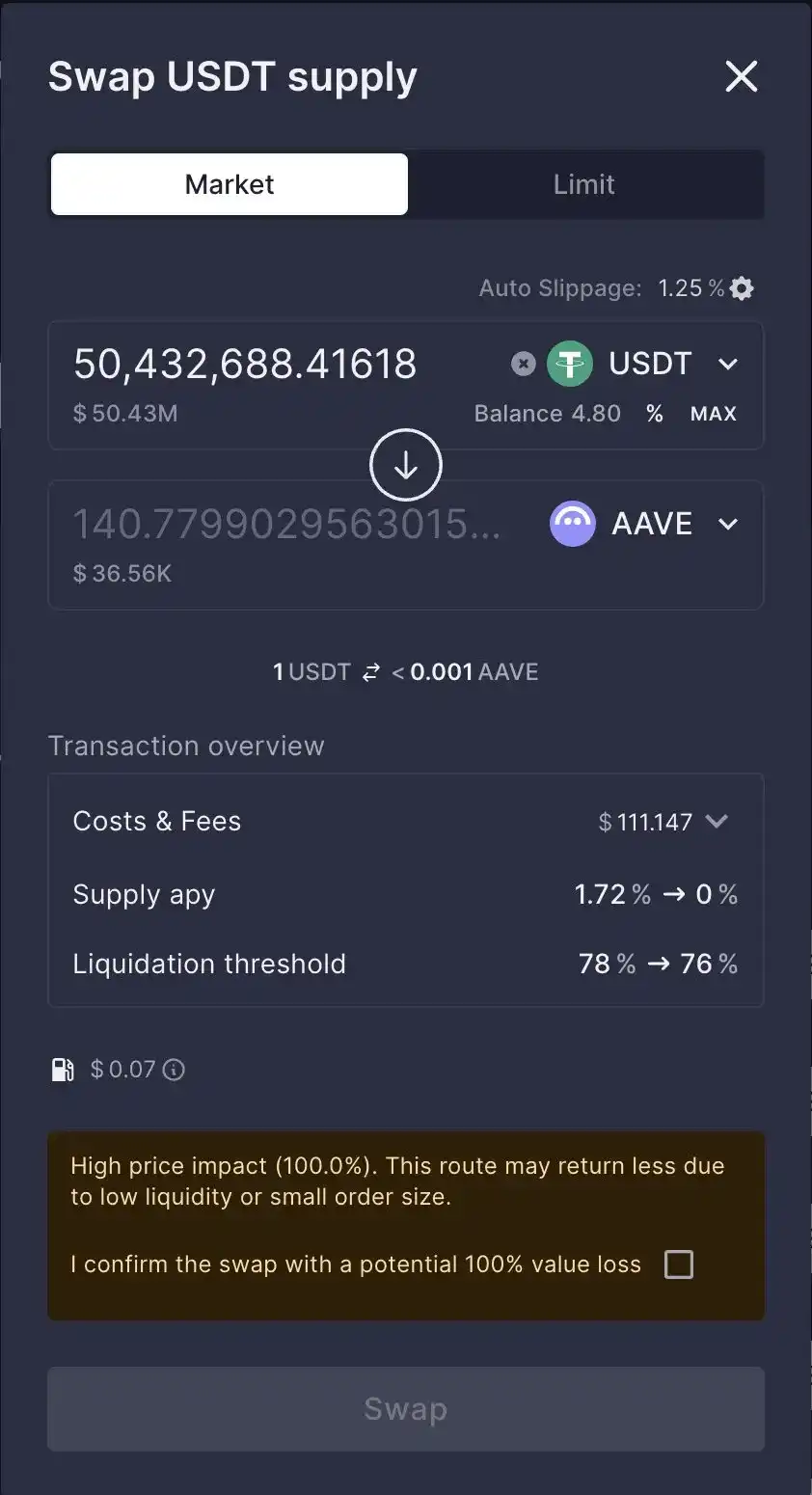
Although Aave explained in its post-mortem that the user ignored explicit high-price impact warnings, its founder and CEO Stani Kulechov posted on X that the Aave team "will look into how to improve these safeguards."

Jargon aside, the takeaway is clear: a fast interface allowed a catastrophic trade to proceed too far before the system could react. While one might question the user's judgment and disregard for warnings, treating this as an isolated incident is both convenient and counterproductive for the development of new financial infrastructures like blockchain.

If cryptocurrency wants to avoid repeating past mistakes, the solution lies in building smarter execution layers. Some decentralized finance (DeFi) trading protocols are already moving in this direction.

For example, Definitive.Fi argues that large on-chain transactions should not simply be processed along the technically possible path. They should be simulated before submission, tested against actual market conditions, split into smaller lots if necessary, and routed through broader liquidity pools. Thus, a good trading system should not only check if it *can* execute the trade but also determine the *best* path to fulfill the order.

For any emerging infrastructure, trust and additional security are not optional features, especially in finance. A product that makes trading, lending, or transferring funds easy and convenient can help it grow rapidly, but when it fails, the consequences are severe. We've seen this pattern in all the traditional finance cases above. Systems try to minimize visible points of friction—even when those frictions are necessary limits—mask their complexity, and hope that a smooth operation will win more consumer trust.

But confidence in finance is rarely built this way. It often comes from financial institutions identifying critical moments that require intervention and taking some unpleasant but necessary steps to stop the action. This is the case with Pay.UK's Confirmation of Payee. While repeatedly being asked to confirm a bank account name is certainly not a pleasant experience, it does stop the action at a point where a mistake could be costly and irreversible.

Aave's Stani understands this well. That's why he acknowledged that customers aren't always clear about the order flow, who they are paying, or if there's a better channel for the trade. This understanding is especially important in emerging industries like cryptocurrency and blockchain, where few users understand the technical flow of a transaction and the consequences of each click. In such contexts, acknowledging pain points and taking steps to address them is crucial for building consumer trust.

The tricky part is that the line between a braking mechanism and random inconvenience or friction is thin. Good brakes don't slow things down completely; they apply slight resistance with precise timing. In the case of the Aave-CoW incident, we can imagine a good brake as a kind of economic sanity check. It allows the system to scan more trading venues before routing, prevents order intent from falling into the wrong hands, simulates outcomes before execution, and splits large trades to avoid users being penalized for their size. These mechanisms are key to ensuring financial infrastructure is trustworthy.

This distinction is important because genuine pain points still exist in finance. For example, cumbersome and useless paperwork, inefficient compliance processes that slow everything down, hidden fees disguised as part of the process, and intimidating,繁琐 registration processes that scare away new users.

None of these should be defended. Installing "brakes" is not about defending uglier products or adding more pop-ups; it's about designing a pause when a user is about to make an irreversible decision based on incomplete information. This is especially true when customers are handling large orders in illiquid markets, selling high-risk products, exploring new payment methods, and performing one-click actions where the risk is immediate and speed is not the primary consideration.

There are business implications here too.

The finance industry often talks about building safeguards *after* achieving product-market fit. This gets it backwards. In finance, safeguards are an integral part of product-market fit. When implemented well, safeguards aren't even hindrances. The Pay.UK case further confirms that "Confirmation of Payee" is not just an optional anti-fraud feature but has become a "utility service that customers expect to see" when using the system to transact.

Emerging financial infrastructures, such as blockchain, aim to earn trust and withstand errors, scandals, and market pressures just like traditional finance. But this is not easy. It must think more proactively about how to earn trust *before* winning users, because trust will naturally bring users. The reverse is not necessarily true.

If blockchain can adopt strategic braking measures, its speed will surpass that of any other financial infrastructure.


Domande pertinenti

QWhat is the main argument of the article 'Finance Needs Speed and Brakes'?

AThe main argument is that while the financial industry has long pursued frictionless, high-speed transactions, certain types of 'brakes' or intentional frictions are essential safety mechanisms that prevent catastrophic errors, build trust, and are a necessary part of a robust financial infrastructure.

QWhat example from traditional banking is given to illustrate a beneficial 'brake'?

AThe article cites Pay.UK's 'Confirmation of Payee' service, which introduces a pause to verify a recipient's name before a wire transfer is completed. This friction has significantly reduced mistaken payments and user financial losses.

QWhat historical market event is mentioned to demonstrate the catastrophic cost of lacking 'brakes'?

AThe 1987 Black Monday crash is mentioned, where the Dow Jones fell 22% in a single day, erasing $1.7 trillion in global market value. This led to the implementation of 'circuit breakers' as a necessary pause mechanism.

QHow does the Aave-CoW Swap incident relate to the article's core theme?

AThe Aave-CoW incident, where a user lost millions due to a poorly executed large swap, exemplifies the danger of a high-speed DeFi system without adequate 'brakes,' such as pre-trade simulations or liquidity checks, to prevent such catastrophic user errors.

QAccording to the article, what is the key difference between a good 'brake' and a bad friction point in finance?

AA good brake is a precisely timed intervention that creates a meaningful pause to prevent an irreversible, bad decision based on incomplete information (e.g., large trades, high-risk products). Bad friction is pointless inefficiency that adds no value, like cumbersome paperwork or hidden fees that slow down processes without enhancing safety.

Letture associate

Must-Watch Events Next Week|CLARITY Act Could Face Senate Vote; SpaceX, Circle to Report Earnings (8.3-8.9)

**Summary: Key Events and Developments to Watch (August 3-9)** The upcoming week is marked by significant financial disclosures, key legislative deadlines, and notable product updates. **Major Financial Events:** Several companies are scheduled to release their Q2 2026 earnings. American Bitcoin (ABTC) will report on August 3, followed by SpaceX and Hut 8 Mining Corp. on August 4, and Circle on August 5. Notably, a significant portion of SpaceX shares (up to 12% of total shares) will be unlocked on August 6 following their earnings release. **Key Legislative Deadline:** The U.S. Senate faces an August 7 deadline to secure 60 votes for the CLARITY Act, a bipartisan bill aiming to establish a federal regulatory framework for cryptocurrencies. The Senate may hold a full vote on the bill during the week. **Economic Data:** The U.S. July Non-Farm Payrolls report will be released on August 7, providing crucial labor market data. **Technology & Product Updates:** * **Shutdowns:** DeFi portfolio tracker Zapper and wallet app Ctrl Wallet will cease operations on August 3. * **Upgrades:** LayerZero will deprecate its v1 relayers on August 3. XRP Ledger's new version 3.3.0, featuring five new functions, is expected next week. * **AI:** Elon Musk announced that the advanced Grok 4.6 AI model is set for release around August 7. * **Bitcoin:** The BIP-110 forced signaling for a potential Bitcoin network change is scheduled to begin around August 8. **Other Notable Events:** Chinese robotics firm Unitree Tech has set its preliminary price inquiry for its IPO for August 5. South Korean exchange Upbit will delist AQT and AERGO tokens on August 3.

marsbit41 min fa

Must-Watch Events Next Week|CLARITY Act Could Face Senate Vote; SpaceX, Circle to Report Earnings (8.3-8.9)

marsbit41 min fa

Stocks Are Plummeting More Sharply Than Cryptocurrencies. Where Has the Money Gone?

Stock Markets Plunge Deeper Than Cryptocurrencies: Where Did the Money Go? In late July, Seoul's Kospi index triggered circuit breakers for two consecutive days, plummeting over 40% from its June high. The collapse was led by heavyweight stocks like SK Hynix, whose record profits still disappointed investors, and devastating leveraged ETFs, with one major product losing over 83% of its value. This signaled a global, forced deleveraging targeting the most crowded trades. Interestingly, while stocks exhibited extreme volatility akin to crypto markets, Bitcoin rose nearly 15% in July after a prior steep drop. Analysis shows the money fleeing equities did not flow into Bitcoin. Instead, Bitcoin had already absorbed its sell-off in May-June, when U.S. spot Bitcoin ETFs saw historic outflows. The true safe-haven beneficiary was gold, whose price rose over 20% year-on-year, highlighting a decoupling between Bitcoin and gold as "digital gold." The sell-off was a targeted unwinding of leveraged positions in tech and semiconductors, accelerated by broker-dealer risk management and shifts in the AI narrative, including new competition from Chinese memory chipmakers. The retreat path was clear: from high-valuation tech stocks to cash and U.S. Treasuries, then to gold. For Bitcoin to attract sustained institutional inflows, conditions like eased global liquidity pressure, a "soft-landing" Fed rate cut, and U.S. regulatory clarity via legislation like the stalled CLARITY Act are needed. Currently, Bitcoin is not a safe haven but an already-cleared asset. Its low correlation with tech stocks, however, makes it a potential diversification play for institutional portfolios once the storm passes. The money isn't here yet, but the positioning is underway.

marsbit41 min fa

Stocks Are Plummeting More Sharply Than Cryptocurrencies. Where Has the Money Gone?

marsbit41 min fa

In Conversation with Ray Dalio: We Are Currently in an AI Bubble, with 1% of My Portfolio in Bitcoin

Ray Dalio, founder of Bridgewater Associates, warns in an interview that the current AI boom shows classic bubble characteristics, which could lead to significant economic downturns as seen in past cycles like 1929 or 2000. He explains that speculative enthusiasm, fueled by debt and overvaluation, often precedes a crash when rising rates or taxation force asset sales, causing widespread losses and recession. Dalio also outlines his "Big Cycle" theory, describing an approximate 80-year pattern where widening wealth gaps, massive government deficits, and shifting geopolitical power (like China's rise) create internal conflict and global instability. He emphasizes that we are in a late-cycle, transitional phase where traditional powers like the US and UK face decline. For personal wealth protection, Dalio advises diversification beyond cash into assets like stocks, bonds, real estate, and particularly gold, which he prefers over Bitcoin. While he holds about 1% of his portfolio in Bitcoin as a non-printable hard asset, he views gold as more secure from technological or governmental threats. Regarding AI's impact, Dalio believes it will disproportionately benefit capital owners, worsening inequality by replacing both physical and cognitive labor. He suggests that human intuition and emotional intelligence, combined with AI, will be key for future workers. On taxation, Dalio argues that wealth taxes are impractical and risk triggering asset sell-offs, reducing productive investment. He points to the UK as a cautionary example of debt, low productivity, and political strife. Geopolitically, Dalio foresees a more regionalized world, with the US showing weakness in prolonged conflicts like with Iran, akin to past imperial declines. The ideal outcome, he suggests, is coexisting powerful blocs (e.g., Americas, China-Asia Pacific) without major war.

marsbit4 h fa

In Conversation with Ray Dalio: We Are Currently in an AI Bubble, with 1% of My Portfolio in Bitcoin

marsbit4 h fa

Daily 7.2 Trillion KRW: Foreign Capital's Record Net Buying on Friday! Wall Street Says Headwinds for Korean Stock Fund Flows Have Subsided

South Korean stock market sees a dramatic shift in fund flows. On July 31, foreign investors made a record net purchase of approximately KRW 7.2 trillion in KOSPI stocks, marking a fundamental reversal from the persistent large-scale net outflows seen in previous months. This contributed to a significant narrowing of foreign net selling in July to KRW 9.8 trillion, down sharply from KRW 48.4 trillion in June and KRW 44.5 trillion in May. Simultaneously, domestic institutional pressure eased. South Korean pension funds and asset managers turned to a net buying position in July, purchasing KRW 1.0 trillion worth of KOSPI shares, contrasting with net sales in May and June. Market volatility is expected to be dampened by new financial regulations. Effective July 31, the Financial Services Commission tightened access for retail investors to single-stock leveraged ETFs by raising the minimum cash deposit requirement. Trading volumes for these products subsequently dropped to about 50% of their monthly average. Citigroup Research maintains its year-end KOSPI target of 10,000 points. The firm cites several supportive factors: the substantial easing of headwinds from capital outflows, a robust fundamental outlook for the semiconductor sector, historically low market valuations, strong economic fundamentals, and the potential for policy support from financial authorities if needed.

marsbit4 h fa

Daily 7.2 Trillion KRW: Foreign Capital's Record Net Buying on Friday! Wall Street Says Headwinds for Korean Stock Fund Flows Have Subsided

marsbit4 h fa

Trading

Spot
活动图片




