Fei-Fei Li's Manifesto for World Models

marsbitPubblicato 2026-06-09Pubblicato ultima volta 2026-06-09

Introduzione

"Feifei Li's World Model Manifesto" draws a crucial distinction between current AI's linguistic prowess and its lack of understanding of the physical world. Citing Wittgenstein, Li argues that true intelligence requires moving beyond text statistics to comprehend physical laws like optics, inertia, and collision. The article diagnoses the current confusion around "world models" and proposes a clear taxonomy based on the Partially Observable Markov Decision Process (POMDP) framework. Li identifies three core, interdependent pillars for building such models: 1) The **Renderer**, which masters visual plausibility and pixel generation (e.g., Sora, image models) but lacks structural integrity. 2) The **Simulator**, which prioritizes strict adherence to physical laws (mass, friction, collision) and is essential for robotics and real-world application, though it is computationally demanding and data-hungry. 3) The **Planner**, which connects perception to action, enabling decision-making in complex, unstructured environments. Li posits the **Simulator as the critical nexus** linking rendering and planning, highlighting NVIDIA's Omniverse as a leading example. Mastering physical simulation is key to industrial AI applications. Despite challenges like scarce annotated 3D data and "physics-unrealistic" generative outputs, a convergent trend is emerging. The future lies in a **unified foundational model** that seamlessly integrates rendering, simulation, and planning into a dynamic, i...

"The world is everything that is the case."

In 1921, Ludwig Wittgenstein wrote this famous sentence in *Tractatus Logico-Philosophicus*. A century later, it is quoted by AI pioneer Fei-Fei Li as the opening of her latest technical blog post.

In the landscape of deep learning, people have become accustomed over the past three years to AI's disruptive impact on language, starting with ChatGPT which endowed machines with expression, programming, and reasoning abilities far surpassing humans.

However, behind this digital miracle lies a blind spot that is often overlooked: machines can talk about the world, yet remain ignorant of its physical essence. The blog post released by Fei-Fei Li serves as a sobering reality check.

Today, as generative AI has become an indispensable tool globally, the industry's internal definition of "world models" is becoming increasingly chaotic. Whether in video generation or embodied intelligence, various companies are vying for the interpretive authority of this concept.

After Fei-Fei Li published this blog post, many believed she was attempting to reclaim the definition of "world models." But on the contrary, I think what Fei-Fei Li truly aims to do is to issue a declaration: The world is not constituted by language, but by the rigorous laws of physical space and time.

For machines to truly step into the human physical world, they must break free from the comfort zone of text statistics and instead understand the refraction of light, the inertia of objects, and the logic of collisions. This is not only a paradigm shift in technology but also a necessary path for AI's advancement toward embodied intelligence.

01

We Need a Taxonomy

It must be admitted that in the AI lexicon, "world model" has devolved into a catch-all pronoun; any project involving image generation or environment simulation seems capable of being linked to it. This ambiguity stems precisely from the multi-dimensional human need to define the "world."

When a technology is just starting out, there naturally won't be unified doctrines to confine it within clear boundaries. This chaos in defining "world models" is not uncommon in history. When ancient Greek philosophers debated whether the essence of the world was water, fire, or indivisible atoms, they were essentially searching for a cornerstone for their reasoning.

The AI field now faces a similar problem: When a video generation model produces visuals that are extremely realistic yet physically impossible, how should we define it? Fei-Fei Li's blog mentions an ancient and robust foundational definition: the Partially Observable Markov Decision Process (POMDP).

This is also the core axiom of reinforcement learning mechanisms, revealing the eternal closed loop of interaction between an agent and the physical world: The agent takes an Action, leading to a change in the world's State. However, the agent lacks a god's-eye view and can only construct a partial perception of reality through Observation.

Essentially, a world model is the abstract model of the world that a machine builds in its "brain" to survive within this closed loop. If any part of this loop is not clearly defined, then the so-called world model remains merely a blind stacking of pixels.

02

The Three Pillars of Building Intelligence

This loop sounds simple, with each component's function easily understood. However, upon careful analysis, each contains countless details with blurred definitions. To explain the chaos within, Fei-Fei Li deconstructs world models into three core components. They serve both as a technical taxonomy and as the three pillars for AI's journey toward embodied intelligence.

1. Renderer

The core logic of the renderer is visual plausibility. Its output is pixels, striving to make the imagery appear natural, coherent, and aesthetically pleasing to the human eye.

This is currently the most mature field commercially. Models we are familiar with, such as OpenAI's Sora and ByteDance's Seedance 2.0 for video generation, and OpenAI's GPT-image-2 and Google's Nano Banana 2 for image generation, are essentially the most sophisticated visual probability machines available. By learning from billions of internet images and videos, they have ultimately mastered the distribution patterns of light, shadow, and form.

This seemingly beautiful reality comes at a cost, as Fei-Fei Li points out. While these top models can generate magnificent architecture, attempting to interact within their generated physical structures would likely cause the building to collapse instantly due to a lack of support structure. In other words, they don't understand what "support" is; they generate only what the viewer "sees," not what the world "is."

2. Simulator

What the simulator pursues is precisely the structural fidelity that the renderer lacks. It doesn't care at all whether a video looks good; its sole concern is whether the world follows physical laws. When a simulator outputs a mundane cup, it must include the cup's mass distribution, material friction coefficient, gravity response, and physical boundaries during collisions.

With a simulator, the content in videos gains a claim to realism. However, simulators are not only severely underestimated but often outright ignored in the current AI wave.

From the case of the cup above, the existence of a simulator transforms "discussing art" into "studying physics." Constructing a simulator that strictly adheres to physical laws requires unimaginable computational resources and annotation costs. But for robots, visual aesthetics are almost a useless attribute; physical precision determines everything.

If a simulator isn't accurate enough, robots trained within it can never enter the real world. The Sim-to-Real challenge is objectively real. Test actions that pass 100% in the lab can be completely paralyzed by minute friction in the real world—this is what we often call the "Moravec's paradox."

3. Planner

The planner is responsible for action output. As the connection point between perception and feedback, it needs to solve the core question with no standard answer: "What should be done next?" In Fei-Fei Li's framework, this is also the final component of the entire "perception-action" closed loop and simultaneously the most frontier-challenging domain.

All current Vision-Language-Action (VLA) models are attempting to enable systems to make decisions in unstructured, complex worlds. The planner doesn't merely predict the future; it chooses, from countless possibilities, the path most likely to achieve the goal. It is the key for machines to evolve from "observers" into "practitioners."

03

The Hundred-Billion-Dollar Hub

Among the three categories Fei-Fei Li outlines, models corresponding to the renderer and planner are relatively common; the remaining simulator has logically become the most difficult component to realize. Fei-Fei Li also offers an insightful judgment: The simulator is the link connecting rendering and planning, and the core hub of the entire system.

The company performing most excellently in the field of simulators is not OpenAI, Anthropic, or Google, but Jensen Huang's NVIDIA.

NVIDIA's Omniverse claims to support trillion-dollar digital twin dreams precisely because it grasps the essence of the simulator. On NVIDIA's platform, the operations of factories, supply chains, and warehouses have all become complete digital mirrors. For the industrial world, this is no longer a visual demo but a core infrastructure for productivity.

This is not an exaggeration but a trillion-dollar market opportunity visible to all.

From virtual visualization in architectural engineering to molecular dynamics simulations in the pharmaceutical industry, and scenario testing for autonomous driving. What these industries lack is not vivid image or video generation models, but a high-fidelity simulator. It's no exaggeration to say that mastering the ability to simulate the physical world equates to holding a priority ticket for AI industrialization.

But the difficulties in reality leave this field with almost no technological optimists. Fei-Fei Li also admits that a huge gap persists.

First is the issue of embodied intelligence data, which we have repeatedly mentioned before. Video data on the internet is abundant, but 3D data with explicit geometric structure, material properties, and physical feedback annotations is extremely scarce.

Second, the application of generative AI will always be accompanied by hidden risks. AI-generated geometric models can at best achieve visual perfection but are often physically unreasonable—like cups intersecting with tabletops, or objects colliding and losing volume. In human terms, the brief phrase "clipping through" can summarize these bizarre phenomena, but in real industrial applications, this spells disaster.

04

Toward a Unified World Model

Despite the immense difficulties, Fei-Fei Li offers a positive prediction of industry trends: The boundaries between rendering, simulation, and planning are becoming increasingly blurred.

This is not a distant vision but a reality already unfolding. After exploration, Fei-Fei Li's World Labs team believes humanity is already moving towards a unified foundation model. In this architecture, imagination and logic can merge into one.

The models of the future will no longer be a patchwork of single-function add-ons, but a unified neural network foundation. It can simultaneously render realistic scenes via Gaussian splatting and generate the collision meshes required by physics engines in real time. Simply put, a unified foundation model will achieve seamless switching between the visual patterns humans need and the state patterns physics engines require.

From another perspective, traditional models are static, while future world models will possess stronger interactivity. Renderers will no longer be passive video generators but will gradually begin to accept action instructions; simulators will become more editable and controllable; planners will also be capable of logical reasoning, automatically adjusting strategies based on environmental changes.

05

The Long Arc of Spatial Intelligence

Finally, returning to the macro level, why is all this about "world models" important?

In Fei-Fei Li's view, decades of AI research have been searching for that key to allow machines to enter the physical world. Today, we already possess language models adept at handling logic; what we need next are models that handle space. The core of spatial intelligence lies in how machines interact with the physical world they inhabit.

This battle is not about who possesses more computing power, but about who can define the digital standard for the physical world.

World models are by no means a simple algorithmic optimization, but a grand feat of AI evolution.

"Language gives machines the ability to talk about this world, while world models are the way machines ultimately understand, imagine, reason, and interact with the physical world."

Every person in this era is transitioning from the stage of talking about the world toward a new epoch of truly understanding and reconstructing it.

Nonetheless, world models are merely an intermediate node on the path to AGI, and the AI created by humans still has a long way to go before reaching a truly meaningful "world model." Here, the somewhat extreme view of another world model luminary, Yann LeCun, is worth sharing:

Optimistically, it will take at least another five to ten years for machine intelligence to barely approach that of a puppy.

This article is from the WeChat public account "Silicon-Based Spark," author: Siqi

Crypto di tendenza

Domande pertinenti

QWhat is the core problem with current AI models highlighted by Li Fei-Fei in the context of 'world models'?

ACurrent AI models, particularly generative AI, are proficient at processing and generating language but have a fundamental blind spot: they can talk about the world but lack an understanding of its physical essence—the laws of physics, space, and time. They operate in a 'text statistics comfort zone' without grasping concepts like light refraction, object inertia, or collision logic.

QAccording to Li Fei-Fei's framework, what are the three core components (or pillars) of a world model?

ALi Fei-Fei's framework identifies three core components: 1. The Renderer, which focuses on visual plausibility and aesthetic output (pixels). 2. The Simulator, which prioritizes structural fidelity and adherence to physical laws. 3. The Planner, which is responsible for action output and decision-making, connecting perception to action.

QWhy is the Simulator considered the crucial 'hub' in Li Fei-Fei's analysis of world models?

AThe Simulator is the crucial hub because it connects rendering (visual plausibility) with planning (action). It provides the essential understanding of physical laws that allows models to generate content that is not just visually appealing but also structurally sound and interactive. This makes it foundational for applications in embodied AI, robotics, and industrial digital twins, representing a massive market opportunity.

QWhat major challenges does the development of effective world models (particularly simulators) currently face?

AKey challenges include: 1. A severe scarcity of high-quality, well-annotated 3D data that includes geometric structures, material properties, and physical feedback, unlike the abundance of internet video data. 2. The risk of 'physics-unrealistic' outputs from generative AI (e.g., object interpenetration or 'clipping'), which are catastrophic for industrial applications. 3. The immense computational resources and labeling costs required to build high-fidelity simulators.

QWhat is the predicted future trend for world models as mentioned in the article?

AThe trend is toward a unified foundational model where the boundaries between rendering, simulation, and planning become blurred. This model would be a single, interactive neural network capable of seamlessly switching between generating visually realistic scenes and producing the physical state representations needed for simulation and planning, thereby combining imagination with logic.

Letture associate

Wall Street's Most Famous 'Cassandra' Now Has His Sights Set on Nvidia

Michael Burry, the famed "Big Short" investor, has once again captured Wall Street's attention with a series of short positions against major tech and semiconductor stocks, most notably Nvidia. In late June and July, through his "Cassandra Unchained" newsletter, Burry disclosed short bets against Nvidia, Tesla, Applied Materials, Caterpillar, the SOXX semiconductor ETF, and later, Micron Technology. His core thesis revolves around potential distortions in the AI infrastructure boom, specifically questioning whether extended depreciation schedules (e.g., 6 years vs. a realistic 2-3 years for AI chips) by cloud giants like Microsoft and Google artificially inflate profits. He also raises concerns about possible "off-balance-sheet circular financing," where chip demand might be propped up by vendor-backed funding to clients. Nvidia's stock experienced volatility following these disclosures, briefly dipping but largely holding near Burry's reported entry points, leaving his positions roughly flat or slightly underwater as of late July. This move is part of a pattern for Burry, whose track record since his legendary 2008 bet is mixed. He has faced notable losses, such as on Tesla in 2021, while scoring on broader market turns like the 2020 pandemic crash. His methodology focuses intensely on free cash flow and scrutinizing original financial documents to spot overvaluation and structural risks, but it often struggles with timing the market. The article contrasts Burry's stance with other prominent investors. Steve Eisman, another "Big Short" figure, is not shorting Nvidia, citing strong fundamentals but expressing nervousness about sustainability. Jim Chanos agrees with the broad "accounting mismatch" concern—comparing it to the dot-com bubble—but targets financial leverage in private equity firms rather than the chip stocks themselves. While Nvidia's short interest remains relatively low at 1.3-1.4% of float, the massive stock size means absolute short losses have been significant, exceeding $5 billion earlier this year. The piece concludes that for ordinary investors, the key takeaway is not replicating specific short bets but learning from the critical frameworks these investors use: questioning rosy accounting, identifying structural vulnerabilities, and maintaining skepticism during market euphoria, even if pinpointing the exact catalyst for a downturn remains elusive.

marsbit17 min fa

Wall Street's Most Famous 'Cassandra' Now Has His Sights Set on Nvidia

marsbit17 min fa

Weekly Selection丨Epic Stock Market Volatility, Changxin Tech's IPO Reshapes Storage Landscape, Saylor Aims to Re-Anchor STRC Around September 8th

PANews Weekly Digest: Market Turmoil, Tech Breakthroughs, and Crypto Developments. The week saw significant volatility across global markets. South Korea's KOSPI index experienced extreme turbulence, including multiple trading halts, largely driven by sharp declines in AI hardware stocks like SK Hynix. In contrast, China's Changxin Xinqiao (CXC) achieved a landmark IPO with a market cap surpassing 4 trillion yuan, marking a major success for the domestic DRAM industry after a decade of losses. In the crypto and Web3 space, several key narratives emerged. AI is driving demand for new infrastructure, with projects like AI agent wallets and programmable payments gaining traction, attracting interest from firms like Coinbase. The Bitcoin mining sector is pivoting, with companies like MARA focusing on energy management as electricity becomes a core AI-era asset. Meanwhile, the RWA (Real World Assets) sector faces a "utilization puzzle," with hundreds of billions in on-chain assets remaining dormant. Notable market movements included a historic single-day surge of over 17% for the KOSPI index and a significant migration of $16.5 billion in staked ETH within the Lido ecosystem. Michael Saylor announced a target to re-peg the STRC stablecoin around September 8th. Other highlights include discussions on Ethereum's ambitious 2030 roadmap for scaling and privacy, analysis showing high protocol revenues not always translating to token price gains, and warnings from Citi about potential extreme commodity price shocks by late 2026.

marsbit23 min fa

Weekly Selection丨Epic Stock Market Volatility, Changxin Tech's IPO Reshapes Storage Landscape, Saylor Aims to Re-Anchor STRC Around September 8th

marsbit23 min fa

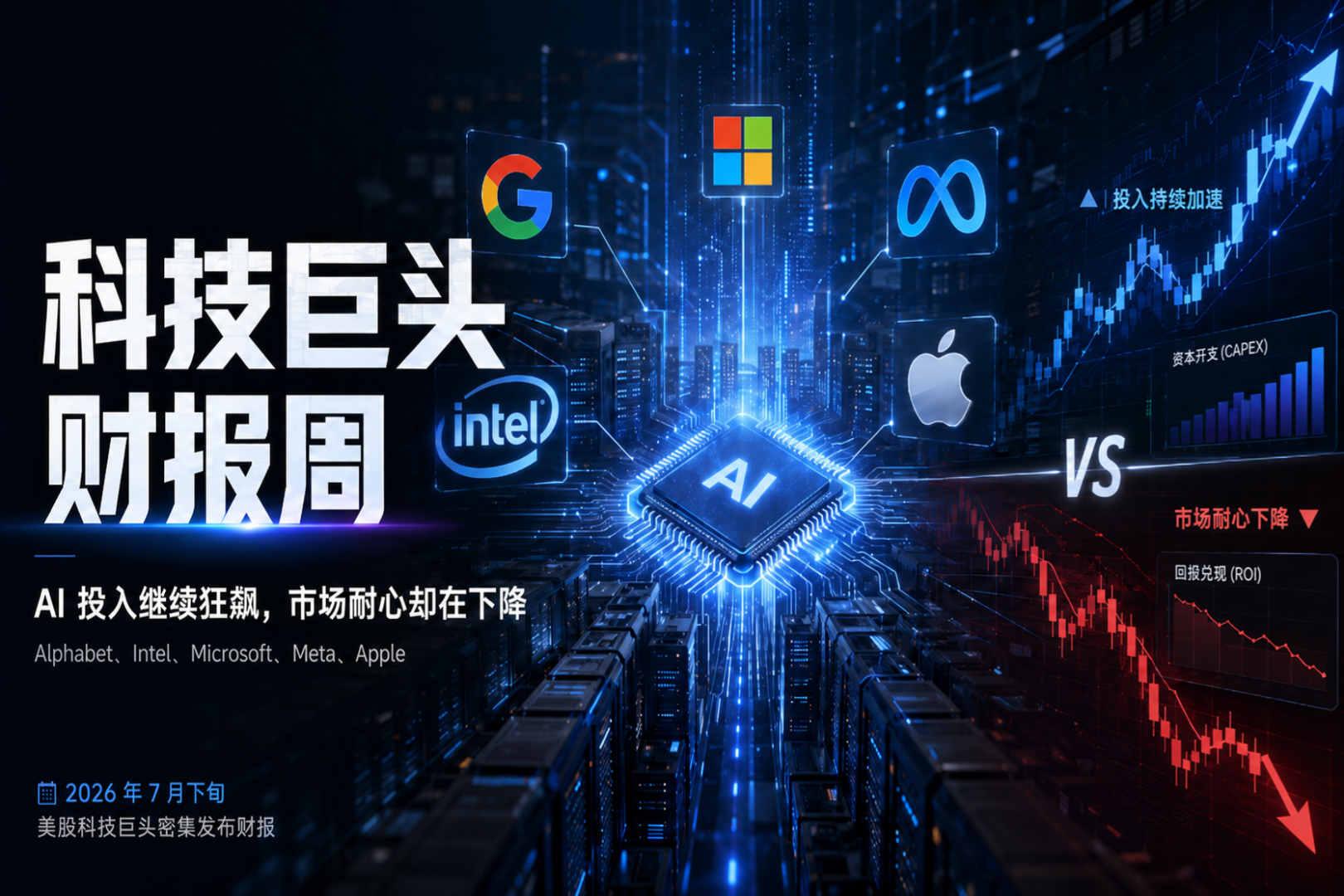
When the Market Begins to Question AI Capex: A Full Analysis of Q2 Earnings Reports from Five Tech Giants

In late July 2026, five major US tech giants—Alphabet, Intel, Microsoft, Meta, and Apple—released their Q2 earnings reports. While all companies exceeded revenue and profit expectations, driven by strong AI-related business growth, investor reactions diverged sharply due to concerns over escalating AI capital expenditures (capex) and their impact on free cash flow. Alphabet reported strong revenue growth and a surging cloud business, but its stock fell after announcing a doubled year-on-year capex and negative quarterly free cash flow for the first time. Intel posted its strongest revenue growth in over 15 years, but its stock experienced volatile trading after significantly raising its full-year capex guidance. Microsoft saw its stock surge after beating estimates and, crucially, lowering its capex forecast while projecting positive free cash flow. Meta faced the most severe sell-off as its profits declined despite revenue beats, with free cash flow plunging over 90% and its capex guidance raised. Apple reported record June-quarter results, but its stock plummeted after providing Q4 revenue guidance that fell short of expectations, citing supply chain constraints and forex headwinds. The overall takeaway is that the market's focus has shifted from validating AI demand to scrutinizing the timeline for returns on massive AI investments. Companies demonstrating a clearer path to managing capex and preserving free cash flow, like Microsoft, were rewarded, while those signaling continued aggressive spending faced investor skepticism.

Odaily星球日报32 min fa

When the Market Begins to Question AI Capex: A Full Analysis of Q2 Earnings Reports from Five Tech Giants

Odaily星球日报32 min fa

a16z: From Companies to DAOs, DUNA May Become the Next Generation Organizational Form

This article, "From Companies to DAOs: How DUNA Could Become the Next Organizational Form," traces the 500-year evolution of business collaboration. It begins with medieval structures like the *commenda* and Florentine *compagnia*, which exposed partners to personal risk. The modern corporation, exemplified by the Dutch East India Company (VOC), was a revolutionary leap, enabling large-scale, capital-intensive ventures by offering limited liability and reducing coordination costs. However, corporations introduced new challenges like principal-agent problems and bureaucratic overhead. The piece argues that software and internet-native protocols are now reducing these traditional overheads. Decentralized Autonomous Organizations (DAOs) emerged as a new model for coordination without centralized management. Yet, DAOs face a significant legal vacuum: they lack legal recognition, leaving members exposed to unlimited personal liability, and their tokens are vulnerable to being classified as securities under unclear regulations (e.g., the Howey Test). This has forced projects into suboptimal workarounds like offshore foundations. The article identifies the Decentralized Unincorporated Nonprofit Association (DUNA) as a potential solution. Recently legalized in states like Wyoming, the DUNA provides a legal wrapper for decentralized networks. It grants key protections—legal personality, limited liability, and perpetual existence—to a group without imposing a traditional hierarchical management structure. This allows token-holder communities to govern, hold assets, and contract as a single legal entity, aligning with their decentralized nature. While DUNA doesn't solve all governance challenges or magically resolve securities law questions, it represents a crucial step. It fills the legal recognition gap, offering a native legal form for internet-scale, decentralized collaboration and extending the separation of personal risk from organizational venture into a new domain.

marsbit1 h fa

a16z: From Companies to DAOs, DUNA May Become the Next Generation Organizational Form

marsbit1 h fa

2026 Mid-Year Report On-Chain RWA: Tokenized Stock Market Cap Doubles in a Year, But 90% of Rights Are Hollow Shells

The 2026 Mid-Year Report on On-Chain RWA highlights a significant growth in tokenized stock market capitalization, which nearly doubled from $951 million in March to $1.89 billion by July. However, the report reveals a fundamental contradiction in this "layer 2.5" ecosystem: products with the strongest legal foundation (like regulated U.S. infrastructure) lack liquidity and distribution, while freely tradable offshored wrapper products often lack substantive ownership rights. The increase is driven largely by a few products (SECZ, FGRS, STRCx) and platforms (Ondo, xStocks, Securitize collectively hold over 85% share). While distributed value across networks like Ethereum, Solana, and BNB Chain has grown, the market remains fragmented. Products referencing the same underlying asset (e.g., Apple stock) are distinct legal liabilities with different intermediaries and jurisdictional rules, offering varying degrees of legal claim. The report cautions that headline numbers are misleading, as they reflect changes in distributed token value—driven by issuance, conversions, and price movements—not pure investor inflows. True "canonical shares" with legal ownership, wide wallet distribution, institutional liquidity, and independent on-chain price discovery do not yet exist at scale. Tokenized treasuries show stronger product-market fit, and ETFs may be easier to scale than single stocks. The core takeaway is a trade-off: legal certainty versus liquidity and composability.

marsbit2 h fa

2026 Mid-Year Report On-Chain RWA: Tokenized Stock Market Cap Doubles in a Year, But 90% of Rights Are Hollow Shells

marsbit2 h fa

Trading

Spot

Articoli Popolari

Cosa è $S$

Comprendere SPERO: Una Panoramica Completa Introduzione a SPERO Mentre il panorama dell'innovazione continua a evolversi, l'emergere delle tecnologie web3 e dei progetti di criptovaluta gioca un ruolo fondamentale nel plasmare il futuro digitale. Un progetto che ha attirato l'attenzione in questo campo dinamico è SPERO, denotato come SPERO,$$s$. Questo articolo mira a raccogliere e presentare informazioni dettagliate su SPERO, per aiutare gli appassionati e gli investitori a comprendere le sue basi, obiettivi e innovazioni nei domini web3 e crypto. Che cos'è SPERO,$$s$? SPERO,$$s$ è un progetto unico all'interno dello spazio crypto che cerca di sfruttare i principi della decentralizzazione e della tecnologia blockchain per creare un ecosistema che promuove l'impegno, l'utilità e l'inclusione finanziaria. Il progetto è progettato per facilitare interazioni peer-to-peer in modi nuovi, fornendo agli utenti soluzioni e servizi finanziari innovativi. Al suo interno, SPERO,$$s$ mira a responsabilizzare gli individui fornendo strumenti e piattaforme che migliorano l'esperienza dell'utente nello spazio delle criptovalute. Questo include la possibilità di metodi di transazione più flessibili, la promozione di iniziative guidate dalla comunità e la creazione di percorsi per opportunità finanziarie attraverso applicazioni decentralizzate (dApps). La visione sottostante di SPERO,$$s$ ruota attorno all'inclusività, cercando di colmare le lacune all'interno della finanza tradizionale mentre sfrutta i vantaggi della tecnologia blockchain. Chi è il Creatore di SPERO,$$s$? L'identità del creatore di SPERO,$$s$ rimane piuttosto oscura, poiché ci sono risorse pubblicamente disponibili limitate che forniscono informazioni dettagliate sul suo fondatore o fondatori. Questa mancanza di trasparenza può derivare dall'impegno del progetto per la decentralizzazione—un ethos che molti progetti web3 condividono, dando priorità ai contributi collettivi rispetto al riconoscimento individuale. Centrando le discussioni attorno alla comunità e ai suoi obiettivi collettivi, SPERO,$$s$ incarna l'essenza dell'empowerment senza mettere in evidenza individui specifici. Pertanto, comprendere l'etica e la missione di SPERO rimane più importante che identificare un creatore singolo. Chi sono gli Investitori di SPERO,$$s$? SPERO,$$s$ è supportato da una varietà di investitori che vanno dai capitalisti di rischio agli investitori angelici dedicati a promuovere l'innovazione nel settore crypto. Il focus di questi investitori generalmente si allinea con la missione di SPERO—dando priorità a progetti che promettono avanzamenti tecnologici sociali, inclusività finanziaria e governance decentralizzata. Queste fondazioni di investitori sono tipicamente interessate a progetti che non solo offrono prodotti innovativi, ma contribuiscono anche positivamente alla comunità blockchain e ai suoi ecosistemi. Il supporto di questi investitori rafforza SPERO,$$s$ come un concorrente degno di nota nel dominio in rapida evoluzione dei progetti crypto. Come Funziona SPERO,$$s$? SPERO,$$s$ impiega un framework multifunzionale che lo distingue dai progetti di criptovaluta convenzionali. Ecco alcune delle caratteristiche chiave che sottolineano la sua unicità e innovazione: Governance Decentralizzata: SPERO,$$s$ integra modelli di governance decentralizzati, responsabilizzando gli utenti a partecipare attivamente ai processi decisionali riguardanti il futuro del progetto. Questo approccio favorisce un senso di proprietà e responsabilità tra i membri della comunità. Utilità del Token: SPERO,$$s$ utilizza il proprio token di criptovaluta, progettato per servire varie funzioni all'interno dell'ecosistema. Questi token abilitano transazioni, premi e la facilitazione dei servizi offerti sulla piattaforma, migliorando l'impegno e l'utilità complessivi. Architettura Stratificata: L'architettura tecnica di SPERO,$$s$ supporta la modularità e la scalabilità, consentendo un'integrazione fluida di funzionalità e applicazioni aggiuntive man mano che il progetto evolve. Questa adattabilità è fondamentale per mantenere la rilevanza nel panorama crypto in continua evoluzione. Coinvolgimento della Comunità: Il progetto enfatizza iniziative guidate dalla comunità, impiegando meccanismi che incentivano la collaborazione e il feedback. Nutrendo una comunità forte, SPERO,$$s$ può affrontare meglio le esigenze degli utenti e adattarsi alle tendenze di mercato. Focus sull'Inclusione: Offrendo basse commissioni di transazione e interfacce user-friendly, SPERO,$$s$ mira ad attrarre una base utenti diversificata, inclusi individui che potrebbero non aver precedentemente interagito nello spazio crypto. Questo impegno per l'inclusione si allinea con la sua missione generale di empowerment attraverso l'accessibilità. Cronologia di SPERO,$$s$ Comprendere la storia di un progetto fornisce preziose intuizioni sulla sua traiettoria di sviluppo e sui traguardi. Di seguito è riportata una cronologia suggerita che mappa eventi significativi nell'evoluzione di SPERO,$$s$: Fase di Concettualizzazione e Ideazione: Le idee iniziali che formano la base di SPERO,$$s$ sono state concepite, allineandosi strettamente con i principi di decentralizzazione e focus sulla comunità all'interno dell'industria blockchain. Lancio del Whitepaper del Progetto: Dopo la fase concettuale, è stato rilasciato un whitepaper completo che dettaglia la visione, gli obiettivi e l'infrastruttura tecnologica di SPERO,$$s$ per suscitare interesse e feedback dalla comunità. Costruzione della Comunità e Prime Interazioni: Sono stati effettuati sforzi attivi di outreach per costruire una comunità di early adopters e potenziali investitori, facilitando discussioni attorno agli obiettivi del progetto e ottenendo supporto. Evento di Generazione del Token: SPERO,$$s$ ha condotto un evento di generazione del token (TGE) per distribuire i propri token nativi ai primi sostenitori e stabilire una liquidità iniziale all'interno dell'ecosistema. Lancio della Prima dApp: La prima applicazione decentralizzata (dApp) associata a SPERO,$$s$ è stata attivata, consentendo agli utenti di interagire con le funzionalità principali della piattaforma. Sviluppo Continuo e Partnership: Aggiornamenti e miglioramenti continui alle offerte del progetto, inclusi partnership strategiche con altri attori nello spazio blockchain, hanno plasmato SPERO,$$s$ in un concorrente competitivo e in evoluzione nel mercato crypto. Conclusione SPERO,$$s$ rappresenta una testimonianza del potenziale del web3 e delle criptovalute di rivoluzionare i sistemi finanziari e responsabilizzare gli individui. Con un impegno per la governance decentralizzata, il coinvolgimento della comunità e funzionalità progettate in modo innovativo, apre la strada verso un panorama finanziario più inclusivo. Come per qualsiasi investimento nello spazio crypto in rapida evoluzione, si incoraggiano potenziali investitori e utenti a ricercare approfonditamente e a impegnarsi in modo riflessivo con gli sviluppi in corso all'interno di SPERO,$$s$. Il progetto mostra lo spirito innovativo dell'industria crypto, invitando a ulteriori esplorazioni delle sue innumerevoli possibilità. Mentre il percorso di SPERO,$$s$ è ancora in fase di sviluppo, i suoi principi fondamentali potrebbero effettivamente influenzare il futuro di come interagiamo con la tecnologia, la finanza e tra di noi in ecosistemi digitali interconnessi.

174 Totale visualizzazioniPubblicato il 2024.12.17Aggiornato il 2024.12.17

Cosa è $S$

Cosa è AGENT S

Agent S: Il Futuro dell'Interazione Autonoma in Web3 Introduzione Nel panorama in continua evoluzione di Web3 e criptovalute, le innovazioni stanno costantemente ridefinendo il modo in cui gli individui interagiscono con le piattaforme digitali. Uno di questi progetti pionieristici, Agent S, promette di rivoluzionare l'interazione uomo-computer attraverso il suo framework agentico aperto. Aprendo la strada a interazioni autonome, Agent S mira a semplificare compiti complessi, offrendo applicazioni trasformative nell'intelligenza artificiale (AI). Questa esplorazione dettagliata approfondirà le complessità del progetto, le sue caratteristiche uniche e le implicazioni per il dominio delle criptovalute. Cos'è Agent S? Agent S si presenta come un innovativo framework agentico aperto, progettato specificamente per affrontare tre sfide fondamentali nell'automazione dei compiti informatici: Acquisizione di Conoscenze Specifiche del Dominio: Il framework apprende in modo intelligente da varie fonti di conoscenza esterne ed esperienze interne. Questo approccio duale gli consente di costruire un ricco repository di conoscenze specifiche del dominio, migliorando le sue prestazioni nell'esecuzione dei compiti. Pianificazione su Lungo Orizzonte di Compiti: Agent S impiega una pianificazione gerarchica potenziata dall'esperienza, un approccio strategico che facilita la suddivisione e l'esecuzione efficiente di compiti complessi. Questa caratteristica migliora significativamente la sua capacità di gestire più sottocompiti in modo efficiente ed efficace. Gestione di Interfacce Dinamiche e Non Uniformi: Il progetto introduce l'Interfaccia Agente-Computer (ACI), una soluzione innovativa che migliora l'interazione tra agenti e utenti. Utilizzando Modelli Linguistici Multimodali di Grandi Dimensioni (MLLM), Agent S può navigare e manipolare senza sforzo diverse interfacce grafiche utente. Attraverso queste caratteristiche pionieristiche, Agent S fornisce un framework robusto che affronta le complessità coinvolte nell'automazione dell'interazione umana con le macchine, preparando il terreno per innumerevoli applicazioni nell'AI e oltre. Chi è il Creatore di Agent S? Sebbene il concetto di Agent S sia fondamentalmente innovativo, informazioni specifiche sul suo creatore rimangono elusive. Il creatore è attualmente sconosciuto, il che evidenzia sia la fase embrionale del progetto sia la scelta strategica di mantenere i membri fondatori sotto anonimato. Indipendentemente dall'anonimato, l'attenzione rimane sulle capacità e sul potenziale del framework. Chi sono gli Investitori di Agent S? Poiché Agent S è relativamente nuovo nell'ecosistema crittografico, informazioni dettagliate riguardanti i suoi investitori e sostenitori finanziari non sono documentate esplicitamente. La mancanza di approfondimenti pubblicamente disponibili sulle fondazioni di investimento o sulle organizzazioni che supportano il progetto solleva interrogativi sulla sua struttura di finanziamento e sulla roadmap di sviluppo. Comprendere il supporto è cruciale per valutare la sostenibilità del progetto e il suo potenziale impatto sul mercato. Come Funziona Agent S? Al centro di Agent S si trova una tecnologia all'avanguardia che gli consente di funzionare efficacemente in contesti diversi. Il suo modello operativo è costruito attorno a diverse caratteristiche chiave: Interazione Uomo-Computer Simile a Quella Umana: Il framework offre una pianificazione AI avanzata, cercando di rendere le interazioni con i computer più intuitive. Mimando il comportamento umano nell'esecuzione dei compiti, promette di elevare le esperienze degli utenti. Memoria Narrativa: Utilizzata per sfruttare esperienze di alto livello, Agent S utilizza la memoria narrativa per tenere traccia delle storie dei compiti, migliorando così i suoi processi decisionali. Memoria Episodica: Questa caratteristica fornisce agli utenti una guida passo-passo, consentendo al framework di offrire supporto contestuale mentre i compiti si sviluppano. Supporto per OpenACI: Con la capacità di funzionare localmente, Agent S consente agli utenti di mantenere il controllo sulle proprie interazioni e flussi di lavoro, allineandosi con l'etica decentralizzata di Web3. Facile Integrazione con API Esterne: La sua versatilità e compatibilità con varie piattaforme AI garantiscono che Agent S possa adattarsi senza problemi agli ecosistemi tecnologici esistenti, rendendolo una scelta attraente per sviluppatori e organizzazioni. Queste funzionalità contribuiscono collettivamente alla posizione unica di Agent S all'interno dello spazio crittografico, poiché automatizza compiti complessi e multi-fase con un intervento umano minimo. Man mano che il progetto evolve, le sue potenziali applicazioni in Web3 potrebbero ridefinire il modo in cui si svolgono le interazioni digitali. Cronologia di Agent S Lo sviluppo e le tappe di Agent S possono essere riassunti in una cronologia che evidenzia i suoi eventi significativi: 27 Settembre 2024: Il concetto di Agent S è stato lanciato in un documento di ricerca completo intitolato “Un Framework Agentico Aperto che Usa i Computer Come un Umano”, mostrando le basi per il progetto. 10 Ottobre 2024: Il documento di ricerca è stato reso pubblicamente disponibile su arXiv, offrendo un'esplorazione approfondita del framework e della sua valutazione delle prestazioni basata sul benchmark OSWorld. 12 Ottobre 2024: È stata rilasciata una presentazione video, fornendo un'idea visiva delle capacità e delle caratteristiche di Agent S, coinvolgendo ulteriormente potenziali utenti e investitori. Questi indicatori nella cronologia non solo illustrano i progressi di Agent S, ma indicano anche il suo impegno per la trasparenza e il coinvolgimento della comunità. Punti Chiave su Agent S Man mano che il framework Agent S continua a evolversi, diversi attributi chiave si distinguono, sottolineando la sua natura innovativa e il potenziale: Framework Innovativo: Progettato per fornire un uso intuitivo dei computer simile all'interazione umana, Agent S porta un approccio nuovo all'automazione dei compiti. Interazione Autonoma: La capacità di interagire autonomamente con i computer attraverso GUI segna un passo avanti verso soluzioni informatiche più intelligenti ed efficienti. Automazione di Compiti Complessi: Con la sua metodologia robusta, può automatizzare compiti complessi e multi-fase, rendendo i processi più veloci e meno soggetti a errori. Miglioramento Continuo: I meccanismi di apprendimento consentono ad Agent S di migliorare dalle esperienze passate, migliorando continuamente le sue prestazioni e la sua efficacia. Versatilità: La sua adattabilità attraverso diversi ambienti operativi come OSWorld e WindowsAgentArena garantisce che possa servire un'ampia gamma di applicazioni. Man mano che Agent S si posiziona nel panorama di Web3 e delle criptovalute, il suo potenziale per migliorare le capacità di interazione e automatizzare i processi segna un significativo avanzamento nelle tecnologie AI. Attraverso il suo framework innovativo, Agent S esemplifica il futuro delle interazioni digitali, promettendo un'esperienza più fluida ed efficiente per gli utenti in vari settori. Conclusione Agent S rappresenta un audace passo avanti nell'unione tra AI e Web3, con la capacità di ridefinire il modo in cui interagiamo con la tecnologia. Sebbene sia ancora nelle sue fasi iniziali, le possibilità per la sua applicazione sono vaste e coinvolgenti. Attraverso il suo framework completo che affronta sfide critiche, Agent S mira a portare le interazioni autonome al centro dell'esperienza digitale. Man mano che ci addentriamo nei regni delle criptovalute e della decentralizzazione, progetti come Agent S giocheranno senza dubbio un ruolo cruciale nel plasmare il futuro della tecnologia e della collaborazione uomo-computer.

632 Totale visualizzazioniPubblicato il 2025.01.14Aggiornato il 2025.01.14

Cosa è AGENT S

Come comprare S

Benvenuto in HTX.com! Abbiamo reso l'acquisto di Sonic (S) semplice e conveniente. Segui la nostra guida passo passo per intraprendere il tuo viaggio nel mondo delle criptovalute.Step 1: Crea il tuo Account HTXUsa la tua email o numero di telefono per registrarti il tuo account gratuito su HTX. Vivi un'esperienza facile e sblocca tutte le funzionalità,Crea il mio accountStep 2: Vai in Acquista crypto e seleziona il tuo metodo di pagamentoCarta di credito/debito: utilizza la tua Visa o Mastercard per acquistare immediatamente SonicS.Bilancio: Usa i fondi dal bilancio del tuo account HTX per fare trading senza problemi.Terze parti: abbiamo aggiunto metodi di pagamento molto utilizzati come Google Pay e Apple Pay per maggiore comodità.P2P: Fai trading direttamente con altri utenti HTX.Over-the-Counter (OTC): Offriamo servizi su misura e tassi di cambio competitivi per i trader.Step 3: Conserva Sonic (S)Dopo aver acquistato Sonic (S), conserva nel tuo account HTX. In alternativa, puoi inviare tramite trasferimento blockchain o scambiare per altre criptovalute.Step 4: Scambia Sonic (S)Scambia facilmente Sonic (S) nel mercato spot di HTX. Accedi al tuo account, seleziona la tua coppia di trading, esegui le tue operazioni e monitora in tempo reale. Offriamo un'esperienza user-friendly sia per chi ha appena iniziato che per i trader più esperti.

1.3k Totale visualizzazioniPubblicato il 2025.01.15Aggiornato il 2026.06.02

Come comprare S

Discussioni

Benvenuto nella Community HTX. Qui puoi rimanere informato sugli ultimi sviluppi della piattaforma e accedere ad approfondimenti esperti sul mercato. Le opinioni degli utenti sul prezzo di S S sono presentate come di seguito.

活动图片