Federal Reserve Withdraws Crypto Rules, Banks Get More Freedom

bitcoinistPubblicato 2025-12-18Pubblicato ultima volta 2025-12-18

The Federal Reserve announced on April 24, 2025, that it is pulling back previous rules for banks handling crypto and dollar tokens. From now on, banks will be supervised the usual way, instead of through separate crypto-focused requirements.

Banks Can Now Move Faster With Crypto

The rules being withdrawn included a 2022 letter that told state member banks to notify the Fed before dealing with crypto, and a 2023 letter that required approval before handling dollar tokens. These rules had kept some smaller banks, especially uninsured crypto-focused ones, from accessing Fed accounts or payment systems.
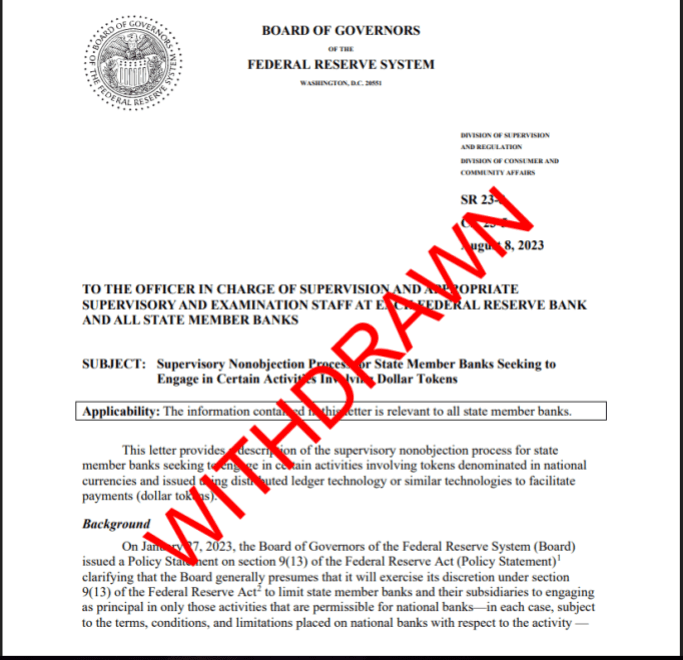
Other regulators moved at the same time. The FDIC and the OCC also withdrew two 2023 statements about crypto risks. Those statements had flagged issues like liquidity and governance risks in crypto banking. By pulling them back, banks now face fewer formal roadblocks when offering crypto services.

Fed’s New Guidance

On Dec. 17, 2025, the Fed introduced new guidance to give both insured and uninsured state member banks a clear path to explore activities like cryptocurrencies, as long as they meet the Fed’s risk-management standards, the central bank said.


Supervision Now Part Of Normal Oversight

The Fed said it will continue watching banks’ crypto work, but through regular supervisory processes. Banks don’t need to send extra notifications or get prior approval for crypto activities anymore. That includes things like custody, trading, or settlement of digital assets. There aren’t new rules being added — it’s just now part of normal oversight.

Total crypto market cap currently at $2.9 trillion. Chart: TradingView

Key Dates And Actions

The important date is April 24, 2025. On this day, the Fed withdrew letters from 2022 and 2023, along with the two joint interagency statements from 2023. These had previously told banks how to report and get approval for crypto work. The withdrawal simply moves crypto activities into regular bank supervision.
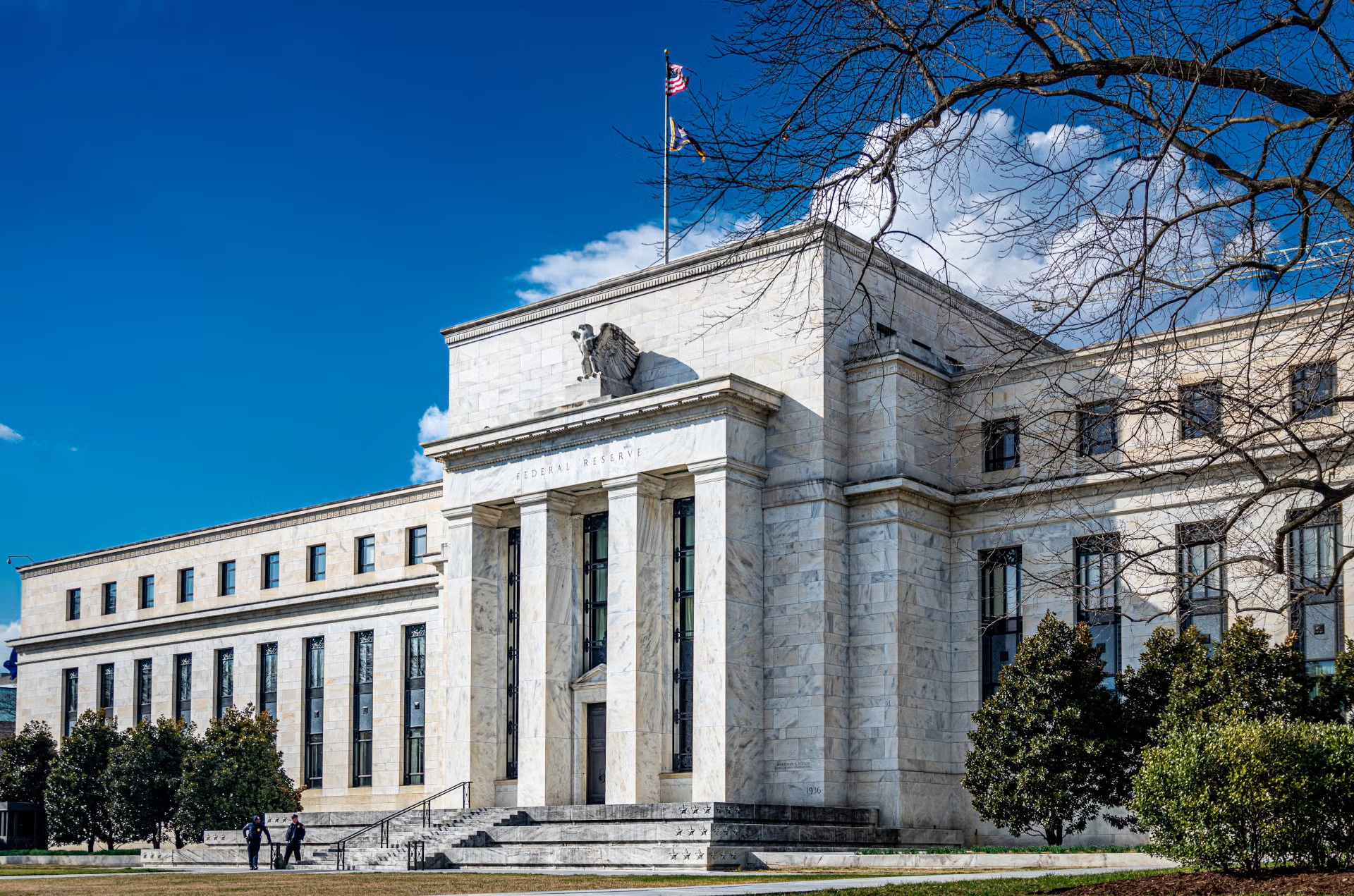
The US Federal Reserve. Image: TuftsNow

What This Means For Banks And Markets

Banks have more leeway to provide crypto services because they no longer have to follow the old regulations. They’ve gained the ability to quickly develop, test, and manage digital assets. However, the Fed continues to keep an eye on how banks manage their risks.

While this change does not eliminate all regulatory requirements, it eliminates much of the extra duplication of paperwork and approvals that acted as barriers and impeded progress in the past.

Featured image from Unsplash, chart from TradingView

Domande pertinenti

QWhat did the Federal Reserve announce on April 24, 2025, regarding banks and crypto?

AThe Federal Reserve announced that it is pulling back previous rules for banks handling crypto and dollar tokens, and that banks will now be supervised through the usual way instead of separate crypto-focused requirements.

QWhich specific regulatory documents were withdrawn by the Fed?

AThe Fed withdrew a 2022 letter that required state member banks to notify the Fed before dealing with crypto, a 2023 letter that required approval before handling dollar tokens, and two joint interagency statements from 2023 about crypto risks.

QHow does the new Fed guidance change the process for banks engaging in crypto activities?

ABanks no longer need to send extra notifications or get prior approval for crypto activities like custody, trading, or settlement of digital assets. These activities are now supervised through regular oversight processes instead of separate requirements.

QWhat was the significance of the 2023 policy statements that were withdrawn?

AThe 2023 statements had flagged issues like liquidity and governance risks in crypto banking and acted as formal roadblocks, which kept some smaller and uninsured crypto-focused banks from accessing Fed accounts or payment systems.

QWhat are the implications of this regulatory change for banks and the crypto market?

ABanks now have more freedom to quickly develop, test, and manage digital asset services without the extra duplication of paperwork and approvals. However, the Fed will continue to oversee risk management, and the change integrates crypto into normal bank supervision rather than eliminating all regulations.

Letture associate

Annual Salary of Millions Competing for Electricians, Meta Rushes to Open Its Own Technical School

The AI boom is facing an unexpected bottleneck: a severe shortage of skilled construction workers and electricians. As tech giants like Meta, OpenAI, and Alphabet race to build massive data centers—such as OpenAI's $16 billion "Stargate" project—they are hitting a critical labor wall. The U.S. needs an estimated 130,000 more electricians, 240,000 construction workers, and 150,000 supervisors by 2030 for AI infrastructure alone, but tens of thousands of electrician jobs go unfilled each year. While AI companies offer high premiums, with electricians earning up to $280,000 annually, worker scarcity still causes massive losses—delays on a single project can cost $14.2 million per month. The complexity of building AI data centers, which require immense power (equivalent to powering hundreds of thousands of homes), sophisticated electrical systems, and advanced liquid cooling solutions, demands highly skilled technicians who are in short supply. To combat this, companies are investing heavily in training. Meta has committed $115 million to a free training school offering tuition, housing, and stipends, targeting 5,000 new workers. OpenAI is partnering with unions to secure skilled labor. These efforts are paying off, with a significant rise in Gen Z interest in trade schools over college. However, the power demands are staggering. AI data centers are driving a rapid surge in electricity consumption, projected to account for up to 12% of U.S. power use by 2028 and raising costs for consumers. Furthermore, the construction boom is project-based, leading to a potential future glut of trained workers once building peaks, which could depress wages industry-wide. The race for AI supremacy now depends as much on skilled hands as on advanced chips.

marsbit1 h fa

Annual Salary of Millions Competing for Electricians, Meta Rushes to Open Its Own Technical School

marsbit1 h fa

OpenAI No Longer Sells Its Most Expensive Model for Profit

OpenAI is shifting its business strategy away from promoting its most expensive, flagship models for every task. Recent price cuts—80% for GPT-5.6 Luna and 20% for Terra—signal a deeper change: the company now actively advises users that many tasks don't require the most powerful model. Instead, OpenAI recommends a tiered approach: use the high-end GPT-5.6 Sol for complex planning and analysis, then delegate execution to cheaper models like Luna. This mirrors moves by Anthropic, which recently launched Claude Opus 5 at half the price of its top model, Fable 5. Both companies are de-emphasizing flagship models as primary revenue drivers, using them instead for brand prestige and technological showcases. The industry is entering a "mass-market" phase, similar to automotive, where high-volume, cost-effective models handle daily operations and drive scale. OpenAI's price reductions are partly enabled by AI models themselves optimizing underlying code and infrastructure, creating a self-reinforcing cycle of efficiency gains and cost reduction. Competition is shifting from "who is smartest" to "who offers the best value." The goal is no longer selling individual models but fostering widespread API adoption and ecosystem lock-in. By making AI calls cheap and ubiquitous, companies like OpenAI aim to become the indispensable, utility-like infrastructure powering automated workflows—the "water and electricity" of software, quietly embedded everywhere.

marsbit1 h fa

OpenAI No Longer Sells Its Most Expensive Model for Profit

marsbit1 h fa

Trading

Spot
活动图片





