Federal Reserve Withdraws Crypto Rules, Banks Get More Freedom

bitcoinistPubblicato 2025-12-18Pubblicato ultima volta 2025-12-18

The Federal Reserve announced on April 24, 2025, that it is pulling back previous rules for banks handling crypto and dollar tokens. From now on, banks will be supervised the usual way, instead of through separate crypto-focused requirements.

Banks Can Now Move Faster With Crypto

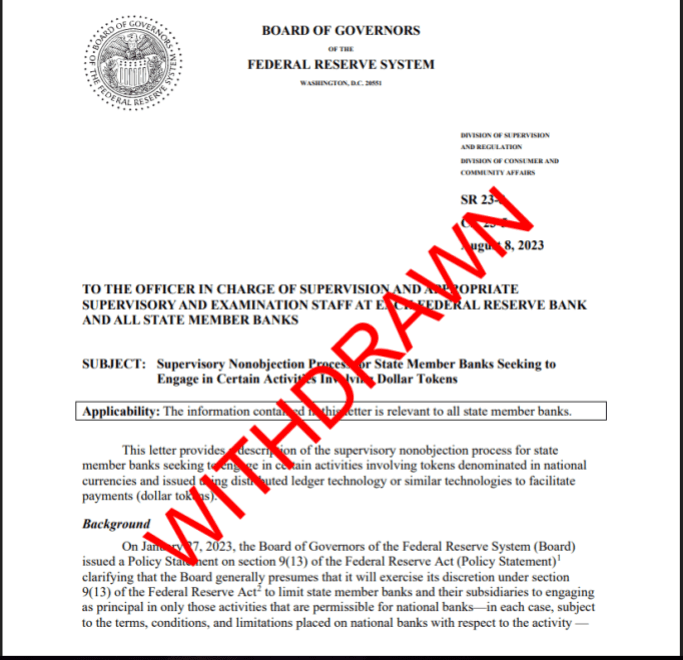
The rules being withdrawn included a 2022 letter that told state member banks to notify the Fed before dealing with crypto, and a 2023 letter that required approval before handling dollar tokens. These rules had kept some smaller banks, especially uninsured crypto-focused ones, from accessing Fed accounts or payment systems.
Other regulators moved at the same time. The FDIC and the OCC also withdrew two 2023 statements about crypto risks. Those statements had flagged issues like liquidity and governance risks in crypto banking. By pulling them back, banks now face fewer formal roadblocks when offering crypto services.

Fed’s New Guidance

On Dec. 17, 2025, the Fed introduced new guidance to give both insured and uninsured state member banks a clear path to explore activities like cryptocurrencies, as long as they meet the Fed’s risk-management standards, the central bank said.


Supervision Now Part Of Normal Oversight

The Fed said it will continue watching banks’ crypto work, but through regular supervisory processes. Banks don’t need to send extra notifications or get prior approval for crypto activities anymore. That includes things like custody, trading, or settlement of digital assets. There aren’t new rules being added — it’s just now part of normal oversight.

Total crypto market cap currently at $2.9 trillion. Chart: TradingView

Key Dates And Actions

The important date is April 24, 2025. On this day, the Fed withdrew letters from 2022 and 2023, along with the two joint interagency statements from 2023. These had previously told banks how to report and get approval for crypto work. The withdrawal simply moves crypto activities into regular bank supervision.
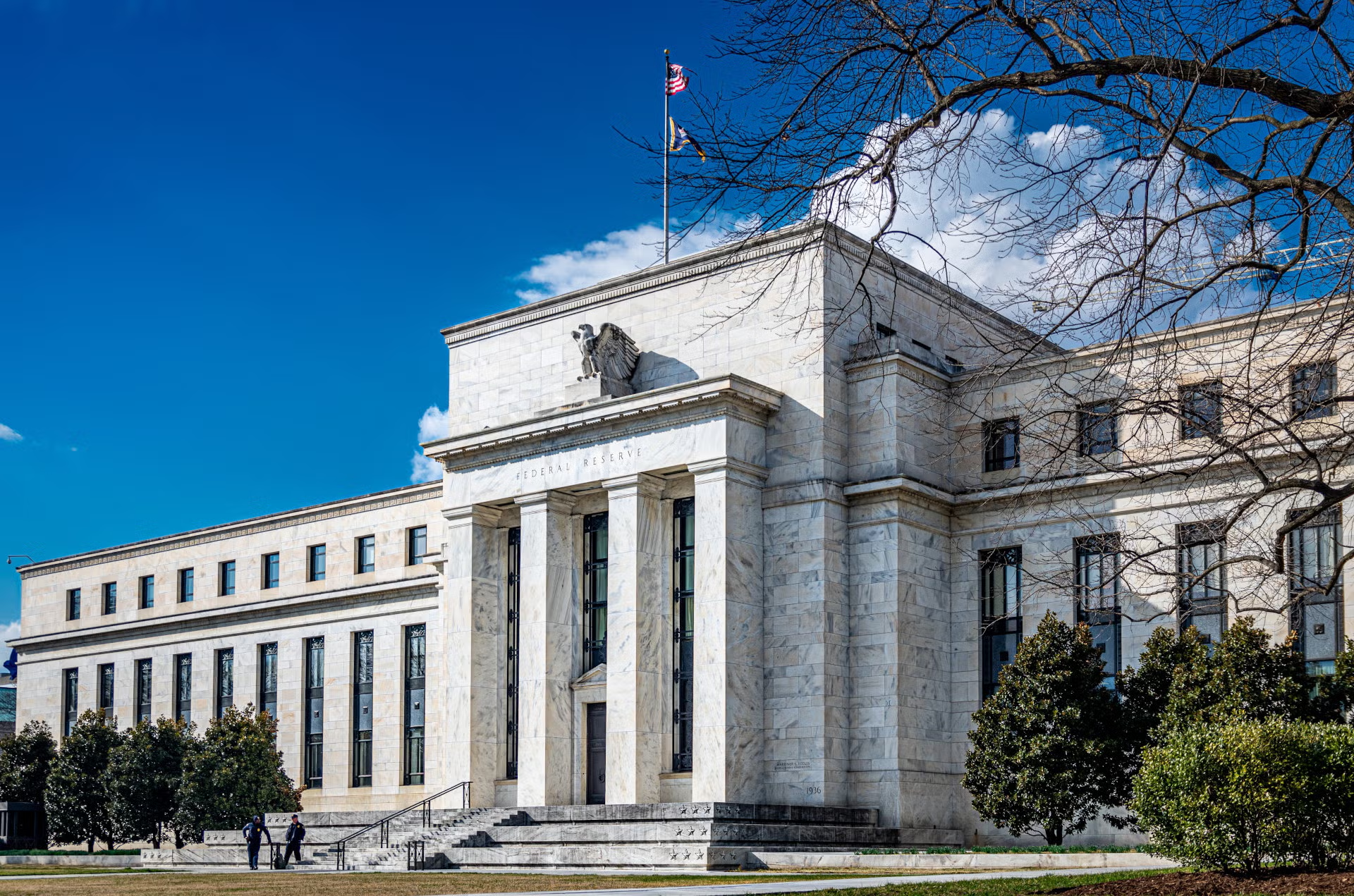
The US Federal Reserve. Image: TuftsNow

What This Means For Banks And Markets

Banks have more leeway to provide crypto services because they no longer have to follow the old regulations. They’ve gained the ability to quickly develop, test, and manage digital assets. However, the Fed continues to keep an eye on how banks manage their risks.

While this change does not eliminate all regulatory requirements, it eliminates much of the extra duplication of paperwork and approvals that acted as barriers and impeded progress in the past.

Featured image from Unsplash, chart from TradingView

Domande pertinenti

QWhat did the Federal Reserve announce on April 24, 2025, regarding banks and crypto?

AThe Federal Reserve announced that it is pulling back previous rules for banks handling crypto and dollar tokens, and that banks will now be supervised through the usual way instead of separate crypto-focused requirements.

QWhich specific regulatory documents were withdrawn by the Fed?

AThe Fed withdrew a 2022 letter that required state member banks to notify the Fed before dealing with crypto, a 2023 letter that required approval before handling dollar tokens, and two joint interagency statements from 2023 about crypto risks.

QHow does the new Fed guidance change the process for banks engaging in crypto activities?

ABanks no longer need to send extra notifications or get prior approval for crypto activities like custody, trading, or settlement of digital assets. These activities are now supervised through regular oversight processes instead of separate requirements.

QWhat was the significance of the 2023 policy statements that were withdrawn?

AThe 2023 statements had flagged issues like liquidity and governance risks in crypto banking and acted as formal roadblocks, which kept some smaller and uninsured crypto-focused banks from accessing Fed accounts or payment systems.

QWhat are the implications of this regulatory change for banks and the crypto market?

ABanks now have more freedom to quickly develop, test, and manage digital asset services without the extra duplication of paperwork and approvals. However, the Fed will continue to oversee risk management, and the change integrates crypto into normal bank supervision rather than eliminating all regulations.

Letture associate

Musk Posted a Recruitment Ad for SpaceX, and After Reading the Comments Section, I Understood

On May 20th, SpaceX filed for a landmark IPO with a $1.75 trillion valuation. Shortly after, Elon Musk posted a recruitment call on X, seeking "world-class engineers and physicists" for SpaceX. The application process was starkly simple: email with three bullet points proving "exceptional ability," with real, complex projects as a plus. Musk promised to review qualifying emails himself. The post garnered millions of views and thousands of replies, revealing a spectrum of responses. Most comments, including a highly-upvoted humorous one listing absurd "skills," merely listed credentials or experiences in a conventional, non-differentiating way. This highlighted a key insight: a traditional resume listing degrees and skills often fails to demonstrate true exceptionalism. Effective self-presentation requires "performance efficiency." A standout reply came from an OpenAI engineering lead, who simply stated "codex." This demonstrated that for those who have built significant, recognized products, the product itself becomes the ultimate resume. The article argues that in the AI era, any tangible, shareable output—a tool, research, or online project—serves as a living, self-evident credential more powerful than a list of attributes. However, a twist emerged when applicants found the provided email address non-functional, leading to speculation that the post might also serve as an IPO publicity stunt, projecting an image of aggressive talent acquisition to investors. Ultimately, the episode served as a microcosm: some participate through performance, others through proof of work, while some question the reality of the stage itself. It underscores the enduring challenge of defining and demonstrating value in an age of abundant, yet often superficial, content.

marsbit42 min fa

Musk Posted a Recruitment Ad for SpaceX, and After Reading the Comments Section, I Understood

marsbit42 min fa

Cutting Off OpenAI, Anthropic Acquires the Tool Provider Used by a Quarter of Global Developers

Anthropic has acquired Stainless, a developer tool company that automatically generated official SDKs (Software Development Kits) for AI giants including OpenAI, Anthropic, Meta, and Cloudflare. The deal, reportedly valued at around $300 million, marks a strategic shift for Anthropic as it builds its "AI agent" infrastructure. Stainless acted as a "translator," converting complex API specifications into ready-to-use code libraries for developers. Its tools indirectly reached about a quarter of professional software developers globally. Following the acquisition, Stainless will shut down its public products and its team will join Anthropic to focus on internal platform development, notably for the Claude Platform. Existing SDKs remain with their respective client companies but will no longer receive updates from Stainless. This move is part of Anthropic's broader 18-month strategy to assemble a complete "agent stack." The stack consists of the Claude model at its core, the newly acquired Stainless for standardized API interfaces, and the Model Context Protocol (MCP), an open standard for connecting agents to external tools and data. This contrasts with OpenAI's focus on model generations and consumer-scale compute. Anthropic believes an agent's ultimate utility depends on its ability to connect to external systems. By internalizing the SDK layer and promoting MCP as a connection standard, Anthropic aims to lock in long-term ecosystem advantages and create path dependency, moving beyond the transient lead provided by any single model generation.

marsbit43 min fa

Cutting Off OpenAI, Anthropic Acquires the Tool Provider Used by a Quarter of Global Developers

marsbit43 min fa

Bankless Founder Sells Off ETH, Collective Collapse of Ethereum Faith

Ethereum faces a "crisis of faith" as David Hoffman, co-founder of the prominent pro-Ethereum media outlet Bankless, announces he has sold all his ETH. This move, coupled with reports of major layoffs at Bankless, signals a potential retreat of Ethereum's staunchest supporters. Hoffman and co-founder Ryan Sean Adams confirm Bankless is entering a "second era," with Adams stepping back and Hoffman exploring new frontiers. Hoffman sharply criticizes the Ethereum Foundation, stating that ETH's poor price performance cannot be separated from its leadership. He has a history of public dissatisfaction, citing the Foundation's failure to drive market growth and its "endless manifestos." His frustration coincides with ETH/BTC hitting multi-month lows and a significant exodus of senior researchers and executives from the Ethereum Foundation, partly attributed to controversial "loyalty oaths." The article contrasts Ethereum's current predicament—with its Layer-2 narrative discredited and ecosystem stagnant—against what should have been a highlight year in 2026 amid tokenization trends. While a previous surge to near $5,000 was driven by corporate buybacks (DAT热潮), ETH has since fallen over 50%. The core question remains: with fading faith and intense competition, what is Ethereum's next solution? Hoffman's divestment symbolizes a growing disconnect between the community and the ecosystem's direction.

Odaily星球日报1 h fa

Bankless Founder Sells Off ETH, Collective Collapse of Ethereum Faith

Odaily星球日报1 h fa

Trading

Spot
Futures
活动图片