Fed Turns Hawkish, Wall Street Capitulates, Citi Stands as 'Last Holdout': Insists on Resuming Rate Cuts in October

marsbitPubblicato 2026-06-22Pubblicato ultima volta 2026-06-22

Introduzione

Amid a surprisingly hawkish shift from the Fed and most of Wall Street capitulating on rate cut expectations, Citigroup stands as a notable outlier, holding firm to its forecast for monetary easing to restart this October. Following the June FOMC meeting, where the "dovish bias" was removed and the dot plot shifted dramatically, markets priced in nearly 37bps of tightening for 2026. Major banks like Deutsche Bank and Goldman Sachs revised their calls, predicting rate hikes as soon as September. Citigroup, however, maintains a baseline scenario for a 25bps rate cut in October, followed by two more cuts in December and January 2027. Its counter-consensus view rests on three key arguments: 1) Plunging oil prices are eliminating a major inflation upside risk. 2) Rising initial jobless claims are mirroring seasonal weakening patterns seen in 2024-2025, signaling a labor market cool-down. 3) The strong core PCE is an "outlier," heavily influenced by AI-related prices and equity market gains rather than broad consumer price pressures, with other inflation metrics showing more moderation. While Wall Street largely "surrenders" to the hawkish Fed narrative, with Deutsche Bank forecasting two hikes and Goldman Sachs warning of potential back-to-back moves, Citigroup remains the "last holdout," betting that disinflationary forces will pave the way for cuts before year-end.

As the Federal Reserve surprisingly turned significantly hawkish and mainstream Wall Street institutions successively withdrew their easing expectations, Citigroup has insisted on a contrarian view, believing that rate cuts within the year are still highly probable, with its baseline scenario locking in a resumption of the easing cycle in October.

At the June FOMC meeting, 9 out of 18 Fed officials projected rate hikes this year in their dot plots, far exceeding market and analyst expectations. In the post-meeting statement, Chair Walsh formally removed the "easing bias" language and refused to provide any forward guidance. Impacted by this shock, the swap market swiftly brought forward expectations for the first rate hike from March 2027 to October this year. The market is currently pricing in about 37 basis points of hikes for the remainder of the year, with the 2-year Treasury yield posting its largest single-day gain since March after the meeting.

Faced with this hawkish shock, Wall Street institutions have changed their stances one after another. In its latest research report, Deutsche Bank officially withdrew its easing forecast, now expecting the Fed to hike rates by 50 basis points cumulatively in September and December, pushing the rate to 4.1%, and warning that action could come as early as July. Goldman Sachs Vice Chairman and former Dallas Fed President Rob Kaplan warned that if inflation data remains stubborn, the Fed could restart rate hikes as early as autumn, most likely in a series of 2 to 3 consecutive actions.

In contrast, the team led by Andrew Hollenhorst at Citigroup has maintained its baseline forecast that starkly differs from the market: the next move will be a rate cut, not a hike. The baseline scenario is a 25 basis point cut in October, followed by another 25 basis point cut each in December and January 2027. Citi's core arguments are as follows: a sharp drop in oil prices is removing the main upside risk to inflation; the trend of rising initial jobless claims is replicating the seasonal weakening patterns seen in 2024 and 2025; and among various inflation indicators, core PCE is increasingly appearing as an "outlier," with its strength reflecting more the impact of stock price gains rather than broad consumer price pressures.

Citi's First Logic: Falling Oil Prices Are Removing Inflation Upside Risk

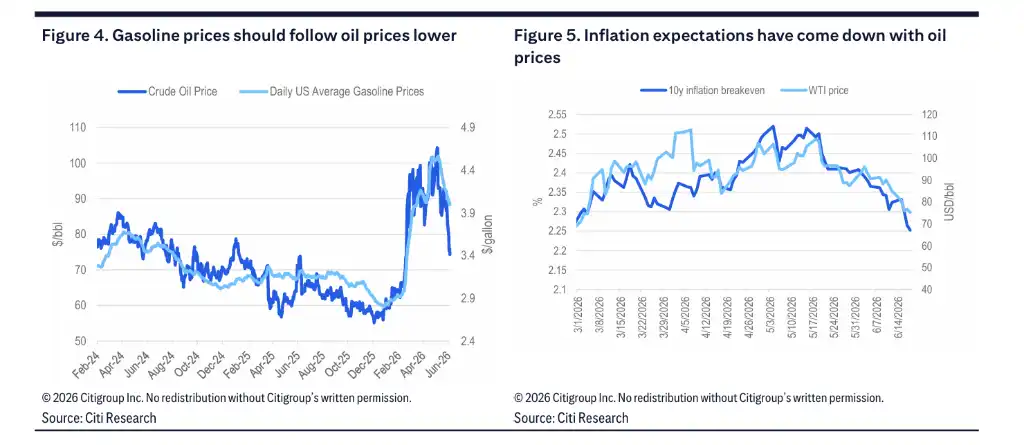
The first core argument underpinning Citi's insistence on rate cut forecasts stems from the rapid decline in oil prices. The bank believes that lower oil prices will lead to a decrease in gasoline prices, thereby removing a major source of the previous inflationary uptick. Market-based inflation expectations have already fallen in sync with oil prices, with the 10-year inflation breakeven rate dropping to levels seen before the outbreak of conflict.

Citi suggests that if Fed officials had more time to digest this latest change in energy prices, the hawkish tone of this FOMC meeting would have been significantly milder. The bank argues that as the effect of lower oil prices gradually manifests in the data, inflation figures in the coming months will trend towards moderation, helping to push more Fed officials towards a more dovish stance before September and create conditions for rate cuts before the year-end.
Citi's Second Logic: Labor Market Weakness Signals Replicate Past Seasonal Patterns

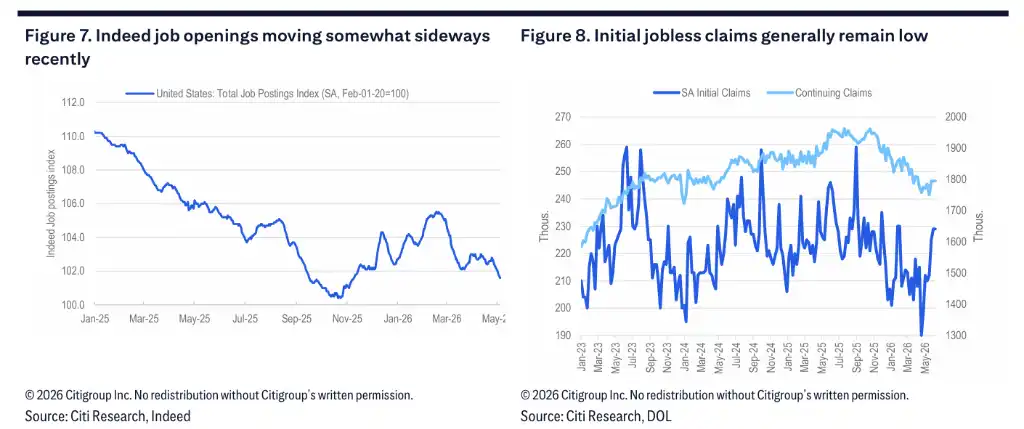
Citi's second core argument focuses on early signs of weakness emerging in the labor market.

Both initial and continuing jobless claims have shown an upward trend for several consecutive weeks. Citi notes that this pattern also appeared in both 2024 and 2025, subsequently leading to a series of weaker monthly employment reports and rising unemployment rates. A rising unemployment rate is a key driver behind Citi's expectation for Fed rate cuts this year. The bank expects initial jobless claims for the week of June 20 to remain around 224,000, with continuing claims rising slightly to 1.813 million, and the 4-week moving average to continue climbing. While the absolute levels are still not high, if the rising trend persists, it would align with the view of a gradually weakening labor market.

Regarding the overall economy, Citi's tracking forecast for Q2 GDP growth is 2.5%. On the consumption front, the May retail sales control group data showed a 0.7% month-over-month increase, indicating ongoing resilience. However, growth in real disposable income has slowed to nearly zero, and the savings rate remains low, suggesting that risks of a slowdown in spending growth are accumulating.
Citi's Third Logic: Core PCE is an 'Outlier,' The Inflation Picture is Not Unified

The third pillar of Citi's contrarian stance lies in questioning the core PCE data itself.

The May core CPI month-over-month reading was only 0.21%, showing moderation. However, Citi expects the upcoming May core PCE month-over-month reading to be as high as 0.37%, indicating a significant divergence between the two. Citi believes the current strength of core PCE has specific reasons: this measure is highly influenced by AI-related prices and is directly boosted by stock market gains—May PPI data showed a 4.8% month-over-month surge in portfolio management fees, mainly reflecting the rebound in stock prices from early April lows to early May highs, rather than genuine price pressures on the consumer side.
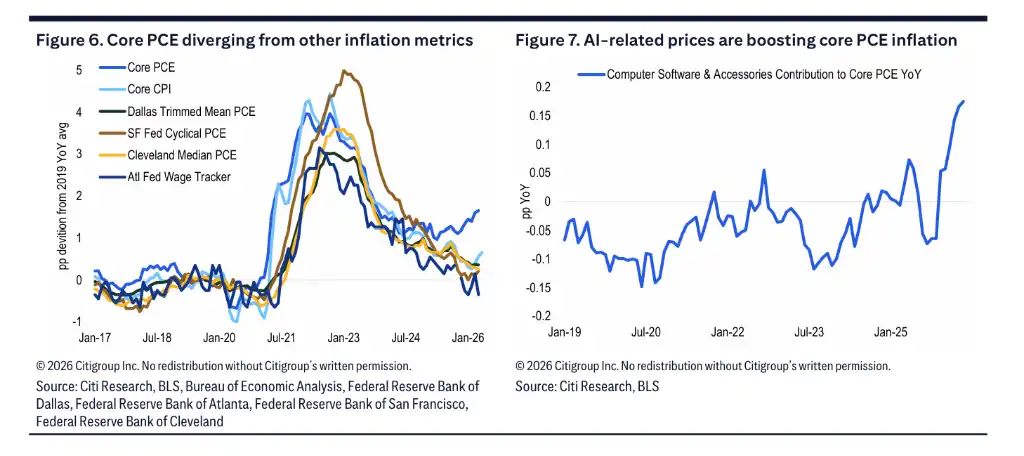
Looking at cross-sectional comparisons, the Dallas Fed's Trimmed Mean PCE, the San Francisco Fed's Cyclical Core PCE, the Cleveland Fed's Median PCE, and core CPI all show more moderate inflation trends than core PCE. Citi argues that core PCE is increasingly becoming an "outlier" among various inflation indicators, rather than a reliable signal of broad consumer price pressures.

Citi expects that as AI-related prices level off in the second half of the year, the gap between core PCE and core CPI will gradually narrow, and the overall inflation trend will become more supportive of policy easing. Under its forecast path, the year-over-year growth rate of core PCE is expected to gradually decline from the current level around 3.3% to the 2.1%-2.2% range around mid-2027.

Wall Street 'Capitulation': Deutsche Bank Forecasts Two Hikes, Goldman Sachs Warns of Serial Tightening

However, faced with Walsh's hawkish shock, Wall Street institutions have been changing their positions. Deutsche Bank's Chief US Economist Matthew Luzzetti's team clarified in a research report that the main reasons for their earlier delay in raising forecasts were two major uncertainties: the high degree of economic uncertainty stemming from the Iran situation, and the lack of clarity regarding new Fed Chair Walsh's monetary policy reaction function. The outcome of the June FOMC meeting resolved both these concerns at once.

Deutsche Bank significantly raised its inflation forecasts, lifting its expectations for year-end 2026 and 2027 core PCE to 3.2% and 2.5%, respectively. It updated its baseline forecast to: the Fed will hike rates twice in September and December, totaling 50 basis points, raising the rate to 4.1%; thereafter, it will remain on hold throughout 2027, only starting to cut rates in the first half of 2028. Deutsche Bank also warned of hawkish risks: if Chair Walsh has publicly committed to "fixing" the price stability issue and the Committee does not act promptly, its credibility could be tested—this implies a rate hike could come as early as July, and if the goal is to fully undo the easing effect generated by last year's consecutive rate cuts, the total hike for the year might need to be expanded to 75 basis points.

Goldman Sachs Vice Chairman Rob Kaplan explicitly stated that if inflation data fails to cool from now until September, a rate hike in autumn would be a "wise move." He particularly emphasized that the Fed's policy adjustments rarely occur as isolated, single actions; rate changes typically unfold in a series of 2 to 3 moves: "If they act in September, you need to be prepared, there could be one or two more hikes." Kaplan's warning, based on historical experience from navigating multiple monetary policy cycles, serves as a wake-up call for the market.

Domande pertinenti

QWhat is Citigroup's main prediction for the Federal Reserve's monetary policy in 2026, and when does it expect the first action?

ACitigroup's main prediction is that the next move by the Federal Reserve will be a rate cut, not a hike. Their baseline scenario is for a 25-basis-point rate cut to restart the easing cycle in October 2026.

QWhat are the three core arguments presented by Citigroup to support its dovish rate cut forecast?

ACitigroup's three core arguments are: 1) Falling oil prices are eliminating a major upside risk to inflation. 2) Early signs of labor market weakening, following seasonal patterns seen in 2024 and 2025, are emerging. 3) The strength of the core PCE inflation measure is viewed as an 'outlier,' driven more by stock prices and AI-related costs rather than broad consumer price pressures.

QHow did Deutsche Bank revise its Federal Reserve policy forecast following the June FOMC meeting, and what was its rationale?

ADeutsche Bank revised its forecast to predict two 25-basis-point rate hikes in September and December 2026, raising the policy rate to 4.1%. Their rationale was that the June FOMC meeting dispelled two key uncertainties: the economic uncertainty from the Iran situation and the unclear policy reaction function of the new Fed Chair, Walsh. They also warned of a risk of earlier action in July.

QWhat warning did former Dallas Fed President Rob Kaplan give regarding the potential path of Federal Reserve policy?

ARob Kaplan warned that if inflation data does not cool by autumn, a rate hike in the fall would be a 'prudent move.' He emphasized that Fed policy adjustments rarely happen in isolation and typically come in a series of 2 to 3 moves, suggesting that a hike in September could be followed by one or two more.

QAccording to Citigroup, why is the core PCE inflation measure currently considered an 'outlier' and less reliable?

ACitigroup considers the core PCE an 'outlier' because its current strength is seen as special and not reflective of broad consumer price pressures. They argue it is highly influenced by AI-related prices and is directly boosted by rising stock prices (e.g., a surge in portfolio management fees in PPI data), unlike other measures like core CPI, trimmed-mean PCE, or median PCE, which show more moderate inflation.

Letture associate

Ilya Delivers, Huang Jen-Hsun Bets 50 Billion on SSI, First Model Suspected to Launch This Week

Ilya Sutskever's Safe Superintelligence (SSI) lab, backed by a rumored $5 billion investment from NVIDIA granting exclusive access to next-gen systems, may release its first groundbreaking model as early as this week. Industry insiders are hinting at a major breakthrough from a non-major player, with some claiming AI will be "utterly transformed." The model is speculated to fundamentally differ from current large language models like ChatGPT. Instead of relying on massive, static pre-training and ever-larger context windows, SSI's approach reportedly centers on **Test-Time Training (TTT)**. This would allow the model to **update its own internal weights in real-time** as it processes information, effectively "learning on the fly" and internalizing new knowledge like a human, rather than just referencing it from a large prompt. This aligns with Ilya Sutskever's long-stated vision of moving beyond the "pre-training" and "scaling" era. He envisions superintelligence not as a monolithic, pre-loaded database, but as an adaptive, "infinitely curious 15-year-old genius" capable of continual learning through interaction. SSI's strategy has been focused solely on this goal of "safe superintelligence" through efficient continual learning and alignment, explaining its prior silence. If successful, this model could disrupt the entire AI industry, challenging the current reliance on vast compute resources for training and the business models built around context windows. It suggests that core technological leaps, not just financial scale, remain decisive in the AI race.

marsbit33 min fa

Ilya Delivers, Huang Jen-Hsun Bets 50 Billion on SSI, First Model Suspected to Launch This Week

marsbit33 min fa

Demand Test: Bitcoin Whales Earn Record $1.2 Billion, Ethereum Holders Return to Profitability

In just three days after Bitcoin's price recovery, new Bitcoin whales have realized over $1.2 billion in profit, marking the largest profit-taking event for this cohort on record according to CryptoQuant. The peak occurred on August 20 with roughly $614 million, setting a daily record. Analysts note this selling pressure began after Bitcoin rose above the realized price of short-term whales, which was around $68,900. With Bitcoin trading near $77,700 on August 23, these whales were sitting on an average profit of about 12.8%. The market recovery allowed investors who were previously at breakeven or at a loss to lock in gains. CryptoQuant described the situation as a key test for Bitcoin demand; sustained prices above whale cost-basis with normalized profit-taking could signal strong new demand, while continued selling pressure could turn the rally into a mere break-even exit. Simultaneously, large Ethereum holders have also returned to an unrealized profit zone following its rally, as noted by CryptoQuant analyst Darkfost. Current profit levels, however, remain relatively low and are not seen as creating significant selling pressure. The Unrealized Profit/Loss Ratio for different whale cohorts stands at 0.075 (for 1k-10k ETH holders), 0.16 (10k-100k ETH), and 0.38 (over 100k ETH). This marks a significant improvement from June, when these whales were in substantial unrealized loss, with Ethereum having risen over 65% since then. The increased profitability is viewed as a positive sentiment signal for the Ethereum market.

cryptonews.ru45 min fa

Demand Test: Bitcoin Whales Earn Record $1.2 Billion, Ethereum Holders Return to Profitability

cryptonews.ru45 min fa

Kinetiq Team Announces Elysium L2 Network for Hyperliquid

On August 24, the liquid staking protocol Kinetiq announced Elysium, a new L2 network for the Hyperliquid ecosystem. It aims to increase HyperEVM's throughput and simplify the launch of spot markets, tokens, and DeFi applications. Elysium will use $HYPE for gas fees and plans direct integration with HyperCore's trading engine, giving apps access to its liquidity and orderbook data. Technical details and partners will be revealed later, with a launch date set for "soon." A primary reason for Elysium's development is to overcome HyperEVM's limitations, such as low throughput and rising fees during high load. Kinetiq claims the L2 will start with significantly higher block production and transaction speeds, later aiming to approach HyperCore's performance. This targets applications needing frequent state updates like high-frequency spot trading and AMMs, and will provide them deeper access to HyperCore orderbook data. The network also proposes to streamline the process of launching new assets within Hyperliquid, allowing a token to progress from AMM liquidity to HyperCore's spot orderbook and eventually to perp markets via HIP-3 in a unified flow. Regarding revenue, Kinetiq's model allocates 50% of sequencer fees to buy back and burn $KNTQ, 25% to developers using Elysium's block space, and 25% to the Kinetiq treasury. Elysium marks Kinetiq's expansion beyond its core liquid staking product, kHYPE.

cryptonews.ru46 min fa

Kinetiq Team Announces Elysium L2 Network for Hyperliquid

cryptonews.ru46 min fa

Trading

Spot
活动图片