Fed seeks input on account type attractive to crypto firms

cointelegraphPubblicato 2025-12-22Pubblicato ultima volta 2025-12-22

Introduzione

The US Federal Reserve is seeking public input on a proposed "payment account" or "skinny master account" that would grant fintech and crypto firms access to the central bank's payment system without requiring full master account approvals. Fed Governor Christopher Waller stated these accounts aim to support innovation while maintaining safety, reflecting rapid developments in payments. However, Governor Michael Barr expressed concerns over potential money laundering and terrorist financing risks, especially for institutions not directly supervised by the Fed. Crypto firms like Circle, Coinbase, Kraken, and Block could benefit, potentially bridging crypto and traditional banking. Unlike master accounts, these payment accounts would not earn interest, lack access to Fed credit, and have balance caps. The comment period closes 45 days after Federal Register publication, with operational launch expected in Q4 2026.

The US Federal Reserve is requesting public input on its proposed “payment account,” dubbed a “skinny master account” which fintechs and crypto firms are drawn to as it would allow access to the central bank without needing the typical approvals.

"These new payment accounts would support innovation while keeping the payments system safe," Fed Governor Christopher Waller said on Friday. In October, Waller recommended that the Fed explore the idea of implementing payment accounts to clear and settle certain transaction activities of eligible financial institutions.

Waller added the Fed is introducing the payment accounts feature to reflect the “rapid developments” in the payments industry that have led to “innovative approaches to banking” and new changes in business models.

“This tailoring could result in lower risk to the payment system and, as a result, requests for payment accounts could generally receive a streamlined review.”

Not all Fed officials agreed with the decision to seek public input, with Governor Michael Barr arguing that it could pose risks if safeguards against money laundering and terrorist financing are not clearly defined, especially for institutions the Fed does not directly supervise.

Several payment-focused crypto firms could be in the running to connect to the Fed’s banking rails, potentially strengthening the bridge between crypto and traditional banking. Among the largest US-based crypto payments companies are Circle, Coinbase, Kraken, and Block, Inc.
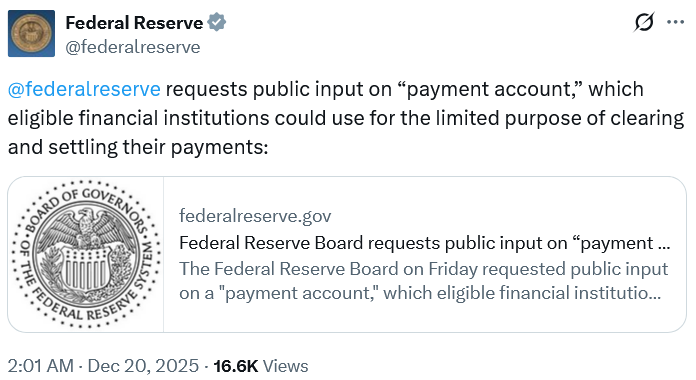
Source: Federal Reserve


Inclusion of crypto firms into the Fed’s banking system would mark a significant turnaround for the industry. Crypto companies last year claimed the Biden administration worked to deliberately cut them off from banking services to stifle the industry with what crypto backers have dubbed Operation Chokepoint 2.0.

Waller noted that the Fed has already been experimenting with blockchain-based payment technologies to modernize the US payment system.

Crypto wouldn’t get the same privileges

Payment platforms granted payment accounts, however, won’t receive the same privileges as big banks and Wall Street institutions that currently have master accounts.

Related: US Clarity Act unlikely to be ‘world-shaking’ for Bitcoin’s price: Brandt

Unlike master accounts, the proposed payment accounts would not earn interest, have access to Fed credit, and would be subject to balance caps, among other restrictions.

The comment period to give feedback on the payments account plan will close 45 days after publication in the Federal Register. Waller said last month that the payment account feature is expected to be operational in the fourth quarter of 2026.

Magazine: Bitcoin’s critical level is $82.5K, Ethereum ‘not done yet’: Trade Secrets

Domande pertinenti

QWhat is the Federal Reserve proposing that is attractive to crypto firms?

AThe Federal Reserve is proposing a 'payment account,' also known as a 'skinny master account,' which would allow fintechs and crypto firms access to the central bank's payment system without needing the typical approvals required for a full master account.

QAccording to Fed Governor Christopher Waller, what is the purpose of these new payment accounts?

AAccording to Fed Governor Christopher Waller, the purpose of these new payment accounts is to 'support innovation while keeping the payments system safe' and to reflect the rapid developments and innovative approaches in the payments industry.

QWhich Fed official expressed disagreement with the proposal and what was their concern?

AGovernor Michael Barr expressed disagreement, arguing that the proposal could pose risks if safeguards against money laundering and terrorist financing are not clearly defined, especially for institutions the Fed does not directly supervise.

QWhat are some of the key limitations of the proposed 'payment accounts' compared to full master accounts?

AUnlike full master accounts, the proposed payment accounts would not earn interest, would not have access to Fed credit, and would be subject to balance caps, among other restrictions.

QWhen is the Fed's payment account feature expected to become operational?

AFed Governor Waller said the payment account feature is expected to be operational in the fourth quarter of 2026.

Letture associate

Breaking: OpenAI Undergoes Major Reorganization, President Brockman Assumes Command

OpenAI has announced a major internal reorganization just months before its anticipated IPO. The company is merging its three flagship product lines—ChatGPT, Codex, and the API platform—into a single, unified product organization. The most significant leadership change involves co-founder and President Greg Brockman moving from a background technical role to take full, permanent control over all product strategy. This follows the indefinite medical leave of AGI Deployment CEO Fidji Simo. Additionally, ChatGPT's longtime lead, Nick Turley, has been reassigned to enterprise products, with former Instagram executive Ashley Alexander taking over consumer offerings. The consolidation, internally framed as a strategic move towards an "Agentic Future," aims to break down internal silos and create a cohesive "Super App." This planned desktop application would integrate ChatGPT's conversational abilities, Codex's coding power, and a rumored internal web browser named "Atlas" to autonomously perform complex user tasks. The reorganization occurs amid significant internal and external pressures. OpenAI has recently seen a wave of high-profile departures, including Sora co-lead Bill Peebles and other senior technical leaders, leading to concerns about a thinning executive bench. Externally, rival Anthropic recently secured funding at a staggering $900 billion valuation, surpassing OpenAI's own. Google's upcoming I/O developer conference also poses a competitive threat. Analysts suggest the dramatic restructure is a pre-IPO move to present a clearer, more focused narrative to Wall Street—streamlining operations and demonstrating decisive leadership under Brockman to counter internal turbulence and intense market competition.

marsbit51 min fa

Breaking: OpenAI Undergoes Major Reorganization, President Brockman Assumes Command

marsbit51 min fa

Two Survival Structures of Market Makers and Arbitrageurs

Market makers and arbitrageurs represent two distinct survival structures in high-frequency trading. Market makers primarily use limit orders (makers) to profit from the bid-ask spread, enjoying high capital efficiency (nominally 100%) but bearing inventory risk. This "inventory risk" arises from passive, fragmented, and discontinuous order fills in the limit order book (LOB). This risk, while a potential cost, can also contribute to excess profit if managed within control boundaries, allowing for mean reversion. Market makers essentially sell "time" (uncertainty over execution timing) to the market for price control and low fees. In contrast, cross-exchange arbitrageurs typically use market orders (takers) to exploit price differences or funding rates, resulting in lower nominal capital efficiency (requiring capital on both exchanges) and higher transaction costs. Their risk exposure stems from asymmetries in exchange rules (e.g., minimum order sizes), execution latency, and infrastructure risks (e.g., ADL, oracle drift). These exposures are active, exogenous gaps that primarily erode profits rather than contribute to them. Arbitrageurs essentially sell "space" (capital sunk across venues) for localized, immediate certainty. Both strategies engage in a trade-off between execution friction and residual risk. Optimal systems allow for temporary, controlled risk exposure rather than enforcing zero exposure at all costs. Their evolution converges towards hybrid models: arbitrageurs may use maker orders to reduce costs, while market makers may use taker orders or hedges for risk management. Ultimately, both use different forms of risk exposure—market makers exposing inventory, arbitrageurs immobilizing capital—to extract marginal, hard-won certainty from the market.

链捕手51 min fa

Two Survival Structures of Market Makers and Arbitrageurs

链捕手51 min fa

Who Will Define the Rules of the AI Era? Anthropic Discusses the 2028 US-China AI Landscape

This article, based on Anthropic's analysis, outlines the intensifying systemic competition between the U.S./allies and China for AI leadership by 2028. It argues that access to advanced computing power ("compute") is the critical bottleneck, where the U.S. currently holds a significant advantage through chip export controls and allied innovation. However, China's AI labs remain competitive by exploiting policy loopholes—via chip smuggling, overseas data center access, and "model distillation" attacks to copy U.S. model capabilities—keeping them close to the frontier. The piece presents two contrasting scenarios for 2028. In the first, decisive U.S. action to tighten compute controls and curb distillation locks in a 12-24 month AI capability lead, cementing democratic influence over global AI norms, security, and economic infrastructure. In the second, policy inaction allows China to achieve near-parity through continued access to U.S. technology, enabling Beijing to promote its AI stack globally and integrate advanced AI into its military and governance systems, altering the strategic balance. Anthropic contends that maintaining a decisive U.S. lead is essential for shaping safe AI development and governance. The core recommendation is for U.S. policymakers to urgently close compute and model access loopholes while promoting global adoption of the U.S. AI technology stack to secure a lasting strategic advantage.

marsbit2 h fa

Who Will Define the Rules of the AI Era? Anthropic Discusses the 2028 US-China AI Landscape

marsbit2 h fa

Trading

Spot
Futures

Articoli Popolari

Come comprare US

Benvenuto in HTX.com! Abbiamo reso l'acquisto di Talus Network (US) semplice e conveniente. Segui la nostra guida passo passo per intraprendere il tuo viaggio nel mondo delle criptovalute.Step 1: Crea il tuo Account HTXUsa la tua email o numero di telefono per registrarti il tuo account gratuito su HTX. Vivi un'esperienza facile e sblocca tutte le funzionalità,Crea il mio accountStep 2: Vai in Acquista crypto e seleziona il tuo metodo di pagamentoCarta di credito/debito: utilizza la tua Visa o Mastercard per acquistare immediatamente Talus NetworkUS.Bilancio: Usa i fondi dal bilancio del tuo account HTX per fare trading senza problemi.Terze parti: abbiamo aggiunto metodi di pagamento molto utilizzati come Google Pay e Apple Pay per maggiore comodità.P2P: Fai trading direttamente con altri utenti HTX.Over-the-Counter (OTC): Offriamo servizi su misura e tassi di cambio competitivi per i trader.Step 3: Conserva Talus Network (US)Dopo aver acquistato Talus Network (US), conserva nel tuo account HTX. In alternativa, puoi inviare tramite trasferimento blockchain o scambiare per altre criptovalute.Step 4: Scambia Talus Network (US)Scambia facilmente Talus Network (US) nel mercato spot di HTX. Accedi al tuo account, seleziona la tua coppia di trading, esegui le tue operazioni e monitora in tempo reale. Offriamo un'esperienza user-friendly sia per chi ha appena iniziato che per i trader più esperti.

381 Totale visualizzazioniPubblicato il 2025.12.11Aggiornato il 2025.12.11

Come comprare US

Discussioni

Benvenuto nella Community HTX. Qui puoi rimanere informato sugli ultimi sviluppi della piattaforma e accedere ad approfondimenti esperti sul mercato. Le opinioni degli utenti sul prezzo di US US sono presentate come di seguito.

活动图片