Fed Rate Cut Tonight Almost Certain, This Meeting More Like a 'Political Pressure Test'!

marsbitPubblicato 2025-12-10Pubblicato ultima volta 2025-12-10

Introduzione

This week's Federal Reserve policy meeting is set to be one of the most contentious in recent years. With key economic data missing due to a 43-day U.S. government shutdown, the meeting has evolved into a stress test of the Fed’s independence and decision-making process. Market expectations for a rate cut have surged from 30% to 97%, reflecting both data uncertainty and growing political influence. Internally, the Fed is deeply divided, with a 4-4 split among key officials between holding rates and cutting. The dot plot shows a rare "bimodal distribution," with 7 officials favoring no change and 8 supporting a 50-basis-point cut. Doves point to a weakening labor market—unemployment rose to 4.3% in August, a four-year high—while hawks emphasize persistent inflation, with core PCE at 2.7%, above the 2% target. Political pressure has intensified, notably through appointments like Stephen Milan, who voted for a deeper cut just one day into his role, aligning with former President Trump’s public demands. The upcoming Fed leadership transition adds further uncertainty, as officials may be positioning for future roles. Amid data gaps and political interference, the Fed faces a complex risk-management dilemma: balancing concerns over slowing employment against inflation risks and soaring government debt interest costs. Communication challenges are heightened by internal divisions, forcing the Fed to rely more on high-frequency and alternative data. This meeting may mark a shift to...

This week's Federal Reserve policy meeting will be one of the most controversial decisions in recent years.

Against the backdrop of a 43-day U.S. government shutdown that has led to a lack of key economic data, this meeting has transcended the realm of pure monetary policy, evolving into a stress test for the Fed's independence and decision-making mechanisms.
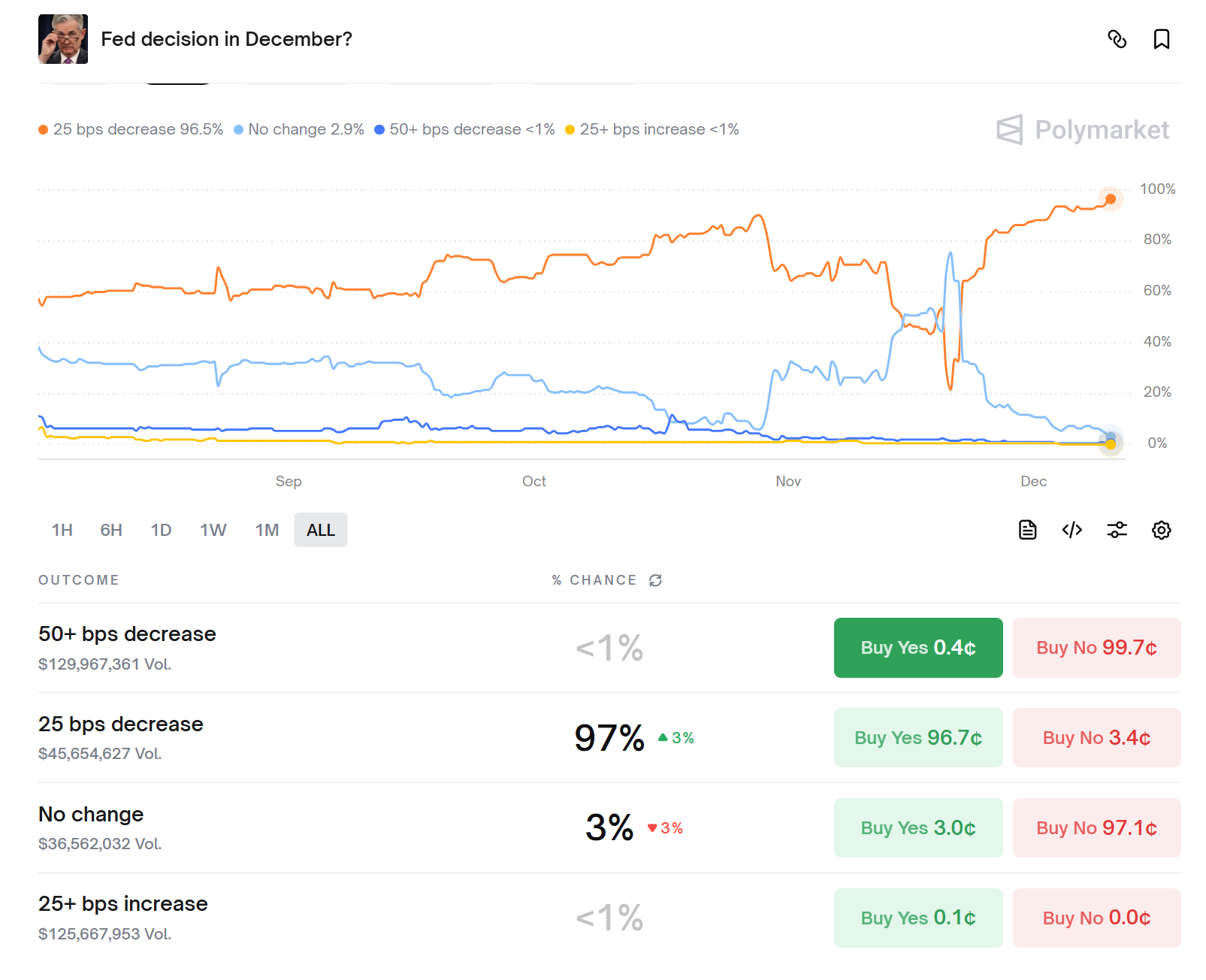
Market expectations for a rate cut have surged from 30% three weeks ago to 97% currently. This dramatic shift not only reflects collective anxiety in a data vacuum but also reveals that political pressure's influence on monetary policy is becoming more explicit.

Data Fog and Internal Divisions

The decision-making environment for the Fed at this meeting is exceptionally unique—the record 43-day U.S. government shutdown has resulted in the absence of most key economic data. This leaves the Fed, which has long emphasized being "data-dependent," seemingly navigating through a fog without clear coordinates for decision-making.

The absence of key official economic data, combined with the "mixed" nature of other alternative data, means the macroeconomic situation lacks a clear, objective anchor, leading to significant divergence in interpretations from various parties. Internal disagreements have become public and are trending toward polarization.

Currently, the stance on rate cuts among Federal Reserve Board members plus the New York Fed President presents a delicate 4-to-4 deadlock. This division is directly reflected in the dot plot, showing a rare "bimodal distribution"—7 officials support keeping rates unchanged for the full year, while 8 believe rates should be cut by 50 basis points.

More notably, the reasoning from both sides is equally compelling. Dovish officials argue the job market has clearly deteriorated, with the unemployment rate rising to 4.3% in August, a four-year high, and nonfarm payrolls increasing by only 22,000, far below expectations. Hawkish officials, however, are focused on inflation issue, with the core PCE price index rising 2.7% year-on-year, still above the Fed's long-term 2% target.


Pathways of Political Pressure Infiltration

The uniqueness of this meeting stems not only from the lack of economic data but also from the fact that political pressure is介入 (intervening in) the monetary policy arena in an unprecedentedly direct manner.

The Trump administration is directly influencing the structure of the Fed's decision-making layer through personnel appointments, breaking the long-standing tradition of "political neutrality" at the Fed.

The appointment of new Governor Stephen Milan is of symbolic significance. As a Fed governor simultaneously serving as Chairman of the White House Council of Economic Advisers, Milan cast a dissenting vote just one day after taking office, advocating for a more aggressive 50 basis point rate cut.

This policy stance highly aligns with Trump's public demand to "cut rates immediately and by a larger margin," raising deep concerns about the Fed's independence. More alarmingly, the Trump administration has clearly indicated that a nomination for the next Fed Chairperson might be announced before the end of December.

For the current core Fed decision-makers, this meeting might be their last chance to state their position and choose sides. Policy decisions during this power transition period inevitably involve considerations of personal career prospects.

The Fed faces not just a technical decision on interest rate adjustments but a severe test of its institutional independence. The balance between political pressure and professional judgment has become a key variable affecting the outcome of this meeting.


The Dilemma of Risk Management

Under the dual challenges of data absence and political pressure, the Fed's decision this time is essentially a complex risk management practice, requiring finding a balance between conflicting objectives. On one hand, the Fed needs to address the downside risks from a weakening labor market. Nonfarm payrolls increased by only 22,000 in August, a significant drop from the revised 79,000 in July, and the unemployment rate rose to a four-year high of 4.3%. If this slowing trend continues, it could trigger a vicious cycle of consumption contraction and economic recession.

On the other hand, inflation risks persist. Although current price pressures mainly stem from supply-side factors (such as import costs pushed up by tariff policies) rather than demand-pull from an overheating economy, whether inflation expectations can be effectively anchored remains uncertain. If the rate cut is too large, it could increase inflation risks, even triggering a wage-price spiral.

Making it more complex, the U.S. government's interest expense on debt has reached $1.1 trillion annually. While rate cuts could ease fiscal pressure, they might also fuel asset bubbles. This权衡 (trade-off) under multiple objectives complicates the Fed's decision-making framework, going beyond the traditional "dual mandate."


Institutional Resilience and Communication Challenges

This meeting tests not only the Fed's decision-making wisdom but also its institutional resilience and communication capabilities. With serious internal divisions, how to form a consensus and effectively communicate policy signals is a key challenge facing Chair Powell.

The divergence in the dot plot is phenomenal. Among the 19 policymakers, 6 believe no further rate cuts are needed, 9 support two more cuts, and there is also one clear outlier (likely Milan) hoping for an additional 125 basis points of cuts this year. This dispersed forecast distribution increases market skepticism about the Fed's communication strategy.

The Fed might address this challenge by strengthening forward guidance. A possible strategy is to emphasize the principle of "deciding meeting-by-meeting," avoiding clear commitments to the future path while stressing that policy will remain flexible. While this strategy might temporarily sidestep internal disagreements, it could weaken the effectiveness of policy signals.

A more profound challenge is how to gain market trust for decisions made in a data-deficient environment. The Fed may rely more heavily on high-frequency data (like weekly jobless claims) and alternative indicators (such as business surveys and the Beige Book) as references for decision-making. This shift in decision-making mode itself is a test of its communication ability.

As 2025 draws to a close, the Fed's future path remains full of unknowns. The分散的 (scattered) predictions on the dot plot indicate that officials hold differing views on the economic outlook and policy path for 2026. This meeting might inaugurate a全新的 (brand new) monetary policy framework: data absence will become the norm, not the exception; political pressure will move from behind the scenes to the forefront; and the Fed's independence will depend on its ability to maintain policy resolve in a complex environment.


Domande pertinenti

QWhy is the Federal Reserve's upcoming policy meeting considered a 'political pressure test'?

AThe meeting is seen as a political pressure test because it is occurring amid unprecedented political influence, including direct demands from the Trump administration for rate cuts and the appointment of a Fed governor who also serves as a White House economic advisor, challenging the Fed's traditional independence.

QWhat makes the decision-making environment for this Fed meeting particularly unusual?

AThe decision-making environment is unusual due to the 43-day U.S. government shutdown, which has resulted in a lack of key economic data, leaving the Fed to operate in a 'data fog' without clear benchmarks for its typically data-dependent approach.

QHow are the Fed officials divided on the issue of interest rates according to the dot plot?

AThe dot plot shows a rare bimodal distribution: 7 officials support keeping rates unchanged for the year, while 8 expect a 50 basis point cut. One outlier, likely Stephen Milan, even advocates for a 125 basis point cut by year-end.

QWhat are the key risks the Fed must balance in its rate decision?

AThe Fed must balance the risk of a weakening labor market, with unemployment at a four-year high, against persistent inflation concerns, as core PCE remains above the 2% target, while also considering the impact on government debt costs and potential asset bubbles.

QWhat challenges does the Fed face in communicating its policy amid internal divisions?

AThe Fed faces challenges in forming a consensus and effectively signaling policy due to stark internal divisions. It may emphasize a 'meeting-by-meeting' approach and rely more on high-frequency and alternative data, but this could weaken the clarity of its policy guidance.

Letture associate

Three Frameworks for Ordinary People to Achieve AI Capability Leap: Say Goodbye to the Dilemma of 'Repeating Inputs Every Day'

Summary: This article outlines three frameworks for maximizing AI efficiency, moving beyond basic prompt usage. 1. **Three-Layer Evolution**: Users progress from (1) **Prompt** (one-off instructions, reset each session), to (2) **Project** (context-aware within a specific project), to (3) **Skill** (permanent, auto-applied knowledge). Most users stagnate at the first layer, repeating the same instructions daily with no cumulative improvement. Skills transform the AI from a chat tool into a personalized work system. 2. **Transaction vs. Compound Interest Mindset**: Using prompts is a linear transaction—effort and output are 1:1, and stopping resets progress. Investing time in building Skills is compound interest; a small initial time investment pays continuous dividends, as each Skill permanently elevates the AI's baseline performance. 3. **Thin Harness, Fat Skills**: The system architecture should prioritize thick, well-defined Skills (90% of the value—containing processes, standards, and domain knowledge) and a thin "harness" (the minimal technical environment). Avoid over-engineering the toolchain while neglecting the AI's actual knowledge. Skills are permanent assets that automatically improve with model updates. The key takeaway: Identify tasks you repeat, encode them into Skills (using tools like Claude's Skill Creator), and shift focus from daily prompting to building a compounding, self-improving AI system.

marsbit40 min fa

Three Frameworks for Ordinary People to Achieve AI Capability Leap: Say Goodbye to the Dilemma of 'Repeating Inputs Every Day'

marsbit40 min fa

Trading

Spot
Futures

Articoli Popolari

Come comprare CFG

Benvenuto in HTX.com! Abbiamo reso l'acquisto di Centrifuge (CFG) semplice e conveniente. Segui la nostra guida passo passo per intraprendere il tuo viaggio nel mondo delle criptovalute.Step 1: Crea il tuo Account HTXUsa la tua email o numero di telefono per registrarti il tuo account gratuito su HTX. Vivi un'esperienza facile e sblocca tutte le funzionalità,Crea il mio accountStep 2: Vai in Acquista crypto e seleziona il tuo metodo di pagamentoCarta di credito/debito: utilizza la tua Visa o Mastercard per acquistare immediatamente CentrifugeCFG.Bilancio: Usa i fondi dal bilancio del tuo account HTX per fare trading senza problemi.Terze parti: abbiamo aggiunto metodi di pagamento molto utilizzati come Google Pay e Apple Pay per maggiore comodità.P2P: Fai trading direttamente con altri utenti HTX.Over-the-Counter (OTC): Offriamo servizi su misura e tassi di cambio competitivi per i trader.Step 3: Conserva Centrifuge (CFG)Dopo aver acquistato Centrifuge (CFG), conserva nel tuo account HTX. In alternativa, puoi inviare tramite trasferimento blockchain o scambiare per altre criptovalute.Step 4: Scambia Centrifuge (CFG)Scambia facilmente Centrifuge (CFG) nel mercato spot di HTX. Accedi al tuo account, seleziona la tua coppia di trading, esegui le tue operazioni e monitora in tempo reale. Offriamo un'esperienza user-friendly sia per chi ha appena iniziato che per i trader più esperti.

506 Totale visualizzazioniPubblicato il 2026.03.19Aggiornato il 2026.03.19

Come comprare CFG

Cosa è WL

I. Introduzione al ProgettoWorldLand è una L2 o side chain di Ethereum, progettata come una soluzione dal basso verso l'alto per migliorare l'ecosistema di Ethereum.II. Informazioni sul Token1) Informazioni di BaseNome del token: WL (WorldLand)III. Link CorrelatiSito web:https://worldland.foundation/Esploratori:https://bscscan.com/address/0x8aaB31fbc69C92fa53f600910Cf0f215531F8239Social:https://x.com/WorldLand_space Nota: L'introduzione al progetto proviene dai materiali pubblicati o forniti dal team ufficiale del progetto, che sono solo a scopo di riferimento e non costituiscono consulenza per gli investimenti. HTX non si assume alcuna responsabilità per eventuali perdite dirette o indirette risultanti.

287 Totale visualizzazioniPubblicato il 2026.03.28Aggiornato il 2026.03.28

Cosa è WL

Come comprare WL

Benvenuto in HTX.com! Abbiamo reso l'acquisto di WorldLand (WL) semplice e conveniente. Segui la nostra guida passo passo per intraprendere il tuo viaggio nel mondo delle criptovalute.Step 1: Crea il tuo Account HTXUsa la tua email o numero di telefono per registrarti il tuo account gratuito su HTX. Vivi un'esperienza facile e sblocca tutte le funzionalità,Crea il mio accountStep 2: Vai in Acquista crypto e seleziona il tuo metodo di pagamentoCarta di credito/debito: utilizza la tua Visa o Mastercard per acquistare immediatamente WorldLandWL.Bilancio: Usa i fondi dal bilancio del tuo account HTX per fare trading senza problemi.Terze parti: abbiamo aggiunto metodi di pagamento molto utilizzati come Google Pay e Apple Pay per maggiore comodità.P2P: Fai trading direttamente con altri utenti HTX.Over-the-Counter (OTC): Offriamo servizi su misura e tassi di cambio competitivi per i trader.Step 3: Conserva WorldLand (WL)Dopo aver acquistato WorldLand (WL), conserva nel tuo account HTX. In alternativa, puoi inviare tramite trasferimento blockchain o scambiare per altre criptovalute.Step 4: Scambia WorldLand (WL)Scambia facilmente WorldLand (WL) nel mercato spot di HTX. Accedi al tuo account, seleziona la tua coppia di trading, esegui le tue operazioni e monitora in tempo reale. Offriamo un'esperienza user-friendly sia per chi ha appena iniziato che per i trader più esperti.

203 Totale visualizzazioniPubblicato il 2026.03.28Aggiornato il 2026.03.28

Come comprare WL

Discussioni

Benvenuto nella Community HTX. Qui puoi rimanere informato sugli ultimi sviluppi della piattaforma e accedere ad approfondimenti esperti sul mercato. Le opinioni degli utenti sul prezzo di A A sono presentate come di seguito.

活动图片