Fed Cuts Rates Amid Divisions, but Bitcoin's 'Fanger Zone' Keeps BTC Below $100K

marsbitPubblicato 2025-12-10Pubblicato ultima volta 2025-12-10

Introduzione

The Federal Reserve approved a 25-basis-point rate cut amid internal divisions, but Bitcoin remains stuck below $100,000 due to structural weaknesses and persistent selling pressure. Despite a pre-FOMC rally to $94,000, the "hawkish" tone of the rate cut and concerns over inflation and economic slowdown limited upward momentum. According to Glassnode, BTC is trapped in a fragile range between $81,300 and $102,700, with unrealized losses rising and realized losses hitting $555 million daily—levels last seen during the FTX collapse. Long-term holders are realizing over $1 billion in profits daily, while new buyers face capitulation. The rally has been driven by spot demand rather than leveraged speculation, but sustained growth may require renewed derivatives activity. The Fed's rate cut is unlikely to provide significant short-term bullish momentum for Bitcoin.

The Federal Reserve approved a 0.25% rate cut amid internal divisions, but concerns over inflation and economic growth, along with what Glassnode highlights as BTC's "fragile zone," may continue to keep it suppressed below $100,000.

On Wednesday, the U.S. Federal Reserve approved a 25 basis point rate cut, the third such cut this year, in line with market expectations. Mirroring pre-FOMC meeting price action seen previously, Bitcoin had surged past $94,000 on Monday, but a "hawkish" media interpretation of this cut reflects ongoing divisions within the Fed regarding U.S. monetary policy and the economic outlook.

Given this week's rate cut being labeled as "hawkish," Bitcoin's price could see a "sell the news" reaction and continue to trade sideways until new momentum catalysts emerge.

As reported by CNBC, the Fed's decision passed with a 9-3 vote, indicating lingering concerns among members about persistent inflation and expectations for slower economic growth and a more gradual pace of rate cuts through 2026.

According to Glassnode data, Bitcoin (BTC $92,626) remains trapped in a structurally fragile zone below $100,000, with its price action bounded by the short-term holder cost basis at $102,700 and the "true market mean" at $81,300.

Glassnode's data further shows that Bitcoin continues to be held below $100,000 in an environment of weakening on-chain conditions, reduced futures demand, and persistent selling pressure.

Key Takeaways:

  • Bitcoin's structurally fragile zone is stalling the market below $100,000, with mounting unrealized losses.
  • Realized losses have surged to $555 million per day, the highest level since the FTX collapse in 2022.
  • Massive profit-taking by holders of one year or more, coupled with capitulation from top buyers, is preventing Bitcoin from reclaiming the STH (Short-Term Holder) cost basis.
  • The Fed's rate cut may not provide significant near-term upside momentum for Bitcoin.

Time is Running Out for Bitcoin to Reclaim $100,000

According to Glassnode, Bitcoin's failure to break above $100,000 reflects intensifying structural pressure: time is working against the bulls. The longer the price remains stuck in this fragile zone, the more unrealized losses accumulate, increasing the likelihood of forced selling.
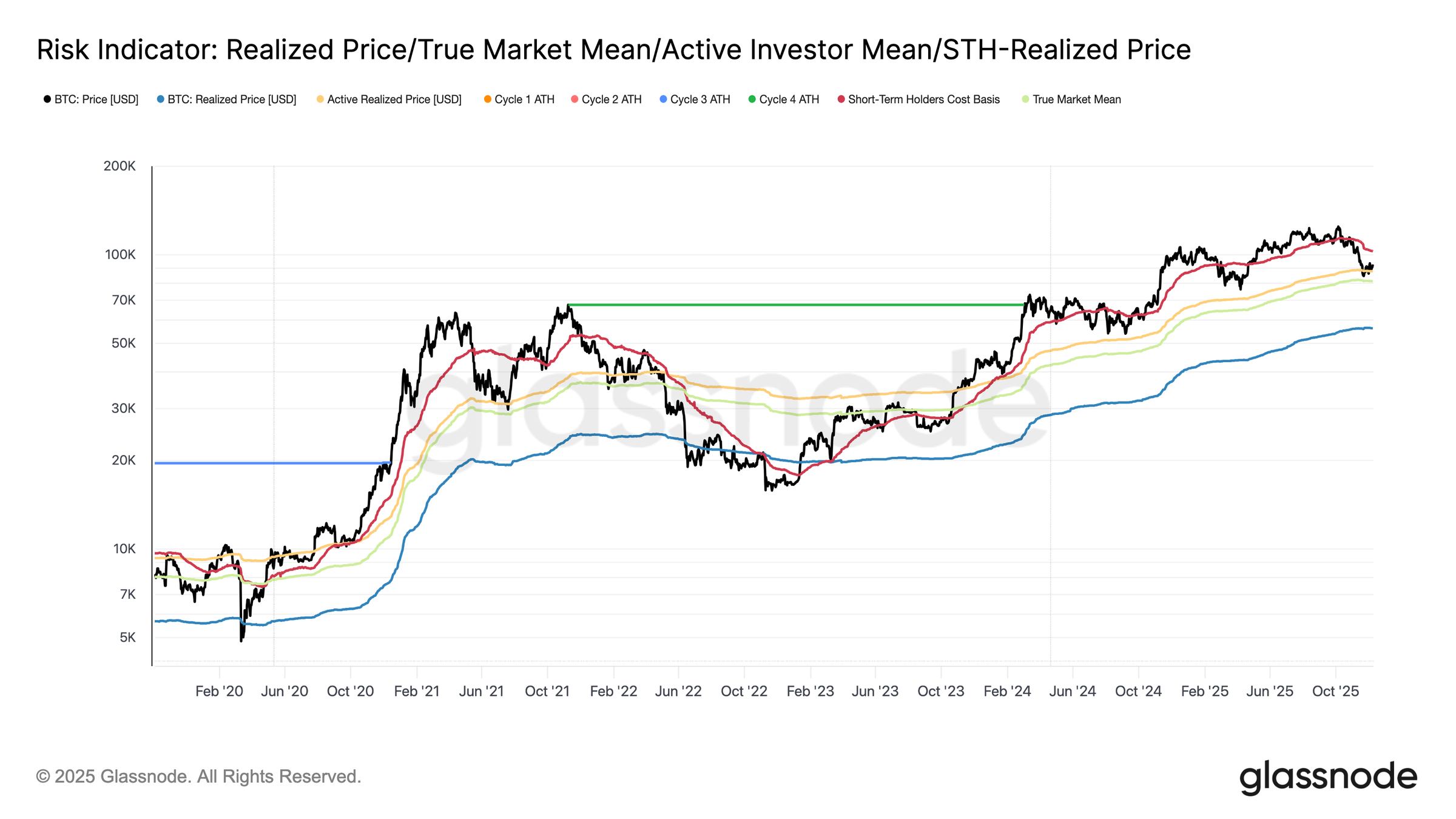
Realized price and true market mean for Bitcoin. Source: Glassnode

The 30-day simple moving average (SMA) of relative unrealized loss has risen to 4.4%, breaking out of a two-year sub-2% range and signaling an entry into a higher-stress market environment. Despite Bitcoin's rebound from the November 22 low to around $92,700, the entity-adjusted realized loss continues to climb, reaching $555 million per day, levels consistent with the FTX capitulation period.

Simultaneously, long-term holders (holding for over one year) are realizing over $1 billion in profits daily, with peaks hitting a record $1.3 billion. Capitulation from top buyers combined with massive distribution by long-term holders will likely keep BTC suppressed below key cost bases, preventing a reclaim of the $95,000–$102,000 resistance zone, which marks the upper bound of the fragile zone.
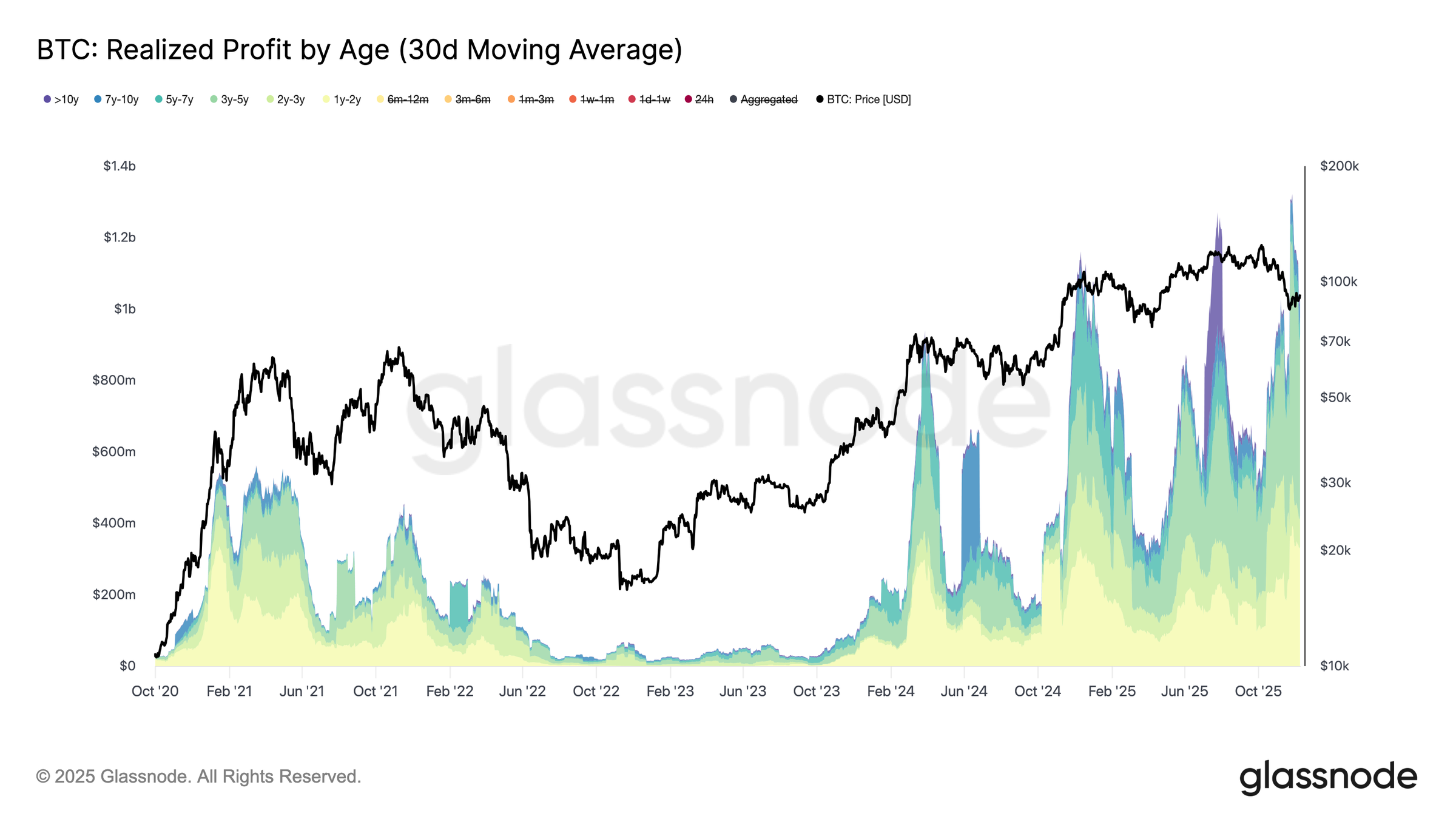
Realized profit by age. Source: Glassnode

Spot-Led Rally Meets a Shrinking Futures Market

Data from CryptoQuant shows that crypto markets typically rally ahead of FOMC meetings, but a significant divergence has recently appeared: Bitcoin's price is rising while open interest (OI) continues to decline.
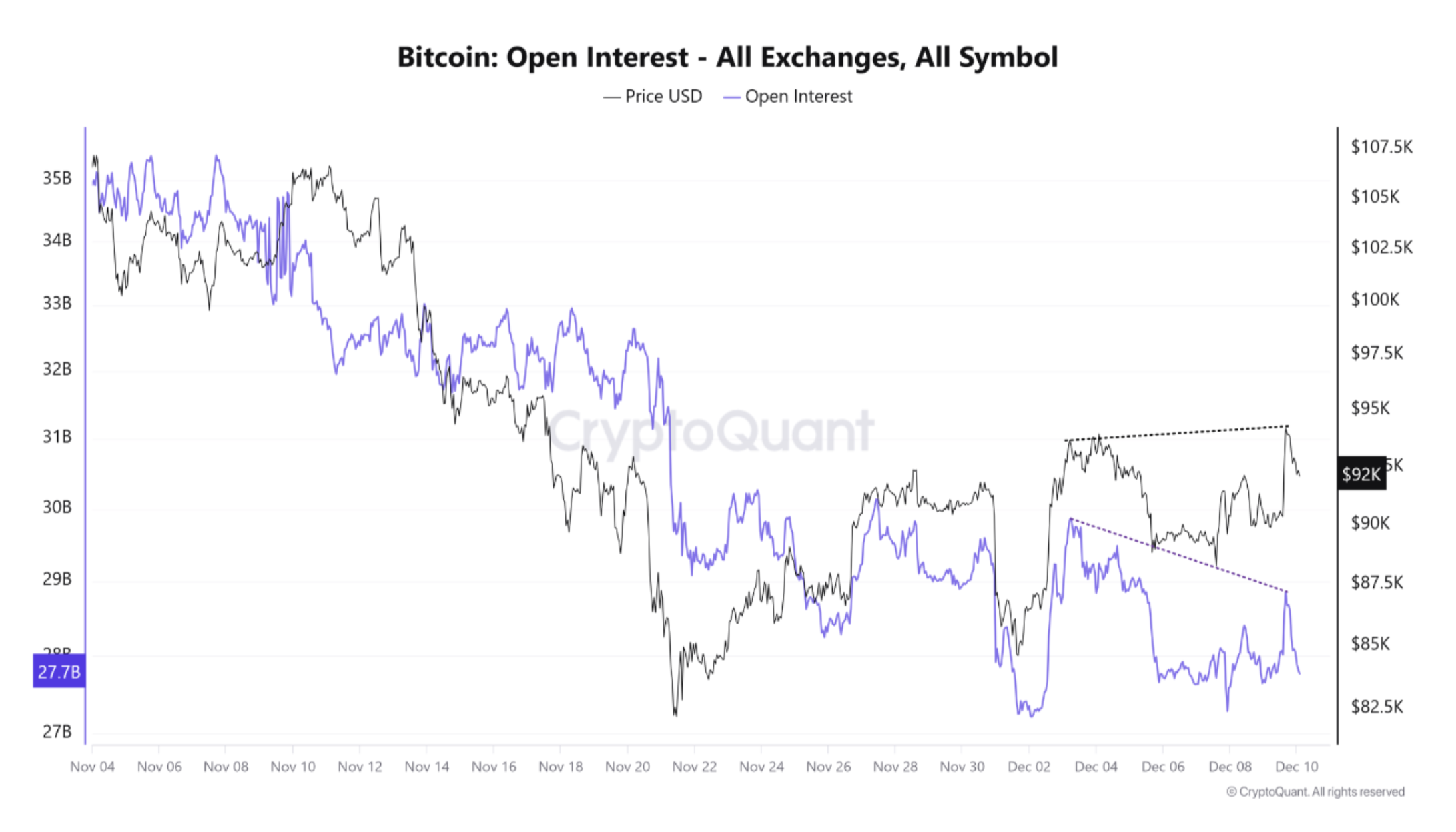
Bitcoin price versus open interest divergence. Source: CryptoQuant

Open interest has been declining throughout the correction since October, and even as Bitcoin found a bottom on November 21st and prices moved higher, OI continued to fall. This suggests the current rally is primarily driven by spot demand, not leveraged speculation.

CryptoQuant added that while spot-driven advances are generally healthier, sustained bullish momentum historically still requires a rise in leveraged positions. Given that derivatives trading volume structurally dominates the market—with spot volume accounting for only about 10% of derivatives activity—this spot-driven strength could be difficult to sustain if market expectations for future rate cuts weaken ahead of the meetings.

Domande pertinenti

QWhat was the outcome of the recent Federal Reserve meeting regarding interest rates, and how did it align with market expectations?

AThe Federal Reserve approved a 25 basis point interest rate cut, which was the third cut of the year and in line with market expectations.

QAccording to Glassnode, what is the key price range trapping Bitcoin below $100,000, and what are the upper and lower bounds of this 'structurally fragile' zone?

ABitcoin is trapped in a structurally fragile range below $100,000, bounded by the short-term holder cost basis at $102,700 and the 'true market mean' at $81,300.

QWhat does the data show about the daily losses being realized in the Bitcoin market, and how does it compare to a previous significant event?

ARealized losses have surged to $555 million per day, which is the highest level since the FTX collapse in 2022.

QHow does the current market rally differ from previous ones in terms of the role of derivatives, and what does this suggest about its sustainability?

AThe current rally is primarily driven by spot demand rather than leveraged speculation, as indicated by declining open interest. While a spot-led rally is generally healthier, sustained bullish momentum has historically required an increase in leverage, which is currently absent.

QWhat two major groups of sellers are applying significant selling pressure, preventing Bitcoin from reclaiming a key resistance zone?

ALong-term holders (holding for over a year) are realizing profits at a record scale, and 'top buyers' are capitulating. These two groups are applying significant selling pressure, preventing Bitcoin from reclaiming the $95,000–$102,000 resistance zone.

Letture associate

4 Key Themes Orchestrating the 2025 Crypto Symphony

Four Keywords Outline Crypto's 2025 Journey: Trump Effect, DAT Treasuries, Stock Tokenization, and the October Crash. 2025 was a pivotal year for crypto, marked by mainstream adoption, regulatory shifts, and extreme volatility. The year unfolded in four distinct acts: **Spring: The Trump Effect.** Following his January inauguration, President Trump's pro-crypto stance fueled a market surge. The "official" TRUMP meme coin created a wealth frenzy, and BTC approached $110k. Key developments included appointing a crypto-friendly SEC chairman and initiating a Bitcoin strategic reserve using seized assets, though not without controversy. **Summer: DAT Treasury Companies & Stablecoins.** A Trump-led global tariff war triggered a "Black Monday" crash in April. The market rebounded with the rise of DAT (Digital Asset Treasury) companies, following Circle's landmark IPO. Public companies like Sharplink and Bitmine pivoted to hold massive ETH treasuries, sparking a trend that later saw many face significant paper losses as hype faded. **Autumn: Stock Tokenization & Hype Cycles.** The success of stablecoins and Circle's stock performance ignited the RWA sector. Platforms like xStocks and MyStonks pioneered tokenized stock trading, a trend even Nasdaq sought to join. Meanwhile, hype surrounded new Perp DEXs like Aster and stablecoin projects like Plasma and the Trump-affiliated WLFI, though many saw dramatic price collapses later. **Winter: The October Crash & Prediction Markets.** After a new BTC high, a Trump-announced tariff hike on October 11th triggered a historic market crash, resulting in an estimated $30-40 billion in liquidations. In the aftermath, prediction markets Polymarket and Kalshi emerged as dominant players, both achieving multi-billion dollar valuations as they became central to navigating the volatile political and financial landscape. The year demonstrated that while crypto is increasingly shaped by U.S. policy and TradFi adoption, it remains a high-stakes arena of immense opportunity and risk.

marsbit6 min fa

4 Key Themes Orchestrating the 2025 Crypto Symphony

marsbit6 min fa

Trading

Spot
Futures
活动图片