FARTCOIN draws smart money interest, yet price stays trapped – Why?

ambcryptoPubblicato 2025-12-13Pubblicato ultima volta 2025-12-13

Introduzione

Despite being identified as the most bought token by smart money over 24 hours, Fartcoin (FARTCOIN) continued trading within a bearish flag pattern, keeping technical pressure high. While smart money inflows provided short-term support, the price remained compressed between key levels. It traded near $0.36, just above a critical ascending support at $0.35. A break below this level could invalidate the current structure. On the upside, resistance lies at $0.42–$0.43. A confirmed breakout above this zone could target $0.65–$0.70. However, momentum indicators like RSI showed bearish divergence, signaling weakening buying pressure and elevated downside risk. Broader memecoin sentiment stayed cautious despite selective capital rotation into stronger setups like FARTCOIN.

Most memecoins traded in oversold territory, but smart money showed selective interest in stronger setups.

Against that backdrop, Fartcoin stood out after StalkChain data showed it as the most bought token by smart money over 24 hours. Broader memecoin sentiment stayed cautious, yet capital rotated into names showing relative strength.

However, that accumulation unfolded while Fartcoin [FARTCOIN] traded inside a bearish flag, keeping technical pressure elevated despite inflows.

At press time, FARTCOIN traded near $0.36, holding just above a rising ascending support defining its recent structure. Volatility compressed inside the bearish flag, setting up a near-term inflection point.

Smart money meets hesitation

According to analyst Sjuul, FARTCOIN’s move above the 4-hour EMA 200 marked an important technical shift. The EMA 200 often acted as a long-term trend filter, and holding above it limited downside continuation.

That said, upside momentum failed to expand.

On the 4-hour chart, FARTCOIN continued compressing inside a well-defined bearish flag. Sellers pressed gradually lower, while buyers stayed active near support. Smart money inflows offered support, but breakout confirmation remained absent.

Can bulls defend $0.35?

Momentum indicators continued flashing caution.

RSI printed a bearish divergence as the price attempted higher levels, signaling weakening buying pressure. As RSI drifted toward neutral territory, downside risk increased if the structure failed.

The $0.35 ascending trendline remained the key support that bulls needed to defend. A breakdown there risked invalidating the current structure.

On the upside, price faced resistance near $0.42–$0.43, where prior selling capped advances. A confirmed reclaim could open a move toward $0.65, followed by supply near $0.70.

Until then, the price stayed compressed between rising support and overhead resistance, keeping FARTCOIN in a high-risk decision zone.


Final Thoughts

  • Smart money accumulation gave FARTCOIN short-term support, but price action did not confirm a trend shift yet.
  • Holding the $0.35 ascending support remained critical for maintaining structure.

Letture associate

Why Not Short Even When Bearish? Munger Did the Math on a 'Losing Trade'

Why Not Short Even When Bearish? Charlie Munger's Calculated "Loss-Making Account" Many traders, drawn to speculative tools like futures contracts, often face repeated failures. As the article notes, unless one is a genius, such instruments should be avoided for long-term profit-seeking. Similarly, the practice of short selling is viewed with caution. The author firmly states a policy of not shorting, even when bearish, preferring to simply wait. The core reason? Successful short selling requires exceptionally difficult conditions to profit. Legendary investors Warren Buffett and Charlie Munger have themselves reflected on painful short-selling experiences. Munger highlights two critical flaws in the mathematical logic of shorting: 1. Asymmetrical Risk/Reward: A long position has a maximum loss of 100% but unlimited upside. A short position caps profit at 100% (if a stock falls to zero) but carries theoretically unlimited loss potential. 2. The "Promoter" Problem: Fraudulent or struggling companies can prolong their decline. As Munger said, "You can run out of money before the promoter runs out of ideas," meaning short sellers may be forced to cover positions at a loss before the company's true fate unfolds. The article cites Stanley Druckenmiller, a famed hedge fund manager. He once shorted 12 companies that all eventually went bankrupt. However, intense market rallies forced him to cover his positions within three weeks, resulting in massive losses—$200 million of his capital plus an additional $600 million. He concluded he likely never made money shorting in his career. His experience perfectly illustrates Munger's points: facing unlimited losses and being wiped out before being proven right. The conclusion is clear: for most investors, complex instruments like short selling and derivatives are not viable paths to stable, long-term gains. Self-reflection is advised before repeatedly wasting time and capital on such speculative strategies.

marsbit16 min fa

Why Not Short Even When Bearish? Munger Did the Math on a 'Losing Trade'

marsbit16 min fa

For Hedging, Buy Gold and Oil; For Explosive Growth, Buy AI; Bitcoin, the 'Outdated' Asset, Enters a Bear Market

Bitcoin’s price has recently fallen sharply, hitting a two-month low near $66,000, with Ethereum also dropping to a three-month low. While surface explanations point to ETF outflows, geopolitical tensions, and corporate selling, a deeper issue is emerging: Bitcoin is losing a crucial asset competition. For years, Bitcoin thrived in a low-rate environment where investors sought alternatives amid inflation fears and dissatisfaction with traditional options. Now, the market landscape has shifted, leaving Bitcoin stuck in an "awkward middle ground," facing challenges on three fronts: 1. **As an inflation hedge, gold is winning.** Investors worried about persistent inflation are turning to tangible assets like gold, energy stocks, and commodity producers, which offer more direct pricing power and physical backing. 2. **For growth exposure, AI is winning.** Those seeking high growth now favor AI-related companies with actual revenues and profits, an area where Bitcoin's lack of cash flow puts it at a disadvantage. 3. **Within crypto, infrastructure and stablecoins are winning.** Even investors wanting crypto exposure have alternatives like exchanges, stablecoin issuers, and tokenization firms, whose performance is directly tied to real-world adoption and offers clearer operational leverage. The recent market reaction to inflation warnings highlights this shift. Instead of boosting Bitcoin as "digital gold," such news now drives flows toward traditional inflation-sensitive assets. Therefore, recent events like ETF outflows and corporate selling are seen not as causes, but as symptoms of this new reality. Capital has more compelling options, and investors are becoming more selective. The emerging bear case for Bitcoin is no longer about it being a fraud or failed technology, but rather that **scarcity alone is no longer enough**. It is no longer seen as the best hedge, the best growth asset, or the only crypto play.

marsbit32 min fa

For Hedging, Buy Gold and Oil; For Explosive Growth, Buy AI; Bitcoin, the 'Outdated' Asset, Enters a Bear Market

marsbit32 min fa

SaaS Battle Royale: The Survivors Who Win All Share One Common Trait

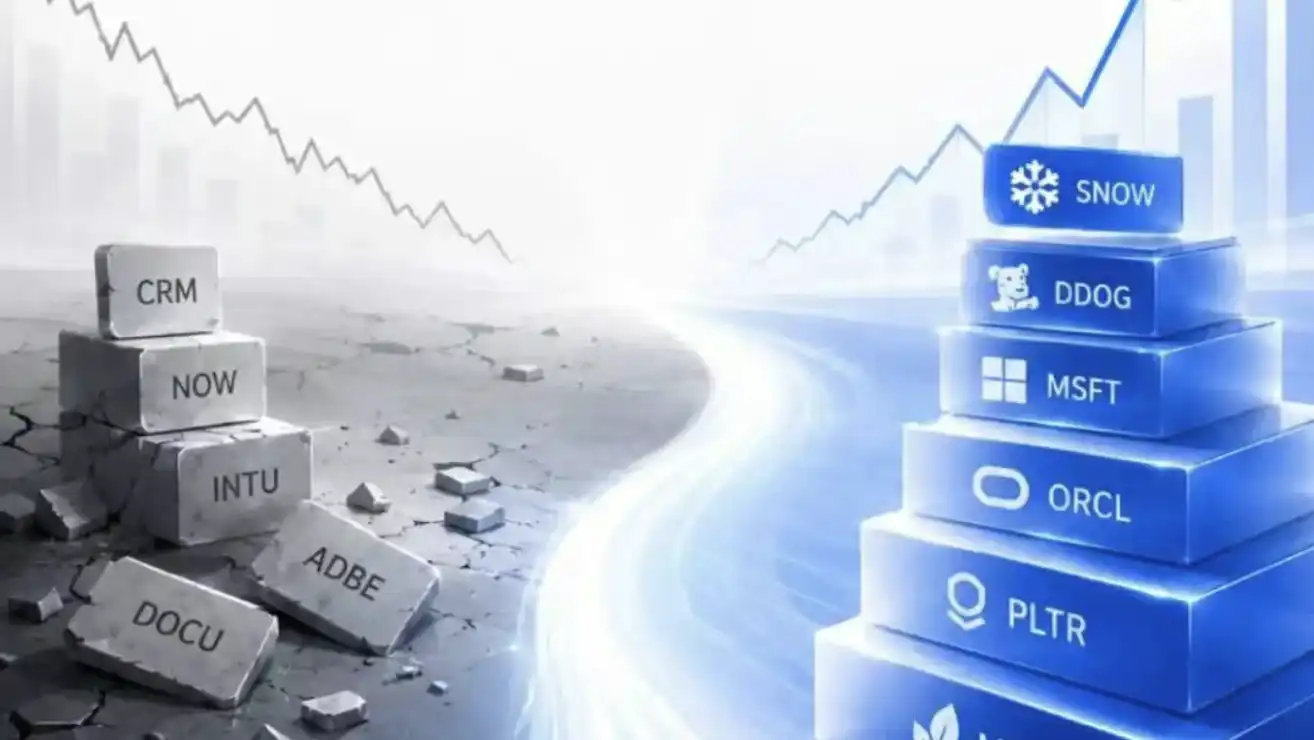
**Summary** The AI revolution has triggered a "SaaS apocalypse," forcing a brutal market shakeout. The key dividing line is the pricing model. Companies like Snowflake and Datadog, which charge based on consumption (e.g., data processed or compute used), are thriving. AI workloads actively *generate* more demand for their services, fueling growth. Datadog's accelerating revenue is a prime example. Microsoft and Palantir, as platform/ecosystem players, also benefit by acting as essential channels for AI deployment. In contrast, traditional SaaS firms built on per-seat or per-task licensing (e.g., Intuit, Adobe) face direct pressure, as AI threatens to automate the very human tasks their software supports. Companies like Salesforce, a per-seat giant, are caught in the middle. While showing strong AI monetization (e.g., its Agentforce platform) and experimenting with consumption-based "Flex Credits," its stock remains under pressure, illustrating that the market rewards *completed* transitions, not just the intent. The recent Microsoft Build conference underscored key trends: AI is evolving from an assistant to an autonomous "agent," and platform providers like Microsoft are consolidating their control. The market's recovery is highly selective, focused on identifying which companies are "fed by AI" versus "eaten by AI." Future focus will be on the diffusion of this recovery to transforming companies and the real-world adoption data of AI agents like Microsoft Copilot.

marsbit50 min fa

SaaS Battle Royale: The Survivors Who Win All Share One Common Trait

marsbit50 min fa

Trading

Spot
Futures

Articoli Popolari

Come comprare FARTCOIN

Benvenuto in HTX.com! Abbiamo reso l'acquisto di Fartcoin (FARTCOIN) semplice e conveniente. Segui la nostra guida passo passo per intraprendere il tuo viaggio nel mondo delle criptovalute.Step 1: Crea il tuo Account HTXUsa la tua email o numero di telefono per registrarti il tuo account gratuito su HTX. Vivi un'esperienza facile e sblocca tutte le funzionalità,Crea il mio accountStep 2: Vai in Acquista crypto e seleziona il tuo metodo di pagamentoCarta di credito/debito: utilizza la tua Visa o Mastercard per acquistare immediatamente FartcoinFARTCOIN.Bilancio: Usa i fondi dal bilancio del tuo account HTX per fare trading senza problemi.Terze parti: abbiamo aggiunto metodi di pagamento molto utilizzati come Google Pay e Apple Pay per maggiore comodità.P2P: Fai trading direttamente con altri utenti HTX.Over-the-Counter (OTC): Offriamo servizi su misura e tassi di cambio competitivi per i trader.Step 3: Conserva Fartcoin (FARTCOIN)Dopo aver acquistato Fartcoin (FARTCOIN), conserva nel tuo account HTX. In alternativa, puoi inviare tramite trasferimento blockchain o scambiare per altre criptovalute.Step 4: Scambia Fartcoin (FARTCOIN)Scambia facilmente Fartcoin (FARTCOIN) nel mercato spot di HTX. Accedi al tuo account, seleziona la tua coppia di trading, esegui le tue operazioni e monitora in tempo reale. Offriamo un'esperienza user-friendly sia per chi ha appena iniziato che per i trader più esperti.

532 Totale visualizzazioniPubblicato il 2024.12.10Aggiornato il 2026.06.02

Come comprare FARTCOIN

Discussioni

Benvenuto nella Community HTX. Qui puoi rimanere informato sugli ultimi sviluppi della piattaforma e accedere ad approfondimenti esperti sul mercato. Le opinioni degli utenti sul prezzo di FARTCOIN FARTCOIN sono presentate come di seguito.

活动图片