Applied Materials (AMAT.O) released its Q3 FY2026 (ending July 2026) earnings after the U.S. market close on August 14, 2026, Beijing time. Key points are as follows:
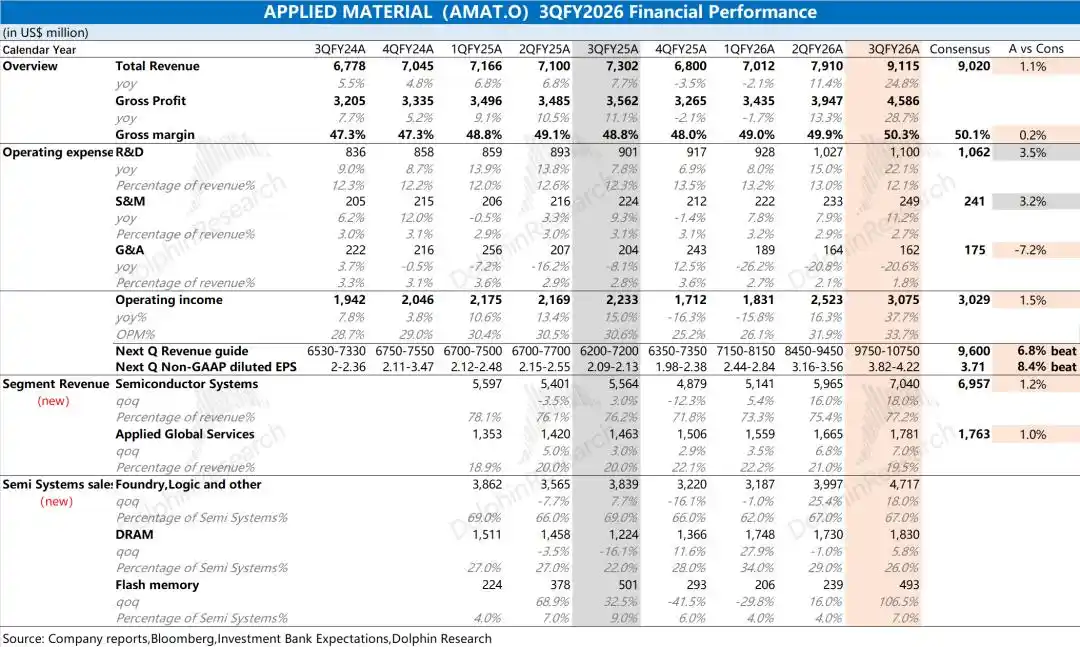
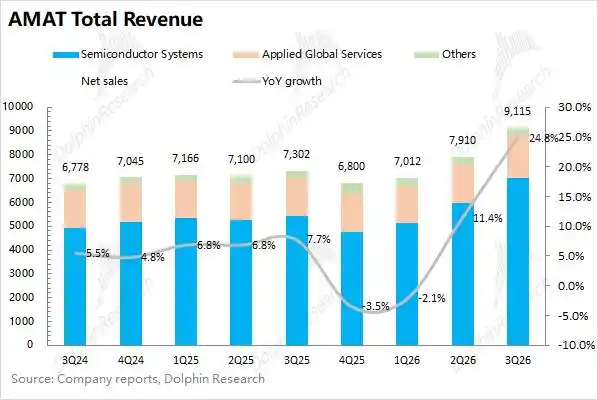
1. Key Data:Applied Materials (AMAT) reported revenue of $9.12 billion this quarter, a 25% year-over-year increase, slightly better than market expectations ($9.02 billion). The growth was primarily driven by the expansion of AI computing infrastructure, which increased demand for advanced logic, DRAM, and advanced packaging equipment.
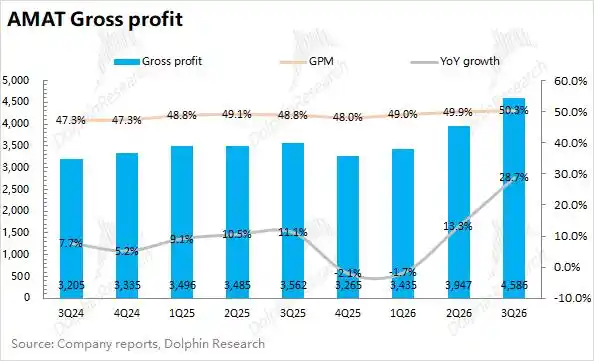
The company's gross margin for this quarter was 50.3%, a sequential increase of 0.4 percentage points, meeting market expectations (50.1%). Against the backdrop of downstream capital expenditure expansion, the company's gross margin showed an upward trend. Regarding the relatively slow rate of improvement, the company explained it has also increased cost investments in the semiconductor equipment and services segments.
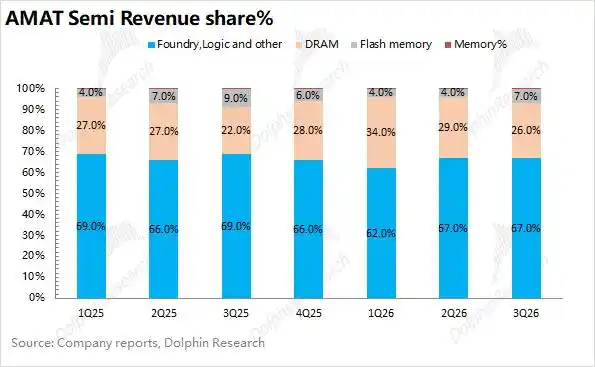
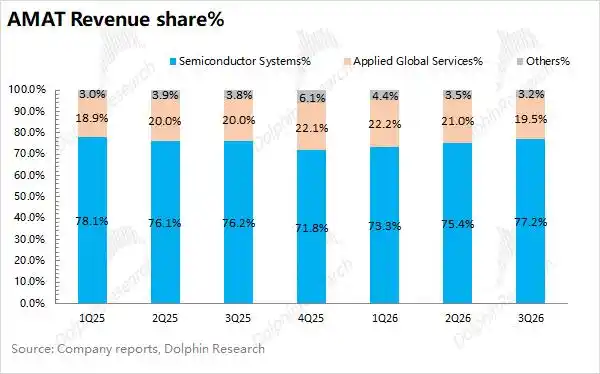
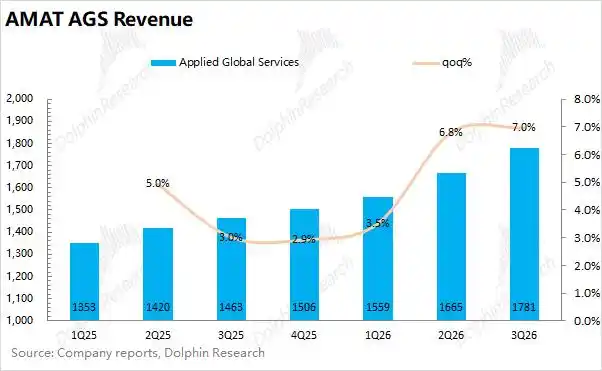
2. Specific Business Situation: Applied Materials' (AMAT) business is mainly divided into Semiconductor Systems (equipment) and Applied Global Services (services). Semiconductor Systems is the company's largest revenue source, accounting for over 70%.
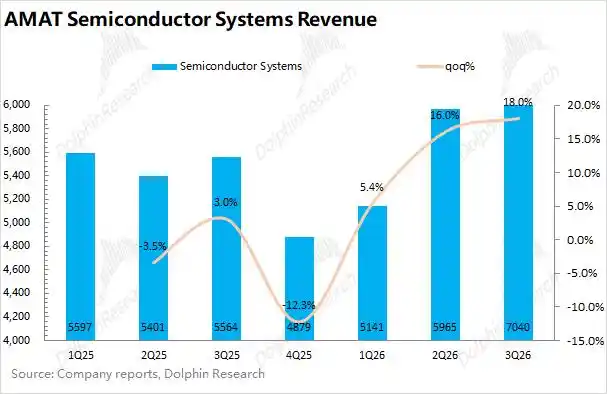
Within Semiconductor Systems: 1) Logic-related business revenue this quarter was $4.72 billion, an 18% sequential increase, mainly driven by demand for advanced nodes; 2) DRAM business revenue this quarter was $1.83 billion, a 6% sequential increase, impacted by the mismatch between customer expansion schedules and delivery cycles (limited cleanroom space).
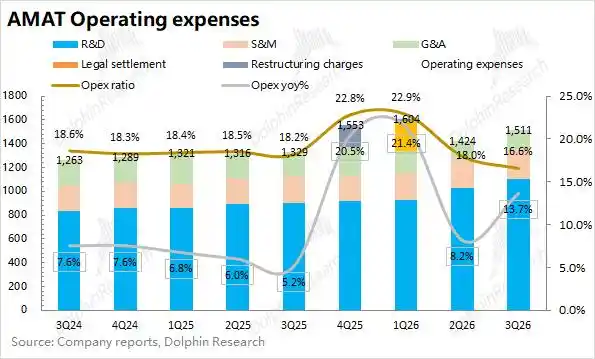
3. Operating Expenses:The company's operating expenses increased to approximately $1.51 billion, up 14% year-over-year. In terms of core operating expenses, R&D expenses this quarter increased to $1.1 billion, while SG&A expenses remained stable.
The company announced a 4% workforce reduction at the end of October 2025. With the improving business performance, the company has significantly expanded its hiring of semiconductor engineers and service personnel. The number of employees grew by 7% sequentially this quarter.
4. Next Quarter Guidance:Applied Materials (AMAT) expects Q4 FY2026 revenue to be between $9.75 billion and $10.75 billion, better than market expectations ($9.6 billion). The midpoint of the range implies a 12.5% sequential growth. The company expects next quarter's Non-GAAP EPS to be between $3.82 and $4.22, also better than market expectations ($3.71).
Dolphin Research Overall View: Good earnings failed to support conservative guidance.
Applied Materials' (AMAT) earnings report figures were good, with both revenue and gross margin meeting market expectations. The company's growth was mainly driven by the expansion of AI infrastructure, boosting demand for advanced logic, DRAM, and advanced packaging equipment.
The company's guidance for the next quarter was also better than market expectations. However, the company's stock price plunged after hours, primarily influenced by management's commentary during the earnings call. The company had previously guided that its "Semiconductor Systems business is expected to grow over 30% in calendar year 2026." Yet, following this earnings report, it did not explicitly raise this guidance.
Management mentioned that demand continued to strengthen this quarter and that business growth would also exceed the "over 30%" emphasized last quarter. The company also stressed expectations for increased market share within the year, but refrained from giving a quantitative figure, even something like "40%." This reflects a lack of confidence in the company's own order visibility.
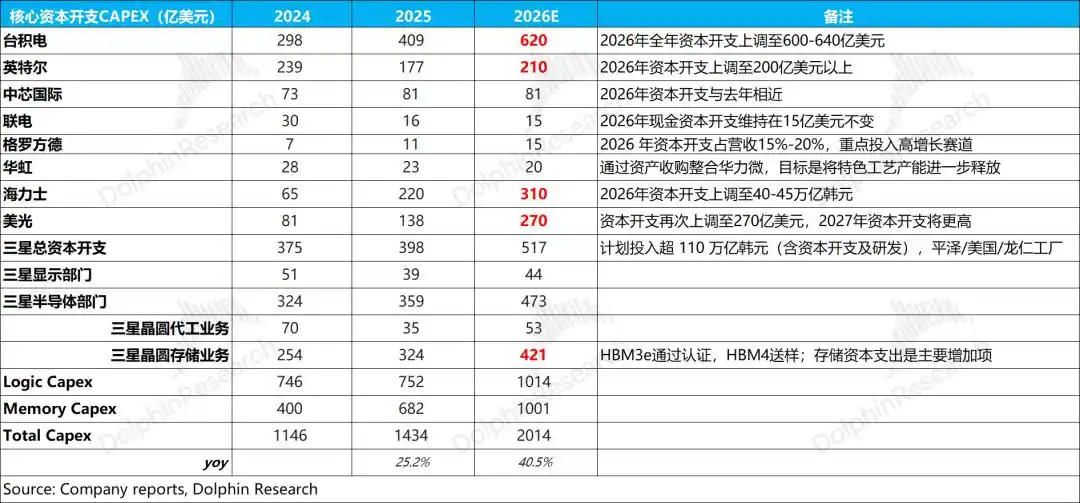
Considering the capital expenditures of major core fabs (growing over 40% for the full year), Applied Materials' guidance is noticeably weak. Especially given that several major fabs have recently raised their full-year capital expenditure forecasts again, the market was anticipating a significant upward revision from the company.
On the other hand, due to the two-month offset between Applied Materials' fiscal year and the calendar year, even if calendar year 2026 growth were assumed to be 40%, it would imply a significant sequential deceleration for the Semiconductor Systems business (18% this quarter -> 12% next quarter -> 6% the quarter after). Notably, Q1 FY27 (ending January 2027) has 14 weeks, meaning that the implied "+6%" growth, when adjusted to a comparable 13-week basis, would be close to zero sequential growth. This obviously does not satisfy the market.
Beyond this quarter's performance, the market is also focused on the following developments:
a) Foundry Capital Expenditure: Driven by AI demand, several core foundries have again raised their capital expenditure outlooks, which has been the main driver pushing up the semiconductor equipment sector and company stock prices.
Specifically: 1) TSMC raised its 2026 capital expenditure guidance to $60-64 billion, with the annual increment reaching around $20 billion; 2) Micron increased its 2026 capital expenditure again to $27 billion; 3) Samsung and SK Hynix have also explicitly increased capital expenditures.
Considering the capital expenditure outlooks from these companies, the growth rate of global core fab capital expenditures in 2026 will increase to around 40%. The main increments come from TSMC's advanced nodes and memory manufacturers' capacity expansions. However, the company did not explicitly raise its "full-year growth over 30%" guidance for the Semiconductor Systems business post-earnings, which is hard for the market to accept.
b) Memory Demand and Order Visibility:
Judging from the capital expenditure outlooks of major fabs, memory manufacturers have a relatively stronger desire to expand capital expenditures. Since DRAM and HBM manufacturing rely more on processes like deposition, CMP, and advanced packaging, Applied Materials (AMAT) will benefit from this round of capital expenditure driven by memory manufacturers.
Because Applied Materials' (AMAT) revenue focus comes from the logic sector, with memory accounting for only 20-30% of total revenue, memory's pulling effect on the company is not as pronounced as for Lam Research (where memory revenue accounts for nearly half). Notably, Applied Materials has the broadest coverage across various segments in the DRAM/HBM field (deposition/CMP/metrology/packaging), which should bring more stable performance.
The company's management maintained during the call that its "largest customer provides rolling forecasts for up to 8 quarters," with the incremental information being "some customer dialogues extend to 2030." The latter is still in the discussion phase, with the relatively certain visibility remaining at the 8-quarter timeframe.
Indeed, Applied Materials (AMAT), ASML, and Lam Research all belong to the upstream equipment segment of the semiconductor industry, forming a basket of stocks influenced by the semiconductor cycle/fab capital expenditures. Applied Materials' current valuation multiples are also similar to those of peers like ASML and Lam Research.
Investing in semiconductor equipment companies primarily focuses on the certainty of semiconductor capacity expansion and high growth over the next 2-3 years. As long as the momentum of AI Capex/the semiconductor cycle remains strong, subsequent upward revisions to capital expenditures are still expected to drive the earnings and valuations of upstream semiconductor equipment-related companies higher.
Previously, semiconductor demand was concentrated in advanced nodes and the memory sector. Looking at SMIC's gross margin yesterday, the mature node segment has also entered an upturn cycle, with price increases becoming common especially in the 8-inch area. Starting from AI demand, the "tight supply-demand situation" has already spilled over to more semiconductor segments. If companies subsequently increase investments in traditional semiconductor areas as well, it could further boost demand for semiconductor equipment and related sectors.
Overall, driven by the continuous increase in AI Capex and the recovery in traditional semiconductors, the trend of this semiconductor cycle has not changed. Major manufacturers are still likely to continue strengthening their capital expenditure efforts, which is the foundation for accelerated growth for the company and the semiconductor equipment industry.
Regarding the company's management not explicitly raising the full-year outlook for the Semiconductor Systems business this time (still "over 30%"), it will impact market confidence in the short term. As long as the semiconductor cycle's upward trend remains unchanged, short-term pullbacks will likely not be too deep. Subsequent increases in downstream customer expansion demand and investments are still expected to drive the company's earnings and valuations higher.
Below is Dolphin Research's detailed data on Applied Materials' (AMAT) earnings:
This article is from the WeChat public account "Dolphin Investment Research" (ID: haituntouyan), author: Dolphin Research