As 2025 draws to a close, the crypto market hasn't produced any miraculous rallies; instead, it has brought the exaggerated price predictions from the past couple of years back down to earth.
First, let's look at the current prices: As of 8:00 AM Beijing Time on December 27th, Bitcoin ≈ $87,423, Ethereum ≈ $2,926.
With the numbers right before our eyes, those earlier predictions of "Bitcoin hitting $200,000" and "Ethereum breaking $10,000" seem a bit awkward now. Market volatility, policy swings, international situations... each one reminds us: predictions are predictions, but the market moves on its own.
Below, let's review those "expert predictions" we once追捧ed (chased after/admired) that have already been "slapped in the face" by reality.
BTC: Mainstream Institutions Bullish En Masse
In 2023–2024, following ETF approvals, a shift in US political winds, and improved macro liquidity, almost all heavyweight institutions and opinion leaders publicly offered specific BTC price targets for 2025.
In hindsight, these targets formed a highly concentrated "prediction cluster."
Michael Saylor (MicroStrategy): Reach Six Figures by 2025, Eventually Reach $1 Million
-
Prediction:
-
BTC $100,000 (2025)
-
Long-term target: $1,000,000
Saylor's judgment wasn't merely a price prediction but an entire long-term narrative of "Bitcoin as a digital capital network." Before 2025, he repeatedly emphasized that BTC would not fall back below sixty thousand.
BTC did indeed maintain a high range for most of 2025, but the $100k mark as a "certain outcome" did not materialize as expected.
Mark Yusko (Morgan Creek CEO): 2025 $150k
-
Prediction: BTC $150,000 (2025)
-
Rationale: Network effects / FOMO driving / New capital inflows
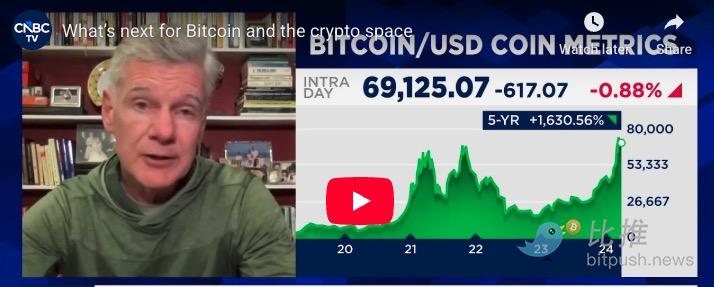
This is a typical "cycle top pricing model", assuming this bull run would completely replicate historical amplitudes.
However, the problem is that ETFs brought about a "structural change," not simply a "leveraged amplification of the cycle."
Tom Lee (Fundstrat Co-founder): $250,000

-
Prediction: BTC $250,000 (2025)
-
Key Catalyst: He believed changes in the US political landscape and potential government Bitcoin holdings were key catalysts. He stated these developments indicate Bitcoin is becoming a legitimate alternative to traditional stores of value like gold.
Tom Lee's prediction was highly influential in 2024 but also heavily reliant on the premise of "policy + sentiment + capital moving in sync."
It's worth noting that Tom Lee revised his prediction downward multiple times in 2025 but still emphasized near-term potential for new highs as the year ended. Just last week, Sean Farrell, Head of Digital Asset Strategy at his firm Fundstrat, predicted in an internal report that BTC could fall to $60,000-65,000 in the first half of 2026 (under a base case). This contrasts with Tom Lee's public optimism, with the company explaining it as a difference in time frames.
Standard Chartered: Close to $200,000
-
Prediction: BTC $200,000 (2025)
-
Rationale/Comparison: Historical price increases following Gold ETF listings. The bank expected significant inflows into Bitcoin spot ETFs to drive this growth, similar to gold's 4x price increase after its first ETF launched.
But unlike gold, Bitcoin did not enter a one-way trend post-ETF; instead, it experienced more frequent pullbacks and repricing.
AllianceBernstein: $200,000
-
Prediction Timeline: September 2025
-
Additional Forecasts:
-
$500k by 2029
-
$1M+ by 2033
This was one of the few institutional predictions offering a specific monthly target. Reality shows: timing targets are the easiest part of any prediction to get wrong.
InvestingHaven: $115,200 (Bull) / $75,000 (Bear)
-
Method: Scenario analysis
This was one of the few models that provided both bull and bear case ranges.
Even so, its bull target was not fully realized in 2025, while the bear case range was validated by the market multiple times.
Tim Draper (VC): $250,000 (Revised)
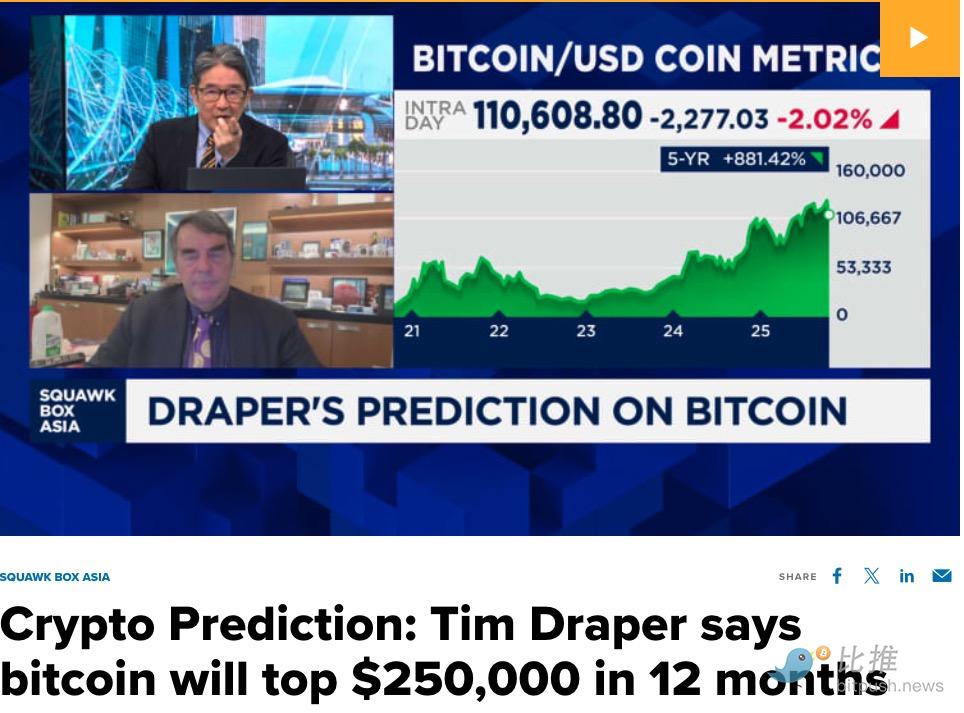
An early investor in Tesla, Skype, Baidu, and Twitch, among others. Draper previously predicted Bitcoin would reach this price in 2022, later revising the timeline to 2025.
Matthew Sigel (VanEck Head of Research): $180,000
-
Prediction: BTC $180,000+ in 2025
-
Rationale:
-
ETF inflows
-
US political cycle changes
But the reality is: ETFs provided more of a floor lift than a ceiling explosion.
Sminston With (Crypto Researcher, PhD): $275,000
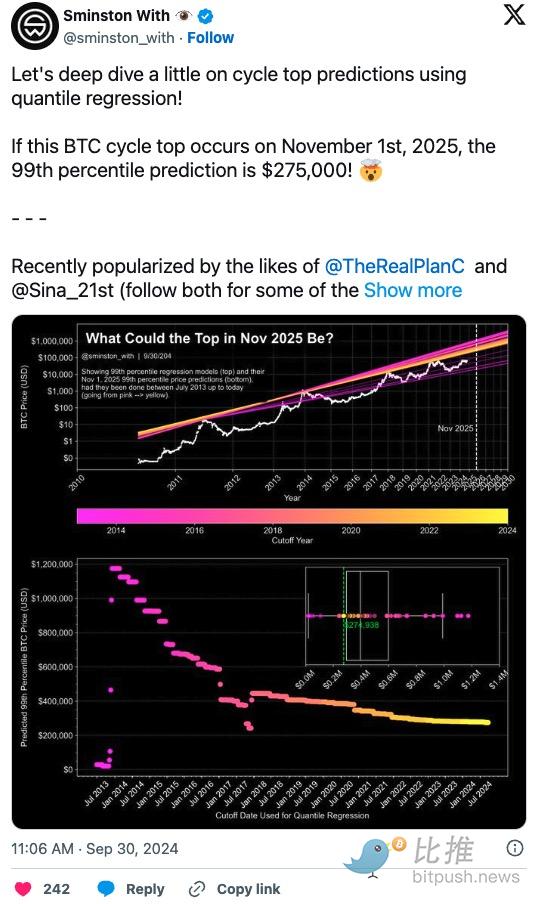
Bitcoin researcher Sminston With used quantile regression to predict the cycle top, estimating it would arrive on November 1, 2025, with Bitcoin reaching $275,000.
By the end of 2025, this prediction was clearly off the mark (had clearly failed).
Cathie Wood (ARK Invest): $1,000,000

-
Prediction:
-
Base case: $650,000 (2030)
-
Optimistic: $1,000,000+
Strictly speaking, this prediction hasn't been "slapped" yet, but it represents the long-term version of the same logic.
ETH: Predictors Bet on "Upgrade Delivery"
In 2025, ETH's fundamental narrative didn't fail, but the price refused to pay for the narrative.
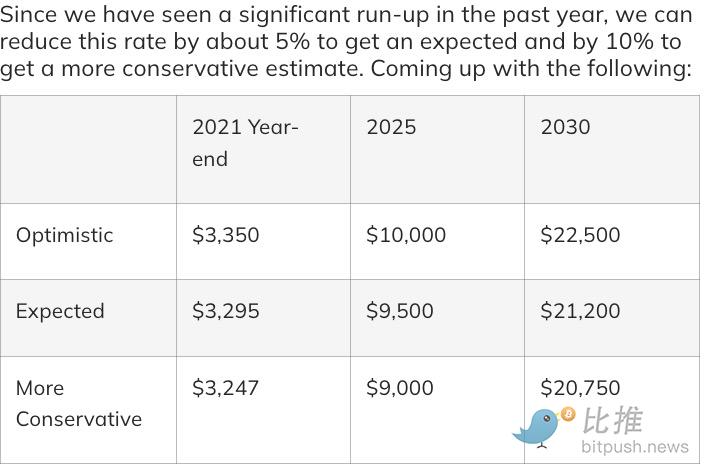
Deltec Bank:
-
2025: Optimistic $10,000 / Expected $9,500 / Conservative $9,000.
Standard Chartered: The "ETF+Upgrade" Path to $14,000
-
Standard Chartered suggested in 2024 that ETH could reach $14,000 (2025), with ETFs being a core catalyst. But by 2025, Standard Chartered revised its year-end ETH prediction up to $7,500.
Finder Analysts: In February 2024, the average prediction from 50 analysts was ETH $6,105 (2025).
VanEck predicted Ethereum would reach $11,800 by 2030, citing network growth and adoption.
Bitwise: Predicted end-2024 that Ethereum would reach $7,000 in 2025, alongside new highs for BTC and SOL.
Bankless: Believed that after Ethereum realizes its potential in 2025, the pessimistic price would be $10,000, and the reasonable price would be $15,000.
Summary
The 2025 market cycle has given us pause for reflection – trying to predict the future based solely on past experience is becoming less effective in the crypto market. The once-popular "four-year cycle theory" has lost much of its explanatory power under the impact of massive ETF fund flows and a complex macro environment.
Market predictions are essentially about finding anchors amidst uncertainty. But when the anchors themselves are drifting, who can guarantee accuracy every time? Facing 2026, perhaps what we need is not to rush to find the next "prophet," but to maintain patience and flexibility – the market will always chart its own course, and our job is to prepare to respond, not stubbornly guess.
It should be noted that this article is not meant to negate the value of professional institutional analysis. Rigorous research remains precious in an information-cluttered market. But ultimately, the market always provides the answer, and what we need to do is learn to coexist with predictions while maintaining independent thinking. After all, in this field, there can be many opinions, but the true answer is always only one – the market itself.
Author: Seed.eth
Twitter:https://twitter.com/BitpushNewsCN
Bitpush TG Discussion Group:https://t.me/BitPushCommunity
Bitpush TG Subscription: https://t.me/bitpush