Exposing $74 Billion Government Corruption, He 'Incidentally' Earned Millions on X Platform

比推Pubblicato 2026-02-04Pubblicato ultima volta 2026-02-04

Introduzione

An anonymous X user known as Beaver won a $1 million creator competition on the platform by publishing an investigative article exposing a massive corruption scandal involving the consulting firm Deloitte and the U.S. government. The article, titled "Deloitte, a $74 Billion Cancer Metastasized Across America," revealed that Deloitte had received $40 billion in government contracts over two decades but caused approximately $34 billion in losses due to systemic failures, fraud, and deeply entrenched conflicts of interest, including frequent employee exchanges between the firm and government agencies. Beaver, who operates a data transparency website called SomaliScan, used public records to document the misuse of public funds. Although not primarily involved in cryptocurrency, Beaver had previously launched a memecoin called SS, which saw a temporary price surge following the article’s viral success—garnering 45 million views. The author pledged to use the prize money to purchase SS. The top three articles in the competition aligned with perennial popular themes: political exposure (winner), financial strategy (runner-up), and self-improvement advice (third place). The outcome underscores that high-impact content on X often revolves around uncovering hidden truths, offering practical guidance, or resonating with broad public sentiment.

Written by: Eric, Foresight News

Original Title: The Creator Who Took $1 Million from X Once Launched a Memecoin


At 00:00 Beijing time on February 4, 2025, X announced the results of its $1 million creator competition launched two weeks ago. The event was open only to U.S. participants, who were required to write an original article of at least 1,000 words. The article with the highest number of reads on the "Home Timeline" of X's paid users would win the exclusive million-dollar prize.

Given the precedent of "How to Completely Change Your Life in One Day" with 170 million views, many speculated that the winning article would likely be a similar "inspirational piece." However, the result was both unexpected and yet made sense.

Writing Articles Is More Profitable Than Trading Cryptocurrency

The creator who became a millionaire with a single article goes by the X username Beaver. His article, "Deloitte, a $74 Billion Cancer Metastasized Across America," garnered 45 million views.
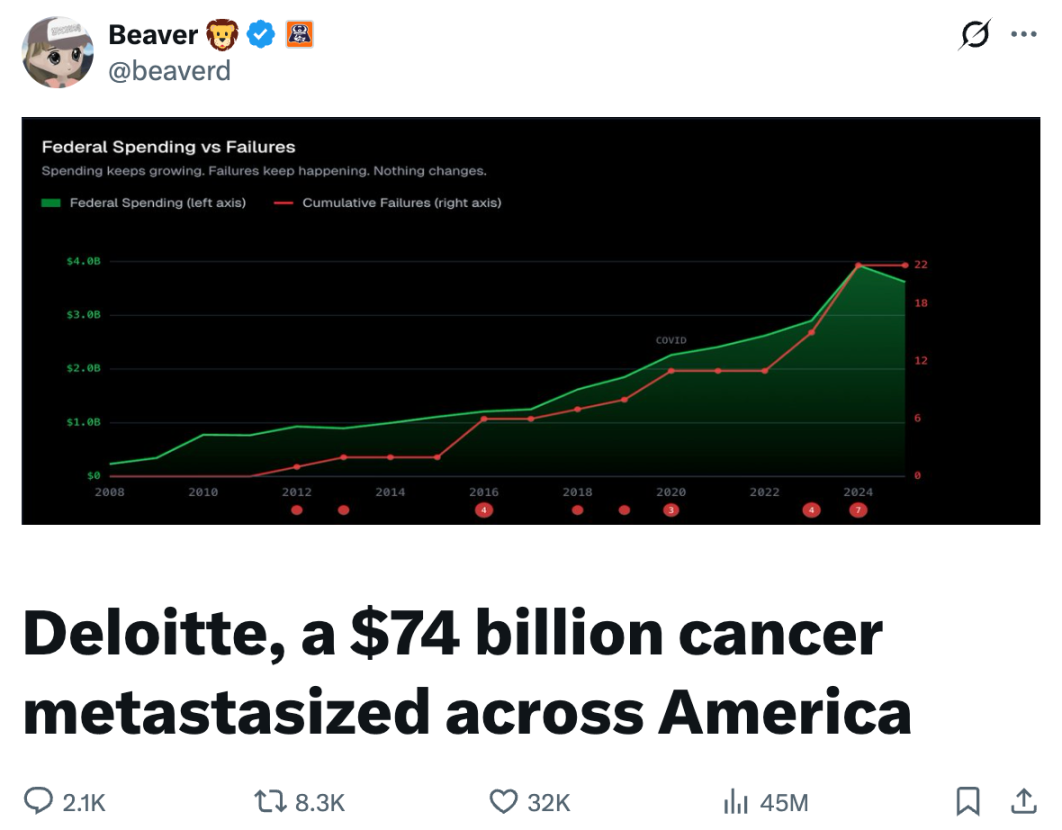
The winning article is an in-depth investigative report exposing a U.S. government scandal. The author, through analyzing public documents such as federal contracts, state contracts, recorded defaults, lawsuits, and audits, uncovered a history of "collusion between officials and businesses" involving tens of billions of dollars: Over the past 20 years, Deloitte has secured a total of $40 billion in contracts from federal and state governments. However, the various systems it developed, including unemployment benefit application systems, either suffered from vulnerabilities that led to billions in fraudulent claims or were abandoned after budgets were multiplied without results.

In summary, the government spent $40 billion on systems that ultimately caused $34 billion in losses. Even more alarming, there is frequent employee movement between Deloitte and the U.S. government, allowing Deloitte to infiltrate every aspect of the government, "like cancer cells spreading through the bloodstream," continuously siphoning taxpayers' money with no clear source or way to eradicate it.

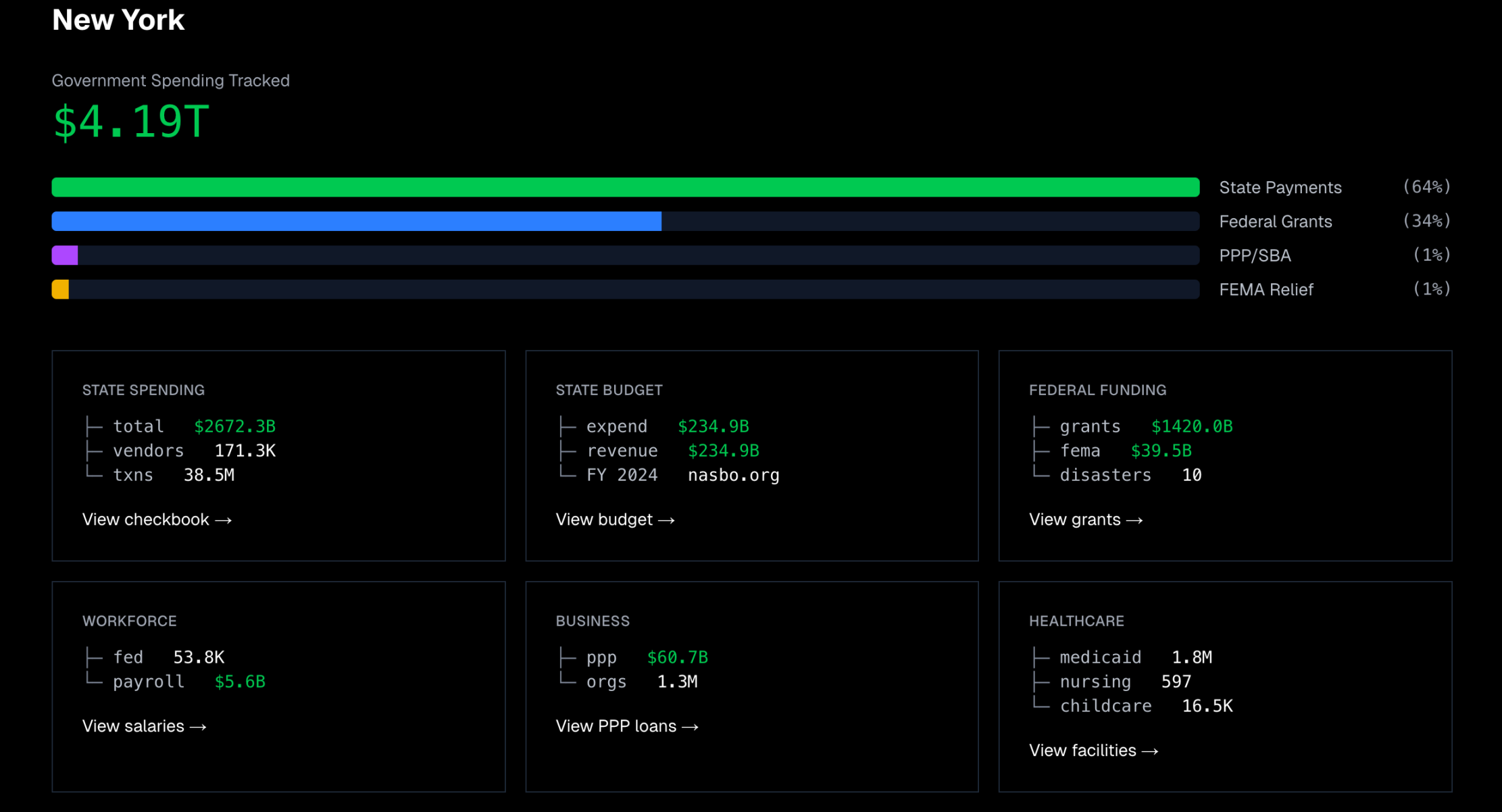
Looking through Beaver's account, you'll find that its main theme is "concern for the country and its people," with topics almost always related to government, politics, and public welfare. Additionally, Beaver launched a website called SomaliScan, which compiles public data on government budgets, expenditures, federal grants, labor statistics, and includes information on political donations and other politically related data. The corrupt relationship between Deloitte and the government was uncovered by analyzing this data.
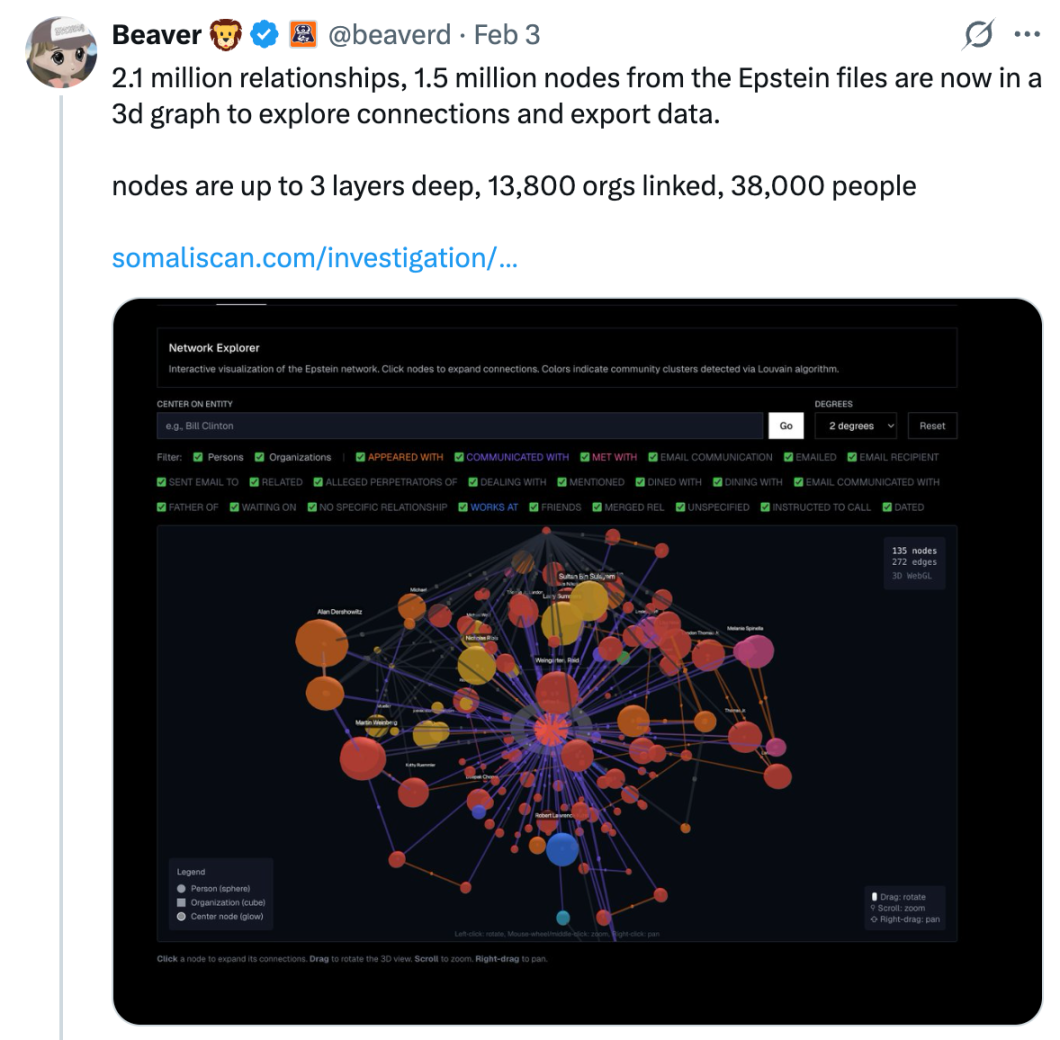
On February 3, Beaver also organized the massive "Epstein Files" released to the public into complex relationship diagrams on the website.
Interestingly, this political commentator launched a meme token called SS (9NrkmoqwF1rBjsfKZvn7ngCy6zqvb8A6A5RfTvR2pump) for the website on January 2 of this year. The token performed poorly initially but surged to a阶段性 high on January 28 after Beaver's article gained tens of millions of views, and spiked again when the winner was announced today. Compared to SS's dismal performance and the $1 million prize, this might be a rare case where "writing articles is more profitable than trading cryptocurrency."
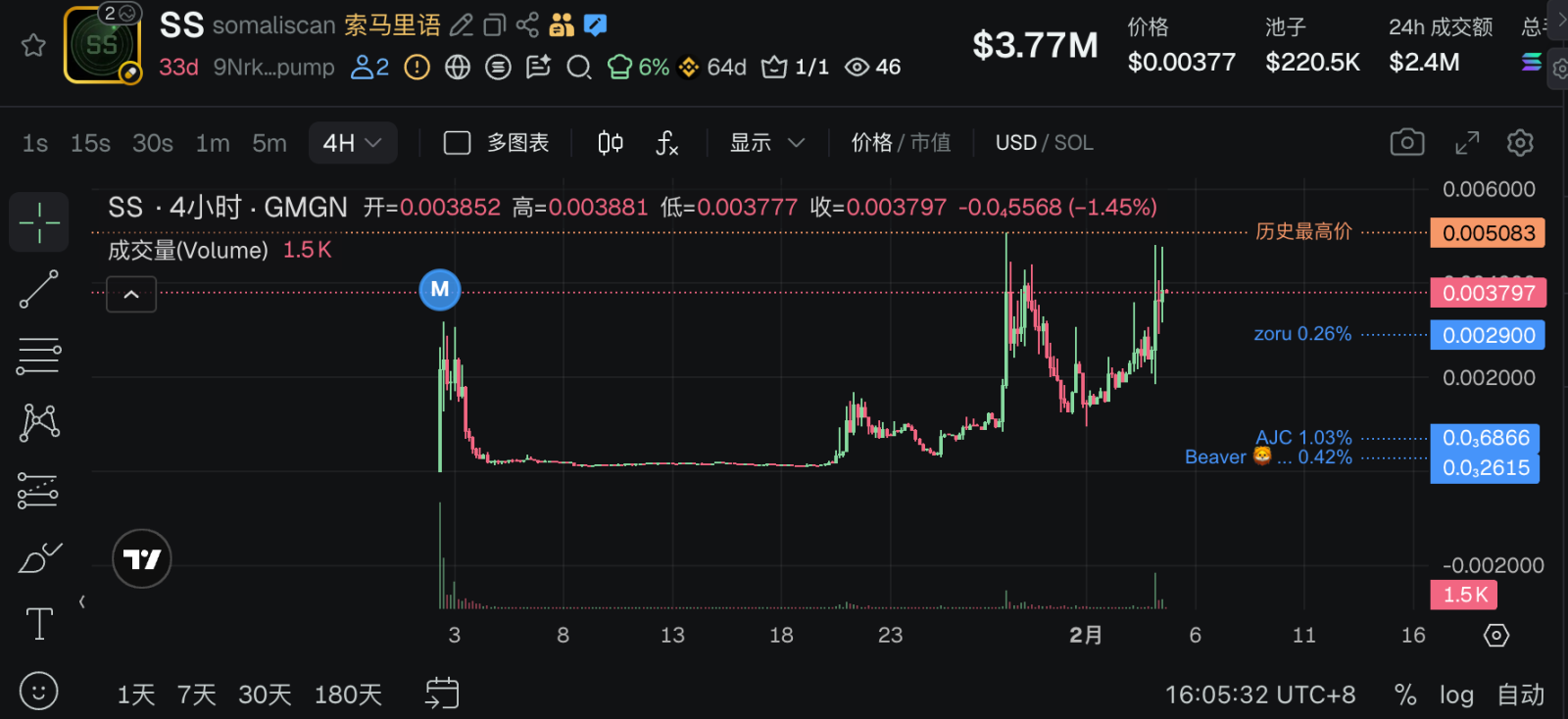
On January 25, Beaver stated that the competition prize money would be entirely used to purchase SS, with 10% of the total SS supply reserved for hackathons, 20% locked, and Beaver keeping only 4.5% for themselves.

It's certain that Beaver is not a "crypto insider." The market cap of less than $4 million also indicates that this meme token has little热度. Those who spend real money to buy SS are likely supporters of Beaver and SomaliScan. It's worth noting that the SomaliScan website also has a donation channel supporting Bitcoin, Ethereum, SOL, and XMR donations. If you enjoy stirring up trouble, you can support this "champion of democracy" who dares to expose U.S. government scandals.

Common Topics Among Netizens: Politics, Money, and Emotions

The Chinese internet has three enduringly popular topics: political trends, economic situations/how to make money, and personal emotions.

The top three articles in X's U.S.-only competition恰好 correspond to these points:

  • First Place: "Deloitte, a $74 Billion Cancer Metastasized Across America," exposing U.S. government corruption;

  • Second Place: "A Detailed Explanation of President Trump's Tariff Strategy: A Step-by-Step Guide on How to Operate," analyzing the patterns of Trump's tariff policies to derive an investment strategy应对变化;

  • Third Place (Official Favorite): "The Complete Guide: How to Achieve Extreme Focus," another piece of self-improvement鸡汤 from Daniel Koe.

High-readership Chinese articles on X also revolve around these topics.

If you read these articles carefully, you'll find that they aren't particularly flowery in language but mostly present facts and reasoning, satisfying readers' emotional or practical needs. For creators, the conclusion is very simple: At least on the X platform, to gain more exposure, you either tell a new story unknown to others, whether about yourself or social issues, or provide a detailed "operational guide"—be it on how to make money, how to adjust your mindset, or even, as shown in the image above, how to find video codes.


Twitter:https://twitter.com/BitpushNewsCN

BitPush TG Discussion Group:https://t.me/BitPushCommunity

BitPush TG Subscription: https://t.me/bitpush

Original article link:https://www.bitpush.news/articles/7608637

Domande pertinenti

QWho won the $1 million creator competition on X and what was the topic of their article?

AThe winner was a creator named Beaver, whose article titled 'Deloitte, a $74 billion cancer metastasized across America' exposed government corruption involving Deloitte and U.S. government contracts.

QHow much did Deloitte receive in federal and state contracts over 20 years, and what was the estimated loss caused by their systems?

ADeloitte received $40 billion in contracts over20 years, and their systems caused an estimated $34 billion in losses.

QWhat is SomaliScan, and how is it related to Beaver's work?

ASomaliScan is a website created by Beaver that compiles and analyzes public data on government budgets, spending, federal grants, labor, and political donations, which he used to investigate and expose the corruption between Deloitte and the government.

QWhat meme token did Beaver launch, and how did its performance compare to his competition winnings?

ABeaver launched the meme token SS (SomaliScan token). Its market performance was relatively poor with less than $4 million in market cap, making the $1 million prize from the competition a rare case where writing an article was more profitable than trading the meme coin.

QWhat were the top three topics of the highest-read articles in X's creator competition, and how do they relate to popular topics in Chinese internet culture?

AThe top three topics were:1) government corruption (winning article),2) investment strategies based on political policies (second place), and3) self-improvement and focus (third place). These align with the perennial popular topics in Chinese internet culture: politics, money/economics, and personal emotions/self-help.

Letture associate

Near Returns to the AI Stage: Transformation into a Public Chain Due to 'Payroll Difficulties,' Agent and Privacy Emerge as New Growth Narratives

NEAR Returns to AI Origins: From Payroll Struggles to Blockchain, Now Focusing on AI Agents and Privacy NEAR Protocol's journey began not with grand blockchain ambitions, but from a practical hurdle: its AI startup founders, including Transformer paper co-author Illia Polosukhin, couldn't efficiently pay international developers in 2017. This led them to pivot and build a high-performance, scalable blockchain. After years navigating various crypto narratives like sharding and cross-chain interoperability, NEAR is now leveraging its AI roots to re-enter the AI arena. A key driver is its "NEAR Intents" layer, which abstracts complex cross-chain transactions. Users simply state their goal (e.g., swap BTC for ETH), and a solver network finds the optimal route. This system has processed over $20B in cross-chain volume, generating significant fee revenue. A major growth area is private transactions via "Confidential Intents/Swaps," which hide trade details until settlement to protect against MEV and front-running. Remarkably, private swaps recently accounted for over 40% of NEAR's transaction volume, highlighting strong demand but also potential regulatory scrutiny. With its AI-founder pedigree, NEAR is positioning itself at the intersection of blockchain, AI agents, and privacy, aiming to become infrastructure for the emerging agent economy while navigating the challenges of its rapid adoption.

marsbit2 h fa

Near Returns to the AI Stage: Transformation into a Public Chain Due to 'Payroll Difficulties,' Agent and Privacy Emerge as New Growth Narratives

marsbit2 h fa

From Ethereum to AI's 'CROPS': What Exactly is This Set of 'Slow Variables' That Vitalik Repeatedly Emphasizes?

In recent discussions, Vitalik Buterin has frequently emphasized the concept of "CROPS," a framework defining core values for Ethereum's development. CROPS stands for Censorship Resistance, Capture Resistance, Open Source, Privacy, and Security. Initially outlined in the Ethereum Foundation's "EF Mandate," it represents a commitment to user sovereignty, ensuring that the network resists external control, remains open, protects privacy, and prioritizes security. The relevance of CROPS extends beyond Ethereum's foundational principles, becoming crucial in the context of AI integration. As AI agents begin handling wallet operations and automated transactions, the risk increases that users may cede control over their digital assets, privacy, and intentions to centralized AI service providers. A "CROPS AI" would therefore emphasize local execution where possible, privacy-preserving remote model calls (e.g., using zero-knowledge proofs), and transparent, verifiable processes to maintain user agency. Vitalik highlights a significant convergence between "CROPS Ethereum access layer" and "CROPS AI." Both address the same fundamental challenge: how users can access powerful services—be it blockchain data via RPCs or AI models—without exposing sensitive information or relinquishing ultimate control. This intersection points toward a future digital entry point that is more private, secure, and user-controlled. Ultimately, CROPS is not merely an abstract ideal but a practical guidepost. It steers development—from protocol resilience and wallet design to AI agent safety—towards a future where users retain self-sovereignty even as digital systems grow more complex and powerful. In an era of accelerating AI adoption, these "slow variables" of censorship resistance, openness, privacy, and security may define Ethereum's enduring value.

marsbit2 h fa

From Ethereum to AI's 'CROPS': What Exactly is This Set of 'Slow Variables' That Vitalik Repeatedly Emphasizes?

marsbit2 h fa

Silicon Valley 'Startup Guru' Steve Hoffman: Web3 + AI Could Be a Trap

Silicon Valley investor and "Godfather of Startups" Steve Hoffman warns that combining Web3 with AI is likely a trap, not a promising venture. In an interview, Hoffman argues that while AI is a foundational technology touching all industries, Web3 adds complexity, friction, and regulatory risk without solving mainstream consumer or business needs. He advises founders to focus on deep, specialized applications where startups can out-iterate giants, rather than on generic features easily replicated by large tech companies. Hoffman observes that Silicon Valley will lead foundational AI research, while China excels at rapid, large-scale application and commercialization, particularly in robotics. He stresses that AI-driven autonomous agents capable of collaborative, multi-step tasks are 2-4 years away, which will cause significant job displacement. The solution is not to slow AI but to redesign business models around human-AI collaboration and reform social systems like education and retraining. For startups, Hoffman recommends focusing on vertical, expertise-heavy domains to build defensibility. He sees major opportunities in AI fraud detection and cybersecurity. Key founder mindsets include systemic thinking over feature-focus, relentless customer centricity, building adaptive teams, and deeply understanding AI's capabilities and limits. Hoffman is also leading a non-profit initiative to establish university centers aimed at training future leaders in responsible, human-value-aligned AI innovation.

marsbit3 h fa

Silicon Valley 'Startup Guru' Steve Hoffman: Web3 + AI Could Be a Trap

marsbit3 h fa

Token Inefficient, Economy Tokenless

The article "Tokens Aren't Economical, Economics Aren't Tokenized" analyzes a pivotal shift in the AI industry from a technology-driven narrative to one dominated by capital efficiency. It highlights two concurrent trends: a severe capital shortage due to the exorbitant and recurring costs of compute (e.g., OpenAI's high burn rate) and a wave of corporate spin-offs where major tech companies are separating their AI units (like Kuaishou's Kling and Baidu's Kunlunxin). The core argument is that AI's "anti-internet" business model, where user growth increases costs rather than profits, has created a disconnect between high valuations and actual cash flow. Spin-offs address this by allowing AI assets to be valued independently. Within a parent company, they are seen as cost centers, but as standalone entities, they are priced based on their growth potential and scarcity in the primary market, leading to massive valuation premiums (e.g., Kling's estimated value tripling post-spin-off). The industry is at an inflection point, moving from "model worship" to "value realization." The competition is evolving from a pure compute (GPU) race to a broader focus on systemic efficiency and full-stack engineering (involving CPUs and orchestration) to achieve viable commercialization. The year 2026 is framed as a critical moment where the industry must definitively answer how to economically translate AI capability into tangible business value, reshaping the sector's future power structure.

marsbit3 h fa

Token Inefficient, Economy Tokenless

marsbit3 h fa

Trading

Spot
Futures
活动图片