Experts Predict Bitcoin Crash to $10,000 This Year. Is There a Rescue?

bitcoinistPubblicato 2025-12-17Pubblicato ultima volta 2025-12-17

Introduzione

Bitcoin's price decline below $90,000 has reignited fears of a potential drop to $10,000, driven by a shift in market sentiment away from riskier assets. Amid this uncertainty, attention is turning toward practical infrastructure solutions rather than speculative narratives. Bitcoin Layer 2 technologies, such as Bitcoin Hyper, are gaining traction as they address key limitations of the Bitcoin network—high fees, slow throughput, and limited programmability. Bitcoin Hyper, which integrates Solana Virtual Machine (SVM), aims to provide faster execution and lower latency, enabling DeFi, NFTs, and dApps on Bitcoin without compromising its security. The project has already raised over $29.5 million in its presale, indicating significant investor interest. As market cycles emphasize utility over hype, infrastructure projects like Bitcoin Hyper could play a crucial role in Bitcoin's next growth phase, even amid bearish predictions.

The market has switched again from "eternal growth" mode to "all is lost" mode. This week, $BTC fell below $90,000 amid deteriorating risk appetite: investors were frightened by signals that the AI spending boom might generate profits slower than expected, meaning pressure on risky assets is returning.

Against this backdrop, the most "toxic" price target in crypto has resurfaced: $10,000 for Bitcoin. It is actively promoted in the media by Mike McGlone from Bloomberg Intelligence — he links the risk of a significant drawdown to a deflationary scenario following a period of inflation. The idea is not that "tomorrow it will be $10k," but that when the cycle turns, the market can overshoot downward just as aggressively as it overshot upward.

But here's what many discussions miss: even if you believe in the long-term growth of $BTC, in the short term you still need infrastructure that makes Bitcoin a working tool, not just a "ticker on Twitter." High fees, limited throughput, and almost zero native programmability are a basic UX pain. And this time, "rescue" on the market is more often sought not in another meme story, but in Bitcoin Layer 2 and the infrastructure around it (yes, it sounds less exciting — but much more practical). Projects from this niche regularly make it into lists of the best coins for 2025.

This leads to a logical bridge to Bitcoin Hyper: if the next market phase is about efficiency, speed, and applications on Bitcoin, then projects that provide $BTC with a proper execution layer will gather attention — even if someone is simultaneously drawing horror stories about $10,000. In previous cycles, similar logic has already worked: when growth slows, the market begins to value what brings real utility.

BUY BITCOIN HYPER

How Layer 2s Become a Stress Test for $BTC

When volatility increases, capital becomes more selective. Investors stop buying narratives for the sake of narratives and start looking at where real activity will appear: transactions, fees, liquidity, developers. Reuters is just noting a shift towards more cautious strategies and the market's attempts to "mature" after sharp movements.

Right now, Bitcoin Layer 2 is a race for two goals simultaneously: scaling payments and launching a full-fledged on-chain economy (DeFi, NFTs, games) around Bitcoin, all without losing trust in the base asset. Solutions have different approaches: Lightning handles micropayments, rollup approaches promise computations "off L1," and the BitVM narrative pushes the market towards more complex constructions without changing the L1 consensus. But the user demand is the same: "give us speed and fees at the level of modern networks, without breaking trust in $BTC."

And this is where Bitcoin Hyper appears as one of the bets on "Bitcoin with normal speed and programmability" — without the need to convince people to abandon $BTC for another L1. It sounds reasonable. And it's precisely such utilitarian stories that usually start "preparing" the next rotation of the cycle.

Why Bitcoin Hyper Could Launch a New Cycle for All of Bitcoin

Bitcoin Hyper promotes a clear idea: a modular architecture where Bitcoin L1 remains the settlement and trust layer, and execution moves to a fast L2 with Solana Virtual Machine integration. SVM is a bet on high performance and a developer-friendly stack, especially if you need to quickly launch DeFi mechanics, NFT platforms, or gaming dApps.
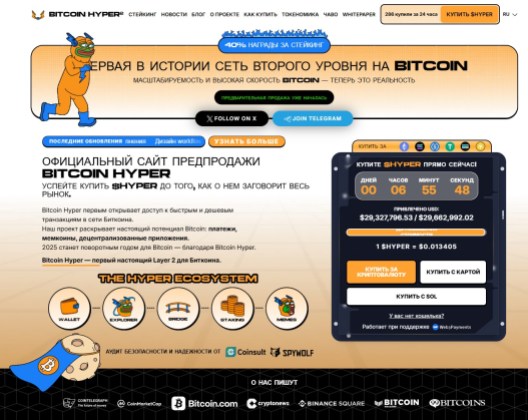
The project's key message is formulated very directly: "the first Bitcoin Layer 2 with SVM integration," which aims for ultra-low execution latency. This is important for a very practical reason: without fast smart contracts, the Bitcoin economy almost inevitably leaks to other ecosystems — to places where you can do swaps, lending, staking, and more complex strategies without waiting for blocks and without the pain of fees. And if the next market cycle is indeed about utility, then infrastructure often wins over noise — a boring thought, but a working one (and traders who track such shifts usually notice it first).

Interest in the story is also fueled by presale numbers: the project has already raised $29,556,732.75, with a token price of $0.013435. This is not a guarantee of success — it's just a marker of demand. The activity of large wallets also looks interesting: whale tracking has spotted two notable purchases totaling about $396k, with the largest transaction being approximately $53k from November 19, 2025.

The final touch is the staking mechanics after TGE: a high APY is announced (without disclosing the rate), instant launch, a 7-day vesting period for presale stakers, and a focus on rewards for community participation. The risk here is obvious: without specific yield parameters, the market will demand transparency, otherwise expectations can easily turn into disappointment. This is not a "project minus," but rather a test of communication maturity — how prepared the Bitcoin Hyper team is to disclose details on time.


Domande pertinenti

QWhat is the main reason for the recent decline in Bitcoin's price below $90,000?

AThe decline is due to a shift in market sentiment from 'eternal growth' to 'all is lost,' driven by reduced risk appetite among investors. They were spooked by signals that the boom in AI spending might generate profits slower than expected, leading to renewed pressure on risky assets.

QWho is promoting the $10,000 Bitcoin price target and what is their reasoning?

AMike McGlone from Bloomberg Intelligence is promoting the $10,000 Bitcoin price target. He links the risk of a deep decline to a deflationary scenario following a period of inflation, suggesting that the market could aggressively overcorrect downward when the cycle turns, just as it overcorrected upward.

QWhat is Bitcoin Hyper and what problem does it aim to solve?

ABitcoin Hyper is a Bitcoin Layer 2 solution that aims to address the UX pain points of high fees, limited throughput, and near-zero native programmability on the Bitcoin network. It provides a fast execution layer with Solana Virtual Machine (SVM) integration to enable speed, low fees, and programmable functionality like DeFi, NFTs, and dApps without sacrificing trust in Bitcoin.

QHow much funding has Bitcoin Hyper raised in its presale and what is the current price of its token?

ABitcoin Hyper has raised $29,556,732.75 in its presale, and the current token price is $0.013435.

QWhat is the key message of the Bitcoin Hyper project and why is it significant?

AThe key message of Bitcoin Hyper is that it is 'the first Bitcoin Layer 2 with SVM integration,' targeting ultra-low execution latency. This is significant because without fast smart contract capabilities, Bitcoin's economy risks leaking to other ecosystems that offer faster transactions, lower fees, and more complex financial strategies, making this infrastructure crucial for Bitcoin's utility in the next market cycle.

Letture associate

It Took Me a Year to See the Bitter Truth About Agent Payments

After a year building infrastructure for the Agent economy, engaging with major players like Stripe, Visa, and Coinbase, the author shares a sobering analysis of the current state of Agent payments. The core finding is a stark lack of genuine, immediate demand across most envisioned use cases. The article breaks down four key market segments: 1. **Agent-to-Merchant (Consumer Shopping):** For most product categories (e.g., clothing, electronics), conversational AI shopping is a step backwards from visual e-commerce interfaces. While agents excel at understanding needs, they can't replace side-by-side product comparison. Real merchant interest is defensive "Agent Engine Optimization," not driven by current customer demand. Potential exists for high-frequency, low-decision purchases (like food delivery) or navigating complex store UIs, but these require massive B2C distribution channels dominated by giants like Amazon. 2. **Agent-to-API (Developer Services):** Developers already have subscriptions and billing relationships for APIs (compute, data). Prepaid balances solve micro-payment issues for low transaction volumes. A deeper structural problem is that major SaaS vendors' business models rely on enterprise contracts, resisting granular pay-per-call pricing. While protocols like MPP and x402 serve the long tail of niche services, this market is small and developers are historically low-willingness-to-pay. 3. **Agent-to-Agent:** This remains largely theoretical with minimal transaction volume. While it represents a long-term bet on a fundamentally new transaction infrastructure (sub-second, micro-penny to million-dollar, multi-party settlements), it does not constitute a present market. 4. **Agent-to-Finance:** This is the only category with existing, paying demand. Integrating AI into financial workflows (trading, portfolio management) is a natural evolution and enables new capabilities like autonomous rebalancing. However, competition favors established, regulated institutions. The "real problem" is not moving money between agents, but the broader challenge of **coordination**—orchestrating work between agents and humans, verifying outcomes, and settling results. Payment is just one component of settlement, which is itself part of coordination. Companies that solve the coordination layer will subsume payment, not the other way around. While well-funded incumbents build defensively for a long-term future, startups must find where the market is today—which, for the author's team, lies outside these four categories in an area of real, growing, and underserved activity.

marsbit9 min fa

It Took Me a Year to See the Bitter Truth About Agent Payments

marsbit9 min fa

It Took Me a Year to See the Hard Truth About Agent Payments

**Title: It Took Me a Year to See the Hard Truth About Agent Payments** Over the past year, I've worked on infrastructure for the Agent economy, engaging with major players like Stripe, Visa, Coinbase, and numerous startups. The findings reveal a stark reality: genuine, widespread demand for Agent-based payments does not yet exist. **Key Observations:** * **Agent-to-Merchant (Shopping):** The user experience for AI shopping often falls short, especially for visual product discovery. While AI excels at understanding needs, conversational interfaces can't yet replace browsing and comparing multiple products visually. Current merchant interest is largely defensive ("Agent Engine Optimization") for a future that hasn't arrived. High-frequency, low-friction purchases (like food delivery) are potential fits, but lack open APIs and face high AI inference costs. Simpler, more affordable, or cross-language interactions for complex UIs are a niche opportunity but require massive consumer distribution to scale. * **Agent-to-API (Developer Tools):** Developer payment needs for APIs (computing, data, models) are already met through subscriptions and prepaid credits. The core challenge is not payment friction but supplier economics: most large SaaS providers prefer enterprise contracts over micropayments for API calls. Protocols like MPP and x402 suit the long-tail of smaller services but cater to a developer market historically reluctant to pay for these tools. Major infrastructure needs at the top of the stack are already being addressed. * **Agent-to-Agent (Machine Commerce):** This is a long-term vision with almost no current transaction volume. While a future with high-speed, high-frequency, multi-party machine-to-machine transactions would require novel infrastructure, it remains theoretical. The market is not here yet. * **Agent-to-Finance:** This is the only category with clear, present demand. Financial professionals and DeFi users already pay for tools, and AI augmentation is a natural evolution. Autonomous AI agents can enable entirely new financial strategies. However, competition is fierce from established, regulated incumbents who can more easily layer AI onto their existing products. **The Core Insight:** Companies, especially giants with long time horizons, are building defensively for a potential future of mass machine commerce. For them, early investment is a low-cost hedge. For startups, the current market reality is different. The primary challenge isn't just moving money between agents (payments). The larger, unsolved problem is **orchestration** – coordinating work between agents and humans, verifying outcomes, and then settling. Payment is just a part of settlement, which is just a part of orchestration. Companies that solve the orchestration problem will subsume payments, not the other way around. After a year of building, we see the real, growing, and underserved market opportunity lies in this broader domain of orchestration.

链捕手32 min fa

It Took Me a Year to See the Hard Truth About Agent Payments

链捕手32 min fa

Claude Opus 4.8 Finds a $4.5 Billion Bug: The AI Era is Mass-Producing Hackers

A researcher discovered a critical "infinite mint" vulnerability in the Zcash cryptocurrency's Orchard protocol using Claude Opus 4.8, leading to a swift fix but also a 50% market drop, erasing billions in value. This incident highlights a new era where powerful, accessible AI models are dramatically lowering the barrier to finding software vulnerabilities. Previously, the security community feared specialized models like Claude Mythos Preview, capable of finding decades-old zero-day exploits. The Zcash case, however, involved a publicly available, general-purpose model. This shift makes advanced security auditing—and attack capabilities—accessible to far more people, not just experts. The mass democratization of vulnerability discovery brings a dual challenge: a flood of low-quality, AI-generated false reports that overwhelm maintainers, and the real, rapid uncovering of deep, dangerous bugs. Open-source projects, often understaffed and unfunded, are particularly vulnerable to this "attention DDoS." The article cites examples like curl shutting down its bug bounty program due to the unsustainable workload. Our perceived digital safety has often been luck, relying on the high cost and effort required to find deeply hidden flaws in complex systems, as seen with historical vulnerabilities like Heartbleed or Baron Samedit. AI changes this cost structure, effectively "mass-producing flashlights" to illuminate every corner of our codebase. While large companies operate extensive security chains involving external white-hat hackers and massive defensive operations, the global cybersecurity workforce faces a severe shortage, especially of experienced personnel capable of analyzing complex threats and coordinating fixes. The core dilemma emerges: AI makes *finding* bugs cheap and scalable, but *fixing* them remains a slow, expensive, and human-intensive process. The article concludes that AI won't destroy the internet but acts as a bright light, revealing that our digital existence is not inherently secure but is precariously maintained by ongoing human effort. The true cost in the AI era may not be discovery, but whether there will be enough people left willing and able to do the hard work of repair.

marsbit1 h fa

Claude Opus 4.8 Finds a $4.5 Billion Bug: The AI Era is Mass-Producing Hackers

marsbit1 h fa

Codex Goal Mode Usage Guide: How to Make AI Continuously Pursue a Specific Objective

"Codex Goal Mode: How to Make AI Work Continuously Toward a Specific Goal" OpenAI's Codex "goal mode" (/goal) transforms the AI from a reactive code assistant into a proactive execution agent capable of working autonomously for hours or even days to achieve a defined objective. To maximize its effectiveness, follow these key principles: 1. **Define Clear, Verifiable Exit Criteria:** The goal prompt should be a concise, measurable success condition, not a lengthy specification. Use quantifiable metrics like "reduce build time by 30%" or "achieve 100% test parity." 2. **Provide Initial Guidance and Tools:** Direct Codex toward likely problem areas and specify available tools (e.g., browsers, testing environments) to prevent it from exploring unproductive paths. 3. **Enable Progress Measurement:** Equip Codex with ways to track advancement, such as creating comparison tools for visual tasks or evaluation sets, ensuring it can gauge its own progress. 4. **Use a Realistic Execution Environment:** For tasks like performance optimization, provide access to environments that closely mimic production (e.g., similar configs, databases) to yield valid results. 5. **Be Cautious with Visual Goals:** Avoid vague "pixel-perfect" instructions. Instead, supplement visual references with functional checklists or design system specifications to prevent Codex from obsessing over minor details. 6. **Implement Progress Tracking:** For long-running tasks, have Codex commit code to draft PRs, update progress documents, or send Slack updates to maintain visibility into its work. 7. **Review and Consolidate Results:** Once the goal is met, instruct Codex to review its work, clean up ineffective experimental code, and reflect on what strategies succeeded or failed. Ultimately, using goal mode shifts the developer's role from writing prompts to managing a persistent engineering agent—defining objectives, establishing metrics, configuring environments, and conducting final reviews.

marsbit2 h fa

Codex Goal Mode Usage Guide: How to Make AI Continuously Pursue a Specific Objective

marsbit2 h fa

Trading

Spot
Futures

Articoli Popolari

Come comprare BILL

Benvenuto in HTX.com! Abbiamo reso l'acquisto di Billions Network (BILL) semplice e conveniente. Segui la nostra guida passo passo per intraprendere il tuo viaggio nel mondo delle criptovalute.Step 1: Crea il tuo Account HTXUsa la tua email o numero di telefono per registrarti il tuo account gratuito su HTX. Vivi un'esperienza facile e sblocca tutte le funzionalità,Crea il mio accountStep 2: Vai in Acquista crypto e seleziona il tuo metodo di pagamentoCarta di credito/debito: utilizza la tua Visa o Mastercard per acquistare immediatamente Billions NetworkBILL.Bilancio: Usa i fondi dal bilancio del tuo account HTX per fare trading senza problemi.Terze parti: abbiamo aggiunto metodi di pagamento molto utilizzati come Google Pay e Apple Pay per maggiore comodità.P2P: Fai trading direttamente con altri utenti HTX.Over-the-Counter (OTC): Offriamo servizi su misura e tassi di cambio competitivi per i trader.Step 3: Conserva Billions Network (BILL)Dopo aver acquistato Billions Network (BILL), conserva nel tuo account HTX. In alternativa, puoi inviare tramite trasferimento blockchain o scambiare per altre criptovalute.Step 4: Scambia Billions Network (BILL)Scambia facilmente Billions Network (BILL) nel mercato spot di HTX. Accedi al tuo account, seleziona la tua coppia di trading, esegui le tue operazioni e monitora in tempo reale. Offriamo un'esperienza user-friendly sia per chi ha appena iniziato che per i trader più esperti.

203 Totale visualizzazioniPubblicato il 2026.05.07Aggiornato il 2026.06.02

Come comprare BILL

Cosa è ATWO

I. Introduzione al ProgettoArena Two è una piattaforma interattiva decentralizzata che consente ai fan di svolgere un ruolo attivo e tokenizzato nei risultati degli eventi in tempo reale. A differenza dei modelli di trasmissione tradizionali che riducono i fan a spettatori passivi, Arena Two sfrutta la tecnologia blockchain per consentire ai fan di votare direttamente in tempo reale e influenzare i risultati sul campo.II. Informazioni sul TokenNome del token: ATWO(Arena Two)III. Link CorrelatiSito web:https://arenatwo.com/Esploratori:https://basescan.org/token/0x499D35eBE6cEe9B2Ac35Fd003fcBbeeB9CFc7B32Twitter:https://x.com/arenatwoXNota: L'introduzione al progetto proviene dai materiali pubblicati o forniti dal team ufficiale del progetto, che è solo a scopo di riferimento e non costituisce consulenza sugli investimenti. HTX non si assume responsabilità per eventuali perdite dirette o indirette derivanti.

145 Totale visualizzazioniPubblicato il 2026.05.18Aggiornato il 2026.06.02

Cosa è ATWO

Come comprare ATWO

Benvenuto in HTX.com! Abbiamo reso l'acquisto di Arena Two (ATWO) semplice e conveniente. Segui la nostra guida passo passo per intraprendere il tuo viaggio nel mondo delle criptovalute.Step 1: Crea il tuo Account HTXUsa la tua email o numero di telefono per registrarti il tuo account gratuito su HTX. Vivi un'esperienza facile e sblocca tutte le funzionalità,Crea il mio accountStep 2: Vai in Acquista crypto e seleziona il tuo metodo di pagamentoCarta di credito/debito: utilizza la tua Visa o Mastercard per acquistare immediatamente Arena TwoATWO.Bilancio: Usa i fondi dal bilancio del tuo account HTX per fare trading senza problemi.Terze parti: abbiamo aggiunto metodi di pagamento molto utilizzati come Google Pay e Apple Pay per maggiore comodità.P2P: Fai trading direttamente con altri utenti HTX.Over-the-Counter (OTC): Offriamo servizi su misura e tassi di cambio competitivi per i trader.Step 3: Conserva Arena Two (ATWO)Dopo aver acquistato Arena Two (ATWO), conserva nel tuo account HTX. In alternativa, puoi inviare tramite trasferimento blockchain o scambiare per altre criptovalute.Step 4: Scambia Arena Two (ATWO)Scambia facilmente Arena Two (ATWO) nel mercato spot di HTX. Accedi al tuo account, seleziona la tua coppia di trading, esegui le tue operazioni e monitora in tempo reale. Offriamo un'esperienza user-friendly sia per chi ha appena iniziato che per i trader più esperti.

81 Totale visualizzazioniPubblicato il 2026.05.18Aggiornato il 2026.06.02

Come comprare ATWO

Discussioni

Benvenuto nella Community HTX. Qui puoi rimanere informato sugli ultimi sviluppi della piattaforma e accedere ad approfondimenti esperti sul mercato. Le opinioni degli utenti sul prezzo di A A sono presentate come di seguito.

活动图片













