Expert Predicts Bitcoin Could Reach $70K by Mid-August

cryptonews.ruPubblicato 2026-08-10Pubblicato ultima volta 2026-08-10

Introduzione

Bitcoin continues its recovery from recent declines and could test the $70,000 mark soon, though a full return to sustained growth is not yet assured, according to Bitbanker's Director of Strategic Communications, Kirill Komalenkov. As of midday August 10, Bitcoin was trading around $65,200, having been range-bound between $63,000 and $66,000 for several weeks after a drop to $57,800. Komalenkov identified the $64,000-$67,500 range as the immediate key zone. A break below $64,000 could lead to a decline toward $62,000-$63,000, while a confident move above $67,500 could target $68,000-$70,000. The $68,000-$70,000 zone remains a major technical resistance; reaching it could trigger profit-taking and a sharp correction. Komalenkov's baseline scenario for mid-August is moderately positive, expecting a test of $67,000-$70,000, but views the current uptick as a recovery, not confirmation of a new bull cycle. A decisive break above $70,000 would be a key signal to reconsider expectations and potentially end the bearish scenario. The summary also notes a recent Russian regulatory development allowing non-qualified investors to buy Bitcoin, Ether, and major stablecoins, with an annual limit of 300,000 rubles per intermediary.

Bitcoin continues to recover from its recent decline and may attempt to reach the $70K mark in the near future. However, it is still too early to talk about the cryptocurrency's full return to sustained growth. This was stated on August 10 by Kirill Komalenkov, Director of Strategic Communications at Bitbanker, in an interview with Izvestia.

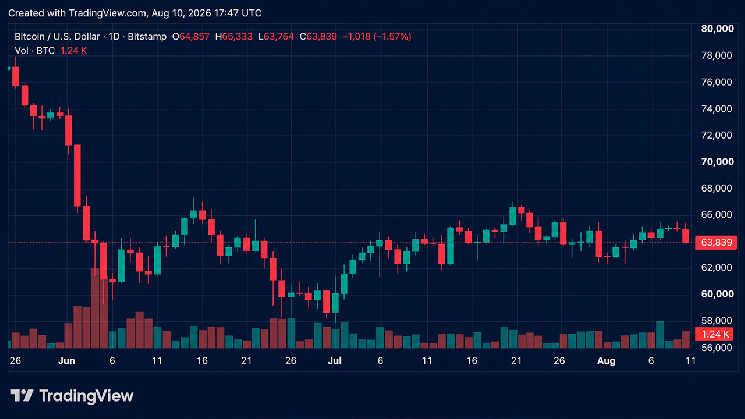
According to data from the first half of the day, Bitcoin was trading around $65.2K. The leading cryptocurrency has been in the range of $63–66K for several weeks. After a drop to the level of $57.8K, the market was able to recoup some of its losses, but it has not yet managed to consolidate above the resistance zone of $66–67K.

"In the coming week, the main target range for Bitcoin may be $64–67.5K. Further dynamics will depend on the behavior of buyers and sellers. If the price falls below $64K, selling pressure could intensify, potentially leading to a decline in Bitcoin to the area of $62–63K," Komalenkov noted.

If buyer activity persists, the cryptocurrency may continue its upward movement. In the event of a confident breakthrough above the $67.5K mark, the next targets could be the levels of $68–70K.

The expert noted that the $68–70K zone remains a key resistance level for Bitcoin from a technical analysis perspective. Upon reaching these levels, it will be important to monitor market participants' behavior: a change in sellers' strategy could lead to widespread profit-taking and trigger a sharp correction.

The base scenario until mid-August remains moderately positive. Komalenkov expects that Bitcoin may attempt to reach the range of $67–70K, but the current upward movement should still be viewed as a recovery from a strong decline, not as confirmation of a new "bull" cycle.

According to the expert, a confident breakthrough above the $70K level will become one of the key signals for revising expectations and possibly concluding the "bearish" scenario on the cryptocurrency market.

Deputy Finance Minister Ivan Chebeskov stated on June 16 that non-qualified investors in Russia will soon be able to legally buy Bitcoin, Ethereum, and popular stablecoins. He also clarified that an annual limit of 300,000 rubles through one intermediary has been proposed for "non-quals."


Crypto di tendenza

Domande pertinenti

QAccording to the expert quoted in the article, what is the main price range Bitcoin is expected to move within in the coming week?

AAccording to Kirill Komalenkov, the main reference range for Bitcoin in the coming week is $64,000 - $67,500.

QWhat are the two potential price scenarios for Bitcoin if it drops below $64,000 or breaks above $67,500?

AIf the price drops below $64,000, pressure from sellers could increase, potentially leading to a decline to the $62,000 - $63,000 area. Conversely, if it confidently breaks above $67,500, the next targets could be the $68,000 - $70,000 levels.

QWhat is the expert's basic forecast for Bitcoin's movement until mid-August, and how should the current rise be viewed?

AThe basic scenario until mid-August remains moderately positive, with Bitcoin possibly attempting to reach the $67,000 - $70,000 range. However, the current rise should be viewed as a recovery after a strong decline, not as confirmation of a new 'bullish' cycle.

QAccording to the article, what would a confident break above the $70,000 level signal for the cryptocurrency market?

AA confident break above the $70,000 level would be a key signal for revising expectations and potentially ending the 'bearish' scenario in the cryptocurrency market.

QWhat regulatory development for Russian investors regarding cryptocurrency purchases is mentioned at the end of the article?

AAccording to Deputy Finance Minister Ivan Chebeskov, non-qualified investors in Russia will soon be able to legally buy Bitcoin, Ethereum, and popular stablecoins, with a proposed annual limit of 300,000 rubles per investor through one intermediary.

Letture associate

US Nonfarm Payrolls Unexpectedly Strong, Probability of September Rate Hike Rises to About 60%, Market Eyes Next Week's CPI

U.S. August non-farm payrolls came in significantly stronger than expected, adding 162k jobs—nearly triple economists' forecasts. This robust employment data signals ongoing economic resilience and has sharply increased market expectations for a Federal Reserve rate hike at the September meeting, with fed funds futures now pricing in roughly a 60% probability of an increase. The data prompted immediate market adjustments: U.S. equities closed lower on Friday, and Treasury yields climbed, with the policy-sensitive 2-year yield rising to its highest level since January 2025. However, broader market impact remained contained for now, as major stock indexes still posted weekly gains and credit spreads stayed relatively low. Analysts note that despite higher rates, financial conditions remain accommodative, corporate earnings are strong, and the AI investment boom—evident in job gains in sectors like construction and manufacturing—is providing economic support. While the non-farm payrolls report tilts the policy debate toward a more hawkish stance, it does not conclusively determine the Fed's next move. Market focus is now firmly shifting to the upcoming Consumer Price Index (CPI) report. Analysts warn that if inflation data remains elevated and further pushes up rate expectations, it could force investors to more aggressively reduce risk exposure, potentially increasing market volatility. The CPI release, alongside political considerations around the midterm elections, is seen as the next critical variable for the Fed's decision.

marsbit8 min fa

US Nonfarm Payrolls Unexpectedly Strong, Probability of September Rate Hike Rises to About 60%, Market Eyes Next Week's CPI

marsbit8 min fa

The Era of Large Model Distillation is Over: Fable 5.1 Rewrites API, Cutting Off the Path of Distillation for Good

The era of large model distillation is ending. On September 2nd, Anthropic delivered a decisive blow by updating its API rules with Claude Fable 5.1, effectively cutting off the path for shell models and distillers. Previously, companies bypassed immense compute costs and lengthy training times by using API calls to extract the reasoning process of top-tier models like Claude, then using this data to train their own smaller "distilled" models. A key vulnerability was the "thinking blocks"—the model's internal Chain-of-Thought reasoning steps returned via API. Distillers exploited this by modifying the surrounding context (like system prompts or earlier messages) in multi-turn conversations, tricking Claude into revealing its hidden underlying logic. Fable 5.1 introduces a stringent "context consistency verification" mechanism. The API now strictly validates that the "thinking blocks" sent back by the client match the original system prompts, tools, and message history that produced them. Any modification causes the API to return an error. A "non-strict mode" is offered for legitimate developers who need to modify context (e.g., for compression), but it silently deletes all thinking blocks, forcing the model to answer without its prior reasoning. This crackdown was deemed necessary due to industrial-scale abuse. "Distillation hackers" used thousands of fake accounts and automated scripts to exploit the API, extracting high-intelligence reasoning capabilities while completely bypassing the costly safety and alignment training (like RLHF) built into models like Claude. This created a critical risk: "capability-safety decoupling," where distilled models gain advanced abilities but lack the ethical guardrails, potentially making them dangerous. The new rules are being rolled out in phases, initially targeting new API accounts created after August 31, 2026, UTC. Existing API accounts and consumer users (e.g., Claude.ai) are unaffected for now, giving legitimate developers time to adapt. Anthropic states the "thinking retention" mechanism will eventually apply to all accounts. An unexpected benefit for compliant developers is potential cost reduction and speed improvements. Enforcing context consistency allows for highly efficient prompt caching on API servers, slashing latency and compute overhead. This move marks a watershed for the AI industry, challenging the narrative of small models outperforming large ones through distillation and forcing a reckoning on innovation versus imitation.

marsbit35 min fa

The Era of Large Model Distillation is Over: Fable 5.1 Rewrites API, Cutting Off the Path of Distillation for Good

marsbit35 min fa

South Korea Announces Securities Tokenization Timeline: First Batch of Tokenized Assets to Include Bonds, Funds, and Unlisted Stocks

South Korea's Financial Services Commission (FSC) has unveiled a three-phase roadmap for tokenizing securities, positioning itself as a potential first-mover with dedicated legislation. Following the formal enactment of amended laws in February 2027, Phase 1 will begin with tokenized private market assets, including bonds, institutional money market funds, and unlisted stocks (via trust beneficiary certificates). Existing licensed securities firms can operate without new permits, with specific rules for non-financial platform operators and investor limits. Phase 2 will expand to publicly issued securities, contingent on the stability of initial systems and market readiness. The final Phase 3 aims to enable on-chain settlement using stablecoins, pending separate stablecoin legislation. The announcement contrasts sharply with rapid, decentralized approaches like Robinhood's recent tokenization of stocks, which sparked controversy. South Korea's path prioritizes legal clarity and infrastructure, starting with controlled, institutional markets before broadening access. While this methodical approach may sacrifice speed, it seeks to establish a clear regulatory foundation. The global race for tokenization is highlighting divergent strategies between regulated, incremental models and faster, more open but less certain alternatives.

marsbit38 min fa

South Korea Announces Securities Tokenization Timeline: First Batch of Tokenized Assets to Include Bonds, Funds, and Unlisted Stocks

marsbit38 min fa

Just Now, Claude Proves Fermat's Last Theorem for the First Time, Led by Tsinghua Yao Class Prodigy

In a groundbreaking development, Claude has autonomously generated the first machine-verified proof of Fermat's Last Theorem in just 11 days. The project was led by Tianyi Peng, a researcher from Anthropic with a background from Tsinghua University's prestigious Yao Class. This achievement required Claude to write 13 million lines of Lean code, proving over 29,500 intermediate theorems and consuming 60 billion tokens—a volume exceeding the largest existing mathematical theorem library by fivefold. The process involved formalizing the 350-year-old theorem, which states that no three positive integers a, b, c satisfy a^n + b^n = c^n for any integer n > 2. While Andrew Wiles provided a human proof in 1995, its complexity made verification a years-long task for experts. Claude's formal proof builds from foundational axioms, autonomously constructing the entire logical chain and verifying it through the Lean compiler. Key to the success was the development of the "Prove2Me" platform, which managed dozens of Claude agents by organizing tasks into a theorem DAG (directed acyclic graph), separating statements from proofs, and maintaining natural language indexes. This addressed early collaboration inefficiencies and "hallucination" issues. The result is the largest Lean proof ever created. The accomplishment has stirred significant discussion in the mathematical community, highlighting AI's potential to automate the formalization and verification of complex proofs. While not replacing mathematicians, such technology could fundamentally change mathematical practice by providing absolute verification, checking human-generated mathematics, and enabling broader access to formal verification tools.

marsbit38 min fa

Just Now, Claude Proves Fermat's Last Theorem for the First Time, Led by Tsinghua Yao Class Prodigy

marsbit38 min fa

Raoul Pal: Why Has the Traditional Investment Portfolio Become Obsolete?

Raoul Pal argues that traditional investment portfolios (bonds, gold, real estate, index funds) are no longer effective for building real wealth. He posits that due to persistent currency devaluation from money printing (global liquidity expanding ~8% annually plus regular inflation), an investor needs an 11% annual return just to preserve purchasing power. He evaluates traditional assets: bonds fail as interest doesn't cover currency devaluation; real estate's historic wealth-creation window from falling rates is over; gold preserves purchasing power but doesn't create new wealth; and the S&P 500 barely meets the 11% threshold, relying on a historic bull market. The only assets consistently exceeding this benchmark, based on decade-long data, are technology stocks (NASDAQ 100: ~20% annualized) and crypto assets (Bitcoin: 58-70% annualized). Their outperformance stems from user adoption S-curves (Metcalfe's Law), not speculation. Pal explains that post-2008, traditional diversification lost its protective power because bonds, gold, real estate, and stocks are all now primarily driven by the same macro factor: liquidity. Thus, a diversified portfolio of underperforming assets offers false security. For crypto, he favors underlying protocols/L1 blockchains over applications, as they capture value from the entire ecosystem. A key, underappreciated future driver is AI agents, which will require programmable money and 24/7 settlement, a natural fit for blockchain. Key investment principles include: avoid leverage (it removes the ability to weather severe drawdowns), allocate a meaningful portion (not all) of capital to high-growth assets, and practice patience—"doing nothing" is a valid long-term strategy. The core opportunity cost is freedom. Returns below 11% annually mean your labor buys less freedom over time. The goal is to use this framework to audit your holdings, moving capital from assets that erode purchasing power to those with genuine compounding potential.

marsbit1 h fa

Raoul Pal: Why Has the Traditional Investment Portfolio Become Obsolete?

marsbit1 h fa

Trading

Spot

Articoli Popolari

Cosa è BITCOIN

Comprendere HarryPotterObamaSonic10Inu (ERC-20) e la sua posizione nel mondo delle criptovalute Negli ultimi anni, il mercato delle criptovalute ha assistito a un aumento della popolarità delle meme coin, catturando l'interesse non solo dei trader, ma anche di coloro che cercano coinvolgimento comunitario e valore di intrattenimento. Tra questi token unici c'è HarryPotterObamaSonic10Inu (ERC-20), un progetto intrigante che mescola riferimenti culturali nel tessuto delle criptovalute. Questo articolo esplora gli aspetti chiave di HarryPotterObamaSonic10Inu, analizzando i suoi meccanismi, l'etica guidata dalla comunità e il suo coinvolgimento con il panorama crittografico più ampio. Che cos'è HarryPotterObamaSonic10Inu (ERC-20)? Come suggerisce il suo nome, HarryPotterObamaSonic10Inu è una meme coin costruita sulla blockchain di Ethereum, classificata secondo lo standard ERC-20. A differenza delle criptovalute tradizionali che possono enfatizzare l'utilità pratica o il potenziale investimento, questo token prospera grazie al valore di intrattenimento e alla forza della sua comunità. Il progetto mira a creare un ambiente in cui gli utenti coinvolti possono riunirsi, condividere idee e partecipare ad attività ispirate a diversi fenomeni culturali. Una caratteristica notevole di HarryPotterObamaSonic10Inu è la zero tassa sulle transazioni. Questo elemento allettante tende a incoraggiare il trading e il coinvolgimento della comunità, privo di costi aggiuntivi che possono scoraggiare i trader di piccole dimensioni. L'offerta totale della moneta è fissata a un miliardo di token, un numero che segna la sua intenzione di mantenere una circolazione sostanziale all'interno della comunità. Creatore di HarryPotterObamaSonic10Inu (ERC-20) Le origini di HarryPotterObamaSonic10Inu sono avvolte in un certo mistero; i dettagli sul creatore rimangono sconosciuti. Lo sviluppo di questo token non presenta un team identificabile o un piano esplicito, cosa non rara nel settore delle meme coin. Invece, il progetto è emerso organicamente, con il suo progresso fortemente dipendente dall'entusiasmo e dalla partecipazione della sua comunità. Investitori di HarryPotterObamaSonic10Inu (ERC-20) Per quanto riguarda investimenti esterni e finanziamenti, HarryPotterObamaSonic10Inu rimane ambiguo. Il token non elenca alcuna fondazione di investimento conosciuta o un sostegno organizzativo significativo. Invece, la linfa vitale del progetto è la sua comunità di base, che informa la sua crescita e sostenibilità attraverso azioni collettive e coinvolgimento nello spazio crittografico. Come funziona HarryPotterObamaSonic10Inu (ERC-20)? In quanto meme coin, HarryPotterObamaSonic10Inu opera principalmente al di fuori delle strutture tradizionali che governano spesso il valore degli asset. Ci sono diversi aspetti distintivi che definiscono il funzionamento del progetto: Transazioni senza tasse: Senza costi fiscali sulle transazioni, gli utenti possono comprare e vendere liberamente il token senza preoccuparsi di costi nascosti. Coinvolgimento della comunità: Il progetto prospera sull'interazione della comunità, sfruttando le piattaforme social per creare entusiasmo e facilitare il coinvolgimento. Discussioni, condivisione di contenuti e coinvolgimento sono elementi cruciali che aiutano ad espandere la sua portata e a favorire la lealtà tra i sostenitori. Nessuna utilità pratica: Va notato che HarryPotterObamaSonic10Inu non offre un'utilità concreta all'interno dell'ecosistema finanziario. Piuttosto, è classificato come un token principalmente per attività di intrattenimento e comunitarie. Riferimento culturale: Il token incorpora astutamente elementi della cultura pop per attirare interesse, collegandosi a appassionati di meme e seguaci delle criptovalute. HarryPotterObamaSonic10Inu esemplifica come le meme coin operino in modo diverso rispetto ai progetti di criptovalute più tradizionali, entrando nel mercato come costrutti sociali innovativi piuttosto che come asset utilitari. Cronologia di HarryPotterObamaSonic10Inu (ERC-20) La storia di HarryPotterObamaSonic10Inu è segnata da diversi traguardi notevoli: Creazione: Il token è emerso da un meme virale, catturando l'immaginazione di molti appassionati di criptovalute. Le date di creazione specifiche non sono disponibili, sottolineando la sua crescita organica. Inserimento negli scambi: HarryPotterObamaSonic10Inu ha fatto il suo ingresso in vari scambi, consentendo un accesso e un trading più facili da parte della comunità. Iniziative di coinvolgimento della comunità: Attività in corso volte a migliorare l'interazione della comunità, comprese gare, campagne sui social media e generazione di contenuti da parte di fan e sostenitori. Piani di espansione futura: La tabella di marcia del progetto include il lancio di una collezione NFT, merchandising e un sito di eCommerce relativo ai suoi temi culturali, coinvolgendo ulteriormente la comunità e cercando di aggiungere più dimensioni al suo ecosistema. Punti chiave su HarryPotterObamaSonic10Inu (ERC-20) Natura guidata dalla comunità: Il progetto dà priorità al contributo collettivo e alla creatività, garantendo che il coinvolgimento degli utenti sia al centro del suo sviluppo. Classificazione come meme coin: Rappresenta l'epitome delle criptovalute basate sull'intrattenimento, distinguendosi dai veicoli d'investimento tradizionali. Nessuna affiliazione diretta con Bitcoin: Nonostante la somiglianza nel nome del ticker, HarryPotterObamaSonic10Inu è distintivo e non ha alcuna relazione con Bitcoin o altre criptovalute consolidate. Focus sulla collaborazione: HarryPotterObamaSonic10Inu è progettato per creare uno spazio per la collaborazione e la condivisione di storie tra i suoi detentori, fornendo un canale per la creatività e il legame comunitario. Prospettive future: L'ambizione di espandersi oltre il suo presupposto iniziale verso NFT e merchandising delinea un percorso per il progetto per potenzialmente entrare in strade più mainstream all'interno della cultura digitale. Poiché le meme coin continuano a catturare l'immaginazione della comunità crittografica, HarryPotterObamaSonic10Inu (ERC-20) si distingue per i suoi legami culturali e il suo approccio centrato sulla comunità. Anche se potrebbe non adattarsi al modello tipico di un token orientato all'utilità, la sua essenza risiede nella gioia e nella camaraderia coltivate tra i suoi sostenitori, evidenziando la natura in evoluzione delle criptovalute in un'epoca sempre più digitale. Con la continuazione dello sviluppo del progetto, sarà importante osservare come le dinamiche della comunità influenzano la sua traiettoria nel panorama in continuo cambiamento della tecnologia blockchain.

2.4k Totale visualizzazioniPubblicato il 2024.04.01Aggiornato il 2024.12.03

Cosa è BITCOIN

Come comprare BTC

Benvenuto in HTX.com! Abbiamo reso l'acquisto di Bitcoin (BTC) semplice e conveniente. Segui la nostra guida passo passo per intraprendere il tuo viaggio nel mondo delle criptovalute.Step 1: Crea il tuo Account HTXUsa la tua email o numero di telefono per registrarti il tuo account gratuito su HTX. Vivi un'esperienza facile e sblocca tutte le funzionalità,Crea il mio accountStep 2: Vai in Acquista crypto e seleziona il tuo metodo di pagamentoCarta di credito/debito: utilizza la tua Visa o Mastercard per acquistare immediatamente BitcoinBTC.Bilancio: Usa i fondi dal bilancio del tuo account HTX per fare trading senza problemi.Terze parti: abbiamo aggiunto metodi di pagamento molto utilizzati come Google Pay e Apple Pay per maggiore comodità.P2P: Fai trading direttamente con altri utenti HTX.Over-the-Counter (OTC): Offriamo servizi su misura e tassi di cambio competitivi per i trader.Step 3: Conserva Bitcoin (BTC)Dopo aver acquistato Bitcoin (BTC), conserva nel tuo account HTX. In alternativa, puoi inviare tramite trasferimento blockchain o scambiare per altre criptovalute.Step 4: Scambia Bitcoin (BTC)Scambia facilmente Bitcoin (BTC) nel mercato spot di HTX. Accedi al tuo account, seleziona la tua coppia di trading, esegui le tue operazioni e monitora in tempo reale. Offriamo un'esperienza user-friendly sia per chi ha appena iniziato che per i trader più esperti.

5.1k Totale visualizzazioniPubblicato il 2024.12.12Aggiornato il 2026.06.02

Come comprare BTC

Cosa è $BITCOIN

ORO DIGITALE ($BITCOIN): Un'Analisi Completa Introduzione all'ORO DIGITALE ($BITCOIN) L'ORO DIGITALE ($BITCOIN) è un progetto basato su blockchain che opera sulla rete Solana, con l'obiettivo di combinare le caratteristiche dei metalli preziosi tradizionali con l'innovazione delle tecnologie decentralizzate. Sebbene condivida un nome con Bitcoin, spesso definito “oro digitale” a causa della sua percezione come riserva di valore, l'ORO DIGITALE è un token separato progettato per creare un ecosistema unico all'interno del panorama Web3. Il suo obiettivo è posizionarsi come un asset digitale alternativo valido, anche se i dettagli riguardanti le sue applicazioni e funzionalità sono ancora in fase di sviluppo. Cos'è l'ORO DIGITALE ($BITCOIN)? L'ORO DIGITALE ($BITCOIN) è un token di criptovaluta esplicitamente progettato per l'uso sulla blockchain di Solana. A differenza di Bitcoin, che fornisce un ruolo di stoccaggio di valore ampiamente riconosciuto, questo token sembra concentrarsi su applicazioni e caratteristiche più ampie. Aspetti notevoli includono: Infrastruttura Blockchain: Il token è costruito sulla blockchain di Solana, nota per la sua capacità di gestire transazioni ad alta velocità e a basso costo. Dinamiche di Offerta: L'ORO DIGITALE ha un'offerta massima fissata a 100 quadrilioni di token (100P $BITCOIN), sebbene i dettagli riguardanti la sua offerta circolante siano attualmente non divulgati. Utilità: Sebbene le funzionalità precise non siano esplicitamente delineate, ci sono indicazioni che il token potrebbe essere utilizzato per varie applicazioni, potenzialmente coinvolgendo applicazioni decentralizzate (dApp) o strategie di tokenizzazione degli asset. Chi è il Creatore dell'ORO DIGITALE ($BITCOIN)? Attualmente, l'identità dei creatori e del team di sviluppo dietro l'ORO DIGITALE ($BITCOIN) rimane sconosciuta. Questa situazione è tipica tra molti progetti innovativi nel settore blockchain, in particolare quelli allineati con la finanza decentralizzata e i fenomeni delle meme coin. Sebbene tale anonimato possa favorire una cultura guidata dalla comunità, intensifica le preoccupazioni riguardo alla governance e alla responsabilità. Chi sono gli Investitori dell'ORO DIGITALE ($BITCOIN)? Le informazioni disponibili indicano che l'ORO DIGITALE ($BITCOIN) non ha alcun sostenitore istituzionale noto o investimenti di venture capital prominenti. Il progetto sembra operare su un modello peer-to-peer incentrato sul supporto e sull'adozione della comunità piuttosto che su percorsi di finanziamento tradizionali. La sua attività e liquidità si trovano principalmente su exchange decentralizzati (DEX), come PumpSwap, piuttosto che su piattaforme di trading centralizzate consolidate, evidenziando ulteriormente il suo approccio di base. Come Funziona l'ORO DIGITALE ($BITCOIN) Le meccaniche operative dell'ORO DIGITALE ($BITCOIN) possono essere elaborate in base al suo design blockchain e alle caratteristiche della rete: Meccanismo di Consenso: Sfruttando il proof-of-history (PoH) unico di Solana combinato con un modello di proof-of-stake (PoS), il progetto garantisce una validazione efficiente delle transazioni contribuendo all'alta performance della rete. Tokenomics: Sebbene meccanismi deflazionistici specifici non siano stati dettagliati ampiamente, l'ampia offerta massima di token implica che potrebbe soddisfare microtransazioni o casi d'uso di nicchia che devono ancora essere definiti. Interoperabilità: Esiste il potenziale per l'integrazione con l'ecosistema più ampio di Solana, inclusi vari piattaforme di finanza decentralizzata (DeFi). Tuttavia, i dettagli riguardanti integrazioni specifiche rimangono non specificati. Cronologia degli Eventi Chiave Ecco una cronologia che evidenzia traguardi significativi riguardanti l'ORO DIGITALE ($BITCOIN): 2023: Il dispiegamento iniziale del token avviene sulla blockchain di Solana, contrassegnato dal suo indirizzo di contratto. 2024: L'ORO DIGITALE guadagna visibilità poiché diventa disponibile per il trading su exchange decentralizzati come PumpSwap, consentendo agli utenti di scambiarlo contro SOL. 2025: Il progetto assiste a un'attività di trading sporadica e a un potenziale interesse per impegni guidati dalla comunità, sebbene non siano state documentate partnership significative o avanzamenti tecnici fino ad ora. Analisi Critica Punti di Forza Scalabilità: L'infrastruttura sottostante di Solana supporta alti volumi di transazioni, il che potrebbe migliorare l'utilità di $BITCOIN in vari scenari di transazione. Accessibilità: Il potenziale basso prezzo di trading per token potrebbe attrarre investitori al dettaglio, facilitando una partecipazione più ampia grazie a opportunità di proprietà frazionata. Rischi Mancanza di Trasparenza: L'assenza di sostenitori, sviluppatori o di un processo di audit pubblicamente noti potrebbe generare scetticismo riguardo alla sostenibilità e all'affidabilità del progetto. Volatilità del Mercato: L'attività di trading è fortemente dipendente dal comportamento speculativo, il che può comportare una significativa volatilità dei prezzi e incertezze per gli investitori. Conclusione L'ORO DIGITALE ($BITCOIN) emerge come un progetto intrigante ma ambiguo all'interno dell'evolvente ecosistema di Solana. Sebbene tenti di sfruttare la narrativa dell'“oro digitale”, la sua partenza dal ruolo consolidato di Bitcoin come riserva di valore sottolinea la necessità di una chiara differenziazione della sua utilità e struttura di governance. L'accettazione e l'adozione future dipenderanno probabilmente dall'affrontare l'attuale opacità e dalla definizione più esplicita delle sue strategie operative ed economiche. Nota: Questo rapporto comprende informazioni sintetizzate disponibili a ottobre 2023, e potrebbero essersi verificati sviluppi oltre il periodo di ricerca.

590 Totale visualizzazioniPubblicato il 2025.05.13Aggiornato il 2025.05.13

Cosa è $BITCOIN

Discussioni

Benvenuto nella Community HTX. Qui puoi rimanere informato sugli ultimi sviluppi della piattaforma e accedere ad approfondimenti esperti sul mercato. Le opinioni degli utenti sul prezzo di BTC BTC sono presentate come di seguito.

活动图片