Expert Explains Changes in the Cryptomarket Starting September 1

cryptonews.ruPubblicato 2026-08-28Pubblicato ultima volta 2026-08-28

Introduzione

Expert explains cryptocurrency market changes effective September 1 in Russia. A new federal law (No. 282-FZ) introduces separate regulation for the crypto market, placing oversight under the Bank of Russia. The central bank gains powers to maintain registries, conduct inspections, and issue mandatory orders for market participants like crypto exchanges and digital depositories. Key changes include: registration requirements for crypto exchanges and depositories with a compliance deadline of July 1, 2027; permission to use digital currency for foreign trade settlements under specific contracts, with mandatory reporting for large transactions (over 10 million rubles) and for using addresses outside Russian depositories from May 2027; a continued ban on using cryptocurrency for domestic payments for goods and services, with few exceptions; and new advertising rules requiring risk warnings while prohibiting promises of profitability. Participants must adapt to the new framework, which aims to regulate operations while warning investors of risks like fraud and total loss of funds.

After the new rules come into force, participants in the cryptomarket will have to operate according to new requirements, including the registration of regulated participants and oversight by the Bank of Russia. The changes will affect crypto exchanges, digital depositories, advertising of services with digital assets, and the use of cryptocurrency in foreign trade. This was reported to Izvestia on August 28 by Dmitry Khrulev, Vice President of the International Association of Mediators "Sila Dialoga".

According to the expert, Federal Law No. 282-FZ introduces separate regulation for the cryptomarket and establishes requirements for crypto exchanges, digital depositories, and other participants in the field. The Bank of Russia will gain the right to maintain registries, conduct inspections, and issue mandatory instructions.

"Starting September 1, Federal Law No. 282-FZ, which introduces separate regulation for the cryptomarket, begins to operate in Russia. It establishes requirements for crypto exchanges, digital depositories, and other participants. Their work will be monitored by the Bank of Russia, which will gain the right to maintain registries, conduct inspections, and issue mandatory instructions," Khrulev noted.

One of the directions of the new regulation will be the use of digital currency in foreign trade settlements. According to the expert, exporters and importers will be able to conduct such operations directly or through an intermediary if they are related to a foreign trade contract between a resident and a non-resident.

To conduct such operations, companies will need to retain the contract, payment terms, and confirmation of the transaction. When using addresses outside Russian digital depositories from May 2, 2027, organizations will be required to submit reports with supporting materials to tax authorities.

Furthermore, operations under foreign trade contracts amounting to 10 million rubles or more will be subject to mandatory control.

Meanwhile, the use of cryptocurrency for payment of goods, works, and services within Russia remains prohibited, except for cases provided by law.

Khrulev noted that separate administrative fines for violations of digital currency operation rules have not yet been adopted. The relevant draft law is under consideration. However, the Bank of Russia will be able to issue mandatory instructions and exclude violators from registries.

Separate requirements will apply to crypto exchanges and digital depositories. To operate, they will need to obtain permission and be included in the Bank of Russia's registries. By July 1, 2027, market participants must bring their activities into compliance with the new requirements.

After this date, residents will be able to conduct operations with digital currency through regulated market participants or with their participation. Banks will be able to limit transfers to persons who illegally organize the circulation of cryptocurrency.

The new rules will also affect advertising of services related to digital assets. According to Khrulev, such advertising must contain information about the organizer, a warning about high risk and the possibility of complete loss of investments.

Furthermore, it is prohibited to specify a specific cryptocurrency, promise profitability, or forecast changes in the exchange rate of a digital asset.

For owners of digital assets, the risks of losing funds and fraud remain. In case of a dispute with a regulated market participant, a citizen will be able to file a complaint and also appeal to the Bank of Russia.

The expert noted that after the new rules come into force, market participants need to consider the established requirements and risks of operations with digital assets.

Russian President Vladimir Putin signed a law establishing the legal framework for the circulation of cryptocurrencies in the country. The document dated August 4 is aimed at regulating operations with digital currencies and defining the procedure for their use within Russian legislation. The law regulates relations in the sphere of organizing the circulation, accounting, and storage of digital currencies and foreign digital instruments, mining, issuance, and circulation of digital rights.

end-content

Domande pertinenti

QWhat major changes will come into effect for the Russian crypto market starting September 1st, as explained by the expert?

AStarting September 1st, Federal Law No. 282-FZ introduces separate regulation for the crypto market. It establishes requirements for crypto exchanges, digital depositories, and other participants, placing their activities under the supervision of the Bank of Russia. The central bank gains the authority to maintain registries, conduct inspections, and issue mandatory prescriptions.

QHow does the new law regulate the use of cryptocurrency in foreign trade settlements?

AThe law allows the use of digital currency in foreign trade settlements for exporters and importers, either directly or through an intermediary, provided it's tied to a foreign trade contract between a resident and non-resident. Contracts, payment terms, and transaction confirmations must be kept. For transactions from May 2, 2027, involving addresses outside Russian digital depositories, reports with supporting documents must be filed with tax authorities.

QIs cryptocurrency allowed for domestic payments within Russia under the new regulations?

ANo, within Russia, the use of cryptocurrency for payments for goods, works, and services remains prohibited, except in cases provided for by legislation.

QWhat are the new advertising requirements for services related to digital assets?

AAdvertisements for digital asset services must contain information about the organizer, a warning about high risks, and the possibility of a complete loss of investment. It is prohibited to specify a particular cryptocurrency, promise profitability, or forecast changes in the price of a digital asset.

QWhat is the deadline for existing market participants to comply with the new requirements, and what happens after that?

AMarket participants must bring their activities into compliance with the new requirements by July 1, 2027. After this date, residents can conduct digital currency operations only through regulated market participants or with their involvement. Banks will be able to restrict transfers to persons illegally organizing cryptocurrency turnover.

Letture associate

Bitcoin Added $14,264 in a Week; According to Galaxy, a Signal the Next Bottom is Near

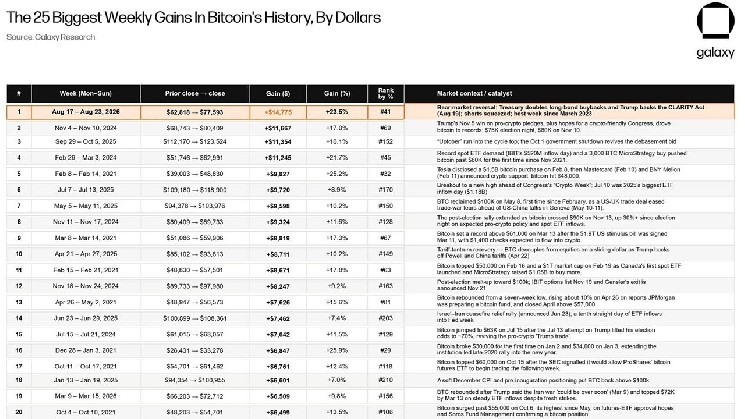
Bitcoin concluded the week ending August 23rd with a gain of $14,264, or 22.7%, closing at $77,387. This marked its largest weekly dollar gain on record, though percentage gains have been larger when prices were lower. The subsequent rally pushed prices to a three-month high above $81,000 before a slight pullback. The catalyst for the surge was identified as the U.S. Treasury's announcement to at least double its long-term bond buyback operations to support liquidity. Galaxy Digital's Head of Research, Alex Thorn, also noted a significant "buying shift" in BlackRock's iShares Bitcoin Trust (IBIT) by retail investors, a signal not seen in two years. Galaxy Research highlighted a key technical level to watch: the 50-week moving average around $82,470. Historical data shows that in 11 of the past 13 bear markets since 2011, a weekly close above this average has coincided with the cycle bottom being in. Failure to achieve this close could mean the rally is merely a corrective bounce within a longer downtrend rather than the start of a new bullish trend. Matt Cole, CEO of Strive, offered an optimistic view, suggesting the next Bitcoin cycle could be the strongest ever, citing its performance relative to the dollar and gold as evidence of changing dynamics. However, as the price base grows, record dollar gains become easier to achieve, making sustainability the key question.

cryptonews.ru27 min fa

Bitcoin Added $14,264 in a Week; According to Galaxy, a Signal the Next Bottom is Near

cryptonews.ru27 min fa

Trading

Spot
活动图片