Ex-Ripple Director Shares 4 Crypto And Blockchain Predictions For 2026

bitcoinistPubblicato 2025-12-24Pubblicato ultima volta 2025-12-24

Introduzione

Former Ripple director and current Evernorth CEO Asheesh Birla predicts that by 2026, institutional adoption will move beyond speculation and become embedded in everyday financial infrastructure. His four key forecasts include: 1) Corporate treasuries will become programmable through DeFi and AI, reducing manual processes and middlemen. 2) Local stablecoins will proliferate and challenge the traditional $9.6 trillion FX market via on-chain exchanges. 3) Stablecoins will achieve mainstream use in corporate and bank settlements for real-time liquidity analytics and faster transactions, potentially growing from $300 billion to $100 trillion in market cap. 4) NFTs will rebrand as digital access tokens for membership, combining ticketing, loyalty, and collectibles. Birla emphasizes a shift toward practical, institutional use cases for blockchain and crypto.

Asheesh Birla, a former Ripple board member who now runs Evernorth, an XRP-focused digital asset treasury, is out with a tidy set of 2026 predictions that basically boil down to one thing: institutions finally stop circling and start using this stuff in production.

In a short video shared to social media, Birla frames next year as the moment crypto infrastructure slips into the background and starts doing the boring work it always promised to do.

“My theme this year is really around how institutions, financial and corporate institutions, are going to start adopting blockchain technology at scale,” he said. “It’s going to be part of everyday financial infrastructure in 2026. It’s going to quietly power how money moves.”

4 Crypto Predictions For 2026 By Ex-Ripple Exec Birla

Prediction No. 1 is corporate treasury operations getting “programmable,” in his words, as DeFi tooling collides with AI-driven automation. The pitch is straightforward: back offices are still messy, manual, and full of middlemen. If you can turn parts of treasury management into code — and then let AI help run the workflows — you compress cost, time, and operational friction.

“It’s just a more efficient way to manage their operations, which today are manual and have a lot of middlemen,” the ex-Ripple director said. “Using DeFi and AI, I think you’re going to see a lot of those efficiency gains start to come to fruition and you’re going to see fewer middlemen and a better experience for moving money and managing your global operations in 2026.”

His second call is a twist on the stablecoin trade: not just more dollar coins, but “local stablecoins” proliferating across regions, then meeting on-chain in FX venues.

“You’re going to see these challenge the 9.6 trillion dollar FX market,” he said, arguing that on-chain DEX liquidity becomes the base layer for a new kind of spot FX market that competes with legacy rails.

Prediction No. 3 is stablecoins going fully mainstream inside corporate and bank plumbing — less as a crypto product, more as settlement tech. Birla claims the upside is obvious to finance teams: “real-time analytics into your liquidity positions around the world,” faster movement, cleaner reconciliation.

He also throws out the big-number trajectory that’s become common in these forecasts, saying stablecoins could grow “from 300 billion to 100 trillion dollars in market cap” based on “industry projections.”

And then there’s the NFT comeback, which he’s careful to describe as a rebrand and a reframing, not a rerun of 2021. Forget JPEG roulette, he says. Think access.

“They’re going to be about membership access,” the ex-Ripple director said in his prediction no. 4. “So it’s going to allow you to combine ticketing, loyalty, and digital collectibles into one digital access token.”

The subtext here matters: Birla’s now building Evernorth around XRP exposure and institutional participation, with the firm positioning itself as a purpose-built XRP treasury.

So his “bigger story” is also a bit of a sales thesis, crypto moving beyond speculation by embedding into how money moves, how treasuries run, and how brands manage customer relationships.

At press time, XRP traded at $1.8577.
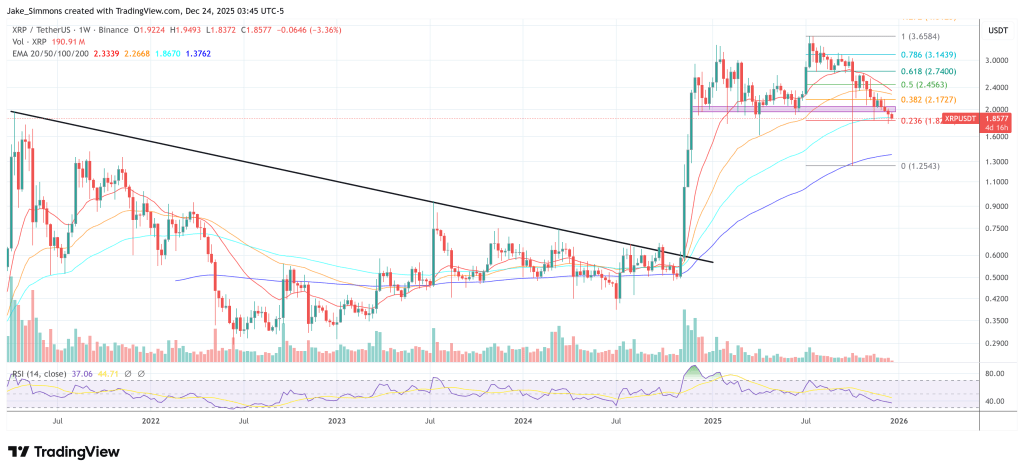
XRP falls below key support, 1-week chart | Source: XRPUSDT on TradingView.com

Domande pertinenti

QWhat is the main theme of Asheesh Birla's 2026 predictions for blockchain and crypto?

AThe main theme is how financial and corporate institutions will start adopting blockchain technology at scale, making it part of everyday financial infrastructure that quietly powers how money moves.

QAccording to Birla, what will be the primary use case for NFTs in 2026, moving beyond the 2021 speculation?

ANFTs will be rebranded and reframed to focus on membership access, combining ticketing, loyalty programs, and digital collectibles into one digital access token.

QHow does Birla predict stablecoins will evolve in the crypto market by 2026?

ABirla predicts stablecoins will go fully mainstream as settlement technology within corporate and bank systems, potentially growing from a $300 billion to a $100 trillion market cap, and will include the proliferation of 'local stablecoins' that challenge the traditional FX market.

QWhat specific efficiency gains does Birla foresee from combining DeFi tooling with AI-driven automation in corporate treasury operations?

AHe foresees that turning parts of treasury management into code and using AI to run workflows will compress cost, time, and operational friction by reducing manual processes and middlemen, leading to a more efficient way to manage global operations and move money.

QWhat role does Birla's company, Evernorth, play in the context of these predictions?

AEvernorth is a digital asset treasury focused on XRP, positioning itself to facilitate institutional participation and exposure to XRP as crypto moves beyond speculation and embeds into money movement, treasury management, and customer relationship management.

Letture associate

It Took Me a Year to See the Bitter Truth About Agent Payments

After a year building infrastructure for the Agent economy, engaging with major players like Stripe, Visa, and Coinbase, the author shares a sobering analysis of the current state of Agent payments. The core finding is a stark lack of genuine, immediate demand across most envisioned use cases. The article breaks down four key market segments: 1. **Agent-to-Merchant (Consumer Shopping):** For most product categories (e.g., clothing, electronics), conversational AI shopping is a step backwards from visual e-commerce interfaces. While agents excel at understanding needs, they can't replace side-by-side product comparison. Real merchant interest is defensive "Agent Engine Optimization," not driven by current customer demand. Potential exists for high-frequency, low-decision purchases (like food delivery) or navigating complex store UIs, but these require massive B2C distribution channels dominated by giants like Amazon. 2. **Agent-to-API (Developer Services):** Developers already have subscriptions and billing relationships for APIs (compute, data). Prepaid balances solve micro-payment issues for low transaction volumes. A deeper structural problem is that major SaaS vendors' business models rely on enterprise contracts, resisting granular pay-per-call pricing. While protocols like MPP and x402 serve the long tail of niche services, this market is small and developers are historically low-willingness-to-pay. 3. **Agent-to-Agent:** This remains largely theoretical with minimal transaction volume. While it represents a long-term bet on a fundamentally new transaction infrastructure (sub-second, micro-penny to million-dollar, multi-party settlements), it does not constitute a present market. 4. **Agent-to-Finance:** This is the only category with existing, paying demand. Integrating AI into financial workflows (trading, portfolio management) is a natural evolution and enables new capabilities like autonomous rebalancing. However, competition favors established, regulated institutions. The "real problem" is not moving money between agents, but the broader challenge of **coordination**—orchestrating work between agents and humans, verifying outcomes, and settling results. Payment is just one component of settlement, which is itself part of coordination. Companies that solve the coordination layer will subsume payment, not the other way around. While well-funded incumbents build defensively for a long-term future, startups must find where the market is today—which, for the author's team, lies outside these four categories in an area of real, growing, and underserved activity.

marsbit39 min fa

It Took Me a Year to See the Bitter Truth About Agent Payments

marsbit39 min fa

It Took Me a Year to See the Hard Truth About Agent Payments

**Title: It Took Me a Year to See the Hard Truth About Agent Payments** Over the past year, I've worked on infrastructure for the Agent economy, engaging with major players like Stripe, Visa, Coinbase, and numerous startups. The findings reveal a stark reality: genuine, widespread demand for Agent-based payments does not yet exist. **Key Observations:** * **Agent-to-Merchant (Shopping):** The user experience for AI shopping often falls short, especially for visual product discovery. While AI excels at understanding needs, conversational interfaces can't yet replace browsing and comparing multiple products visually. Current merchant interest is largely defensive ("Agent Engine Optimization") for a future that hasn't arrived. High-frequency, low-friction purchases (like food delivery) are potential fits, but lack open APIs and face high AI inference costs. Simpler, more affordable, or cross-language interactions for complex UIs are a niche opportunity but require massive consumer distribution to scale. * **Agent-to-API (Developer Tools):** Developer payment needs for APIs (computing, data, models) are already met through subscriptions and prepaid credits. The core challenge is not payment friction but supplier economics: most large SaaS providers prefer enterprise contracts over micropayments for API calls. Protocols like MPP and x402 suit the long-tail of smaller services but cater to a developer market historically reluctant to pay for these tools. Major infrastructure needs at the top of the stack are already being addressed. * **Agent-to-Agent (Machine Commerce):** This is a long-term vision with almost no current transaction volume. While a future with high-speed, high-frequency, multi-party machine-to-machine transactions would require novel infrastructure, it remains theoretical. The market is not here yet. * **Agent-to-Finance:** This is the only category with clear, present demand. Financial professionals and DeFi users already pay for tools, and AI augmentation is a natural evolution. Autonomous AI agents can enable entirely new financial strategies. However, competition is fierce from established, regulated incumbents who can more easily layer AI onto their existing products. **The Core Insight:** Companies, especially giants with long time horizons, are building defensively for a potential future of mass machine commerce. For them, early investment is a low-cost hedge. For startups, the current market reality is different. The primary challenge isn't just moving money between agents (payments). The larger, unsolved problem is **orchestration** – coordinating work between agents and humans, verifying outcomes, and then settling. Payment is just a part of settlement, which is just a part of orchestration. Companies that solve the orchestration problem will subsume payments, not the other way around. After a year of building, we see the real, growing, and underserved market opportunity lies in this broader domain of orchestration.

链捕手1 h fa

It Took Me a Year to See the Hard Truth About Agent Payments

链捕手1 h fa

Claude Opus 4.8 Finds a $4.5 Billion Bug: The AI Era is Mass-Producing Hackers

A researcher discovered a critical "infinite mint" vulnerability in the Zcash cryptocurrency's Orchard protocol using Claude Opus 4.8, leading to a swift fix but also a 50% market drop, erasing billions in value. This incident highlights a new era where powerful, accessible AI models are dramatically lowering the barrier to finding software vulnerabilities. Previously, the security community feared specialized models like Claude Mythos Preview, capable of finding decades-old zero-day exploits. The Zcash case, however, involved a publicly available, general-purpose model. This shift makes advanced security auditing—and attack capabilities—accessible to far more people, not just experts. The mass democratization of vulnerability discovery brings a dual challenge: a flood of low-quality, AI-generated false reports that overwhelm maintainers, and the real, rapid uncovering of deep, dangerous bugs. Open-source projects, often understaffed and unfunded, are particularly vulnerable to this "attention DDoS." The article cites examples like curl shutting down its bug bounty program due to the unsustainable workload. Our perceived digital safety has often been luck, relying on the high cost and effort required to find deeply hidden flaws in complex systems, as seen with historical vulnerabilities like Heartbleed or Baron Samedit. AI changes this cost structure, effectively "mass-producing flashlights" to illuminate every corner of our codebase. While large companies operate extensive security chains involving external white-hat hackers and massive defensive operations, the global cybersecurity workforce faces a severe shortage, especially of experienced personnel capable of analyzing complex threats and coordinating fixes. The core dilemma emerges: AI makes *finding* bugs cheap and scalable, but *fixing* them remains a slow, expensive, and human-intensive process. The article concludes that AI won't destroy the internet but acts as a bright light, revealing that our digital existence is not inherently secure but is precariously maintained by ongoing human effort. The true cost in the AI era may not be discovery, but whether there will be enough people left willing and able to do the hard work of repair.

marsbit1 h fa

Claude Opus 4.8 Finds a $4.5 Billion Bug: The AI Era is Mass-Producing Hackers

marsbit1 h fa

Codex Goal Mode Usage Guide: How to Make AI Continuously Pursue a Specific Objective

"Codex Goal Mode: How to Make AI Work Continuously Toward a Specific Goal" OpenAI's Codex "goal mode" (/goal) transforms the AI from a reactive code assistant into a proactive execution agent capable of working autonomously for hours or even days to achieve a defined objective. To maximize its effectiveness, follow these key principles: 1. **Define Clear, Verifiable Exit Criteria:** The goal prompt should be a concise, measurable success condition, not a lengthy specification. Use quantifiable metrics like "reduce build time by 30%" or "achieve 100% test parity." 2. **Provide Initial Guidance and Tools:** Direct Codex toward likely problem areas and specify available tools (e.g., browsers, testing environments) to prevent it from exploring unproductive paths. 3. **Enable Progress Measurement:** Equip Codex with ways to track advancement, such as creating comparison tools for visual tasks or evaluation sets, ensuring it can gauge its own progress. 4. **Use a Realistic Execution Environment:** For tasks like performance optimization, provide access to environments that closely mimic production (e.g., similar configs, databases) to yield valid results. 5. **Be Cautious with Visual Goals:** Avoid vague "pixel-perfect" instructions. Instead, supplement visual references with functional checklists or design system specifications to prevent Codex from obsessing over minor details. 6. **Implement Progress Tracking:** For long-running tasks, have Codex commit code to draft PRs, update progress documents, or send Slack updates to maintain visibility into its work. 7. **Review and Consolidate Results:** Once the goal is met, instruct Codex to review its work, clean up ineffective experimental code, and reflect on what strategies succeeded or failed. Ultimately, using goal mode shifts the developer's role from writing prompts to managing a persistent engineering agent—defining objectives, establishing metrics, configuring environments, and conducting final reviews.

marsbit2 h fa

Codex Goal Mode Usage Guide: How to Make AI Continuously Pursue a Specific Objective

marsbit2 h fa

Trading

Spot
Futures
活动图片





