Ex-Alameda CEO won’t be spending the holidays in federal prison

cointelegraphPubblicato 2025-12-17Pubblicato ultima volta 2025-12-17

Introduzione

Caroline Ellison, the former CEO of Alameda Research, has been transferred from a federal prison in Connecticut to a Residential Reentry Management field office in New York City. She had been serving a two-year sentence for her role in the collapse of FTX. Her scheduled release date is now February 20, about nine months early, though the reason for the early transfer and release remains unclear. Ellison pleaded guilty and testified against FTX CEO Sam Bankman-Fried, who received a 25-year sentence. She was a key figure in the high-profile case, enduring significant public scrutiny and online mockery. Her story is set to be featured in an upcoming Netflix series.

Caroline Ellison, the former CEO of Alameda Research who pleaded guilty to charges related to her role in the collapse of cryptocurrency exchange FTX, has been transferred out of the Federal Correctional Institution (FCI) in Danbury, Connecticut, where she spent the past few months serving her two-year sentence.

According to Federal Bureau of Prisons records as of Wednesday, Ellison was located at a Residential Reentry Management field office in New York City, marking the first change in housing since she reported to FCI Danbury in November 2024.

The former Alameda CEO received a two-year sentence for her role in FTX’s downfall — one of the lighter sentences compared to that of the exchange’s CEO, Sam “SBF” Bankman-Fried, who was sentenced to 25 years.
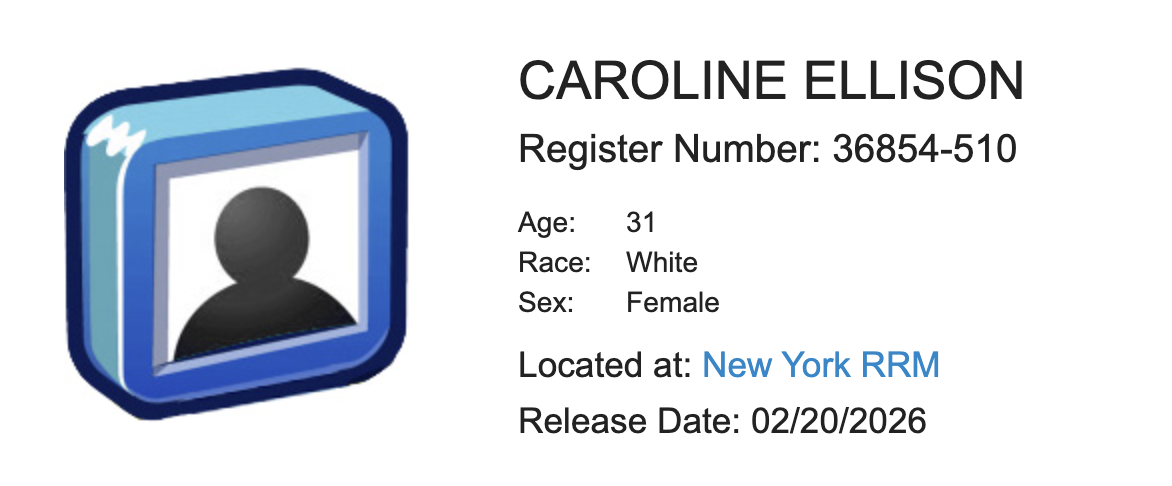
Source: Federal Bureau of Prisons

Prison officials reportedly transferred Ellison on Oct. 16, but did not disclose the reason for the move. According to the Federal Bureau of Prisons, she is scheduled to be released on Feb. 20, about nine months before the end of her sentence. The reason for the early release was unclear at the time of publication.

Ellison, along with Bankman-Fried and others, was indicted as part of a high-profile criminal case involving the collapse of FTX in November 2022. Unlike the former FTX CEO, she and two of her colleagues pleaded guilty to charges and testified at Bankman-Fried’s trial.

Another individual indicted in the debacle, former FTX Digital Markets co-CEO Ryan Salame, accepted a plea deal, did not testify and was sentenced to seven-and-a-half years in prison.

Related: Silvergate Bank lawsuit calls for FTX, Alameda clients to weigh in on $10M settlement

Who is Caroline Ellison?

A native of Boston, Ellison met SBF while both were working at the Jane Street trading firm in 2016. At Bankman-Fried’s invitation, she joined Alameda in 2017, rising to become co-CEO with Sam Trabucco and then the company’s sole CEO in August 2022 following his departure.

When FTX collapsed in November 2022, Ellison, Bankman-Fried and others were indicted on charges of fraud and money laundering. The former Alameda CEO largely stayed out of the public spotlight, in contrast to Bankman-Fried, who initially kept posting to social media after his arrest.

When Bankman-Fried was extradited to the US from the Bahamas, where FTX’s headquarters were located, he was initially allowed to remain in his parents’ California home, subject to travel restrictions. However, a judge revoked Bankman-Fried’s bail in August 2023 after Bankman-Fried allegedly leaked parts of Ellison’s diary to The New York Times.

Following that incident, Ellison’s whereabouts were unknown to the public until she appeared in court to testify against SBF during his October 2023 trial. According to reporting from the courtroom, she placed the blame for the misuse of FTX user funds directly on Bankman-Fried, claiming he “set up the systems” that led to Alameda taking $14 billion from the company.

Subject to public scrutiny, mocked online

Next to Bankman-Fried, Ellison was arguably the most prominent public figure associated with the FTX debacle. She was widely criticized in the crypto community for her role in the exchange’s collapse, as well as her relationship with SBF, whom she briefly dated.

“While public scrutiny of a criminal defendant’s or cooperator’s criminal misconduct is understandable, Ellison endured far more than that,” said prosecutors in a September 2024 sentencing recommendation. “She was mobbed outside the courthouse for comment and photographs, making it difficult to enter and exit without an escort, her physical appearance was scrutinized and criticized, and she was mocked in memes and other content on social media.”

With her pending release from federal custody, Ellison’s time with FTX and Bankman-Fried will likely be put into the spotlight yet again with the anticipated release of “The Altruists,” a Netflix series exploring SBF’s and Ellison’s lives amid the exchange’s collapse. Actress Julia Garner will portray Ellison in the miniseries.

Magazine: When privacy and AML laws conflict: Crypto projects’ impossible choice

Crypto di tendenza

Letture associate

Rubin Ultra Makes Major Cuts, Even Nvidia Can't Handle Memory Price Hikes?

NVIDIA's Rubin Ultra, the top-tier variant of the newly announced Rubin AI accelerators, has reportedly seen significant specification downgrades, according to an industry report from SemiAnalysis. Initially designed with four compute dies (4-die), the Rubin Ultra is now said to be reduced to a 2-die design. Key changes highlighted in the report include: * **No increase in peak theoretical compute performance**, remaining at 35 PFLOPs like the standard Rubin. * **Severe reduction in memory capacity** to 192GB using 8-Hi HBM stacks, which is less than the standard Rubin's 288GB using 12-Hi stacks. * **Negligible memory bandwidth improvement** of only 1 TB/s. * **Slightly higher chip-level power consumption**. * The **primary upgrade is a massive increase in scale-up interconnect capacity**, supporting connections for up to 576 GPUs via NVLink, compared to 72 for the standard Rubin. The report suggests the redesign is primarily a cost-optimization move driven by the sharp rise in HBM (High-Bandwidth Memory) prices. By reducing the expensive HBM content and shifting investment towards enhanced system-scale networking, NVIDIA aims to maintain the platform's value for large-scale AI training clusters while managing soaring material costs. The news reportedly triggered a sell-off in South Korean memory stocks, with SK Hynix and Samsung shares falling around 8%, as markets grew concerned that NVIDIA—a major HBM buyer—might be reducing its reliance on high-capacity memory, potentially capping future pricing power for memory makers.

Odaily星球日报12 min fa

Rubin Ultra Makes Major Cuts, Even Nvidia Can't Handle Memory Price Hikes?

Odaily星球日报12 min fa

Can Generative Models Finally Be Trained End-to-End? The Core Is a For Loop

This article introduces a novel training paradigm for generative models called Explorative Modeling (XM), which enables true end-to-end training. Traditionally, powerful generative models like autoregressive and diffusion models are not trained end-to-end. They are trained to predict a single small step but require iterative multi-step sampling for inference. This "exposure bias" leads to error accumulation and limits performance. The core challenge XM addresses is "mode blurring." In generative tasks, a single input (e.g., "generate a dog") corresponds to many valid outputs (multiple modes). Standard training objectives like reconstruction loss force the model to average these modes, producing unrealistic, blurry outputs. To avoid this, existing models break generation into many small, almost deterministic steps, sacrificing end-to-end training. XM tackles this by restructuring the training loop itself. Its key insight is to amplify "generative expressivity." For each training input, instead of generating one sample, the model generates K candidate outputs. Only the candidate closest to the real data is used for computing the loss and updating the model via backpropagation. This simple "best-of-K" mechanism is implemented as a short for-loop. By exploring multiple possibilities, the model learns to distribute its guesses across different modes rather than collapsing to their uninformative average. The paper demonstrates that "exploration" acts as a new, powerful scaling axis. Gains from XM increase with model size, data scale, and compute. Experiments show improvements in FID scores for image generation and significant efficiency gains, sometimes outperforming larger models without exploration. When pushed to the limit, XM enables fully single-step, end-to-end generative models. In robotics tasks, an "Explorative Policy" matched the performance of a 100-step Diffusion Policy with a single forward pass, drastically improving inference speed. While the best-of-K concept is not entirely new, the authors' contribution lies in formally understanding it as a direct method to boost generative expressivity without fragmenting the generation process. This work suggests that as models scale, enhancing exploration during training may become crucial for overcoming fundamental performance bottlenecks.

marsbit1 h fa

Can Generative Models Finally Be Trained End-to-End? The Core Is a For Loop

marsbit1 h fa

Trading

Spot

Articoli Popolari

Come comprare T

Benvenuto in HTX.com! Abbiamo reso l'acquisto di Threshold Network Token (T) semplice e conveniente. Segui la nostra guida passo passo per intraprendere il tuo viaggio nel mondo delle criptovalute.Step 1: Crea il tuo Account HTXUsa la tua email o numero di telefono per registrarti il tuo account gratuito su HTX. Vivi un'esperienza facile e sblocca tutte le funzionalità,Crea il mio accountStep 2: Vai in Acquista crypto e seleziona il tuo metodo di pagamentoCarta di credito/debito: utilizza la tua Visa o Mastercard per acquistare immediatamente Threshold Network TokenT.Bilancio: Usa i fondi dal bilancio del tuo account HTX per fare trading senza problemi.Terze parti: abbiamo aggiunto metodi di pagamento molto utilizzati come Google Pay e Apple Pay per maggiore comodità.P2P: Fai trading direttamente con altri utenti HTX.Over-the-Counter (OTC): Offriamo servizi su misura e tassi di cambio competitivi per i trader.Step 3: Conserva Threshold Network Token (T)Dopo aver acquistato Threshold Network Token (T), conserva nel tuo account HTX. In alternativa, puoi inviare tramite trasferimento blockchain o scambiare per altre criptovalute.Step 4: Scambia Threshold Network Token (T)Scambia facilmente Threshold Network Token (T) nel mercato spot di HTX. Accedi al tuo account, seleziona la tua coppia di trading, esegui le tue operazioni e monitora in tempo reale. Offriamo un'esperienza user-friendly sia per chi ha appena iniziato che per i trader più esperti.

500 Totale visualizzazioniPubblicato il 2024.12.10Aggiornato il 2026.06.02

Come comprare T

Discussioni

Benvenuto nella Community HTX. Qui puoi rimanere informato sugli ultimi sviluppi della piattaforma e accedere ad approfondimenti esperti sul mercato. Le opinioni degli utenti sul prezzo di T T sono presentate come di seguito.

活动图片