Euro Stablecoins Have Entered DeFi, What Are Other Local Currencies Waiting For?

marsbitPubblicato 2026-03-30Pubblicato ultima volta 2026-03-30

Introduzione

Euro stablecoins are leading the adoption of non-USD stablecoins in DeFi, while other local currency stablecoins remain primarily used for payments and settlements. The implementation of MiCA regulations in Europe effectively ended Tether’s EURT, reducing its supply from over $400M to around $50M. However, the broader non-USD stablecoin market (excluding EURT) has nearly tripled since early 2023, reaching $1.1B by February 2026. Euro-denominated stablecoins account for over 90% of non-USD transaction volume and are increasingly integrated into DeFi protocols like Aave and Morpho for lending and trading. In contrast, other local currency stablecoins (e.g., BRL, JPY) are mostly used for payments, remittances, and enterprise settlements, with nearly 80% of their activity falling under unidentified transfers. Regulatory clarity, as seen in Brazil and Japan, is crucial for adoption. The growth of non-USD stablecoins is driven by their potential to reduce FX costs, streamline cross-border payments, and minimize dollar dependency. While euro stablecoins have set a precedent for DeFi integration, broader adoption of other local currency tokens will likely focus first on payment infrastructure before expanding into DeFi applications.

Author: Prathik Desai / The Token Dispatch

Compiled by: Deep Tide TechFlow

Deep Tide Introduction: This article uses data to clarify a commonly confused issue: non-USD stablecoins are not a monolithic block; euro stablecoins and other local currency stablecoins are on completely different paths.

EURT was directly killed by MiCA regulations, but this forced the entire market to rebuild—its supply has nearly tripled since 2023.

A more critical finding is: 90% of non-USD transfer volume is contributed by euro stablecoins, while other local currencies are currently almost only used for payment settlement. DeFi integration is the next stage, not now.

Full text as follows:

Money is only truly useful when it reaches its destination. Wages earned overseas must pass through banks, foreign exchange counters, payment partners, and local compliance reviews before they can return home to pay for rent, tuition, utilities, and food. Until then, it is just value in motion, not yet a medium of exchange.

The same problem now appears on-chain. Stablecoins move funds globally with code, but their utility depends on where they can connect, who is allowed to use them, and which rules govern their reserves and redemptions.

This concept struck me while I was researching Dune's report "Beyond De-dollarization: The Rise of Local Currency Stablecoins".

In today's quantitative analysis, I will explain the factors affecting the growth of non-USD local currency-pegged stablecoins.

The Teeth of Regulation

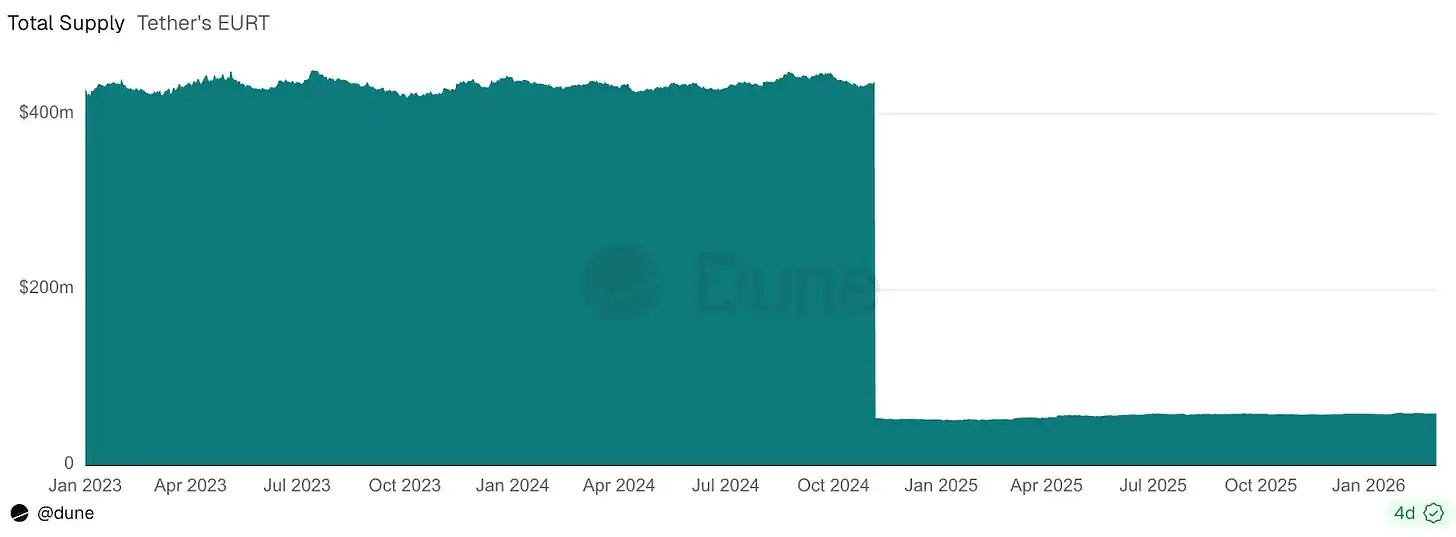
The clearest case of regulatory impact happened to Tether's euro-pegged stablecoin. The European Union's Markets in Crypto-Assets Regulation (MiCA), which came into full effect in 2024, almost immediately pronounced a death sentence on Tether Euro (EURT).

EURT was once one of the earliest and largest non-USD stablecoins, with its circulating supply dropping from over $400 million to about $50 million. The total supply of local currency stablecoins consequently fell from $1 billion to $350 million.
Crypto enthusiasts often assume the code is enough. They create a token, inject liquidity, and expect the market to do the rest. But non-USD stablecoins are not just abstract internet money. They attempt to be better digital versions of local currencies like the Euro, Yen, or Thai Baht, capable of flowing on public rails unrestricted by bank hours. Yet they operate within domestic financial systems, subject to reserve requirements, licensing norms, payment networks, and redemption expectations.

The shutdown of EURT reminds us that first-mover advantage and largest scale are not enough. One change in the domestic rulebook can erase all the advantages of the pioneer.

But regulation is not always detrimental to stablecoins. If it were, non-USD stablecoins might have stalled after EURT's exit.
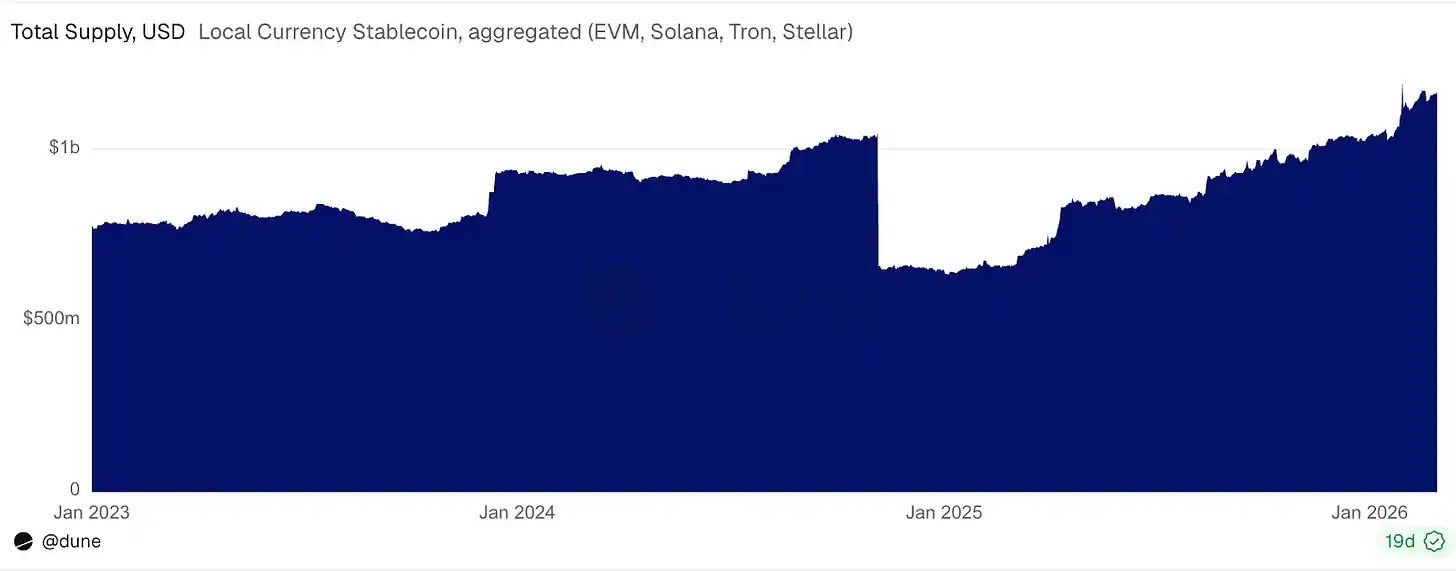
If EURT is excluded, the total supply of non-USD stablecoins grew from about $350 million in January 2023 to $1.1 billion in February 2026, nearly tripling.

The Market is Expanding

While the supply grew, the number of addresses holding balances of such stablecoins grew from about 42,000 to over 1.2 million in the same period.

Monthly transfer volume increased 16-fold, from $600 million to $10 billion. The monthly number of sending addresses grew 22-fold, from about 6,000 to 135,000.

The growth rate of holders and senders was faster than the growth rate of the supply, indicating the market expanded through increased participation.
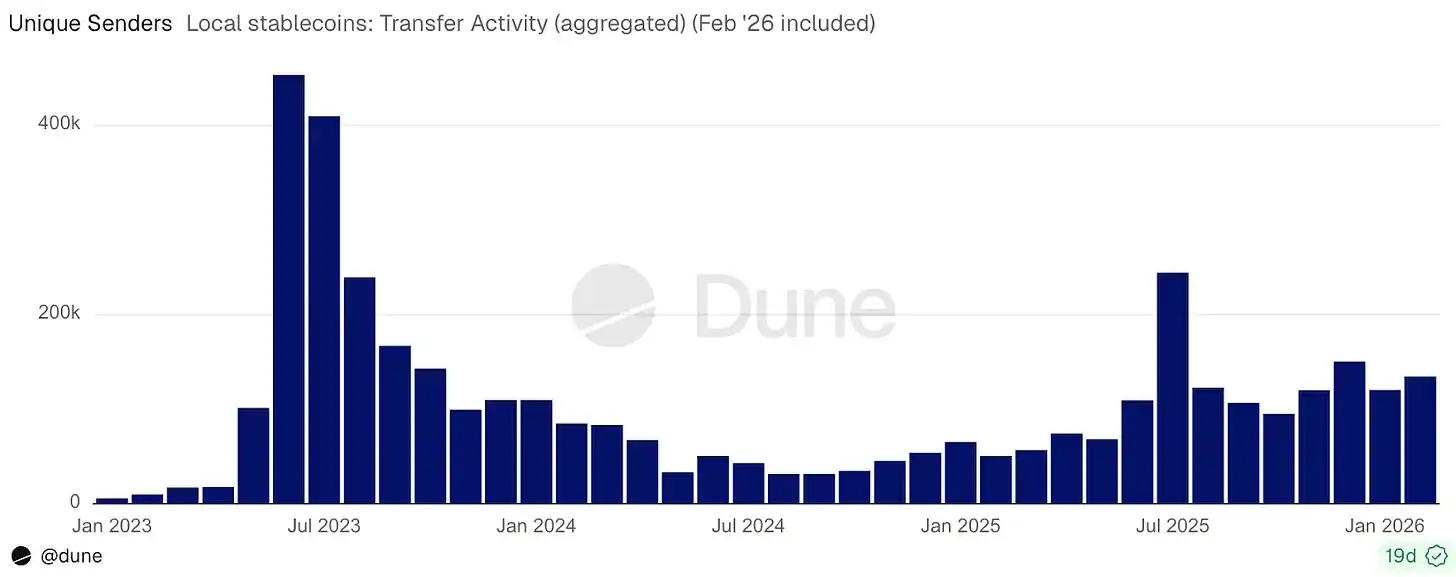
Therefore, regulation is not always harmful to the market as it was for Tether Euro; here it actually attracted more stablecoin issuers and users.

Where Non-USD Funds Are Flowing

By early 2026, unidentified transfers accounted for 38% of total local currency stablecoin transfer activity. This likely reflects payment and settlement activities, including peer-to-peer transfers and transfers from self-custody wallets to payment service providers.

Next was lending, accounting for 29%; DEX activity accounted for 17%; and centralized exchange-related flows accounted for 14%.
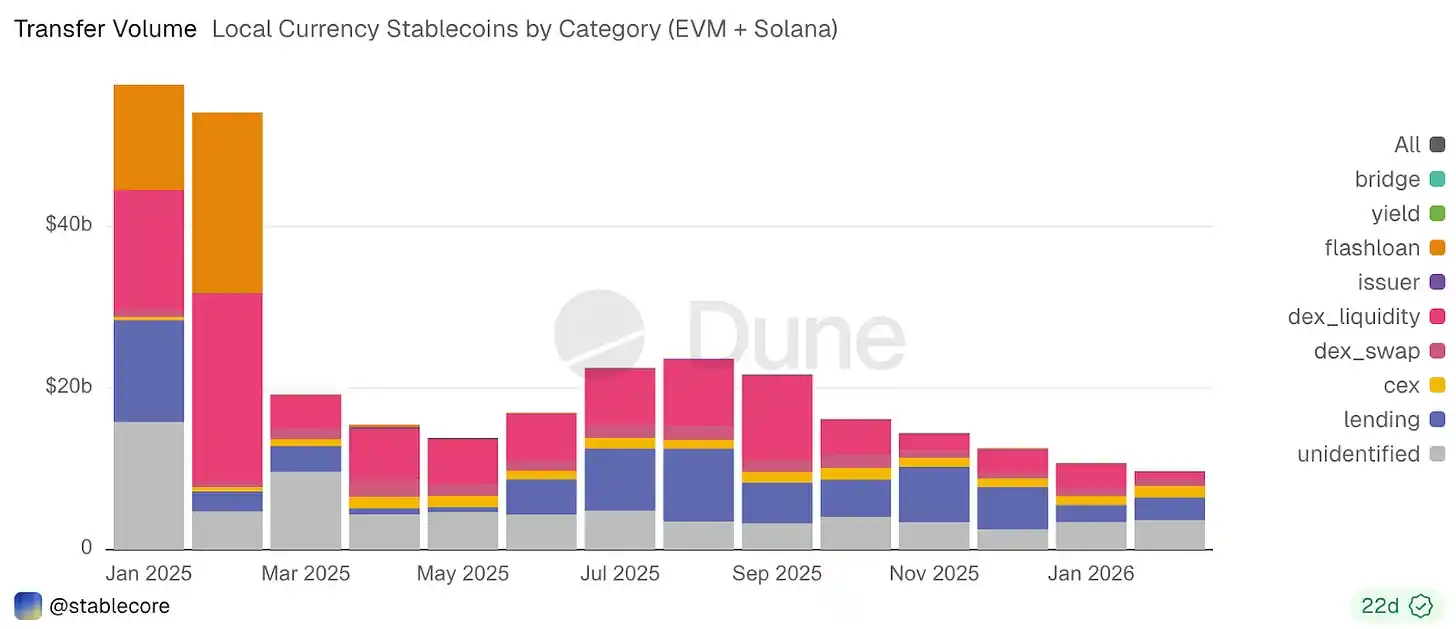
This categorization shows that non-USD stablecoins are primarily used on-chain for two types of scenarios: one is for payments, or as funds flowing between individuals or businesses; the other is for basic DeFi operations, such as lending and trading.

But there is a caveat in the data. If euro-pegged stablecoins are stripped from the data, the market shows a completely different trend.

Euro stablecoins account for over 90% of the transfer volume and are being used as financial assets themselves. Users deposit them into lending markets, use them on DEXs, treating them more as on-chain cash that can earn yield, serve as collateral, and be cycled through DeFi. This makes local currency stablecoins appear more mature.

EURC, along with EURS, EURm, and EUROe, has entered yield-generating DeFi venues like Aave, Morpho, and Fluid.

After removing euro stablecoins, the remaining non-USD digital currencies are primarily used for settlement infrastructure.
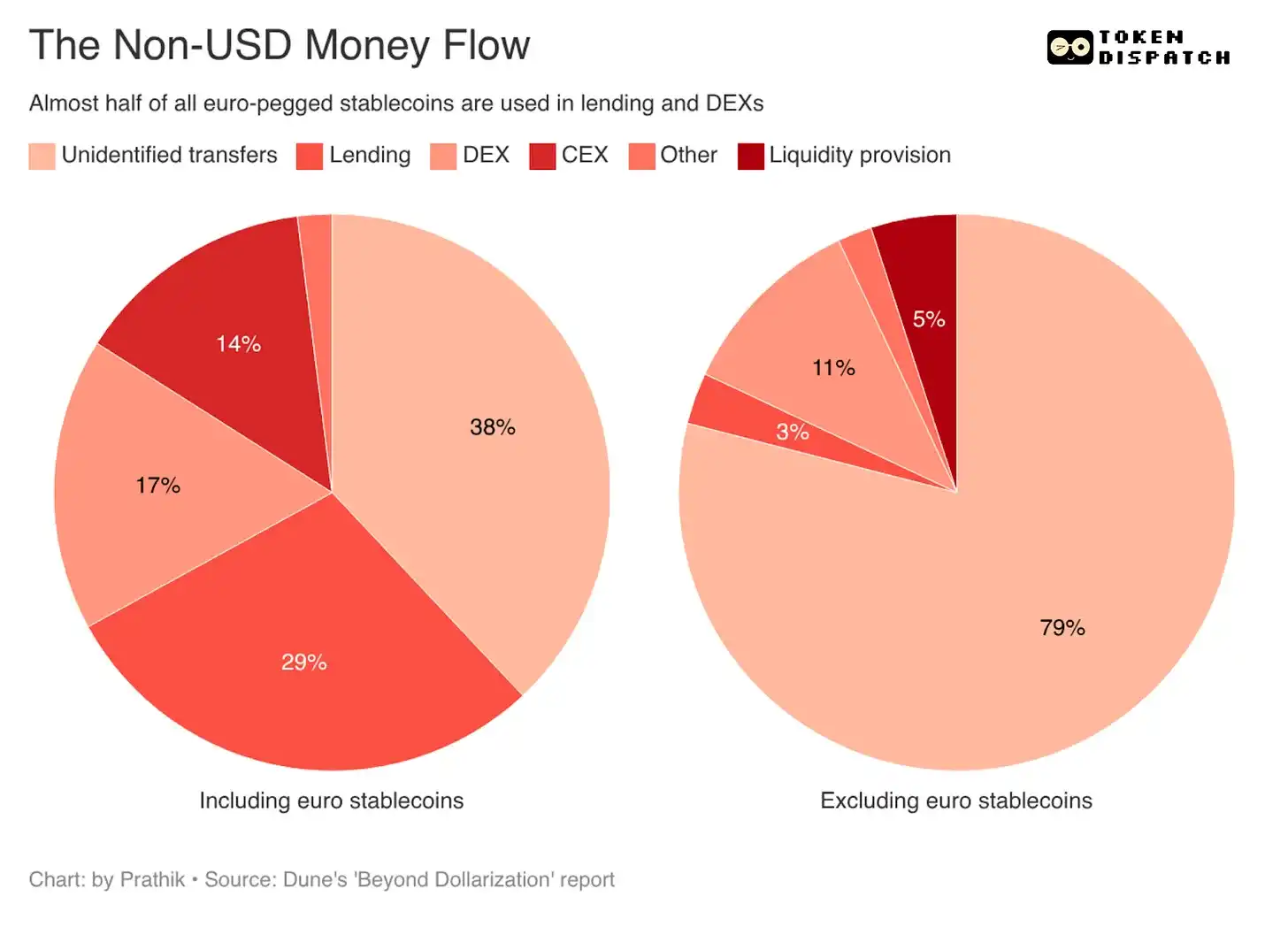
Nearly eighty percent of non-USD, non-euro stablecoin transfers fall into the unidentified transfer category. This likely covers wallet-to-wallet fund transfers, business debt settlements, remittance-style transfers, and payment flows circulating through service providers.

The dominance of euro-pegged currencies among non-USD stablecoins indicates that the next phase of growth is more likely to be concentrated in basic DeFi operations. Beyond the euro, non-USD stablecoins will first expand as infrastructure for domestic funds flowing on digital rails, before they can be used for basic DeFi operations.

This growth is crucial because it will come from stablecoins used for payroll, treasury management, merchant settlements, remittances, and foreign exchange (FX).

These areas are more heavily regulated than basic DeFi operations because operating funds tolerate far less ambiguity than speculative assets. If a token is expected to operate within domestic payment systems, treasury workflows, and environments with strict compliance requirements, it will need predictable reserves, clear redemption processes, and legal clarity. Therefore, regulation will play a key role in the adoption of non-USD stablecoins.

This also explains why growth is concentrated in regions with mature financial systems. The report notes that the activity of the Brazilian Real (BRL) and Japanese Yen (JPY) accelerated after improvements in local regulatory frameworks; while markets lacking specific regulatory regimes, such as Indonesia, lagged behind.

I also found the economic rationale for non-USD stablecoins.

Cross-border payments still bear high conversion costs, with remittances losing a considerable portion to FX spreads and intermediary steps. More local currency stablecoins can reduce the amount of value that needs to detour through the US dollar before reaching its destination. This can lower foreign exchange costs, eliminate settlement friction, and allow businesses and individuals to hold value in the currency they earn, spend, and save.

Its potential is far greater than DeFi itself. Euro stablecoins have already set a strong precedent for integrating local digital money into the financial system. However, the bigger win would be reducing the cost and speed of global cross-border fund flows and reducing reliance on the US dollar globally.

Issuers who can make local currencies easier to send, settle, and embed into existing payment infrastructure will benefit from the huge potential of non-USD stablecoins. If they can create favorable conditions for better adoption, DeFi integration will naturally follow.


Domande pertinenti

QWhat was the impact of the MiCA regulation on Tether's euro-pegged stablecoin (EURT)?

AThe MiCA regulation effectively led to the demise of Tether's euro-pegged stablecoin (EURT), causing its circulating supply to plummet from over $400 million to approximately $50 million.

QHow much has the total supply of non-USD stablecoins (excluding EURT) grown from January 2023 to February 2026?

AExcluding EURT, the total supply of non-USD stablecoins grew from approximately $350 million in January 2023 to $1.1 billion in February 2026, nearly tripling.

QWhat percentage of non-USD stablecoin transfer volume is contributed by euro-pegged stablecoins?

AEuro-pegged stablecoins contribute to over 90% of the total transfer volume of non-USD stablecoins.

QWhat are the two primary use cases for non-USD stablecoins on-chain, as indicated by the data?

AThe two primary use cases are for payments and settlements (including peer-to-peer transfers and transfers to payment service providers) and for DeFi primitive operations such as lending and trading.

QAccording to the article, what is a key factor for the growth of non-USD stablecoin adoption in a market?

AA key factor for growth is the presence of a clear and improved local regulatory framework, as seen in markets like Brazil and Japan, whereas markets lacking such frameworks, like Indonesia, have lagged behind.

Letture associate

Gensyn AI: Don't Let AI Repeat the Mistakes of the Internet

In recent months, the rapid growth of the AI industry has attracted significant talent from the crypto sector. A persistent question among researchers intersecting both fields is whether blockchain can become a foundational part of AI infrastructure. While many previous AI and Crypto projects focused on application layers (like AI Agents, on-chain reasoning, data markets, and compute rentals), few achieved viable commercial models. Gensyn differentiates itself by targeting the most critical and expensive layer of AI: model training. Gensyn aims to organize globally distributed GPU resources into an open AI training network. Developers can submit training tasks, nodes provide computational power, and the network verifies results while distributing incentives. The core issue addressed is not decentralization for its own sake, but the increasing centralization of compute power among tech giants. In the era of large models, access to GPUs (like the H100) has become a decisive bottleneck, dictating the pace of AI development. Major AI companies are heavily dependent on large cloud providers for compute resources. Gensyn's approach is significant for several reasons: 1) It operates at the core infrastructure layer (model training), the most resource-intensive and technically demanding part of the AI value chain. 2) It proposes a more open, collaborative model for compute, potentially increasing resource utilization by dynamically pooling idle GPUs, similar to early cloud computing logic. 3) Its technical moat lies in solving complex challenges like verifying training results, ensuring node honesty, and maintaining reliability in a distributed environment—making it more of a deep-tech infrastructure company. 4) It targets a validated, high-growth market with genuine demand, rather than pursuing blockchain integration without purpose. Ultimately, the boundaries between Crypto and AI are blurring. AI requires global resource coordination, incentive mechanisms, and collaborative systems—areas where crypto-native solutions excel. Gensyn represents a step toward making advanced training capabilities more accessible and collaborative, moving beyond a niche controlled by a few giants. If successful, it could evolve into a fundamental piece of AI infrastructure, where the most enduring value in the AI era is often created.

marsbit6 h fa

Gensyn AI: Don't Let AI Repeat the Mistakes of the Internet

marsbit6 h fa

Why is China's AI Developing So Fast? The Answer Lies Inside the Labs

A US researcher's visit to China's top AI labs reveals distinct cultural and organizational factors driving China's rapid AI development. While talent, data, and compute are similar to the West, Chinese labs excel through a pragmatic, execution-focused culture: less emphasis on individual stardom and conceptual debate, and more on teamwork, engineering optimization, and mastering the full tech stack. A key advantage is the integration of young students and researchers who approach model-building with fresh perspectives and low ego, prioritizing collective progress over personal credit. This contrasts with the US culture of self-promotion and "star scientist" narratives. Chinese labs also exhibit a strong "build, don't buy" mentality, preferring to develop core capabilities—like data pipelines and environments—in-house rather than relying on external services. The ecosystem feels more collaborative than tribal, with mutual respect among labs. While government support exists, its scale is unclear, and technical decisions appear driven by labs, not state mandates. Chinese companies across sectors, from platforms to consumer tech, are building their own foundational models to control their tech destiny, reflecting a broader cultural drive for technological sovereignty. Demand for AI is emerging, with spending patterns potentially mirroring cloud infrastructure more than traditional SaaS. Despite challenges like a less mature data industry and GPU shortages, Chinese labs are propelled by vast talent, rapid iteration, and deep integration with the open-source community. The competition is evolving beyond a pure model race into a contest of organizational execution, developer ecosystems, and industrial pragmatism.

marsbit8 h fa

Why is China's AI Developing So Fast? The Answer Lies Inside the Labs

marsbit8 h fa

3 Years, 5 Times: The Rebirth of a Century-Old Glass Factory

Corning, a 175-year-old glass company, is experiencing a dramatic revival as a key player in AI infrastructure, driven by surging demand for high-performance optical fiber in data centers. AI data centers require vastly more fiber than traditional ones—5 to 10 times as much per rack—to handle high-speed data transmission between GPUs. This structural demand shift, coupled with supply constraints from the lengthy expansion cycle for fiber preforms, has created a significant supply-demand gap. Nvidia has invested in Corning, along with Lumentum and Coherent, in a $4.5 billion total commitment to secure the optical supply chain for AI. Corning's competitive edge lies in its expertise in producing ultra-low-loss, high-density, and bend-resistant specialty fiber, which is critical for 800G+ and future 1.6T data rates. Its deep involvement in co-packaged optics (CPO) with partners like Nvidia further solidifies its position. While not the largest fiber manufacturer globally, Corning's revenue from enterprise/data center clients now exceeds 40% of its optical communications sales, and it has secured multi-year supply agreements with major hyperscalers including Meta and Nvidia. Financially, Corning's optical communications revenue has surged, doubling from $1.3 billion in 2023 to over $3 billion in 2025. Its stock price has risen nearly 6-fold since late 2023. Key future catalysts include the rollout of Nvidia's CPO products and the scale of undisclosed customer agreements. However, risks include high current valuations and potential disruption from next-generation technologies like hollow-core fiber. The company's long-term bet on light over electricity, maintained even through the telecom bubble crash, is now being validated by the AI boom.

marsbit8 h fa

3 Years, 5 Times: The Rebirth of a Century-Old Glass Factory

marsbit8 h fa

Trading

Spot
Futures
活动图片




