Ethereum's Year of Interoperability: A Deep Dive into EIL, a Grand Experiment in Entrusting 'Trust' to Game Theory?

marsbitPubblicato 2026-01-12Pubblicato ultima volta 2026-01-12

Introduzione

Ethereum is entering a major phase of mass adoption in 2026, driven by the development of the Ethereum Interoperability Layer (EIL). EIL is not a new blockchain but a set of standards and protocols designed to connect Ethereum’s Layer 2 (L2) networks seamlessly. It aims to standardize state proofs and message passing between L2s, enabling native interoperability without altering their core security models. Currently, L2s operate as isolated environments with separate signatures, assets, and user experiences. EIL, combined with Account Abstraction (ERC-4337) and a trust-minimized messaging layer (XLP), allows users to perform cross-chain transactions with a single signature, abstracting away complexities like gas fees and repeated authorizations. Unlike traditional bridges or intent-based solutions, EIL avoids introducing new trust assumptions like solvers. Instead, it relies on XLP providers to facilitate instant transactions, with Ethereum L1 serving as a fallback enforcement layer via slashing mechanisms in case of malfeasance. However, EIL faces challenges in balancing efficiency and security. Its model shifts trust from technical verification to economic incentives and penalties, raising questions about sustainability under market volatility, scalability in multi-chain environments, and the economic feasibility of liquidity provision. Despite these open questions, EIL represents a significant experiment in expanding Ethereum’s interoperability while preserving its core...

2026 is destined to be a pivotal year for Ethereum's Mass Adoption.

With the finalization of multiple underlying upgrades in 2025 and the establishment and advancement of the Interop roadmap, the Ethereum ecosystem is gradually entering the "Great Era of Interoperability." Against this backdrop, EIL (Ethereum Interoperability Layer) is stepping into the spotlight from behind the scenes (Further reading: "Ethereum's Interop Roadmap: Unlocking the 'Last Mile' of Mass Adoption").

If early technical discussions were still at the "proof-of-concept" stage, EIL has undoubtedly now entered the deep waters of standard implementation and engineering. This has sparked a series of major community debates. For instance, when pursuing a Web2-smooth cross-chain experience, are we quietly altering the long-held trust boundaries of Ethereum?

Objectively speaking, when any technological vision moves towards engineering implementation, trade-offs between efficiency and security are inevitable. This article also attempts to move beyond technical slogans and, by examining the specific design details of EIL, deconstruct its real trade-offs between efficiency, standards, and security assumptions.

I. What Exactly is EIL 'Sewing' Together?

First, we need to clarify the essence of EIL once again—it is not a new chain, nor a new consensus layer, but rather a set of interoperability communication frameworks and standard protocol collections.

In short, the core logic of EIL lies in standardizing the "state proofs" and "message passing" of different L2s without rewriting Ethereum's underlying security model, enabling different L2s to possess composability and interaction capabilities akin to a single chain without changing their own security assumptions (Further reading: "The End of Ethereum Islands: How EIL Reconstructs Fragmented L2s into a 'Supercomputer'?").

As is well known, in the current Ethereum ecosystem, each L2 is an isolated island. For example, your account (EOA) on Optimism and your account on Arbitrum, while having the same address, have completely isolated states:

  • Signature Isolation: Your signature on Chain A cannot be directly verified by Chain B;
  • Asset Isolation: Your assets on Chain A are also invisible to Chain B;
  • Interaction Barriers: Cross-chain operations require repeated authorizations, gas swaps, waiting for settlement, etc.;

EIL, combining the capabilities of "Account Abstraction (ERC-4337)" and a "trust-minimized message layer," constructs a unified execution environment at the account layer + message layer, attempting to eliminate these artificial divisions:

The author previously gave an intuitive example: cross-chain interactions used to be like traveling abroad—you needed to exchange currency (cross-chain assets), obtain a visa (re-authorize), and follow local traffic rules (purchase target chain Gas). Entering the EIL era, cross-chain interactions are more like using a Visa card globally:

No matter which country you are in, just swipe your card once (sign), and the underlying banking network (EIL) automatically handles exchange rates, settlement, and verification—you don't perceive the existence of national borders.

Compared to traditional cross-chain bridges, Relayers, and Intent/Solver models, the advantages of this design are also intuitive—the Native route is the safest, most transparent, but slow and experience-fragmented; the Intent route offers the best experience but introduces Solver trust and game theory; EIL attempts to push the experience closer to Intent without introducing a Solver, but requires deep integration with wallets and protocol layers.
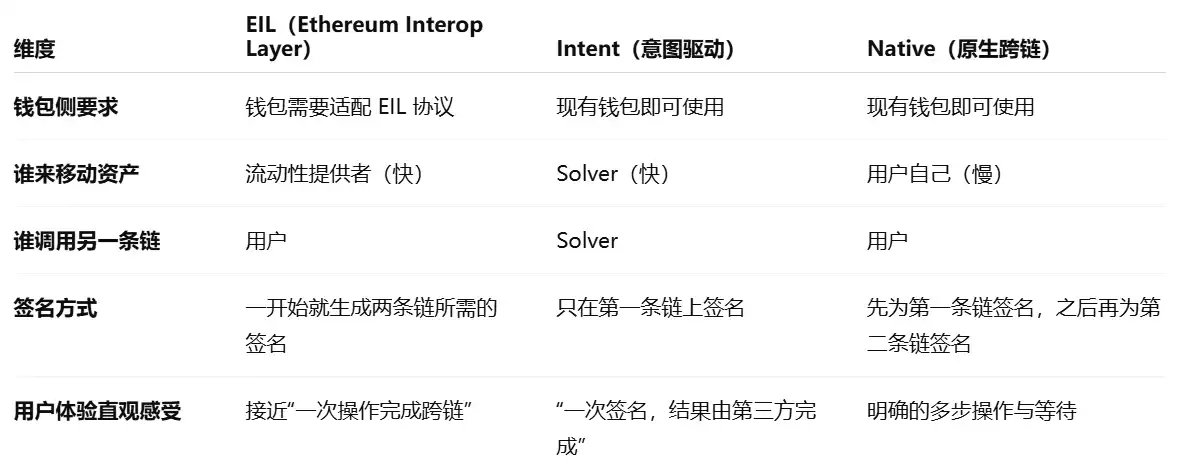
Source: Based on @MarcinM02, self-generated image

The EIL proposal put forward by the Ethereum Foundation's Account Abstraction team paints such a future: users only need to sign once to complete a cross-chain transaction, without relying on centralized relays or adding new trust assumptions, and can initiate transactions directly from their wallet for seamless settlement across different L2s.

II. EIL's Engineering Path: Account Abstraction + Trust-Minimized Message Layer

Of course, this also raises a more practical question: whether the implementation details and ecosystem adaptation of EIL can achieve "theory equals practice" remains an open proposition.

We can break down EIL's engineering implementation path. As mentioned above, it does not attempt to introduce a new inter-chain consensus but is built upon two existing building blocks: ERC-4337 Account Abstraction (AA) + a trust-minimized cross-chain message and liquidity mechanism.

First is Account Abstraction based on ERC-4337. It decouples the account and the private key, allowing a user account to become a smart contract account with customizable validation logic and cross-chain execution logic, no longer limited to the traditional EOA key-pair model.

The significance of this for EIL is that cross-chain operations do not need to rely on external executors (Solvers) to act on your behalf. Instead, they can be expressed at the account layer as a standardized User Operation object (UserOp), constructed and managed uniformly by the wallet.

These functions were previously impossible with EOA itself and required complex external contract wrappers. Account Abstraction based on ERC-4337 allows user accounts to evolve from a rigid "key pair" into programmable code. More bluntly, users only need one signature (UserOp) to express cross-chain intent (Further reading: "From EOA to Account Abstraction: Will Web3's Next Leap Happen in the 'Account System'?"):

Account contracts can embed more complex validation/execution rules; one signature can trigger a series of cross-chain instructions. Combined with mechanisms like Paymaster, it can even achieve Gas abstraction—for example, paying for target chain fees using source chain assets, eliminating the awkwardness of having to buy a few dollars of native Gas tokens before crossing chains.

This is why the EIL narrative is often tied to wallet experience, as what it truly aims to change is the entry point through which users interact with the multi-chain world.

The second is the trust-minimized message passing mechanism—XLP (Cross-chain Liquidity Provider), which solves the efficiency problem of cross-chain message passing.

Because traditional cross-chain interactions rely on relays or centralized bridges, EIL introduces XLP. On this basis, an ideal path that is theoretically efficient and sacrifices as little security as possible can be built:

  • The user submits a cross-chain transaction on the source chain;
  • XLP observes this intent in the mempool and advances funds/Gas on the target chain, providing a "Payment Voucher";
  • The user utilizes the voucher to complete self-execution on the target chain;

The actual user experience is near-instantaneous settlement, without waiting for the slow settlement of the official bridge.

However, you might spot a problem: what if the XLP takes the money but doesn't deliver? The ingenious design of EIL lies in the fact that if an XLP defaults, the user can submit proof on Ethereum L1 to trigger permissionless slashing of its staked assets.

The official bridge is only used for settlement and recourse in case of bad debt. This means the system runs extremely fast under normal conditions; in extreme cases, security is still backed by Ethereum L1.
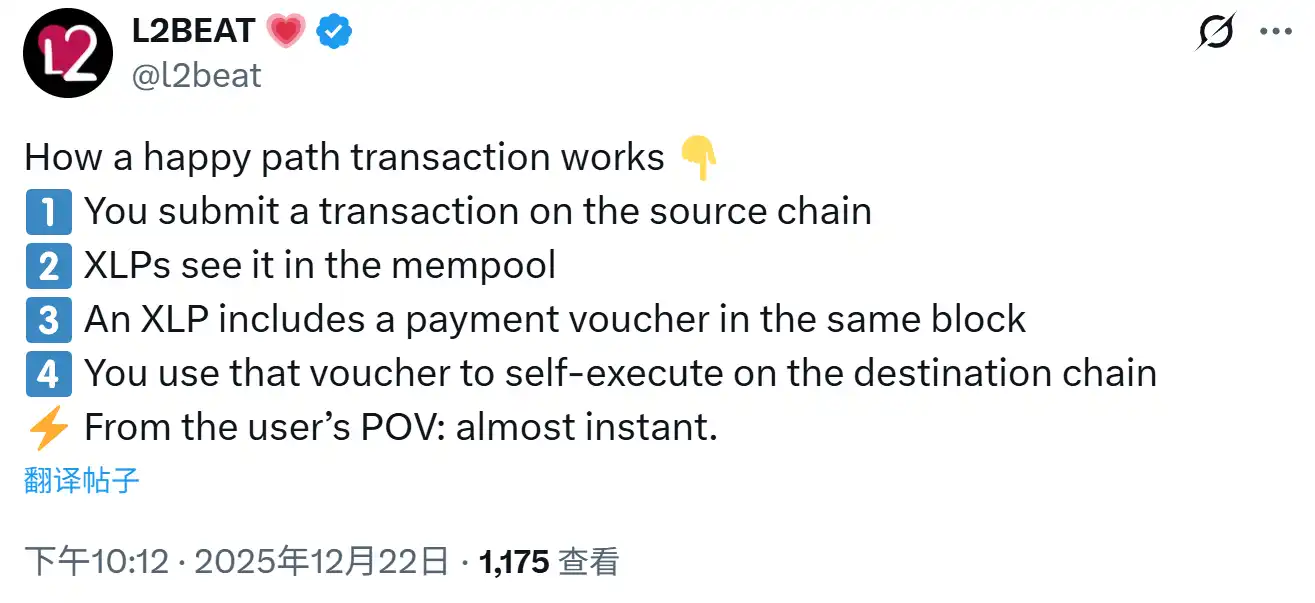
This structure means moving the slow and expensive security mechanism out of the default path, instead concentrating the trust pressure on failure handling.

Of course, this is also one of the sources of controversy: when security relies more on the "executability of the failure path" and the "effectiveness of economic penalties," is EIL truly adding no new trust assumptions? Or is it merely shifting trust from explicit relays to a more hidden, more engineered set of conditions?

This leads to the more critical discussion below—while it looks elegant in theory, what potential centralization and economic frictions might it face in the real-world ecosystem, and why does the community remain cautious about it?

III. Between Vision and Engineering: Is EIL Truly 'Minimizing Trust'?

By now, EIL's ambition is clear. Its design strives to avoid explicit relay trust and attempts to converge cross-chain interactions into one signature and one user operation at the wallet layer.

The problem is—trust doesn't just disappear; it merely migrates.

This is why platforms like L2BEAT, which have long focused on L2 risk boundaries, remain particularly cautious about the engineering implementation of EIL. After all, once an interoperability layer becomes the universal default path, any hidden assumptions, incentive failures, or governance single points of failure could amplify into systemic risks.

Specifically, EIL's efficiency comes from two points: first, AA packages actions into one signature; second, XLP's advance payment allows users to bypass waiting. The former is more straightforward, an efficiency gain from embedded AA. But the latter's advance payment means that some security no longer comes from immediately verifiable finality, but from "economic guarantees that can be pursued and penalized."

This undoubtedly pushes the risk exposure towards several more engineering-oriented questions:

  • Under real market fluctuations, how are the XLP's default probability, capital cost, and risk hedging priced?
  • Is "slashing" timely and executable enough to cover losses in extreme scenarios?
  • When amounts become larger and paths more complex (multi-hop/multi-chain), do failure scenarios become exponentially more difficult?

Ultimately, the trust foundation here is no longer mathematical proof but the validator's staked collateral. If the cost of attack is lower than the potential profit, the system still faces rollback risks.

Furthermore, objectively speaking, EIL attempts to solve liquidity fragmentation through technical means, but liquidity itself is market behavior. If significant cost and trust disparities still exist between chains, a mere communication standard (EIL) cannot make liquidity truly flow. After all, a pure communication protocol standard cannot solve the economic essence of "liquidity unwillingness to flow."

Extending this thought further, without accompanying economic incentive design, EIL might face the dilemma of having standardized pipelines but lacking executors because it's unprofitable.

However, overall, EIL is one of the most important infrastructure concepts proposed by the Ethereum community to address fragmented L2 experiences. It attempts to simplify UX while maintaining Ethereum's core values (self-custody, censorship resistance, disintermediation), which is commendable in itself (Further reading: "Seeing Through the Noise of Ethereum 'Degeneration': Why is 'Ethereum Values' the Widest Moat?").

For ordinary users, there's no need to hastily praise or否定 EIL, but rather to understand its trade-offs and boundary assumptions in protocol design.

After all, for the current Ethereum, EIL is not a simple upgrade to existing cross-chain pain points, but a technical and value attempt that deeply integrates experience, economy, and security trust boundaries. It has the potential to push Ethereum towards truly seamless interoperability, but it might also expose new boundary effects and necessary compromises during implementation.

In Conclusion

In 2026, EIL is not a plug-and-play ultimate answer, but more like a systematic test of trust boundaries, engineering feasibility, and the limits of user experience.

If it succeeds, Ethereum's L2 world will truly look like one chain; if it is less successful, it will undoubtedly leave clear lessons for the next generation of interoperability design.

Before 2026, everything is still an experiment.

And this, perhaps, is Ethereum's most real and most respectable aspect.

Domande pertinenti

QWhat is the core purpose of the Ethereum Interoperability Layer (EIL)?

AThe core purpose of the Ethereum Interoperability Layer (EIL) is to serve as a set of interoperability communication frameworks and standard protocol collections. It aims to standardize 'state proofs' and 'message passing' for different Layer 2 solutions (L2s) without altering Ethereum's underlying security model, enabling seamless composability and interaction between L2s as if they were a single chain.

QHow does EIL combine Account Abstraction (ERC-4337) and trust-minimized messaging to improve cross-chain experiences?

AEIL combines Account Abstraction (ERC-4337), which decouples accounts from private keys and allows user accounts to become programmable smart contract accounts, with a trust-minimized cross-chain messaging and liquidity mechanism (XLP). This enables users to express cross-chain intent with a single signature (UserOp), while XLP providers prepay funds/Gas on the target chain for near-instant transactions, backed by economic penalties for malfeasance enforceable via Ethereum L1.

QWhat are the potential risks or trust assumptions introduced by EIL's engineering design?

AEIL's design shifts some security from immediate verifiable finality to economic guarantees reliant on penalties. Risks include the pricing of XLP违约 probability and capital costs, the timeliness and executability of slashing mechanisms in extreme cases, and potential systemic risks if incentives fail or governance becomes centralized. Trust is not eliminated but transferred to more engineered economic and failure-handling processes.

QHow does EIL differ from traditional cross-chain bridges or Intent/Solver models in terms of security and user experience?

ATraditional cross-chain bridges (native routes) are secure and transparent but slow with fragmented user experiences. Intent/Solver models offer the best user experience but introduce solver trust and博弈. EIL attempts to approach Intent-like usability without solvers by deeply integrating wallet and protocol standards, relying on Account Abstraction and trust-minimized messaging, though it requires significant ecosystem adaptation and introduces new economic trust assumptions.

QWhy is the Ethereum community cautious about EIL's implementation despite its promising vision?

AThe Ethereum community remains cautious because EIL's efficiency gains depend on economic incentives and penalty mechanisms that are untested at scale. Concerns include the feasibility of timely slashing, market-driven risks for XLP providers, liquidity fragmentation economic issues not solved by mere communication standards, and the potential for new centralization points or failure scenarios in complex multi-chain transactions, which could amplify systemic risks if not properly engineered.

Letture associate

In-Depth Report on the On-Chain Lending Market: When Off-Chain Credit Meets On-Chain Liquidation

The on-chain lending market has evolved from a peripheral DeFi niche into core financial infrastructure. As of early 2026, total value locked (TVL) in on-chain lending protocols has reached $64.3 billion, accounting for 53.54% of total DeFi TVL, making it the largest and most mature vertical within decentralized finance. Aave dominates the sector with approximately $32.9 billion in TVL, commanding nearly half of the market—a leadership position that is unlikely to be challenged in the foreseeable future. However, the path of on-chain lending forward is not without risk. Liquidation cascades, credit defaults, and cross-chain vulnerabilities remain systemic threats hanging over the industry. At the same time, a deeper structural transformation is underway: on-chain lending is shifting from a “leverage tool for crypto-native users” to a “compliant gateway for institutional capital”. The scale of RWA (Real World Asset) lending has surpassed $18.5 billion, with U.S. Treasuries and government securities increasingly serving as core collateral. Institutional capital inflows are reshaping both the user base and risk appetite of the sector. This report systematically analyzes the evolution of on-chain lending definitions, competitive dynamics, core risks, and future trends, providing a comprehensive industry outlook for investors and trade practitioners. Key findings suggest that the “one dominant player with several strong challengers” structure will persist in the short term, while fixed-rate lending, compliant collateral, and institutional credit underwriting will define the next phase of competition. For investors focused on DeFi infrastructure, three key opportunity tracks stand out, namely, the Aave ecosystem (Morpho, Spark), RWA lending protocols (Ondo, Maple) and fixed-rate innovation (Notional, Pendle).

HTX Learn1 h fa

In-Depth Report on the On-Chain Lending Market: When Off-Chain Credit Meets On-Chain Liquidation

HTX Learn1 h fa

Fu Peng's First Public Speech in 2026: What Exactly Are Crypto Assets? Why Did I Join the Crypto Asset Industry?

Fu Peng, a renowned macroeconomist and now Chief Economist at New火 Group, delivered his first public speech of 2026 at the Hong Kong Web3 Festival. He explained his perspective on crypto assets and why he joined the industry, framing it within the context of macroeconomic trends and financial evolution. Fu emphasized that crypto assets are transitioning from an early, belief-driven phase to a mature, institutionally integrated asset class. He drew parallels to the 1970s-80s, when technological advances (like computing) revolutionized traditional finance, leading to the rise of FICC (Fixed Income, Currencies, and Commodities). Similarly, current advancements in AI, data, and blockchain are reshaping finance, with crypto assets becoming part of a new "FICC + C" (C for Crypto) framework. He noted that institutional capital, including traditional hedge funds, avoided early crypto due to its speculative nature but are now engaging as regulatory clarity emerges (e.g., stablecoin laws, CFTC classifying crypto as a commodity). Fu predicted that 2025-2026 marks a turning point where crypto becomes a standardized, financially viable asset for diversified portfolios, akin to commodities or derivatives in traditional finance. Fu defined Bitcoin not as "digital gold" in a simplistic sense but as a value-preserving, financially tradable asset. He highlighted that crypto's future lies in regulated, institutional adoption, moving away from retail-dominated trading. His entry into crypto signals this maturation, where traditional finance integrates crypto into mainstream asset management.

marsbit2 h fa

Fu Peng's First Public Speech in 2026: What Exactly Are Crypto Assets? Why Did I Join the Crypto Asset Industry?

marsbit2 h fa

Justin Sun Sues Trump Family: What $75 Million Bought Was Only a Blacklist

Justin Sun, founder of Tron, has filed a lawsuit in federal court against World Liberty Financial (WLF), alleging he was made the "primary target of a fraudulent scheme" after investing $75 million. Sun claims the investment secured him an advisor title and WLFI tokens, which were later frozen by WLF, causing "hundreds of millions in losses." The dispute began in late 2024 when Sun's investment helped revive WLF's struggling token sale, which ultimately raised $550 million. Shortly after, the SEC dropped its lawsuit against Sun following Donald Trump's inauguration. However, relations soured when Sun refused WLF's demands for additional funding. In August 2025, WLF added a "blacklist" function to its smart contract, allowing it to unilaterally freeze tokens. Sun's holdings, worth approximately $107 million, were frozen, and he was threatened with token destruction. The lawsuit highlights WLF's structure, which directs 75% of token sale profits to the Trump family, who had earned $1 billion by December 2025. WLF's CEO is Zach Witkoff, son of U.S. Middle East envoy Steve Witkoff. The project faces scrutiny for opaque operations, including a controversial loan arrangement on the Dolomite platform, co-founded by a WLF advisor. Despite Sun's history with the SEC, the case underscores centralization risks within DeFi, as WLF controls governance and holds powers to freeze assets arbitrarily. Sun's tokens remain frozen as legal proceedings begin.

marsbit2 h fa

Justin Sun Sues Trump Family: What $75 Million Bought Was Only a Blacklist

marsbit2 h fa

Trading

Spot
Futures

Articoli Popolari

Cosa è ETH 3.0

ETH3.0 e $eth 3.0: Un'Analisi Approfondita del Futuro di Ethereum Introduzione Nel panorama in rapida evoluzione delle criptovalute e della tecnologia blockchain, ETH3.0, spesso indicato come $eth 3.0, è emerso come un argomento di considerevole interesse e speculazione. Il termine comprende due concetti principali che warrantono chiarimenti: Ethereum 3.0: Questo rappresenta un potenziale futuro aggiornamento volto ad aumentare le capacità dell'attuale blockchain di Ethereum, concentrandosi principalmente sul miglioramento della scalabilità e delle prestazioni. ETH3.0 Meme Token: Questo progetto di criptovaluta distinto cerca di sfruttare la blockchain di Ethereum per creare un ecosistema incentrato sui meme, promuovendo il coinvolgimento all'interno della comunità delle criptovalute. Comprendere questi aspetti di ETH3.0 è essenziale non solo per gli appassionati di criptovalute, ma anche per coloro che osservano tendenze tecnologiche più ampie nello spazio digitale. Che cos'è ETH3.0? Ethereum 3.0 Ethereum 3.0 è pubblicizzato come un aggiornamento proposto per la rete Ethereum già stabilita, che è stata la spina dorsale di molte applicazioni decentralizzate (dApps) e contratti smart sin dalla sua nascita. I miglioramenti previsti si concentrano principalmente sulla scalabilità, integrando tecnologie avanzate come lo sharding e le prove a conoscenza zero (zk-proofs). Queste innovazioni tecnologiche mirano a facilitare un numero senza precedenti di transazioni al secondo (TPS), potenzialmente raggiungendo milioni, affrontando così una delle limitazioni più significative della tecnologia blockchain attuale. Il miglioramento non è meramente tecnico, ma anche strategico; è volto a preparare la rete Ethereum per un'adozione e un'utilità diffuse in un futuro contrassegnato da un aumento della domanda di soluzioni decentralizzate. ETH3.0 Meme Token Al contrario di Ethereum 3.0, l'ETH3.0 Meme Token si avventura in un dominio più leggero e giocoso, combinando la cultura dei meme di internet con la dinamica delle criptovalute. Questo progetto consente agli utenti di acquistare, vendere e scambiare meme sulla blockchain di Ethereum, fornendo una piattaforma che promuove il coinvolgimento della comunità attraverso la creatività e interessi condivisi. L'ETH3.0 Meme Token mira a dimostrare come la tecnologia blockchain possa intersecarsi con la cultura digitale, creando casi d'uso che siano sia divertenti che finanziariamente praticabili. Chi è il Creatore di ETH3.0? Ethereum 3.0 L'iniziativa verso Ethereum 3.0 è principalmente propulsa da un consorzio di sviluppatori e ricercatori all'interno della comunità di Ethereum, tra cui Justin Drake. Conosciuto per le sue intuizioni e contributi all'evoluzione di Ethereum, Drake è stato una figura di spicco nelle discussioni riguardanti la transizione di Ethereum verso un nuovo livello di consenso, chiamato “Beam Chain.” Questo approccio collaborativo allo sviluppo significa che Ethereum 3.0 non è il prodotto di un creatore singolo, ma piuttosto una manifestazione di ingegno collettivo focalizzato sul progresso della tecnologia blockchain. ETH3.0 Meme Token I dettagli riguardanti il creatore dell'ETH3.0 Meme Token sono attualmente non rintracciabili. La natura dei token meme conduce spesso a una struttura più decentralizzata e guidata dalla comunità, il che potrebbe spiegare la mancanza di attribuzione specifica. Questo si allinea con l'etica della comunità crypto più ampia, dove l'innovazione spesso nasce da sforzi collaborativi piuttosto che individuali. Chi sono gli Investitori di ETH3.0? Ethereum 3.0 Il supporto per Ethereum 3.0 proviene principalmente dalla Ethereum Foundation insieme a una comunità entusiasta di sviluppatori e investitori. Questa associazione fondamentale fornisce un considerevole grado di legittimità e migliora le prospettive di implementazione di successo poiché sfrutta la fiducia e la credibilità costruite nel corso degli anni di operazioni della rete. Nel clima in rapida evoluzione delle criptovalute, il supporto della comunità gioca un ruolo cruciale nello sviluppo e nell'adozione, posizionando Ethereum 3.0 come un serio contenditore per i futuri progressi della blockchain. ETH3.0 Meme Token Sebbene le fonti attualmente disponibili non forniscano informazioni esplicite riguardo ai fondamenti o alle organizzazioni di investimento che sostengono l'ETH3.0 Meme Token, ciò è indicativo del modello di finanziamento tipico per i token meme, che spesso si basa sul supporto di base e sul coinvolgimento della comunità. Gli investitori in tali progetti sono tipicamente individui motivati dal potenziale per innovazioni guidate dalla comunità e dallo spirito di cooperazione trovato all'interno della comunità crypto. Come Funziona ETH3.0? Ethereum 3.0 Le caratteristiche distintive dell'Ethereum 3.0 risiedono nella sua proposta di implementazione della tecnologia di sharding e zk-proof. Lo sharding è un metodo di partizionamento della blockchain in pezzi più piccoli e gestibili o “shard,” che possono elaborare transazioni in modo concorrente piuttosto che sequenziale. Questa decentralizzazione dell'elaborazione aiuta a prevenire la congestione e garantisce che la rete rimanga reattiva anche sotto un carico pesante. La tecnologia delle prove a conoscenza zero (zk-proof) contribuisce con un ulteriore livello di sofisticazione consentendo la validazione delle transazioni senza rivelare i dati sottostanti coinvolti. Questo aspetto non solo migliora la privacy, ma aumenta anche l'efficienza complessiva della rete. Si parla anche di incorporare una macchina virtuale Ethereum a conoscenza zero (zkEVM) in questo aggiornamento, amplificando ulteriormente le capacità e l'utilità della rete. ETH3.0 Meme Token L'ETH3.0 Meme Token si distingue capitalizzando sulla popolarità della cultura dei meme. Stabilisce un mercato per gli utenti che desiderano partecipare al trading di meme, non solo per divertimento, ma anche per potenziale guadagno economico. Integrando funzioni come lo staking, la fornitura di liquidità e meccanismi di governance, il progetto promuove un ambiente che incentiva l'interazione e la partecipazione della comunità. Offrendo una miscela unica di intrattenimento e opportunità economica, l'ETH3.0 Meme Token mira ad attrarre un pubblico variegato, che va dagli appassionati di crypto ai semplici intenditori di meme. Timeline di ETH3.0 Ethereum 3.0 11 Novembre 2024: Justin Drake accenna al prossimo aggiornamento ETH 3.0, incentrato sui miglioramenti della scalabilità. Questo annuncio segna l'inizio delle discussioni formali riguardo l'architettura futura di Ethereum. 12 Novembre 2024: La proposta attesa per Ethereum 3.0 dovrebbe essere svelata a Devcon a Bangkok, preparando il terreno per un feedback più ampio della comunità e potenziali passi successivi nello sviluppo. ETH3.0 Meme Token 21 Marzo 2024: L'ETH3.0 Meme Token viene ufficialmente elencato su CoinMarketCap, segnando il suo ingresso nel dominio pubblico delle criptovalute e aumentando la visibilità per il suo ecosistema basato sui meme. Punti Chiave In conclusione, Ethereum 3.0 rappresenta una significativa evoluzione all'interno della rete Ethereum, concentrandosi sul superamento delle limitazioni riguardanti scalabilità e prestazioni attraverso tecnologie avanzate. I suoi aggiornamenti proposti riflettono un approccio proattivo alle future esigenze e usabilità. D'altra parte, l'ETH3.0 Meme Token incarna l'essenza della cultura guidata dalla comunità nello spazio delle criptovalute, sfruttando la cultura dei meme per creare piattaforme coinvolgenti che incoraggiano la creatività e la partecipazione degli utenti. Comprendere gli scopi e le funzionalità distinte di ETH3.0 e $eth 3.0 è fondamentale per chiunque sia interessato ai continui sviluppi nello spazio crypto. Con entrambe le iniziative che tracciano percorsi unici, esse sottolineano collettivamente la natura dinamica e multifacetica dell'innovazione blockchain.

170 Totale visualizzazioniPubblicato il 2024.04.04Aggiornato il 2024.12.03

Cosa è ETH 3.0

Cosa è ETHEREUM

HarryPotterTrumpHomerSimpson777Inu: Panoramica di un Progetto Crypto Web3 Introduzione Nel mondo in rapida evoluzione delle criptovalute e della finanza decentralizzata, progetti innovativi emergono frequentemente, catturando l'interesse della comunità degli investitori e degli appassionati di crypto. Uno di questi progetti è HarryPotterTrumpHomerSimpson777Inu, una criptovaluta che si trova all'incrocio tra cultura popolare e tecnologia blockchain. Questo token guidato dalla comunità mescola personaggi e figure politiche ben noti, con l'obiettivo di creare una piattaforma coinvolgente e promuovere un'adozione diffusa. Che cos'è HarryPotterTrumpHomerSimpson777Inu? HarryPotterTrumpHomerSimpson777Inu è un token costruito sulla blockchain di Ethereum, progettato per essere accessibile e divertente per un pubblico diversificato. L'unicità di questo progetto deriva dal suo approccio tematico, che intreccia elementi di fantasia, politica e intrattenimento. Sfruttando il fascino nostalgico di personaggi amati, il progetto cerca di creare un'esperienza di criptovaluta coinvolgente, incoraggiando il coinvolgimento e la partecipazione della comunità. L'obiettivo principale di HarryPotterTrumpHomerSimpson777Inu è stabilire un token che risuoni con gli utenti a livello personale, promuovendo sia il divertimento che il coinvolgimento nell'ambito crypto. Questo branding distintivo mira ad attrarre individui che in precedenza potrebbero non essersi interessati alle criptovalute, facilitando un nuovo punto di ingresso per utenti potenziali. Creatore di HarryPotterTrumpHomerSimpson777Inu L'identità del creatore dietro HarryPotterTrumpHomerSimpson777Inu rimane sconosciuta. Questa non è una pratica rara nel dominio delle criptovalute, dove l'anonimato è spesso preferito dai fondatori come mezzo di protezione della privacy e promozione di un ethos decentralizzato. Questa oscurità non diminuisce il valore del progetto; al contrario, riflette una tendenza più ampia all'interno del settore, dove molti progetti di successo sono emersi da origini anonime. Investitori di HarryPotterTrumpHomerSimpson777Inu Le informazioni pubbliche riguardo agli investitori di HarryPotterTrumpHomerSimpson777Inu sono limitate. La natura del progetto, incentrata sul coinvolgimento della comunità, suggerisce una dipendenza da investimenti di piccole dimensioni da parte di singoli appassionati piuttosto che da sostegni sostanziali da fondazioni di investimento consolidate o corporation. Questo livello di trasparenza nel finanziamento è tipico di molti progetti di criptovaluta guidati dalla comunità, dove il supporto spesso proviene da movimenti di base piuttosto che da investitori istituzionali. Come Funziona HarryPotterTrumpHomerSimpson777Inu? Operando sulla blockchain di Ethereum, HarryPotterTrumpHomerSimpson777Inu sfrutta la sua solida infrastruttura per facilitare transazioni e promuovere interazioni tra gli utenti all'interno della comunità. Ciò che distingue questo progetto è il suo posizionamento tematico: canalizzando il carisma di personaggi iconici provenienti da diversi ambiti culturali, crea un'identità di marca distintiva. Questo approccio non solo attrae gli utenti, ma coltiva anche una comunità fedele attorno al token. Le meccaniche operative del progetto si concentrano sul coinvolgimento della comunità. Adotta un modello decentralizzato che incoraggia la partecipazione, consentendo agli utenti di interagire attraverso vari canali mentre promuovono lo scambio di idee e esperienze. Inoltre, il progetto abbraccia i principi del Web3, privilegiando la sovranità degli utenti e la decentralizzazione, che sono i pilastri del futuro di Internet. Timeline di HarryPotterTrumpHomerSimpson777Inu La storia di HarryPotterTrumpHomerSimpson777Inu è segnata da diversi eventi decisivi: 12 agosto 2023: L'inizio di HarryPotterTrumpHomerSimpson777Inu, segnando il suo ingresso nell'ecosistema delle criptovalute. Fase di Sviluppo: Un periodo focalizzato sulla costruzione di una strategia completa per stimolare la crescita guidata dalla comunità e il coinvolgimento degli utenti. Listing sugli Scambi: Sebbene i dettagli specifici di listing non siano stati divulgati, il progetto è stato reso accessibile su vari scambi di criptovalute, migliorando la sua visibilità nel mercato. Coinvolgimento della Comunità: Sforzi continui per coinvolgere attivamente la comunità, stabilendo canali di dialogo e promuovendo la partecipazione attraverso varie attività, tra cui concorsi, discussioni e votazioni comunitarie. Aspetti Chiave di HarryPotterTrumpHomerSimpson777Inu Focus sulla Comunità Un tratto distintivo di HarryPotterTrumpHomerSimpson777Inu è la sua forte enfasi sul coinvolgimento della comunità. Il progetto incoraggia attivamente gli utenti a partecipare a discussioni, condividere idee e contribuire all'evoluzione del progetto. Questa interazione coltiva un senso di appartenenza e di ownership tra i membri della comunità, essenziale per la sostenibilità a lungo termine del token. Utilizzo della Blockchain di Ethereum La scelta di costruire sulla blockchain di Ethereum consente a HarryPotterTrumpHomerSimpson777Inu di sfruttare le sue caratteristiche di sicurezza ben consolidate e architettura decentralizzata. Questa base garantisce affidabilità per le transazioni e fornisce un framework affidabile su cui sviluppare varie funzionalità. Approccio Tematico Unico Fusione di elementi della cultura pop nella sua identità, HarryPotterTrumpHomerSimpson777Inu crea una narrazione coinvolgente che lo differenzia da altre criptovalute. L'amalgama di personaggi e temi genera riconoscimento e intrigo immediati, rendendo il token relazionabile a un'ampia gamma di utenti potenziali. Anonimato nello Sviluppo Il creatore anonimo del progetto rimane una caratteristica ricorrente in molte iniziative di criptovaluta. Questo aspetto evidenzia un ethos di decentralizzazione, introducendo anche un livello di mistero che potrebbe affascinare un segmento della comunità crypto, attirando l'attenzione sul progetto e invitando l'impegno da parte di utenti che supportano l'idea di un'iniziativa decentralizzata e gestita dalla comunità. Conclusione HarryPotterTrumpHomerSimpson777Inu si presenta come un'aggiunta distintiva al panorama delle criptovalute, combinando il fascino della cultura popolare con le meccaniche innovative della tecnologia blockchain. Sebbene i dettagli riguardanti il creatore e gli investitori specifici rimangano non divulgati, il focus del progetto sulla comunità e il suo approccio tematico lo contraddistinguono come un potenziale attore influente nel contesto del Web3 e delle criptovalute. Man mano che l'ecosistema delle criptovalute continua ad espandersi, iniziative come HarryPotterTrumpHomerSimpson777Inu ci ricordano le molteplici modalità in cui la blockchain può connettere le comunità globali attraverso narrazioni e valori condivisi.

724 Totale visualizzazioniPubblicato il 2024.04.06Aggiornato il 2024.12.03

Cosa è ETHEREUM

Come comprare ETH

Benvenuto in HTX.com! Abbiamo reso l'acquisto di Ethereum (ETH) semplice e conveniente. Segui la nostra guida passo passo per intraprendere il tuo viaggio nel mondo delle criptovalute.Step 1: Crea il tuo Account HTXUsa la tua email o numero di telefono per registrarti il tuo account gratuito su HTX. Vivi un'esperienza facile e sblocca tutte le funzionalità,Crea il mio accountStep 2: Vai in Acquista crypto e seleziona il tuo metodo di pagamentoCarta di credito/debito: utilizza la tua Visa o Mastercard per acquistare immediatamente EthereumETH.Bilancio: Usa i fondi dal bilancio del tuo account HTX per fare trading senza problemi.Terze parti: abbiamo aggiunto metodi di pagamento molto utilizzati come Google Pay e Apple Pay per maggiore comodità.P2P: Fai trading direttamente con altri utenti HTX.Over-the-Counter (OTC): Offriamo servizi su misura e tassi di cambio competitivi per i trader.Step 3: Conserva Ethereum (ETH)Dopo aver acquistato Ethereum (ETH), conserva nel tuo account HTX. In alternativa, puoi inviare tramite trasferimento blockchain o scambiare per altre criptovalute.Step 4: Scambia Ethereum (ETH)Scambia facilmente Ethereum (ETH) nel mercato spot di HTX. Accedi al tuo account, seleziona la tua coppia di trading, esegui le tue operazioni e monitora in tempo reale. Offriamo un'esperienza user-friendly sia per chi ha appena iniziato che per i trader più esperti.

2.7k Totale visualizzazioniPubblicato il 2024.12.10Aggiornato il 2025.03.21

Come comprare ETH

Discussioni

Benvenuto nella Community HTX. Qui puoi rimanere informato sugli ultimi sviluppi della piattaforma e accedere ad approfondimenti esperti sul mercato. Le opinioni degli utenti sul prezzo di ETH ETH sono presentate come di seguito.

活动图片















