Ethereum’s first ZK-rollup, ZKsync Lite, to be retired in 2026

cointelegraphPubblicato 2025-12-08Pubblicato ultima volta 2025-12-08

Introduzione

ZKsync Lite, the first zero-knowledge rollup on Ethereum, will be retired in 2026 as part of a planned phase-out. Launched in 2020 by Matter Labs, it served as a proof-of-concept for fast transfers and NFT minting but did not support smart contracts. The team confirmed that user funds remain safe and withdrawals will continue uninterrupted. Development shifted to ZKsync Era, a zkEVM with smart contract support, in early 2023. ZKsync Lite currently holds nearly $50 million in assets but has seen minimal recent activity. The deprecation does not affect other ZKsync products, and migration details will be shared soon.

ZKsync Lite, the first-ever zero-knowledge (ZK) rollup network to launch on Ethereum, will be deprecated next year, its team says, as it has fulfilled its purpose.

“In 2026, we plan to deprecate ZKsync Lite (aka ZKsync 1.0), the original ZK-rollup we launched on Ethereum,” ZKsync wrote to X on Sunday. “This is a planned, orderly sunset for a system that has served its purpose and does not affect any other ZKsync systems.”

It added that ZKsync Lite “was a groundbreaking proof-of-concept and validated critical ideas related to building production ZK systems.”

“It did its job: prove what’s possible and pave the way for the next generation.”

Technology company Matter Labs launched ZKsync Lite in 2020, designed for fast transfers and minting non-fungible tokens (NFTs). However, it didn’t support smart contracts, which limited its use.
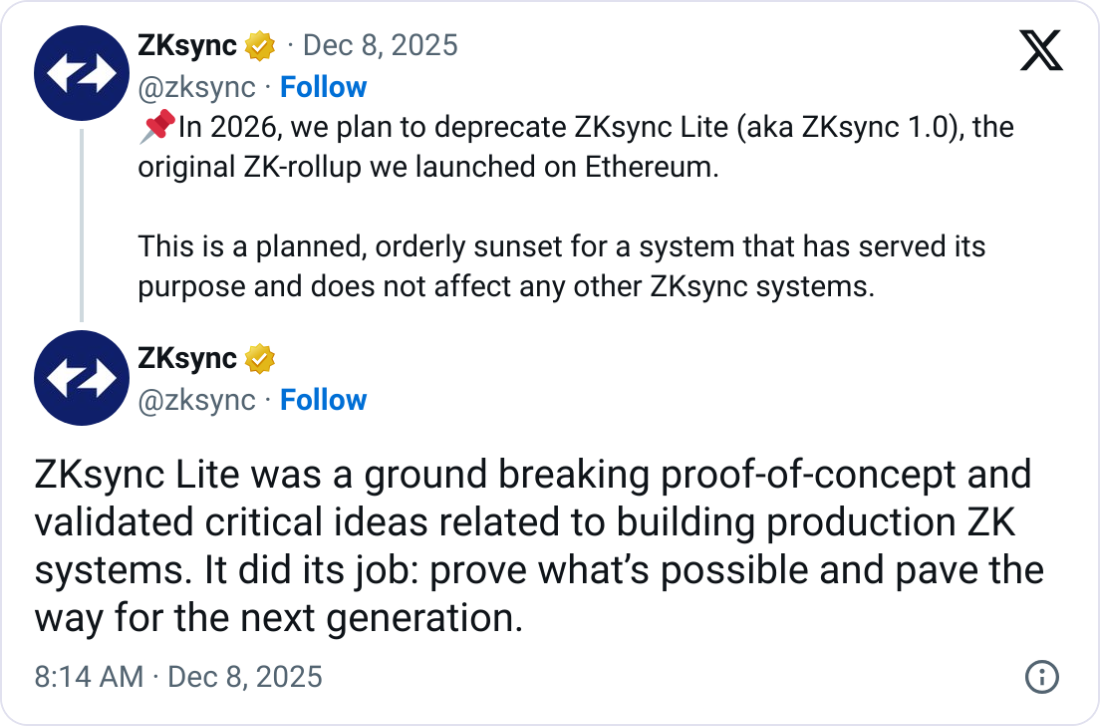
Source: ZKsync

The network was the first to use validity proofs that instantly proved if a transaction was valid, before transactions were bundled up and sent to the Ethereum mainnet for final validation.

Matter Labs stopped development on ZKsync Lite in early 2023 after launching its zero-knowledge Ethereum Virtual Machine (zkEVM) that supported smart contracts, ZKsync Era.

ZKsync said that no immediate action was required from ZKsync Lite users, and the network is operating as usual. “Funds remain safe, and withdrawals to L1 will keep working through the process,” it added.

Its other products are similarly unaffected, and the team said it would share “concrete details, dates, and migration guidance soon” for ZKsync Lite.

Related: Privacy tools are rising behind institutional adoption, says ZKsync dev

Just under $50 million is currently bridged to the network, according to DefiLlama, but L2BEAT data shows it has only seen just over 330 user operations in the past day.

By comparison, ZKsync Era has a total value locked of $36.4 million and has seen over 22,000 user operations over the past day.

It comes as the blockchain could be undergoing more changes. Last month, ZKsync co-creator Alex Gluchowski proposed overhauling its ZKsync (ZK) governance token to prioritize “economic utility,” tying the token to the network’s fees.

Magazine: What are native rollups? Full guide to Ethereum’s latest innovation

Letture associate

Altcoin: The ETF Boom Explodes – XRP, SOL, LTC, HBAR, DOGE, LINK, and the Emergence of New Opportunities

While the spotlight has been on Solana (SOL) ETFs, which have attracted approximately $682 million in inflows, XRP ETFs have quietly surpassed them with $874 million, despite launching later. Simultaneously, a new wave of altcoin ETFs for LTC, HBAR, DOGE, and LINK has entered the market, each recording modest but stable inflows since their debut. Seven separate Solana ETFs have generated $618.62 million in net inflows, holding $915.08 million in assets under management, representing about 1.15% of Solana's market cap. In contrast, four XRP ETFs have attracted $874.28 million, with Canary's XRPC leading at $357 million. The newly launched altcoin ETFs for LINK, HBAR, LTC, and DOGE have collectively seen $133.46 million in net inflows. Grayscale's GLNK attracted $40.90 million, Canary's LTCC (Litecoin) drew $7.67 million, and its HBR (HBAR) ETF recorded $82.04 million. Two DOGE ETFs brought in $2.85 million. This expansion signals a new market phase of diverse choices and intense competition. However, these new altcoin ETFs remain far behind the established Bitcoin and Ethereum ETFs in terms of total capital. Amid this ETF boom, Bitcoin Hyper (HYPER) is emerging as a potential altcoin outside the traditional ETF scope. It's a Bitcoin Layer-2 project built on the Solana Virtual Machine (SVM), combining Solana's speed with Bitcoin's security. Having raised nearly $29 million in its presale, it offers a fixed supply of 21 billion tokens and 40% staking APY, positioning itself to unlock Bitcoin's potential in DeFi.

bitcoinist45 min fa

Altcoin: The ETF Boom Explodes – XRP, SOL, LTC, HBAR, DOGE, LINK, and the Emergence of New Opportunities

bitcoinist45 min fa

Trading

Spot
Futures
活动图片