Ethereum's 2025 Report Card: Won the Consensus, Lost the Price

marsbitPubblicato 2025-12-26Pubblicato ultima volta 2025-12-26

Introduzione

Despite a disappointing year for ETH investors with the token's price declining over 15% since January 2025, the Ethereum blockchain itself achieved significant milestones. Key developments include a surge in ETH ETF inflows, which grew nearly fivefold to over $10 billion between June and September, making ETH more accessible to mainstream investors. Additionally, corporate treasury adoption emerged as a major trend, with the top five companies holding 5.56 million ETH (4.6% of supply), valued at over $16 billion. These institutional pathways helped Ethereum gain mainstream attention, reflected in increased Google search trends. Ethereum maintained its dominance in stablecoins and real-world asset (RWA) tokenization, hosting over half of all tokenized assets globally. Technologically, the Pectra and Fusaka upgrades enhanced scalability, reduced transaction costs, and improved network reliability—critical for supporting large-scale applications like Rollups and institutional settlements. While Ethereum solidified its position as a robust financial infrastructure, ETH’s price performance lagged behind network growth. The divergence highlights a year where Ethereum won consensus as a platform but failed to deliver gains for token holders, setting the stage for potential price appreciation in 2026 if ecosystem momentum translates into value.

Original Author: Prathik Desai

Original Compilation: Chopper, Foresight News

As a staunchly bullish ETH investor, I developed a frustrating habit this year. Every day, I would open the ETH price chart and silently calculate how much my portfolio had lost. After doing the math, I would close the chart and hope it wouldn't be too long before I could break even.

As the year ends, I imagine most investors who bought ETH at the start of the year can't help but feel disappointed. However, over the past 12 months, despite ETH's disappointing price performance and wealth creation effect, the Ethereum blockchain itself has stood out among its competitors.

If measured by the standard of "making money," 2025 was undoubtedly a bad year. But looking beyond token returns, holding ETH became more convenient in 2025, thanks mainly to the rise of market instruments like ETFs and corporate treasuries (DAT). Furthermore, the two major upgrades completed by Ethereum this year, Pectra and Fusaka, have allowed this public chain to support large-scale applications more easily and efficiently.

In this article, I will reveal why the development trajectories of the Ethereum network and the ETH token diverged in 2025 and what this implies for their future directions.

Ethereum Finally Arrives

For much of the past two years, "institutional-grade ETH investment" seemed like a distant dream to many. As of June 30th, ETH ETFs had seen cumulative inflows of just over $4 billion since their launch a year prior. At that time, public companies were only just starting to consider the idea of adding ETH to their corporate treasuries.

A turning point quietly emerged in the second half of the year.

Between June 1st and September 30th, 2025, the cumulative inflow into ETH ETFs grew nearly fivefold, breaking the $10 billion mark.
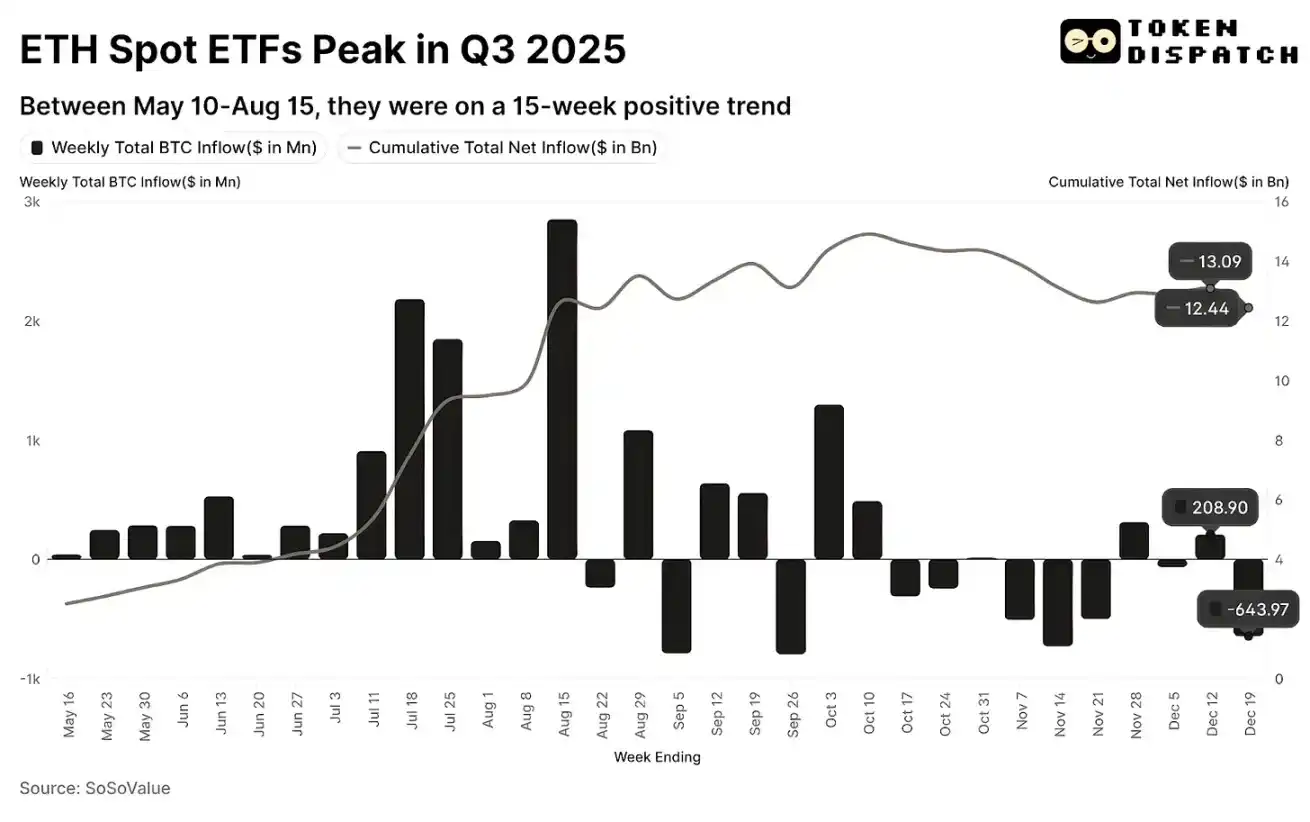
This ETF frenzy not only brought an influx of capital but also triggered a psychological shift in the market. It significantly lowered the barrier for the average investor to buy ETH, expanding ETH's audience from blockchain developers and traders to a third group—ordinary investors hoping to allocate to this world's second-largest cryptocurrency asset.

This leads to another major industry change that emerged this year.

Ethereum Attracts a New Class of Buyers

Over the past five years, influenced by the investment strategy proposed by the CEO of Strategy (MicroStrategy?), the Bitcoin corporate treasury seemed to be the only paradigm for corporate cryptocurrency asset adoption. Before the flaws in this model were exposed, this strategy was once seen as the simplest path for companies to allocate to crypto: a public company buys a scarce cryptocurrency asset, driving the price up, which in turn boosts the company's stock price; subsequently, the company can use this premium to issue more shares and raise more capital.

This is why many were puzzled when ETH corporate treasuries became an industry hotspot in June of this year. The reason ETH treasuries were able to rise to prominence lies in their ability to achieve functions that Bitcoin treasuries cannot. This became particularly evident after Ethereum co-founder and ConsenSys CEO Joe Lubin announced joining the board of SharpLink Gaming and leading its $425 million ETH treasury investment plan, making the market realize the foresight of this move.

Soon after, numerous companies followed SharpLink Gaming's example.

To date, the top five companies by ETH treasury holdings collectively hold 5.56 million ETH, accounting for over 4.6% of the total supply, worth over $16 billion at current prices.
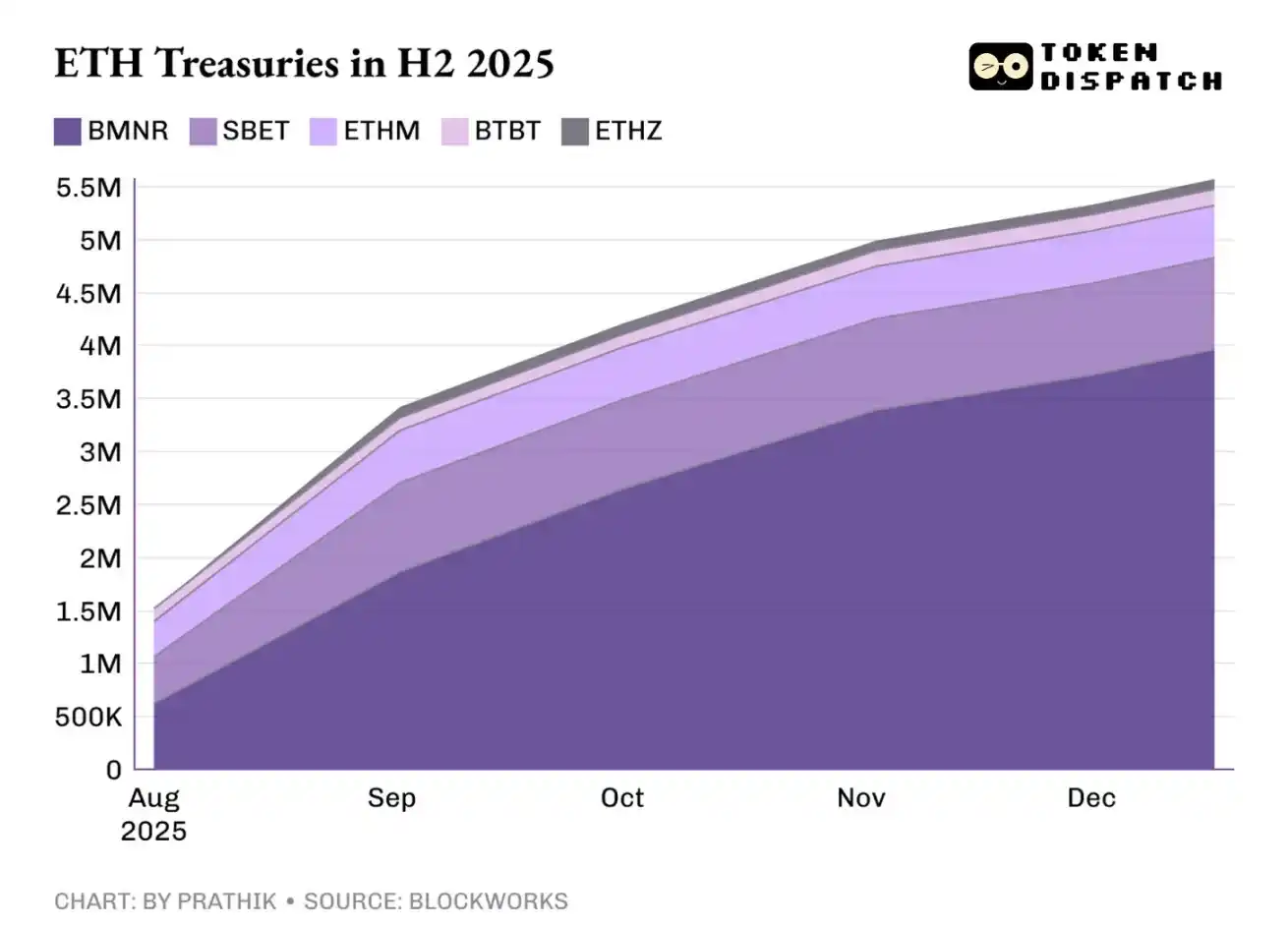
When investors hold an asset through wrapper instruments like ETFs and corporate treasuries, the asset's attributes gradually shift towards those of a "balance sheet item." It becomes incorporated into corporate governance frameworks, requiring regular financial reporting, dedicated board discussions, quarterly performance updates, and oversight from risk committees.

And ETH's staking特性 (property/feature) gives ETH treasuries an advantage that Bitcoin treasuries can hardly match.

A Bitcoin treasury can only generate profits for a company when it sells Bitcoin for a gain; ETH treasuries are different. Companies simply need to hold ETH and stake it, providing security for the Ethereum network, to earn more ETH as staking rewards.

If a company can combine staking rewards with its core business revenue, it can make the ETH treasury business sustainable.

It was from this point that the market truly began to正视 (seriously consider/acknowledge) Ethereum's value.

The "Low-Key" Ethereum Finally Gains Attention

Those who have long followed Ethereum's development know that Ethereum has never been good at active marketing. In the absence of external events (like the launch of wrapper instruments, market cycle shifts, or new narratives), Ethereum often seems quiet, until these external factors emerge, reminding people of its potential.

This year, the rise of ETH corporate treasuries and the surge in ETF inflows finally earned Ethereum significant market attention. I measured this change in attention in a very直观 (intuitive/straightforward) way: observing whether retail investors, who typically have no interest in blockchain technical roadmaps, started discussing Ethereum.
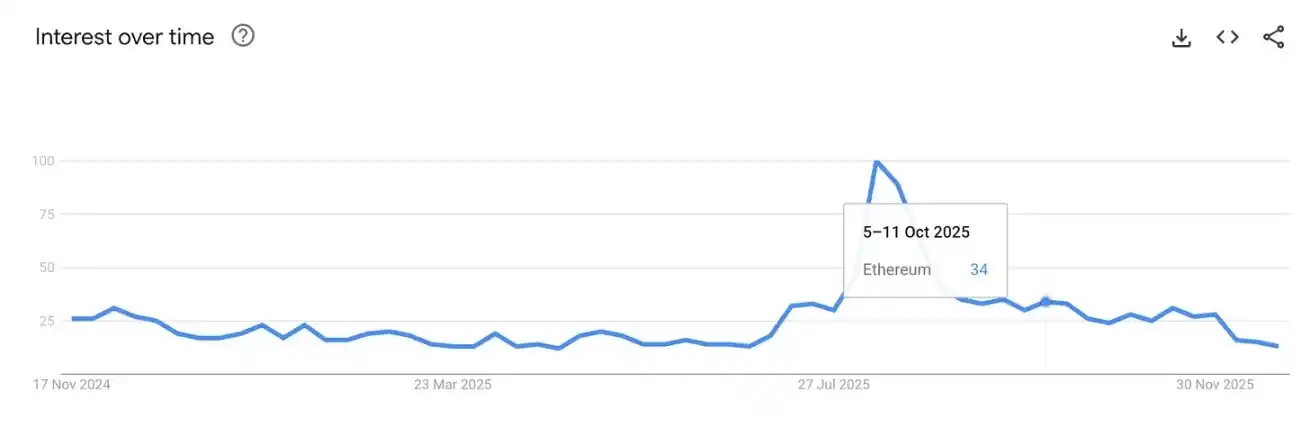
From July to September this year, Google Trends data showed a significant spike in search interest for Ethereum, a trend highly consistent with the momentum of ETH corporate treasuries and ETFs. It was these traditional asset allocation channels that ignited retail investors' curiosity about Ethereum, and curiosity further translated into market attention.

But热度 (heat/hype) alone is far from enough. Market attention is notoriously fickle, coming and going quickly. This leads to another key reason Ethereum supporters view 2025 as a "year of great victory": an often-overlooked critical factor.

The On-Chain Dollar for the Internet

If you look beyond short-term price charts and over a longer time horizon, the rises and falls of cryptocurrency prices are merely products of market sentiment fluctuations. But stablecoins and the tokenization of real-world assets (RWA) are completely different (截然不同); they have solid fundamental support and serve as bridges connecting the traditional financial system with decentralized finance (DeFi).

In 2025, Ethereum firmly maintained its position as the preferred platform for on-chain dollars, continuously supporting the circulation of stablecoins.
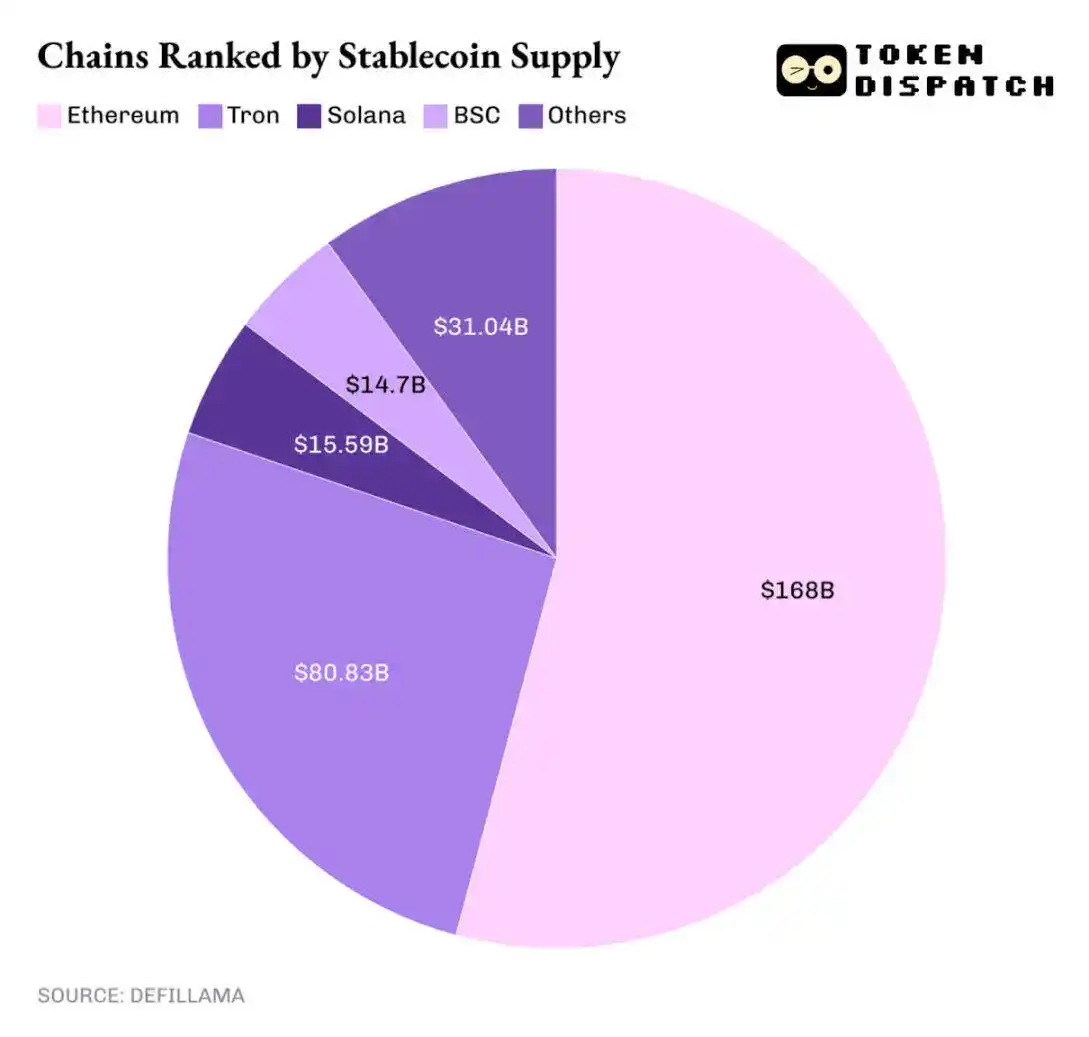
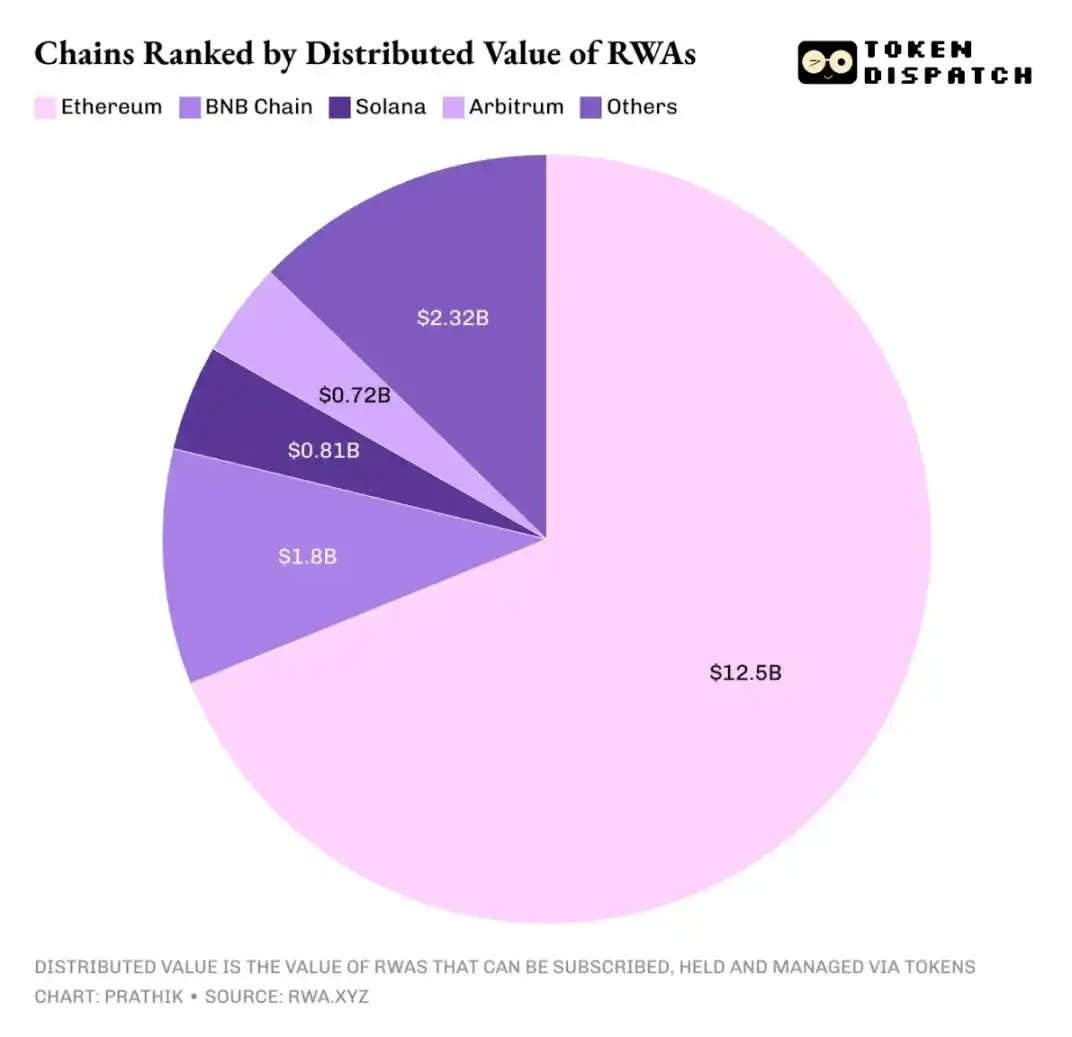
In the realm of real-world asset tokenization, Ethereum同样 (also/similarly) holds an absolute dominant position.

As of the time of writing, tokenized assets issued on the Ethereum network still account for half of the total value of global tokenized assets. This means that over half of the world's tokenized real-world assets, which holders can buy, sell, and manage, are issued on the Ethereum network.
Thus, ETFs lowered the barrier for ordinary investors to buy ETH, while corporate treasuries provided investors with a path to gain leveraged exposure to ETH through Wall Street-compliant channels.

All these developments are further推动 (driving/pushing) the integration of Ethereum with traditional capital markets, allowing investors to comfortably allocate ETH assets within a familiar, compliant environment.

Two Major Upgrades

In 2025, Ethereum completed two major technical upgrades. These upgrades significantly alleviated network congestion, improved system stability, and markedly enhanced Ethereum's practicality as a trusted transaction settlement layer.

The Pectra upgrade went live in May of this year. It improved Ethereum's scalability by expanding data shards (Blobs), providing more compressed data storage space for Layer 2 networks, thereby reducing their transaction costs. This upgrade also increased Ethereum's transaction throughput, sped up transaction confirmation times, and further optimized the efficiency of applications core to Rollup scaling solutions.

Following the Pectra upgrade, the Fusaka upgrade arrived, further enhancing Ethereum's network scalability and optimizing the user experience.

Overall, Ethereum's core goal in 2025 was to optimize its evolution towards reliable financial infrastructure. Both upgrades prioritized network stability, transaction throughput, and cost predictability. These characteristics are crucial for Rollup solutions, stablecoin issuers, and institutional users needing to settle value on-chain. Although these upgrades did not create a strong short-term correlation between Ethereum network activity and ETH price, they tangibly enhanced Ethereum's reliability for scaled application scenarios.

Future Outlook

If one wants to draw a simple,粗暴 (crude/harsh) conclusion about Ethereum's development in 2025, finding a definitive answer to "Ethereum succeeded" or "Ethereum failed" is difficult.

Instead, the market presented a more intriguing, yet slightly frustrating, fact in 2025:

In 2025, Ethereum successfully entered the investment portfolios of fund issuers and the balance sheets of listed companies, and, buoyed by持续 (sustained/continuous) institutional inflows, consistently captured market attention.

However, ETH holders had a disappointing year, with the token's price movement严重脱节 (severely disconnected) from the thriving development of the Ethereum network.

Investors who bought ETH at the beginning of the year are sitting on浮亏 (paper losses) of at least 15%. Although ETH price briefly touched a new all-time high of $4,953 in August, the good times were short-lived, and its price has since retreated to near five-month lows.

Looking ahead to 2026, Ethereum will continue to lead the industry based on its solid technical upgrade achievements and its massive scale in stablecoins and real-world asset tokenization. If the Ethereum network can ride this momentum, it has the potential to translate the动能 (momentum/kinetic energy) of ecosystem development into long-term price appreciation for ETH.

Domande pertinenti

QWhat were the two major Ethereum upgrades in 2025 and what were their primary goals?

AThe two major Ethereum upgrades in 2025 were Pectra and Fusaka. Their primary goals were to enhance the network's scalability, stability, and transaction throughput, while also improving cost predictability and optimizing the user experience, making Ethereum a more reliable financial infrastructure.

QHow did the perception of Ethereum change for institutional and corporate investors in 2025?

AEthereum gained significant traction through the rise of ETH ETFs and corporate treasuries (DATs). These 'wrapped' investment vehicles lowered the barrier to entry, integrated ETH into traditional governance frameworks, and attracted a new class of investors, shifting its perception towards a legitimate asset for institutional portfolios and corporate balance sheets.

QWhat key advantage does an ETH treasury hold over a Bitcoin treasury for a corporation?

AA key advantage of an ETH treasury over a Bitcoin treasury is the ability to earn staking rewards. Corporations can stake their ETH to help secure the network and generate additional ETH as yield, creating a potential revenue stream that is not possible with a static Bitcoin holding.

QDespite network growth, why was 2025 a disappointing year for many ETH investors?

A2025 was disappointing for many ETH investors because the price of the ETH token performed poorly, decoupling from the network's fundamental growth. Investors who bought at the start of the year were facing losses of at least 15%, despite the network's advancements in adoption and technology.

QAccording to the article, what role does Ethereum play in the leading platform for on-chain dollars and real-world assets (RWA)?

AEthereum remains the leading platform for on-chain dollars, as the primary settlement layer for stablecoins. It also dominates the real-world asset (RWA) tokenization space, hosting more than half of the total global value of tokenized real-world assets on its network.

Letture associate

Arthur Hayes' New Article: It's 'No-Trade Zone' Time

Arthur Hayes argues that the current market is in a "no-trade zone," a period of high uncertainty created by two converging forces: the deflationary shock from AI and the inflationary shock from geopolitics. AI agents are rapidly displacing knowledge workers, eroding their incomes and creditworthiness, which will eventually trigger a deflationary financial crisis in consumer credit-dependent Western economies. Simultaneously, the war in the Middle East, particularly the potential disruption to shipping through the Strait of Hormuz, threatens global energy supplies and could force nations to abandon the dollar system. Hayes outlines three main scenarios: 1) A return to normalcy, where the deflationary AI shock remains the primary concern; 2) The "Tehran Toll Booth," where Iran controls the Strait and demands payment in gold or yuan, accelerating the end of dollar hegemony; and 3) "Empire Strikes Back," where the US destroys Iran's capabilities but risks a catastrophic regional war that sends commodity prices soaring. In all but the most extreme scenarios, Hayes posits that the key driver for Bitcoin's price will be the *quantity* of money, not its price (interest rates). He expects that governments, forced to fund wars and stockpile resources, will have to print money, expanding the money supply. This would be bullish for fixed-supply assets like Bitcoin, even if it occurs alongside rising rates. However, he cautions that until this liquidity is explicitly unleashed (e.g., when bond market volatility spikes), the risk/reward for new long positions is poor. His current strategy is to wait for a clear signal of monetary expansion before deploying capital, preferring to hold gold and select crypto assets in the meantime.

marsbit2 h fa

Arthur Hayes' New Article: It's 'No-Trade Zone' Time

marsbit2 h fa

Trading

Spot
Futures

Articoli Popolari

Cosa è $S$

Comprendere SPERO: Una Panoramica Completa Introduzione a SPERO Mentre il panorama dell'innovazione continua a evolversi, l'emergere delle tecnologie web3 e dei progetti di criptovaluta gioca un ruolo fondamentale nel plasmare il futuro digitale. Un progetto che ha attirato l'attenzione in questo campo dinamico è SPERO, denotato come SPERO,$$s$. Questo articolo mira a raccogliere e presentare informazioni dettagliate su SPERO, per aiutare gli appassionati e gli investitori a comprendere le sue basi, obiettivi e innovazioni nei domini web3 e crypto. Che cos'è SPERO,$$s$? SPERO,$$s$ è un progetto unico all'interno dello spazio crypto che cerca di sfruttare i principi della decentralizzazione e della tecnologia blockchain per creare un ecosistema che promuove l'impegno, l'utilità e l'inclusione finanziaria. Il progetto è progettato per facilitare interazioni peer-to-peer in modi nuovi, fornendo agli utenti soluzioni e servizi finanziari innovativi. Al suo interno, SPERO,$$s$ mira a responsabilizzare gli individui fornendo strumenti e piattaforme che migliorano l'esperienza dell'utente nello spazio delle criptovalute. Questo include la possibilità di metodi di transazione più flessibili, la promozione di iniziative guidate dalla comunità e la creazione di percorsi per opportunità finanziarie attraverso applicazioni decentralizzate (dApps). La visione sottostante di SPERO,$$s$ ruota attorno all'inclusività, cercando di colmare le lacune all'interno della finanza tradizionale mentre sfrutta i vantaggi della tecnologia blockchain. Chi è il Creatore di SPERO,$$s$? L'identità del creatore di SPERO,$$s$ rimane piuttosto oscura, poiché ci sono risorse pubblicamente disponibili limitate che forniscono informazioni dettagliate sul suo fondatore o fondatori. Questa mancanza di trasparenza può derivare dall'impegno del progetto per la decentralizzazione—un ethos che molti progetti web3 condividono, dando priorità ai contributi collettivi rispetto al riconoscimento individuale. Centrando le discussioni attorno alla comunità e ai suoi obiettivi collettivi, SPERO,$$s$ incarna l'essenza dell'empowerment senza mettere in evidenza individui specifici. Pertanto, comprendere l'etica e la missione di SPERO rimane più importante che identificare un creatore singolo. Chi sono gli Investitori di SPERO,$$s$? SPERO,$$s$ è supportato da una varietà di investitori che vanno dai capitalisti di rischio agli investitori angelici dedicati a promuovere l'innovazione nel settore crypto. Il focus di questi investitori generalmente si allinea con la missione di SPERO—dando priorità a progetti che promettono avanzamenti tecnologici sociali, inclusività finanziaria e governance decentralizzata. Queste fondazioni di investitori sono tipicamente interessate a progetti che non solo offrono prodotti innovativi, ma contribuiscono anche positivamente alla comunità blockchain e ai suoi ecosistemi. Il supporto di questi investitori rafforza SPERO,$$s$ come un concorrente degno di nota nel dominio in rapida evoluzione dei progetti crypto. Come Funziona SPERO,$$s$? SPERO,$$s$ impiega un framework multifunzionale che lo distingue dai progetti di criptovaluta convenzionali. Ecco alcune delle caratteristiche chiave che sottolineano la sua unicità e innovazione: Governance Decentralizzata: SPERO,$$s$ integra modelli di governance decentralizzati, responsabilizzando gli utenti a partecipare attivamente ai processi decisionali riguardanti il futuro del progetto. Questo approccio favorisce un senso di proprietà e responsabilità tra i membri della comunità. Utilità del Token: SPERO,$$s$ utilizza il proprio token di criptovaluta, progettato per servire varie funzioni all'interno dell'ecosistema. Questi token abilitano transazioni, premi e la facilitazione dei servizi offerti sulla piattaforma, migliorando l'impegno e l'utilità complessivi. Architettura Stratificata: L'architettura tecnica di SPERO,$$s$ supporta la modularità e la scalabilità, consentendo un'integrazione fluida di funzionalità e applicazioni aggiuntive man mano che il progetto evolve. Questa adattabilità è fondamentale per mantenere la rilevanza nel panorama crypto in continua evoluzione. Coinvolgimento della Comunità: Il progetto enfatizza iniziative guidate dalla comunità, impiegando meccanismi che incentivano la collaborazione e il feedback. Nutrendo una comunità forte, SPERO,$$s$ può affrontare meglio le esigenze degli utenti e adattarsi alle tendenze di mercato. Focus sull'Inclusione: Offrendo basse commissioni di transazione e interfacce user-friendly, SPERO,$$s$ mira ad attrarre una base utenti diversificata, inclusi individui che potrebbero non aver precedentemente interagito nello spazio crypto. Questo impegno per l'inclusione si allinea con la sua missione generale di empowerment attraverso l'accessibilità. Cronologia di SPERO,$$s$ Comprendere la storia di un progetto fornisce preziose intuizioni sulla sua traiettoria di sviluppo e sui traguardi. Di seguito è riportata una cronologia suggerita che mappa eventi significativi nell'evoluzione di SPERO,$$s$: Fase di Concettualizzazione e Ideazione: Le idee iniziali che formano la base di SPERO,$$s$ sono state concepite, allineandosi strettamente con i principi di decentralizzazione e focus sulla comunità all'interno dell'industria blockchain. Lancio del Whitepaper del Progetto: Dopo la fase concettuale, è stato rilasciato un whitepaper completo che dettaglia la visione, gli obiettivi e l'infrastruttura tecnologica di SPERO,$$s$ per suscitare interesse e feedback dalla comunità. Costruzione della Comunità e Prime Interazioni: Sono stati effettuati sforzi attivi di outreach per costruire una comunità di early adopters e potenziali investitori, facilitando discussioni attorno agli obiettivi del progetto e ottenendo supporto. Evento di Generazione del Token: SPERO,$$s$ ha condotto un evento di generazione del token (TGE) per distribuire i propri token nativi ai primi sostenitori e stabilire una liquidità iniziale all'interno dell'ecosistema. Lancio della Prima dApp: La prima applicazione decentralizzata (dApp) associata a SPERO,$$s$ è stata attivata, consentendo agli utenti di interagire con le funzionalità principali della piattaforma. Sviluppo Continuo e Partnership: Aggiornamenti e miglioramenti continui alle offerte del progetto, inclusi partnership strategiche con altri attori nello spazio blockchain, hanno plasmato SPERO,$$s$ in un concorrente competitivo e in evoluzione nel mercato crypto. Conclusione SPERO,$$s$ rappresenta una testimonianza del potenziale del web3 e delle criptovalute di rivoluzionare i sistemi finanziari e responsabilizzare gli individui. Con un impegno per la governance decentralizzata, il coinvolgimento della comunità e funzionalità progettate in modo innovativo, apre la strada verso un panorama finanziario più inclusivo. Come per qualsiasi investimento nello spazio crypto in rapida evoluzione, si incoraggiano potenziali investitori e utenti a ricercare approfonditamente e a impegnarsi in modo riflessivo con gli sviluppi in corso all'interno di SPERO,$$s$. Il progetto mostra lo spirito innovativo dell'industria crypto, invitando a ulteriori esplorazioni delle sue innumerevoli possibilità. Mentre il percorso di SPERO,$$s$ è ancora in fase di sviluppo, i suoi principi fondamentali potrebbero effettivamente influenzare il futuro di come interagiamo con la tecnologia, la finanza e tra di noi in ecosistemi digitali interconnessi.

75 Totale visualizzazioniPubblicato il 2024.12.17Aggiornato il 2024.12.17

Cosa è $S$

Cosa è AGENT S

Agent S: Il Futuro dell'Interazione Autonoma in Web3 Introduzione Nel panorama in continua evoluzione di Web3 e criptovalute, le innovazioni stanno costantemente ridefinendo il modo in cui gli individui interagiscono con le piattaforme digitali. Uno di questi progetti pionieristici, Agent S, promette di rivoluzionare l'interazione uomo-computer attraverso il suo framework agentico aperto. Aprendo la strada a interazioni autonome, Agent S mira a semplificare compiti complessi, offrendo applicazioni trasformative nell'intelligenza artificiale (AI). Questa esplorazione dettagliata approfondirà le complessità del progetto, le sue caratteristiche uniche e le implicazioni per il dominio delle criptovalute. Cos'è Agent S? Agent S si presenta come un innovativo framework agentico aperto, progettato specificamente per affrontare tre sfide fondamentali nell'automazione dei compiti informatici: Acquisizione di Conoscenze Specifiche del Dominio: Il framework apprende in modo intelligente da varie fonti di conoscenza esterne ed esperienze interne. Questo approccio duale gli consente di costruire un ricco repository di conoscenze specifiche del dominio, migliorando le sue prestazioni nell'esecuzione dei compiti. Pianificazione su Lungo Orizzonte di Compiti: Agent S impiega una pianificazione gerarchica potenziata dall'esperienza, un approccio strategico che facilita la suddivisione e l'esecuzione efficiente di compiti complessi. Questa caratteristica migliora significativamente la sua capacità di gestire più sottocompiti in modo efficiente ed efficace. Gestione di Interfacce Dinamiche e Non Uniformi: Il progetto introduce l'Interfaccia Agente-Computer (ACI), una soluzione innovativa che migliora l'interazione tra agenti e utenti. Utilizzando Modelli Linguistici Multimodali di Grandi Dimensioni (MLLM), Agent S può navigare e manipolare senza sforzo diverse interfacce grafiche utente. Attraverso queste caratteristiche pionieristiche, Agent S fornisce un framework robusto che affronta le complessità coinvolte nell'automazione dell'interazione umana con le macchine, preparando il terreno per innumerevoli applicazioni nell'AI e oltre. Chi è il Creatore di Agent S? Sebbene il concetto di Agent S sia fondamentalmente innovativo, informazioni specifiche sul suo creatore rimangono elusive. Il creatore è attualmente sconosciuto, il che evidenzia sia la fase embrionale del progetto sia la scelta strategica di mantenere i membri fondatori sotto anonimato. Indipendentemente dall'anonimato, l'attenzione rimane sulle capacità e sul potenziale del framework. Chi sono gli Investitori di Agent S? Poiché Agent S è relativamente nuovo nell'ecosistema crittografico, informazioni dettagliate riguardanti i suoi investitori e sostenitori finanziari non sono documentate esplicitamente. La mancanza di approfondimenti pubblicamente disponibili sulle fondazioni di investimento o sulle organizzazioni che supportano il progetto solleva interrogativi sulla sua struttura di finanziamento e sulla roadmap di sviluppo. Comprendere il supporto è cruciale per valutare la sostenibilità del progetto e il suo potenziale impatto sul mercato. Come Funziona Agent S? Al centro di Agent S si trova una tecnologia all'avanguardia che gli consente di funzionare efficacemente in contesti diversi. Il suo modello operativo è costruito attorno a diverse caratteristiche chiave: Interazione Uomo-Computer Simile a Quella Umana: Il framework offre una pianificazione AI avanzata, cercando di rendere le interazioni con i computer più intuitive. Mimando il comportamento umano nell'esecuzione dei compiti, promette di elevare le esperienze degli utenti. Memoria Narrativa: Utilizzata per sfruttare esperienze di alto livello, Agent S utilizza la memoria narrativa per tenere traccia delle storie dei compiti, migliorando così i suoi processi decisionali. Memoria Episodica: Questa caratteristica fornisce agli utenti una guida passo-passo, consentendo al framework di offrire supporto contestuale mentre i compiti si sviluppano. Supporto per OpenACI: Con la capacità di funzionare localmente, Agent S consente agli utenti di mantenere il controllo sulle proprie interazioni e flussi di lavoro, allineandosi con l'etica decentralizzata di Web3. Facile Integrazione con API Esterne: La sua versatilità e compatibilità con varie piattaforme AI garantiscono che Agent S possa adattarsi senza problemi agli ecosistemi tecnologici esistenti, rendendolo una scelta attraente per sviluppatori e organizzazioni. Queste funzionalità contribuiscono collettivamente alla posizione unica di Agent S all'interno dello spazio crittografico, poiché automatizza compiti complessi e multi-fase con un intervento umano minimo. Man mano che il progetto evolve, le sue potenziali applicazioni in Web3 potrebbero ridefinire il modo in cui si svolgono le interazioni digitali. Cronologia di Agent S Lo sviluppo e le tappe di Agent S possono essere riassunti in una cronologia che evidenzia i suoi eventi significativi: 27 Settembre 2024: Il concetto di Agent S è stato lanciato in un documento di ricerca completo intitolato “Un Framework Agentico Aperto che Usa i Computer Come un Umano”, mostrando le basi per il progetto. 10 Ottobre 2024: Il documento di ricerca è stato reso pubblicamente disponibile su arXiv, offrendo un'esplorazione approfondita del framework e della sua valutazione delle prestazioni basata sul benchmark OSWorld. 12 Ottobre 2024: È stata rilasciata una presentazione video, fornendo un'idea visiva delle capacità e delle caratteristiche di Agent S, coinvolgendo ulteriormente potenziali utenti e investitori. Questi indicatori nella cronologia non solo illustrano i progressi di Agent S, ma indicano anche il suo impegno per la trasparenza e il coinvolgimento della comunità. Punti Chiave su Agent S Man mano che il framework Agent S continua a evolversi, diversi attributi chiave si distinguono, sottolineando la sua natura innovativa e il potenziale: Framework Innovativo: Progettato per fornire un uso intuitivo dei computer simile all'interazione umana, Agent S porta un approccio nuovo all'automazione dei compiti. Interazione Autonoma: La capacità di interagire autonomamente con i computer attraverso GUI segna un passo avanti verso soluzioni informatiche più intelligenti ed efficienti. Automazione di Compiti Complessi: Con la sua metodologia robusta, può automatizzare compiti complessi e multi-fase, rendendo i processi più veloci e meno soggetti a errori. Miglioramento Continuo: I meccanismi di apprendimento consentono ad Agent S di migliorare dalle esperienze passate, migliorando continuamente le sue prestazioni e la sua efficacia. Versatilità: La sua adattabilità attraverso diversi ambienti operativi come OSWorld e WindowsAgentArena garantisce che possa servire un'ampia gamma di applicazioni. Man mano che Agent S si posiziona nel panorama di Web3 e delle criptovalute, il suo potenziale per migliorare le capacità di interazione e automatizzare i processi segna un significativo avanzamento nelle tecnologie AI. Attraverso il suo framework innovativo, Agent S esemplifica il futuro delle interazioni digitali, promettendo un'esperienza più fluida ed efficiente per gli utenti in vari settori. Conclusione Agent S rappresenta un audace passo avanti nell'unione tra AI e Web3, con la capacità di ridefinire il modo in cui interagiamo con la tecnologia. Sebbene sia ancora nelle sue fasi iniziali, le possibilità per la sua applicazione sono vaste e coinvolgenti. Attraverso il suo framework completo che affronta sfide critiche, Agent S mira a portare le interazioni autonome al centro dell'esperienza digitale. Man mano che ci addentriamo nei regni delle criptovalute e della decentralizzazione, progetti come Agent S giocheranno senza dubbio un ruolo cruciale nel plasmare il futuro della tecnologia e della collaborazione uomo-computer.

395 Totale visualizzazioniPubblicato il 2025.01.14Aggiornato il 2025.01.14

Cosa è AGENT S

Come comprare S

Benvenuto in HTX.com! Abbiamo reso l'acquisto di Sonic (S) semplice e conveniente. Segui la nostra guida passo passo per intraprendere il tuo viaggio nel mondo delle criptovalute.Step 1: Crea il tuo Account HTXUsa la tua email o numero di telefono per registrarti il tuo account gratuito su HTX. Vivi un'esperienza facile e sblocca tutte le funzionalità,Crea il mio accountStep 2: Vai in Acquista crypto e seleziona il tuo metodo di pagamentoCarta di credito/debito: utilizza la tua Visa o Mastercard per acquistare immediatamente SonicS.Bilancio: Usa i fondi dal bilancio del tuo account HTX per fare trading senza problemi.Terze parti: abbiamo aggiunto metodi di pagamento molto utilizzati come Google Pay e Apple Pay per maggiore comodità.P2P: Fai trading direttamente con altri utenti HTX.Over-the-Counter (OTC): Offriamo servizi su misura e tassi di cambio competitivi per i trader.Step 3: Conserva Sonic (S)Dopo aver acquistato Sonic (S), conserva nel tuo account HTX. In alternativa, puoi inviare tramite trasferimento blockchain o scambiare per altre criptovalute.Step 4: Scambia Sonic (S)Scambia facilmente Sonic (S) nel mercato spot di HTX. Accedi al tuo account, seleziona la tua coppia di trading, esegui le tue operazioni e monitora in tempo reale. Offriamo un'esperienza user-friendly sia per chi ha appena iniziato che per i trader più esperti.

780 Totale visualizzazioniPubblicato il 2025.01.15Aggiornato il 2025.03.21

Come comprare S

Discussioni

Benvenuto nella Community HTX. Qui puoi rimanere informato sugli ultimi sviluppi della piattaforma e accedere ad approfondimenti esperti sul mercato. Le opinioni degli utenti sul prezzo di S S sono presentate come di seguito.

活动图片