Ethereum's 11th Year: Why Is This Year Particularly Crucial?

marsbitPubblicato 2026-07-31Pubblicato ultima volta 2026-07-31

Introduzione

Ethereum's 11th year proved pivotal, marked by a dual evolution in its technical roadmap and organizational structure. The year saw the completion of the Fusaka upgrade, introducing PeerDAS to make data availability sampling more efficient and laying groundwork for future L2 scaling. This was followed by a significant reorganization of the Ethereum Foundation (EF). The EF downsized, redefining its core mandate around user sovereignty and CROPS principles, while spinning off key functions. Independent entities like Ethlabs (non-profit R&D), Ethereum Institutional (institutional onboarding), and EthSystems (institutional privacy solutions) now operate separately. Technologically, the community debated a bold, long-term vision outlined in Justin Drake's "Lean Ethereum" proposal and the collaborative "Strawmap." These point toward a "third major iteration" for Ethereum, targeting goals like faster finality (~1 second), gigagas-scale L1 throughput, teragas-scale L2 capacity, post-quantum cryptography, and protocol-level privacy. Data underscores Ethereum's dominant position: its L1 still holds roughly half of all stablecoin value, leads in tokenized Real-World Assets (RWA), and commands over 55% of total DeFi TVL. While L2s now handle over 10x more transactions than the mainnet, high-value assets remain concentrated on L1. The launch of Robinhood Chain, an EVM-compatible L2 for stock tokens, signals growing institutional adoption. The immediate roadmap includes the Glamsterdam...

Original Author: KarenZ, Foresight News

In 2015, Ethereum brought the concept of the "world computer" on-chain; in 2026, it is simultaneously restructuring the organizational network maintaining this machine and reshaping its underlying architecture for the years to come.

Over the past year, the Fusaka upgrade laid the foundation for Ethereum to carry more L2 data; the Ethereum Foundation underwent a major reorganization, with parts of its research & development, institutional outreach, and privacy operations being transferred to independent entities like Ethlabs, Ethereum Institutional, and EthSystems; Lean Ethereum and Strawmap then placed the next round of protocol redesigns on the table, covering consensus, validation methods, cryptography, and state, all of which may be redesigned in the coming years.

The First Decade, Condensed into a Few Lines

On July 30, 2015, the Frontier mainnet launched. Ethereum evolved from a concept in a whitepaper into a public network where anyone could deploy and run smart contracts.

In the ten years that followed: In 2016, The DAO was attacked, leading to a hard fork of Ethereum, with the unforked side continuing as Ethereum Classic; in 2020, the Beacon Chain launched; in 2022, The Merge transitioned the mainnet from Proof-of-Work to Proof-of-Stake; in 2023, Shapella enabled staking withdrawals; in 2024, Dencun introduced Blobs via EIP-4844, providing cheaper data space for Rollups.

In May 2025, Pectra further improved account functionality via EIP-7702 and increased the maximum effective balance for a single validator to 2048 ETH.

This roadmap never followed a fixed blueprint neatly. Ethereum's characteristic is precisely that it replaces its own core components while it runs.

The first decade laid Ethereum's foundation, and the past year has redefined where it is headed next.

Fusaka: No Longer Requiring Every Node to Download All Blob Data

On December 3, 2025, Fusaka activated on the mainnet. This was the second major mainnet upgrade Ethereum completed in 2025, following Pectra.

The most important change in Fusaka is PeerDAS. Previously, nodes needed to download the complete blob data to check its availability; PeerDAS allows nodes to only sample and verify a portion of it, then through division of labor and erasure coding mechanisms between different nodes, collectively confirm that the complete data indeed exists.

It's somewhat like inspecting a vast shipment of goods: no longer requiring each inspector to recount all boxes, but having many inspectors each sample check, then combining their results to form a reliable judgment of the entire shipment.

After the upgrade, Ethereum also increased the target blobs per block from 6 to 14 and the limit from 9 to 21 through two BPIs that adjusted only blob parameters; the default block Gas Limit was also raised from 45 million to 60 million.

Fusaka is more like an underlying structural construction, still far from the endpoint of performance expansion. Users may not immediately feel drastic changes, but subsequent increases in Blob capacity and reductions in L2 costs will be built upon this layer.

The Foundation Shrinks, Functions Grow Outward

Protocol upgrades happen on-chain, while another adjustment occurred at the organizational layer. Over the past year, the Ethereum Foundation underwent a reorganization of rare scale.

In March 2026, the Foundation published a Mandate, establishing user sovereignty as a core goal and summarizing censorship resistance, open source, privacy, and security as the non-compromisable CROPS principles.

On June 23, the Foundation announced the completion of a reorganization that lasted several months, with 54 people leaving, representing about 20% of the original team.

The reorganized Foundation set up five work areas: Protocol Layer, Access Layer, User Layer, Community Layer, and Institutional Layer, in addition to an Operations Cluster and management & support teams. It no longer attempts to house all protocol R&D, product access, ecosystem communication, and institutional outreach within a single organization, but focuses limited resources on work it believes only it can sustain long-term.

This reorganization also continued the Foundation's previously announced treasury policy. The EF's treasury policy started from annual operational expenses representing about 15% of the treasury in 2025, planning to linearly decrease over five years to a long-term level of roughly 5%. It chooses to concentrate resources on core protocol, sovereign access, privacy & security, while having more ecosystem functions undertaken by independent organizations.

Meanwhile, a number of new entities involving former Foundation members began operating independently:

  • Ethlabs is an independent non-profit R&D institution. The team includes several former Ethereum Foundation researchers, focusing on Ethereum protocol, scaling, interoperability, and infrastructure R&D.
  • Ethereum Institutional is a non-profit institution incubated within the Foundation and now independent. It positions itself as a neutral entry point for banks, asset management companies, and public institutions into the Ethereum ecosystem, responsible for education, demand aggregation, and ecosystem coordination. On July 29, Ethereum Institutional announced the completion of its first ecosystem funding round and supporter alliance formation, receiving support from over 100 ecosystem participants, led by BitMine, SharpLink, and Ethereum co-founders Joseph Lubin and Mihai Alisie. The amount was not disclosed.
  • EthSystems continues the work of the Foundation's Institutional Privacy Task Force, but operates as an independent for-profit company, designing privacy, compliance, and confidential transaction systems for institutions.

Strictly speaking, these three should not be broadly described as legal "spin-offs" of the Ethereum Foundation: Ethlabs was created by former Foundation researchers, Ethereum Institutional was incubated within the Foundation and then became independent, and EthSystems took over the relevant team and work. A more accurate description is that the Ethereum Foundation is having some talent, funding sources, and specialized functions move outside the Foundation, forming multiple organizations capable of independent financing and decision-making.

This does not directly change the governance of the Ethereum protocol, but it changes the organizational structure around protocol development, institutional communication, and product building. Related work no longer needs to be concentrated on a single balance sheet.

Lean Ethereum and Strawmap: One Vision, One Sketch

Behind this organizational adjustment lies a longer technical thread.

On July 31, 2025, the day after Ethereum's tenth anniversary, Justin Drake published the Lean Ethereum vision, proposing a more radical technical roadmap for the protocol's next decade.

At the consensus layer, Lean Ethereum aims to compress finality time to seconds; at the data layer, it plans to expand Blob capacity through next-generation data availability sampling; at the execution layer, it proposes adopting a leaner instruction set more suitable for SNARK proofs, while trying to preserve EVM compatibility and existing network effects.

On top of these modifications, the protocol also needs to gradually replace signature and cryptography components potentially threatened by quantum computing, preparing in advance for long-term security.

Long-term goals proposed by Lean Ethereum include roughly 1 gigagas/s for L1 and 1 teragas/s for L2, corresponding to its estimated ~10k TPS and ~10 million TPS. It is crucial to emphasize that this document was explicitly labeled as Justin Drake's personal vision upon release, aiming to spur community discussion, not a finalized upgrade commitment that has passed governance procedures.

In February 2026, the Strawmap maintained by EF Architecture went live. Justin Drake, Vitalik Buterin, and others participated in its maintenance and curation. Strawmap is a portmanteau of "strawman" and "roadmap," which can be understood as a sketch of a route awaiting further community modification.

On July 4, Vitalik Buterin published an updated interpretation after the Berlin researcher meeting: He estimated the main parts of Lean Ethereum would take three to four years to be implemented gradually through multiple upgrades; recursive STARKs, post-quantum cryptography, consensus and finality redesign, multi-dimensional gas, new state types, and client architecture are all within the scope of discussion. He termed this phase the "third major iteration" following early Ethereum and The Merge, and emphasized privacy had become a first-class goal.
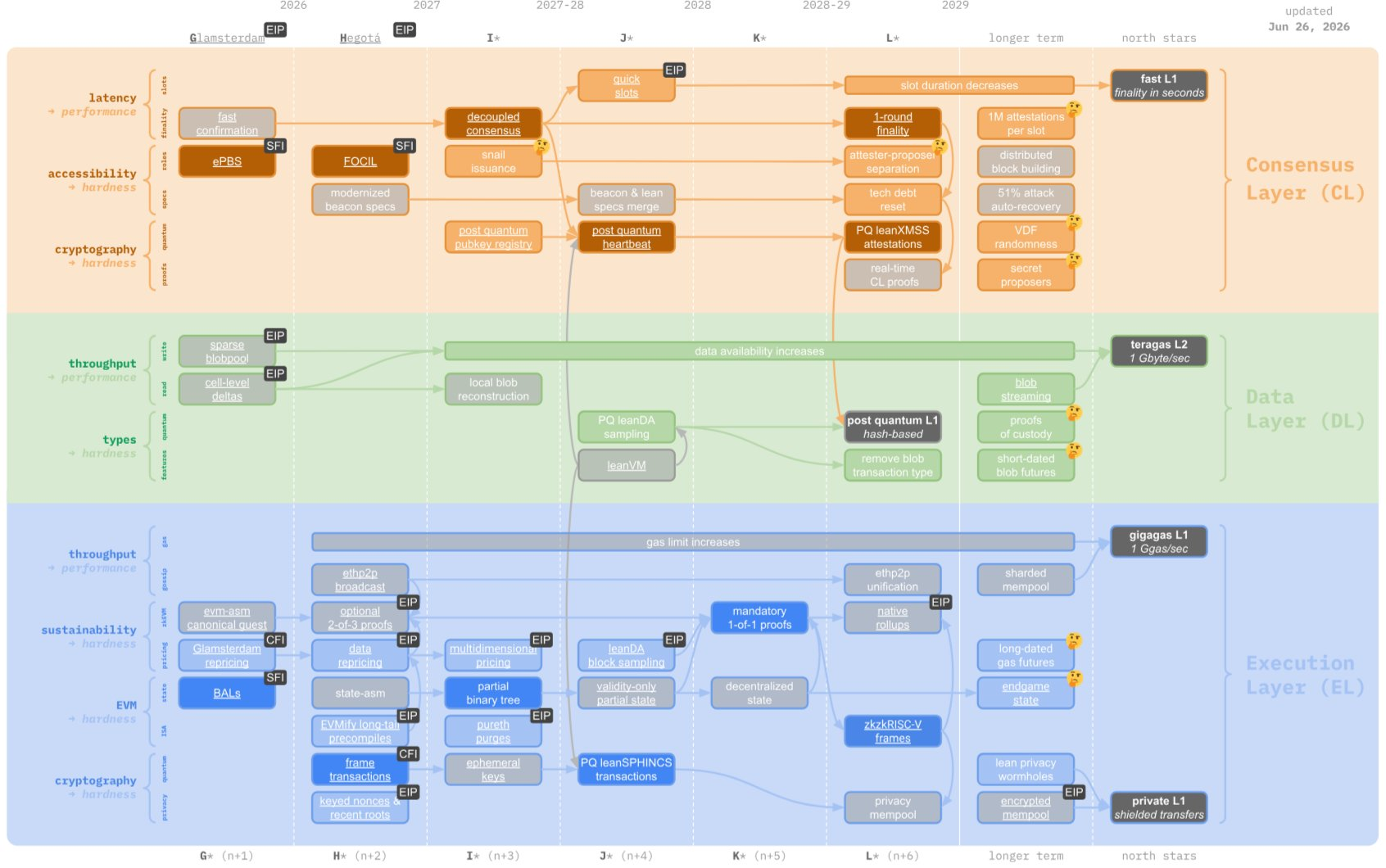
The five "directional goals" given by Strawmap are Fast L1, Gigagas L1, Teragas L2, Post-Quantum L1, and Private L1. In plain language, these are faster confirmation, higher mainnet throughput, larger L2 data space, quantum-resistant cryptography, and protocol-native privacy.

These are research directions and engineering goals, with significant design, implementation, testing, and community coordination work remaining before full deployment.

Four Sets of Data to Understand the 11-Year-Old Ethereum

The first set of data comes from stablecoins.

As of July 31, 2026, RWA.xyz statistics show the stablecoin scale on the Ethereum mainnet is approximately $155.9 billion. Compared to its global statistical value of ~$296.9 billion, the Ethereum mainnet accounts for about 52.5%.

DeFiLlama uses a different set of asset coverage and network classification criteria, reporting the stablecoin scale on Ethereum as approximately $146.9 billion, accounting for about 49.0% of the ~$300.1 billion total scale.
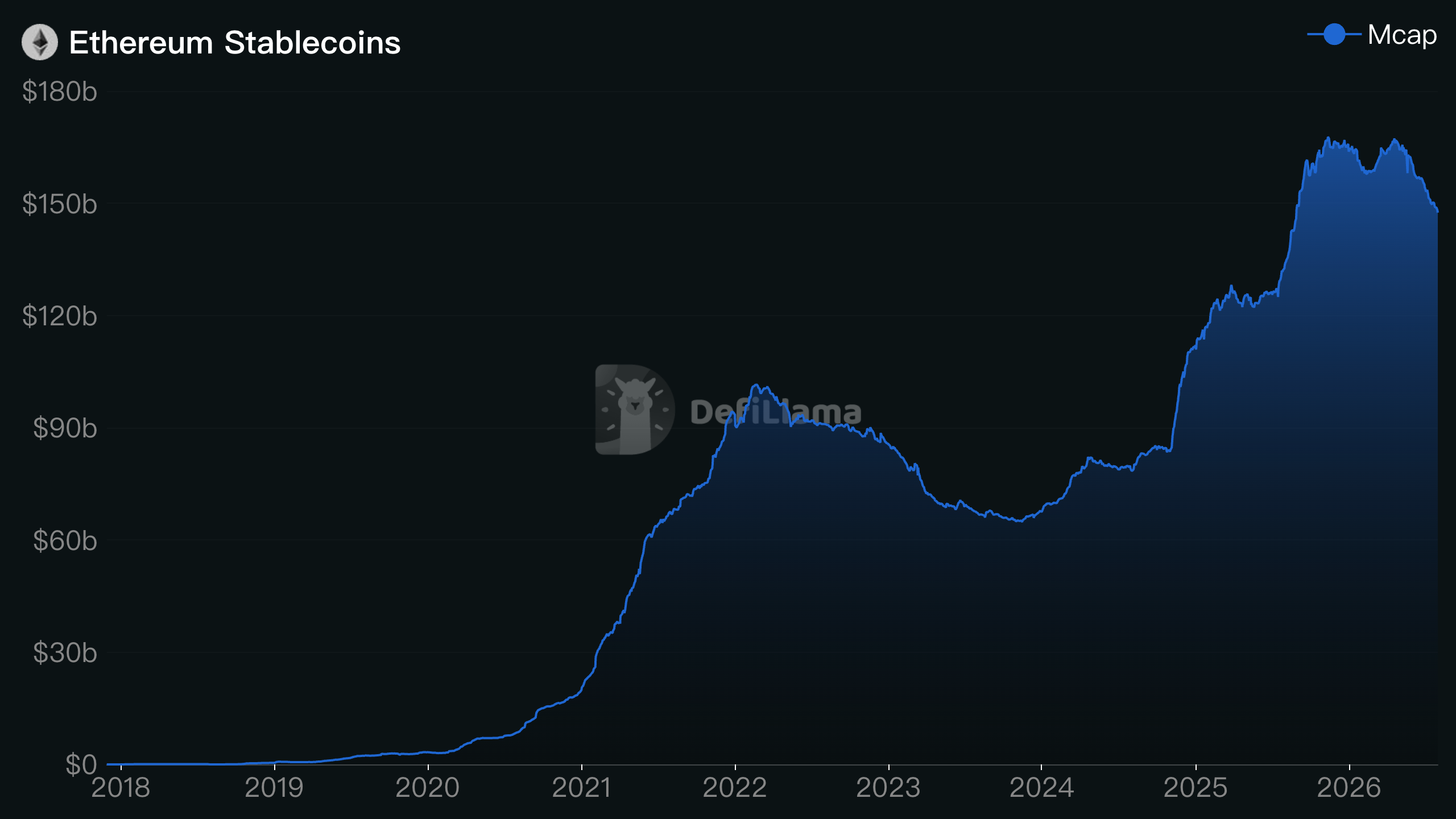
Source: DeFiLlama

The two datasets differ, mainly due to variations in token coverage, cross-chain assets, and statistical methods. However, the common conclusion they point to is that the Ethereum mainnet still carries close to half of the global stablecoin stock.

The second set of data comes from tokenized real-world assets.

According to RWA.xyz statistics, as of July 31, 2026, there are 1,552 RWAs on the Ethereum mainnet, with on-chain distributable asset value of approximately $17.15 billion, about 3.3 times that of the second-ranked BNB Chain, leading among the 38 networks it tracks. On-chain distributable assets refer to tokens that can leave the issuance platform and be transferred between wallets meeting whitelist or investor qualification requirements.

The institutional-grade Ethereum ecosystem service provider Ethereum Institutional, citing RWA.xyz's ecosystem criteria, states: Ethereum and its L2s host over 60% of stablecoin supply and over 75% of tokenized RWAs. This criterion includes L2s and broader asset classes and cannot be directly divided or mixed with RWA.xyz's single L1 data.

The third set of data comes from DeFi.

DeFiLlama statistics show Ethereum L1's DeFi TVL is approximately $41.2 billion, accounting for nearly 55% of all network TVL, with the following BSC and Tron both around $4.9 billion. As a single network, Ethereum's TVL is about 8 times that of the second place.

Another set of data comes from L2.

growthepie data shows that as of July 31, 2026, the tracked Ethereum L2 networks collectively process approximately 24.61 million transactions daily, 13.9 times the mainnet's 1.77 million; about 159.9 million weekly, 9.76 times the mainnet's 16.38 million; and about 661.46 million monthly, 10.4 times the mainnet's 63.51 million.

This data is sufficient to indicate that a large amount of execution activity has moved to scaling layers. Meanwhile, stablecoins, RWAs, and DeFi TVL remain highly concentrated on L1.

Beyond these data points, Robinhood Chain provides a more specific case study.

On July 1, 2026, the Robinhood Chain public mainnet launched. It uses the Arbitrum tech stack, is an EVM-compatible L2 that uses ETH for gas and ultimately settles to Ethereum, primarily targeting stock tokens and other financial assets. A securities brokerage platform with a massive retail user base has begun placing part of its future financial infrastructure within the Ethereum ecosystem.

The aforementioned data and cases cannot individually prove Ethereum has become a "global financial settlement layer." What they can prove is that Ethereum has accumulated substantial stock in stablecoins, DeFi, tokenized assets, and L2 execution activity, while beginning to attract traditional financial platforms to build on-chain infrastructure serving real users.

Next Stop: Glamsterdam, Then Hegotá

Ethereum's next mainnet upgrade is Glamsterdam, a name combining the execution layer upgrade Amsterdam and the consensus layer upgrade Gloas.

As of July 30, 2026, the official planning window is the second half of 2026, but the mainnet activation date has not been announced.

Glamsterdam has two core features. The first is ePBS, which writes the division of labor between proposers and block builders into the Ethereum protocol, reducing the network's reliance on extra-protocol relay services and leaving more time for block propagation. The second is Block-level Access Lists (BAL), allowing nodes to know in advance which accounts and storage locations a block will read and modify, creating conditions for parallel execution and faster synchronization.

Developers believe in testing that combining ePBS, BAL, and EIP-8037 repricing can provide a technical foundation for a post-upgrade baseline Gas Limit of 200 million.

Extended Reading: "Ethereum's Next Stop Glamsterdam: The Core Upgrade Points You Must Know"

The subsequent upgrade is Hegotá, for which a mainnet date has not been announced yet; it will likely be executed in 2027, largely depending on Glamsterdam's progress in the coming months.

Hegotá has selected FOCIL (EIP-7805) as the core feature for the consensus layer. It uses an in-protocol transaction inclusion list to let more validators participate in deciding which transactions should be included in a block, thereby reducing the ability of a single block builder to persistently filter transactions and improving the network's censorship resistance.

Frame Transaction (EIP-8141) is currently in "considered for inclusion" status. This proposal aims to split transaction validation, execution, and gas payment into different Frames, providing a foundation for native account abstraction, flexible signatures, and future migration to quantum-resistant accounts. However, "considered for inclusion" does not mean it's confirmed for the upgrade; client teams may still modify the design or choose other solutions.

Summary

Ethereum's most profound changes over the past year unfolded simultaneously along two lines:

On the technical level, Lean Ethereum and Strawmap pushed targets towards a systemic redesign of consensus, validation methods, cryptography, and state structure.

On the organizational level, the Ethereum Foundation actively shrank its boundaries, with some work previously undertaken internally by the Foundation now being advanced by multiple independent entities.

Eleven years ago, Frontier's first block brought the "world computer" from the whitepaper online. Eleven years later, Ethereum faces a more difficult challenge: how to allow a public network already carrying a massive load of assets, applications, and users to undergo self-reconstruction while maintaining continuous operation.


Crypto di tendenza

Domande pertinenti

QWhat are the two main technical and organizational changes that happened to Ethereum in the past year according to the article?

ATechnically, the vision for systemic protocol overhaul was introduced via Lean Ethereum and Strawmap, targeting consensus, data availability, and cryptography. Organizationally, the Ethereum Foundation significantly restructured, shrinking its scope and allowing independent entities like Ethlabs, Ethereum Institutional, and EthSystems to take over various functions.

QWhat was the key improvement introduced by the Fusaka upgrade in December 2025?

AThe Fusaka upgrade introduced PeerDAS (Peer Data Availability Sampling), which allows nodes to sample and verify only a part of the Blob data instead of downloading it entirely, making data availability checking more scalable.

QWhat is the core goal of the next major Ethereum upgrade, Glamsterdam?

AThe core goals of the Glamsterdam upgrade are to implement ePBS (enshrined Proposer-Builder Separation) to formalize the division of labor between block proposers and builders, and to introduce Block-level Access Lists (BAL) to facilitate parallel execution and faster synchronization.

QAccording to the data in the article, what proportion of global stablecoin supply does the Ethereum mainnet currently hold?

AAccording to the data from different trackers cited in the article, the Ethereum mainnet holds approximately 49% to 52.5% of the global stablecoin supply.

QWhat are the five directional goals outlined in the Strawmap for Ethereum's future development?

AThe five directional goals outlined in the Strawmap are: Fast L1 (faster finality), Gigagas L1 (higher L1 throughput), Teragas L2 (massive L2 data space), Post-Quantum L1 (quantum-resistant cryptography), and Private L1 (protocol-native privacy).

Letture associate

Has Bitcoin Bottomed, or Is a 'Shakeout' Approaching? What's the Situation with XRP?

Cryptocurrency analytics platform Santiment shared key insights on Bitcoin and altcoin markets, highlighting significant signals from on-chain data. Analysis shows Bitcoin's 365-day MVRV ratio has fallen to -26%, indicating substantial losses for long-term holders, a level historically associated with market bottom formations and long-term buying opportunities. While short-term MVRV is near breakeven, suggesting no clear directional signal, the annual perspective points to a bottom before bullish cycles. On-chain data reveals divergent behavior: large wallets (10-10,000 BTC) have been accumulating, adding ~18,500 BTC in 10 days, while smaller retail investors continue buying dips. Analysts caution that high retail demand can sometimes create a risk of a final market shakeout or correction. The altcoin market shows a mixed picture. Ethereum's 365-day MVRV is around -33%, but recent monthly gains combined with overly optimistic social sentiment pose a short-term correction risk. XRP is in oversold territory with 30-day and 365-day MVRVs at -57.5% and -45.5% respectively, signaling potential for a strong mid-to-long term rebound. Social activity and optimism are rising for Solana, while investor sentiment remains calmer towards Cardano. Future direction for Bitcoin and altcoins depends not only on on-chain metrics but also on macroeconomic and regulatory developments. The Federal Reserve's interest rate decision and upcoming policy rulings are increasing market volatility expectations, while uncertainty around the U.S. Congressional clarity process continues to pressure pricing. *This is not investment advice.

cryptonews.ru47 min fa

Has Bitcoin Bottomed, or Is a 'Shakeout' Approaching? What's the Situation with XRP?

cryptonews.ru47 min fa

Bank of Korea Reveals Results of Tokenized Deposit Testing

The Bank of Korea has announced the results of its pilot test for tokenized deposits. Involving 28 central banks and international financial organizations, the project saw participation from major South Korean banks including KB Kookmin Bank, NH NongHyup Bank, Shinhan Bank, Woori Bank, and Hana Bank. Transactions, from payment orders to final settlement, were completed in real time, averaging just 80 seconds. The test involved 30 transactions across 17 different scenarios—such as corporate and interbank transfers—and was conducted in six currencies, including the Korean won, US dollar, and euro, with a total transaction value reaching approximately $995,000. The central bank reported that the platform operated stably throughout, despite being only partially connected to the existing banking infrastructure. Settlements using tokenized deposits were executed seamlessly, quickly, and transparently. An internal transfer of 20 million won (about $13,890) between NH NongHyup Bank and Shinhan Bank was also successfully processed via the Project Agora platform, which involved connecting to the Bank of Korea's CBDC test platform, Project Hangang. Additionally, KB Kookmin Bank and Japan's MUFG Bank tested cross-border payments using these deposit tokens—digital certificates issued by commercial banks within the pilot, not directly by the central bank. The Bank of Korea plans to continue testing payments with tokenized deposits. This follows last year's pledge by South Korean authorities to tighten regulations for won-based stablecoins, which will require approval from both the central bank and the Financial Services Commission.

cryptonews.ru2 h fa

Bank of Korea Reveals Results of Tokenized Deposit Testing

cryptonews.ru2 h fa

Trading

Spot

Articoli Popolari

Cosa è $S$

Comprendere SPERO: Una Panoramica Completa Introduzione a SPERO Mentre il panorama dell'innovazione continua a evolversi, l'emergere delle tecnologie web3 e dei progetti di criptovaluta gioca un ruolo fondamentale nel plasmare il futuro digitale. Un progetto che ha attirato l'attenzione in questo campo dinamico è SPERO, denotato come SPERO,$$s$. Questo articolo mira a raccogliere e presentare informazioni dettagliate su SPERO, per aiutare gli appassionati e gli investitori a comprendere le sue basi, obiettivi e innovazioni nei domini web3 e crypto. Che cos'è SPERO,$$s$? SPERO,$$s$ è un progetto unico all'interno dello spazio crypto che cerca di sfruttare i principi della decentralizzazione e della tecnologia blockchain per creare un ecosistema che promuove l'impegno, l'utilità e l'inclusione finanziaria. Il progetto è progettato per facilitare interazioni peer-to-peer in modi nuovi, fornendo agli utenti soluzioni e servizi finanziari innovativi. Al suo interno, SPERO,$$s$ mira a responsabilizzare gli individui fornendo strumenti e piattaforme che migliorano l'esperienza dell'utente nello spazio delle criptovalute. Questo include la possibilità di metodi di transazione più flessibili, la promozione di iniziative guidate dalla comunità e la creazione di percorsi per opportunità finanziarie attraverso applicazioni decentralizzate (dApps). La visione sottostante di SPERO,$$s$ ruota attorno all'inclusività, cercando di colmare le lacune all'interno della finanza tradizionale mentre sfrutta i vantaggi della tecnologia blockchain. Chi è il Creatore di SPERO,$$s$? L'identità del creatore di SPERO,$$s$ rimane piuttosto oscura, poiché ci sono risorse pubblicamente disponibili limitate che forniscono informazioni dettagliate sul suo fondatore o fondatori. Questa mancanza di trasparenza può derivare dall'impegno del progetto per la decentralizzazione—un ethos che molti progetti web3 condividono, dando priorità ai contributi collettivi rispetto al riconoscimento individuale. Centrando le discussioni attorno alla comunità e ai suoi obiettivi collettivi, SPERO,$$s$ incarna l'essenza dell'empowerment senza mettere in evidenza individui specifici. Pertanto, comprendere l'etica e la missione di SPERO rimane più importante che identificare un creatore singolo. Chi sono gli Investitori di SPERO,$$s$? SPERO,$$s$ è supportato da una varietà di investitori che vanno dai capitalisti di rischio agli investitori angelici dedicati a promuovere l'innovazione nel settore crypto. Il focus di questi investitori generalmente si allinea con la missione di SPERO—dando priorità a progetti che promettono avanzamenti tecnologici sociali, inclusività finanziaria e governance decentralizzata. Queste fondazioni di investitori sono tipicamente interessate a progetti che non solo offrono prodotti innovativi, ma contribuiscono anche positivamente alla comunità blockchain e ai suoi ecosistemi. Il supporto di questi investitori rafforza SPERO,$$s$ come un concorrente degno di nota nel dominio in rapida evoluzione dei progetti crypto. Come Funziona SPERO,$$s$? SPERO,$$s$ impiega un framework multifunzionale che lo distingue dai progetti di criptovaluta convenzionali. Ecco alcune delle caratteristiche chiave che sottolineano la sua unicità e innovazione: Governance Decentralizzata: SPERO,$$s$ integra modelli di governance decentralizzati, responsabilizzando gli utenti a partecipare attivamente ai processi decisionali riguardanti il futuro del progetto. Questo approccio favorisce un senso di proprietà e responsabilità tra i membri della comunità. Utilità del Token: SPERO,$$s$ utilizza il proprio token di criptovaluta, progettato per servire varie funzioni all'interno dell'ecosistema. Questi token abilitano transazioni, premi e la facilitazione dei servizi offerti sulla piattaforma, migliorando l'impegno e l'utilità complessivi. Architettura Stratificata: L'architettura tecnica di SPERO,$$s$ supporta la modularità e la scalabilità, consentendo un'integrazione fluida di funzionalità e applicazioni aggiuntive man mano che il progetto evolve. Questa adattabilità è fondamentale per mantenere la rilevanza nel panorama crypto in continua evoluzione. Coinvolgimento della Comunità: Il progetto enfatizza iniziative guidate dalla comunità, impiegando meccanismi che incentivano la collaborazione e il feedback. Nutrendo una comunità forte, SPERO,$$s$ può affrontare meglio le esigenze degli utenti e adattarsi alle tendenze di mercato. Focus sull'Inclusione: Offrendo basse commissioni di transazione e interfacce user-friendly, SPERO,$$s$ mira ad attrarre una base utenti diversificata, inclusi individui che potrebbero non aver precedentemente interagito nello spazio crypto. Questo impegno per l'inclusione si allinea con la sua missione generale di empowerment attraverso l'accessibilità. Cronologia di SPERO,$$s$ Comprendere la storia di un progetto fornisce preziose intuizioni sulla sua traiettoria di sviluppo e sui traguardi. Di seguito è riportata una cronologia suggerita che mappa eventi significativi nell'evoluzione di SPERO,$$s$: Fase di Concettualizzazione e Ideazione: Le idee iniziali che formano la base di SPERO,$$s$ sono state concepite, allineandosi strettamente con i principi di decentralizzazione e focus sulla comunità all'interno dell'industria blockchain. Lancio del Whitepaper del Progetto: Dopo la fase concettuale, è stato rilasciato un whitepaper completo che dettaglia la visione, gli obiettivi e l'infrastruttura tecnologica di SPERO,$$s$ per suscitare interesse e feedback dalla comunità. Costruzione della Comunità e Prime Interazioni: Sono stati effettuati sforzi attivi di outreach per costruire una comunità di early adopters e potenziali investitori, facilitando discussioni attorno agli obiettivi del progetto e ottenendo supporto. Evento di Generazione del Token: SPERO,$$s$ ha condotto un evento di generazione del token (TGE) per distribuire i propri token nativi ai primi sostenitori e stabilire una liquidità iniziale all'interno dell'ecosistema. Lancio della Prima dApp: La prima applicazione decentralizzata (dApp) associata a SPERO,$$s$ è stata attivata, consentendo agli utenti di interagire con le funzionalità principali della piattaforma. Sviluppo Continuo e Partnership: Aggiornamenti e miglioramenti continui alle offerte del progetto, inclusi partnership strategiche con altri attori nello spazio blockchain, hanno plasmato SPERO,$$s$ in un concorrente competitivo e in evoluzione nel mercato crypto. Conclusione SPERO,$$s$ rappresenta una testimonianza del potenziale del web3 e delle criptovalute di rivoluzionare i sistemi finanziari e responsabilizzare gli individui. Con un impegno per la governance decentralizzata, il coinvolgimento della comunità e funzionalità progettate in modo innovativo, apre la strada verso un panorama finanziario più inclusivo. Come per qualsiasi investimento nello spazio crypto in rapida evoluzione, si incoraggiano potenziali investitori e utenti a ricercare approfonditamente e a impegnarsi in modo riflessivo con gli sviluppi in corso all'interno di SPERO,$$s$. Il progetto mostra lo spirito innovativo dell'industria crypto, invitando a ulteriori esplorazioni delle sue innumerevoli possibilità. Mentre il percorso di SPERO,$$s$ è ancora in fase di sviluppo, i suoi principi fondamentali potrebbero effettivamente influenzare il futuro di come interagiamo con la tecnologia, la finanza e tra di noi in ecosistemi digitali interconnessi.

170 Totale visualizzazioniPubblicato il 2024.12.17Aggiornato il 2024.12.17

Cosa è $S$

Cosa è AGENT S

Agent S: Il Futuro dell'Interazione Autonoma in Web3 Introduzione Nel panorama in continua evoluzione di Web3 e criptovalute, le innovazioni stanno costantemente ridefinendo il modo in cui gli individui interagiscono con le piattaforme digitali. Uno di questi progetti pionieristici, Agent S, promette di rivoluzionare l'interazione uomo-computer attraverso il suo framework agentico aperto. Aprendo la strada a interazioni autonome, Agent S mira a semplificare compiti complessi, offrendo applicazioni trasformative nell'intelligenza artificiale (AI). Questa esplorazione dettagliata approfondirà le complessità del progetto, le sue caratteristiche uniche e le implicazioni per il dominio delle criptovalute. Cos'è Agent S? Agent S si presenta come un innovativo framework agentico aperto, progettato specificamente per affrontare tre sfide fondamentali nell'automazione dei compiti informatici: Acquisizione di Conoscenze Specifiche del Dominio: Il framework apprende in modo intelligente da varie fonti di conoscenza esterne ed esperienze interne. Questo approccio duale gli consente di costruire un ricco repository di conoscenze specifiche del dominio, migliorando le sue prestazioni nell'esecuzione dei compiti. Pianificazione su Lungo Orizzonte di Compiti: Agent S impiega una pianificazione gerarchica potenziata dall'esperienza, un approccio strategico che facilita la suddivisione e l'esecuzione efficiente di compiti complessi. Questa caratteristica migliora significativamente la sua capacità di gestire più sottocompiti in modo efficiente ed efficace. Gestione di Interfacce Dinamiche e Non Uniformi: Il progetto introduce l'Interfaccia Agente-Computer (ACI), una soluzione innovativa che migliora l'interazione tra agenti e utenti. Utilizzando Modelli Linguistici Multimodali di Grandi Dimensioni (MLLM), Agent S può navigare e manipolare senza sforzo diverse interfacce grafiche utente. Attraverso queste caratteristiche pionieristiche, Agent S fornisce un framework robusto che affronta le complessità coinvolte nell'automazione dell'interazione umana con le macchine, preparando il terreno per innumerevoli applicazioni nell'AI e oltre. Chi è il Creatore di Agent S? Sebbene il concetto di Agent S sia fondamentalmente innovativo, informazioni specifiche sul suo creatore rimangono elusive. Il creatore è attualmente sconosciuto, il che evidenzia sia la fase embrionale del progetto sia la scelta strategica di mantenere i membri fondatori sotto anonimato. Indipendentemente dall'anonimato, l'attenzione rimane sulle capacità e sul potenziale del framework. Chi sono gli Investitori di Agent S? Poiché Agent S è relativamente nuovo nell'ecosistema crittografico, informazioni dettagliate riguardanti i suoi investitori e sostenitori finanziari non sono documentate esplicitamente. La mancanza di approfondimenti pubblicamente disponibili sulle fondazioni di investimento o sulle organizzazioni che supportano il progetto solleva interrogativi sulla sua struttura di finanziamento e sulla roadmap di sviluppo. Comprendere il supporto è cruciale per valutare la sostenibilità del progetto e il suo potenziale impatto sul mercato. Come Funziona Agent S? Al centro di Agent S si trova una tecnologia all'avanguardia che gli consente di funzionare efficacemente in contesti diversi. Il suo modello operativo è costruito attorno a diverse caratteristiche chiave: Interazione Uomo-Computer Simile a Quella Umana: Il framework offre una pianificazione AI avanzata, cercando di rendere le interazioni con i computer più intuitive. Mimando il comportamento umano nell'esecuzione dei compiti, promette di elevare le esperienze degli utenti. Memoria Narrativa: Utilizzata per sfruttare esperienze di alto livello, Agent S utilizza la memoria narrativa per tenere traccia delle storie dei compiti, migliorando così i suoi processi decisionali. Memoria Episodica: Questa caratteristica fornisce agli utenti una guida passo-passo, consentendo al framework di offrire supporto contestuale mentre i compiti si sviluppano. Supporto per OpenACI: Con la capacità di funzionare localmente, Agent S consente agli utenti di mantenere il controllo sulle proprie interazioni e flussi di lavoro, allineandosi con l'etica decentralizzata di Web3. Facile Integrazione con API Esterne: La sua versatilità e compatibilità con varie piattaforme AI garantiscono che Agent S possa adattarsi senza problemi agli ecosistemi tecnologici esistenti, rendendolo una scelta attraente per sviluppatori e organizzazioni. Queste funzionalità contribuiscono collettivamente alla posizione unica di Agent S all'interno dello spazio crittografico, poiché automatizza compiti complessi e multi-fase con un intervento umano minimo. Man mano che il progetto evolve, le sue potenziali applicazioni in Web3 potrebbero ridefinire il modo in cui si svolgono le interazioni digitali. Cronologia di Agent S Lo sviluppo e le tappe di Agent S possono essere riassunti in una cronologia che evidenzia i suoi eventi significativi: 27 Settembre 2024: Il concetto di Agent S è stato lanciato in un documento di ricerca completo intitolato “Un Framework Agentico Aperto che Usa i Computer Come un Umano”, mostrando le basi per il progetto. 10 Ottobre 2024: Il documento di ricerca è stato reso pubblicamente disponibile su arXiv, offrendo un'esplorazione approfondita del framework e della sua valutazione delle prestazioni basata sul benchmark OSWorld. 12 Ottobre 2024: È stata rilasciata una presentazione video, fornendo un'idea visiva delle capacità e delle caratteristiche di Agent S, coinvolgendo ulteriormente potenziali utenti e investitori. Questi indicatori nella cronologia non solo illustrano i progressi di Agent S, ma indicano anche il suo impegno per la trasparenza e il coinvolgimento della comunità. Punti Chiave su Agent S Man mano che il framework Agent S continua a evolversi, diversi attributi chiave si distinguono, sottolineando la sua natura innovativa e il potenziale: Framework Innovativo: Progettato per fornire un uso intuitivo dei computer simile all'interazione umana, Agent S porta un approccio nuovo all'automazione dei compiti. Interazione Autonoma: La capacità di interagire autonomamente con i computer attraverso GUI segna un passo avanti verso soluzioni informatiche più intelligenti ed efficienti. Automazione di Compiti Complessi: Con la sua metodologia robusta, può automatizzare compiti complessi e multi-fase, rendendo i processi più veloci e meno soggetti a errori. Miglioramento Continuo: I meccanismi di apprendimento consentono ad Agent S di migliorare dalle esperienze passate, migliorando continuamente le sue prestazioni e la sua efficacia. Versatilità: La sua adattabilità attraverso diversi ambienti operativi come OSWorld e WindowsAgentArena garantisce che possa servire un'ampia gamma di applicazioni. Man mano che Agent S si posiziona nel panorama di Web3 e delle criptovalute, il suo potenziale per migliorare le capacità di interazione e automatizzare i processi segna un significativo avanzamento nelle tecnologie AI. Attraverso il suo framework innovativo, Agent S esemplifica il futuro delle interazioni digitali, promettendo un'esperienza più fluida ed efficiente per gli utenti in vari settori. Conclusione Agent S rappresenta un audace passo avanti nell'unione tra AI e Web3, con la capacità di ridefinire il modo in cui interagiamo con la tecnologia. Sebbene sia ancora nelle sue fasi iniziali, le possibilità per la sua applicazione sono vaste e coinvolgenti. Attraverso il suo framework completo che affronta sfide critiche, Agent S mira a portare le interazioni autonome al centro dell'esperienza digitale. Man mano che ci addentriamo nei regni delle criptovalute e della decentralizzazione, progetti come Agent S giocheranno senza dubbio un ruolo cruciale nel plasmare il futuro della tecnologia e della collaborazione uomo-computer.

629 Totale visualizzazioniPubblicato il 2025.01.14Aggiornato il 2025.01.14

Cosa è AGENT S

Come comprare S

Benvenuto in HTX.com! Abbiamo reso l'acquisto di Sonic (S) semplice e conveniente. Segui la nostra guida passo passo per intraprendere il tuo viaggio nel mondo delle criptovalute.Step 1: Crea il tuo Account HTXUsa la tua email o numero di telefono per registrarti il tuo account gratuito su HTX. Vivi un'esperienza facile e sblocca tutte le funzionalità,Crea il mio accountStep 2: Vai in Acquista crypto e seleziona il tuo metodo di pagamentoCarta di credito/debito: utilizza la tua Visa o Mastercard per acquistare immediatamente SonicS.Bilancio: Usa i fondi dal bilancio del tuo account HTX per fare trading senza problemi.Terze parti: abbiamo aggiunto metodi di pagamento molto utilizzati come Google Pay e Apple Pay per maggiore comodità.P2P: Fai trading direttamente con altri utenti HTX.Over-the-Counter (OTC): Offriamo servizi su misura e tassi di cambio competitivi per i trader.Step 3: Conserva Sonic (S)Dopo aver acquistato Sonic (S), conserva nel tuo account HTX. In alternativa, puoi inviare tramite trasferimento blockchain o scambiare per altre criptovalute.Step 4: Scambia Sonic (S)Scambia facilmente Sonic (S) nel mercato spot di HTX. Accedi al tuo account, seleziona la tua coppia di trading, esegui le tue operazioni e monitora in tempo reale. Offriamo un'esperienza user-friendly sia per chi ha appena iniziato che per i trader più esperti.

1.3k Totale visualizzazioniPubblicato il 2025.01.15Aggiornato il 2026.06.02

Come comprare S

Discussioni

Benvenuto nella Community HTX. Qui puoi rimanere informato sugli ultimi sviluppi della piattaforma e accedere ad approfondimenti esperti sul mercato. Le opinioni degli utenti sul prezzo di S S sono presentate come di seguito.

活动图片